
In recent years, the integration of police drones into law enforcement operations has revolutionized public safety efforts, enabling applications in crime scene investigation, large-scale event security, traffic management, and emergency response. As a researcher and educator in this field, I have observed firsthand how these unmanned aerial systems have become indispensable tools, fostering a trend toward aerial-ground collaborative policing models. However, the rapid expansion of police drone usage has exposed critical gaps in professional talent development, including shortages of skilled personnel and inadequate knowledge in执法 domains, which severely limit operational efficiency. This article delves into the current state of police drone professional talent cultivation, analyzing existing shortcomings and proposing comprehensive strategies to build a robust training system. By leveraging academic institutions, enhancing training protocols, and fostering integrated teaching-research-practice frameworks, we can address these challenges and supply law enforcement agencies with high-quality police drone experts.
The concept of police drone professional talent is multifaceted, encompassing various roles essential for effective operations. According to regulatory frameworks, police drone professionals are categorized into flight crew members, maintenance personnel, and support staff. The flight crew typically includes commanders, pilots, mission planners, payload operators, and link monitors, each with distinct responsibilities in ensuring safe and efficient drone missions. To illustrate this structure, I present a table summarizing these roles and their functions:
| Role Category | Specific Roles | Primary Responsibilities |
|---|---|---|
| Flight Crew Members | Commander | Oversees on-site flight organization and command for police drone operations. |
| Pilot | Handles flight操控 and navigation of the police drone. | |
| Mission Planner | Designs flight missions and monitors execution processes. | |
| Payload Operator | Operates mission-specific equipment on the police drone. | |
| Link Monitor | Manages air-ground communication links and troubleshoots failures. | |
| Maintenance Personnel | Technicians | Perform mechanical, electronic, and communication repairs, and manage parts supply. |
| Support Staff | Logistics and Ground Crew | Provide flight coordination, communication, meteorological,场地, and emergency support. |
Furthermore, police drone pilots require specific licenses based on aircraft type and weight. The licensing system is tiered to ensure competency across different police drone models. Below is a table detailing the license types and their applicability:
| License Type | Applicable Police Drone Models | Advanced Training Pathways |
|---|---|---|
| A1 | Fixed-wing police drones | Qualifies holders as flight instructors for these models. |
| A2 | Multi-rotor police drones | Qualifies holders as flight instructors for these models. |
| B1 | Fixed-wing police drones with max takeoff weight ≤7 kg | After advanced training,可以申请 A-class licenses. |
| B2 | Multi-rotor police drones with max takeoff weight ≤7 kg | After advanced training,可以申请 A-class licenses. |
| C | Police drone helicopters | Specialized training for rotary-wing operations. |
The effectiveness of police drone operations hinges on a balanced team where each member’s expertise is optimized. In my analysis, I often model team performance using a synergy equation: $$ P_{\text{team}} = \alpha \cdot \sum_{i=1}^{n} S_i + \beta \cdot \ln(C_{\text{comm}}) $$ where \( P_{\text{team}} \) represents overall police drone team performance, \( S_i \) denotes individual skill levels of members (e.g., pilots, maintenance staff), \( C_{\text{comm}} \) is communication efficiency, and \( \alpha, \beta \) are weighting coefficients. This highlights the need for holistic talent development beyond just pilot training.
Currently, the cultivation of police drone professionals faces significant shortcomings. From my observations in various regions, there is a pronounced imbalance in training focus. Most programs emphasize pilot training for basic license acquisition, particularly for B2 multi-rotor police drones, while neglecting other critical roles. For instance, maintenance personnel and support staff often receive minimal systematic instruction, leading to operational dependencies on external manufacturers for repairs. This gap can be quantified by a training deficiency index: $$ D = 1 – \frac{T_{\text{actual}}}{T_{\text{required}}} $$ where \( D \) is the deficiency (接近 1 indicating high shortfall), \( T_{\text{actual}} \) is current training hours for non-pilot roles, and \( T_{\text{required}} \) is the optimal training hours based on police drone operational demands. In many areas, \( D \) values exceed 0.7, underscoring urgent needs.
Moreover, the number of advanced police drone pilots is critically low. Data shows that while basic B2 license holders are relatively common,高级 licenses for complex police drone models are scarce. This limits the deployment of advanced police drone capabilities in challenging scenarios like夜间 surveillance or adverse weather operations. I estimate the pilot distribution using a power-law model: $$ N(L) = k \cdot L^{-\gamma} $$ where \( N(L) \) is the number of pilots with license level \( L \), \( k \) is a constant, and \( \gamma > 0 \) indicates a steep drop-off for higher-level police drone licenses. This skewed distribution hampers the scalability of police drone fleets.
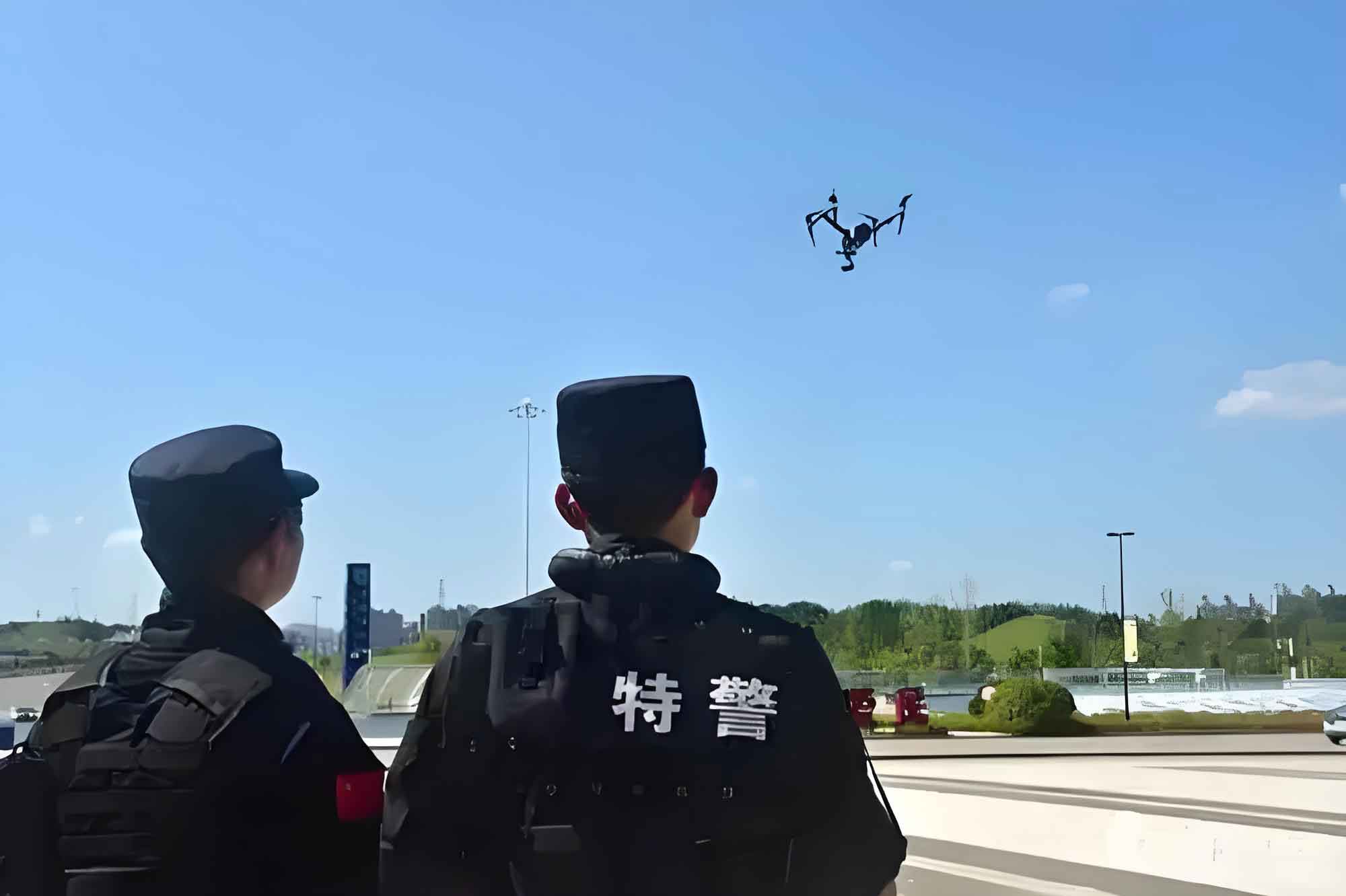
Training modalities for police drone professionals are diverse but poorly integrated. In my engagements with law enforcement agencies, I’ve noted a reliance on civilian institutions for basic courses. These external providers offer foundational knowledge on regulations and flight操控, yet they lack deep insights into警务实战 applications. As a result, police drone training often fails to bridge technical skills with law enforcement tactics, such as suspect tracking or crowd monitoring. This disconnect can be represented by a training effectiveness metric: $$ E = \frac{F_{\text{tech}} \cdot F_{\text{tactical}}}{R_{\text{integration}}} $$ where \( E \) is effectiveness, \( F_{\text{tech}} \) and \( F_{\text{tactical}} \) are technical and tactical proficiency scores, and \( R_{\text{integration}} \) is the resistance to integrating police drone workflows into policing. High \( R_{\text{integration}} \) values,常见 in civilian-led programs, reduce overall \( E \).
Academic institutions, such as police colleges, have begun incorporating police drone curricula, but challenges persist. From my teaching experience, courses often cover basic operations without sufficient emphasis on实战 scenarios. For example, subjects like tactical response or crime scene investigation rarely incorporate police drone-based aerial-ground coordination, missing opportunities to modernize training. To address this, I advocate for a dynamic curriculum model where course content evolves with police drone technological advancements: $$ C(t) = C_0 + \int_{0}^{t} \lambda \cdot A(\tau) \, d\tau $$ Here, \( C(t) \) is curriculum complexity at time \( t \), \( C_0 \) is initial content, \( \lambda \) is an innovation rate, and \( A(\tau) \) represents emerging police drone applications. Regular updates based on field feedback are crucial.
“Order-based” training programs have shown promise in tailoring police drone instruction to specific警种 needs. In my participation in projects like aerial narcotics detection or fire investigation drills, targeted training enhanced police drone utility in those domains. However, these initiatives are often ad hoc and lack systemic scaling. A cost-benefit analysis for such programs can be expressed as: $$ \text{Benefit} = \sum_{i} U_i \cdot M_i – C_{\text{training}} $$ where \( U_i \) is the utility of police drone skills for警种 \( i \), \( M_i \) is the number of personnel trained, and \( C_{\text{training}} \) is total cost. Increasing \( M_i \) through standardized modules would maximize benefits.
To overcome these issues, I propose a multi-faceted strategy for police drone professional talent cultivation. First, leveraging police academies as primary training bases is essential. These institutions possess inherent advantages in师资, facilities, and alignment with law enforcement goals. By establishing dedicated police drone training centers, we can consolidate resources and offer comprehensive programs. A resource optimization formula guides this: $$ R_{\text{total}} = \theta_{\text{academy}} \cdot (I_{\text{facility}} + I_{\text{instructor}}) $$ where \( R_{\text{total}} \) is total training resource output, \( \theta_{\text{academy}} \) is the academy’s efficiency factor, and \( I \) represents investments in facilities and instructors for police drone education.
Second, standardizing and enhancing training protocols is critical. Based on regulatory guidelines, we should develop tiered programs for basic, advanced, and specialized police drone training. Flight hours should be mandated as key performance indicators, with an emphasis on实战 drills and emergency response. I model skill retention over time as: $$ S(t) = S_0 \cdot e^{-\delta t} + \rho \cdot H_{\text{practice}} $$ where \( S(t) \) is skill level at time \( t \), \( S_0 \) is initial training level, \( \delta \) is decay rate, \( \rho \) is practice efficacy, and \( H_{\text{practice}} \) is cumulative practice hours with police drones. Regular training boosts \( H_{\text{practice}} \), sustaining \( S(t) \).
Third, building a professional teaching team for police drone education is paramount. Instructors must hold advanced licenses and教官资质, with continuous professional development through实战 engagements and research collaborations. A team competency score can be computed as: $$ C_{\text{team}} = \frac{1}{n} \sum_{j=1}^{n} (L_j + E_j) $$ where \( L_j \) is license level of instructor \( j \) for police drones, and \( E_j \) is their practical experience index. High \( C_{\text{team}} \) values correlate with better student outcomes in police drone courses.
Fourth, integrating teaching, learning, research, and实战 (TLRP) into a cohesive framework will drive innovation. Establishing specialized research units within academies can explore前沿 police drone applications, such as AI-based autonomy or counter-drone tactics. The synergy from TLRP is captured by: $$ I_{\text{TLRP}} = \alpha_T \cdot T + \alpha_R \cdot R + \alpha_P \cdot P $$ where \( I_{\text{TLRP}} \) is integrated output, and \( T, R, P \) represent teaching quality, research output, and实战 contributions related to police drones, weighted by coefficients \( \alpha \). This approach ensures that police drone training remains relevant and cutting-edge.
Fifth, expanding “order-based” training models for different police units—such as narcotics, traffic, or SWAT teams—will address specific operational needs. Customized modules can be developed using a需求 analysis: $$ M_{\text{custom}} = \arg \max_{M} \left( \sum_{k} \omega_k \cdot \text{Accuracy}_k(M) \right) $$ where \( M_{\text{custom}} \) is the optimal training module, \( \omega_k \) are weights for警种 \( k \) requirements, and \( \text{Accuracy}_k \) measures how well the module prepares personnel for police drone tasks in that domain.
Sixth, forming dedicated police drone实战 units within law enforcement agencies will provide hands-on experience and rapid response capabilities. These units can serve as living labs for testing new tactics and technologies. Their operational readiness can be assessed via: $$ \text{Readiness} = \frac{F_{\text{available}} \times T_{\text{training}}}{D_{\text{deployment}}} $$ where \( F_{\text{available}} \) is fleet availability of police drones, \( T_{\text{training}} \) is unit training intensity, and \( D_{\text{deployment}} \) is deployment complexity. Higher readiness enhances police drone effectiveness in real-world scenarios.
Lastly, creating a centralized talent database for police drone professionals will facilitate resource allocation and career development. By tracking licenses, flight hours, and实战经验, agencies can identify gaps and promote continuous learning. A database utility function is: $$ U_{\text{database}} = \log(1 + \sum_{m} Q_m) $$ where \( Q_m \) represents qualification metrics of入库 individuals for police drone roles. This supports strategic planning in talent management.
In conclusion, the cultivation of police drone professional talent is a complex yet vital endeavor for modern law enforcement. As I reflect on current challenges—from role imbalances to fragmented training—it is clear that a systematic approach centered on academic institutions, standardized programs, and integrated development is essential. By implementing the strategies outlined above, we can build a sustainable pipeline of skilled personnel capable of leveraging police drones to their full potential. This will not only enhance operational efficiency but also foster innovation in aerial-ground policing, ultimately contributing to public safety and security. The journey toward excellence in police drone talent cultivation requires ongoing collaboration, investment, and adaptation to emerging technologies, ensuring that law enforcement remains agile in an ever-evolving landscape.