
In recent years, with the rapid development of high-tech technologies, collaborative operations of UAV drone swarms have drawn significant attention from military powers worldwide. Traditional maintenance support models still rely heavily on periodic inspections, which lead to high manpower consumption and exorbitant maintenance costs. Prognostics and Health Management (PHM) technology, with its inherent capabilities of fault prediction and health management, can effectively address the challenges of existing maintenance models and holds enormous application prospects. In this article, I will elaborate on a functional architecture design for a UAV drone swarm support system based on PHM technology, drawing from my research experience and the latest findings in the field.
Unlike traditional sensor-based diagnostic methods, PHM is a comprehensive fault prediction and health management technology based on intelligent systems. It can integrate available maintenance resources, make appropriate decisions, and coordinate planning during the maintenance process. By employing PHM, ground crew members can promptly understand the health status of equipment, eliminate potential issues, and reduce the impact of failures on combat training missions. The application of PHM represents a direct evolution from passive post-failure maintenance to periodic proactive protection and ultimately to predictive management. The development of PHM technology has gone through five stages: external testing, Built-In Test (BIT), intelligent BIT, integrated diagnostics, and full PHM. With the gradual adoption of new technologies, PHM has evolved into a framework that includes data acquisition and transmission, data processing (condition monitoring, health assessment, predictive diagnostics), decision support, and comprehensive information management, forming a relatively complete mechanism for technology transfer and integrated application.
Currently, PHM technology is deeply researched and widely applied in military powers such as the United States and the United Kingdom. Representative systems include the PHM system used on the F-35 aircraft, the JAHUMS system on the AH-64 Apache helicopter, the IVHM system on the B-2 bomber, and the ICAS system on the Arleigh Burke-class destroyer. Taking the F-35 as an example, it establishes a hierarchical open architecture for PHM diagnostics based on existing onboard hardware and data resources, setting three PHM levels: member level, area level, and aircraft level. The member level includes basic components such as weapons, fuel, and airframe structure. The area level integrates member-level management, including airframe area management, flight control area management, and mission area management. The aircraft level collects results from all area-level managers and performs top-level management of the entire aircraft. In terms of system workflow, each level first uses embedded in-field diagnostic systems, underlying sensors, BIT information, etc., to perform data fusion and prediction algorithms, establishing a current and future health status picture of the target equipment. Then, based on collected information, reasoning is performed. Finally, through continuous analysis and prediction of target equipment performance data, early fault trends and remaining useful life are provided. Additionally, ground crew can compare and verify onboard monitoring data to assist in improving the intelligent prediction and fault diagnosis capabilities of the system, forming a precise fault status diagnostic list. After applying PHM, the F-35 aircraft’s non-reproducible fault rate has been reduced by 82%, maintenance manpower by 20% to 40%, logistics footprint by 50%, aircraft maintenance costs by over 50%, service life has reached 8,000 flight hours, and sortie rate has increased by 25%.
In China, PHM technology research has been carried out in military, space, and other fields, achieving some success in single-aircraft applications. However, there is currently no mature integrated PHM system for UAV drone swarms. Military equipment maintenance still relies mainly on periodic preventive maintenance. Research on mission planning, maintenance strategies, and system integration based on PHM for swarms is still under exploration. Based on the analysis of the F-35 single-aircraft PHM system, I will present a functional architecture design for a UAV drone swarm PHM system by listing typical operational scenarios and analyzing relevant technical requirements.
Technical Design Requirements for the UAV Drone Swarm PHM System
With the acceleration of unmanned systems, UAV drone swarms are playing increasingly important roles in future air combat. Current mature single-aircraft PHM technology is suitable for equipment with low failure rates and high hazard levels, but it does not address the software interaction aspects of swarms. If a single-aircraft system is directly applied to a swarm, a series of problems will arise due to the change in basic combat units, such as how to optimize multi-aircraft configuration under mission and resource constraints, and how to ensure the effectiveness of swarm condition monitoring and fault prediction. Therefore, in view of the characteristics of UAV drone swarms and the need to ensure overall reliability, safety, and long endurance, the swarm PHM design should minimize bus layout and reduce aircraft payload. By interacting with the ground control station, for example, by transmitting self-system status and equipment BIT data, the system can be constructed.
The UAV drone swarm support system based on PHM technology is divided into an airborne segment and a ground segment. The airborne segment mainly collects data from various sensors and important payload information and sends it to the flight control computer. The ground segment is responsible for monitoring the status of ground equipment and receiving PHM data collected from the airborne segment in real time. After data diagnosis and evaluation, simulations are performed to solve the massive data computation problems that the airborne segment cannot handle.
Taking a reconnaissance mission performed by a UAV drone swarm as an example, several multi-purpose UAV drones form a basic combat swarm. The swarm shares reconnaissance intelligence, evaluates target threat levels, and selects reasonable routes to enter the target area to execute the mission. During this process, the swarm PHM system’s main control unit receives the health information of each UAV drone and autonomously decides whether it can continue the mission if a UAV drone needs to be rotated due to factors such as differences in remaining flight time or partial faults. It then determines the timing for return. By analyzing the requirements of traditional single-aircraft PHM systems and considering collaborative activities during the swarm mission, the swarm PHM system must possess capabilities such as distributed information collection, individual fault diagnosis and health assessment, and real-time risk prediction to enable decision-making. According to these requirements, the swarm PHM system should adopt a distributed architecture. Each UAV drone can independently complete tasks such as condition monitoring, fault detection, and fault isolation, and then directly transmit its own health status information to the ground segment, which comprehensively calculates the swarm’s health status and maintenance recommendations.
Functional Architecture Design of the UAV Drone Swarm PHM System
Considering the composition and functional characteristics of the UAV drone swarm, the system’s distributed functional architecture comprises four levels: Condition Awareness, Intelligent Diagnosis, Associated Decision-Making, and Comprehensive Action.
| Level | Primary Function | Key Components / Processes |
|---|---|---|
| Condition Awareness | Acquire all initial data | Fusion of individual UAV drone BIT data, payload data, and subsystem functional status via flight control computer; feature analysis and comprehensive processing |
| Intelligent Diagnosis | Diagnose and evaluate swarm status | Merge initial data from Condition Awareness level; compare with risk assessment models and fault diagnosis models to generate health diagnostic reports. Process includes: receiving data processing signals from swarm via status behavior collection module, monitoring swarm behavior, modulating data fusion according to fault diagnosis, intelligent analysis, and real-time evaluation requirements, comparing with preset fault state diagnostic list and normal state parameter criteria, and outputting fault diagnosis and health assessment results |
| Associated Decision-Making | Provide decision suggestions based on swarm status | Utilize collected data from each equipment level; apply predefined fault prediction and health evaluation models to predict remaining useful life of UAV drone systems or components; predict and monitor operational trends of subsystems and components. Then, based on swarm operation status and critical component health, assess the mission capability of swarm combat units and provide real-time maintenance decision suggestions |
| Comprehensive Action | Implement actions rapidly based on decisions | Swarm executes decisions quickly through communication network to judge combat conditions. Ground segment receives information from upper level, comprehensively derives swarm health status and maintenance suggestions. Ground crew performs maintenance on UAV drones that have reached critical fault status transition points, and replenishes swarm formation as needed, thereby continuously reducing false alarm rates and improving swarm reliability and maintenance support efficiency |
The condition awareness level serves as the foundation for obtaining information. The intelligent diagnosis level processes data through algorithms such as Kalman filtering and Bayesian inference to generate reliable diagnostic results. For instance, the health index of a UAV drone subsystem can be modeled using a weighted sum of multiple sensor parameters:
$$ HI(t) = \sum_{i=1}^{N} w_i \cdot \frac{|x_i(t) – x_{i,normal}|}{x_{i,threshold}} $$
where \( x_i(t) \) is the real-time measurement of the \( i \)-th sensor, \( x_{i,normal} \) is the normal baseline, \( x_{i,threshold} \) is the failure threshold, and \( w_i \) are weighting coefficients determined by historical data. The resulting health index is then compared to a predefined critical value \( HI_{crit} \) to trigger alarms.
For remaining useful life (RUL) prediction, a common approach is to use a degradation model. Assuming exponential degradation of a critical component, the RUL can be expressed as:
$$ RUL(t) = \frac{1}{\lambda} \ln\left( \frac{D_{fail}}{D(t)} \right) $$
where \( D(t) \) is the current degradation measure, \( D_{fail} \) is the failure threshold, and \( \lambda \) is the degradation rate constant estimated from historical data of similar UAV drone components.
Furthermore, the probability of mission success for the entire UAV drone swarm under given health conditions can be modeled using a binomial reliability block diagram. If each UAV drone has a survival probability \( p_i \) during the mission, the probability that at least \( k \) out of \( N \) drones remain operational is:
$$ P_{success} = \sum_{j=k}^{N} \binom{N}{j} \prod_{i \in S_j} p_i \prod_{i \notin S_j} (1-p_i) $$
where \( S_j \) denotes a set of \( j \) drones that survive. This probabilistic model helps in decision-making regarding swarm reconfiguration and maintenance prioritization.
The associated decision-making level integrates outputs from the intelligent diagnosis level with mission plans. For example, a decision table can be used to map health status to maintenance actions:
| Health Status Level | Remaining Useful Life (hours) | Recommended Action |
|---|---|---|
| Good | > 20 | No action; continue mission |
| Fair | 10–20 | Monitor closely; schedule inspection after current mission |
| Degraded | 5–10 | Reduce mission profile; prepare replacement drone |
| Critical | < 5 | Immediate return; perform unscheduled maintenance |
Finally, the comprehensive action level ensures that decisions are executed efficiently through the communication network. The ground segment receives the aggregated health information and generates a priority list for maintenance. The maintenance scheduling can be optimized using a cost function that minimizes total downtime and resource usage. Let \( C_{m}(i) \) be the maintenance cost for drone \( i \) and \( T_{m}(i) \) the time required. The optimization problem is:
$$ \min \sum_{i=1}^{N} \left( \alpha C_m(i) + \beta T_m(i) \right) \quad \text{subject to:} \quad T_m(i) \leq T_{available} $$
where \( \alpha \) and \( \beta \) are weighting factors.
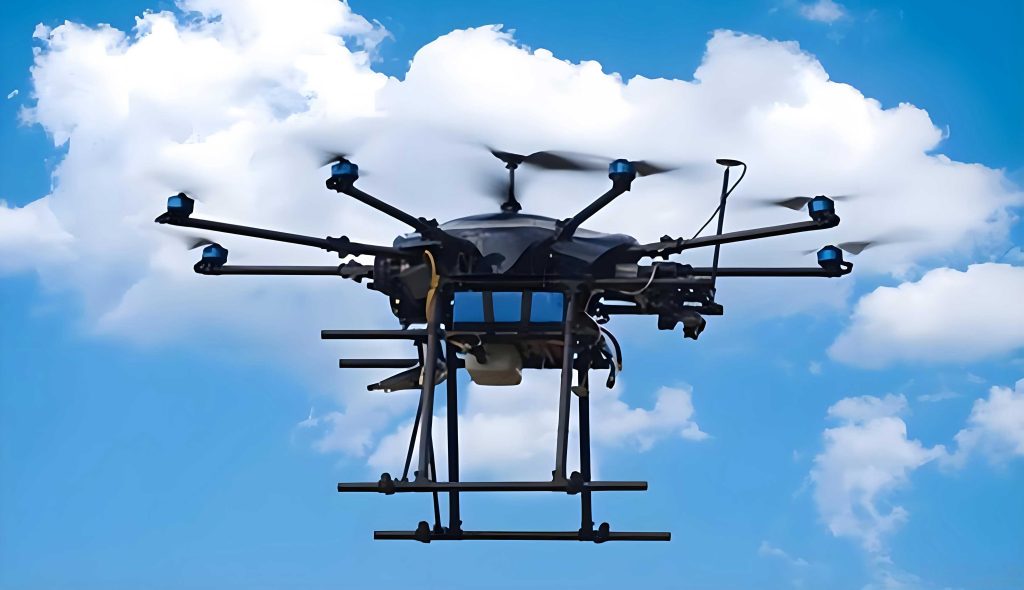
To further quantify the performance improvements brought by the PHM system for UAV drone swarms, I have compiled a comparison of key metrics before and after implementation:
| Metric | Traditional Periodic Maintenance | PHM-Based Predictive Maintenance |
|---|---|---|
| Fault Non-Replication Rate Reduction | Baseline | 82% reduction |
| Maintenance Manpower Requirement | Baseline | 20%–40% reduction |
| Logistics Footprint | Baseline | 50% reduction |
| Aircraft Maintenance Cost | Baseline | Over 50% reduction |
| Service Life (Flight Hours) | Baseline | +25% (e.g., from 6,400 to 8,000 hours) |
| Sortie Generation Rate | Baseline | 25% increase |
These figures are based on extrapolation from single-aircraft results to UAV drone swarms, assuming similar technological maturity. In the context of UAV drone swarms, the PHM system not only reduces costs but also enhances operational availability. For example, consider a swarm of ten UAV drones conducting a persistent surveillance mission. Under traditional maintenance, each drone requires 2 hours of preventive maintenance every 50 flight hours, totaling 20 hours of downtime per 50 operational hours per drone, leading to an average availability of 0.6 for the swarm (assuming maintenance is staggered). With PHM, unscheduled maintenance is minimized, and maintenance can be performed only when degradation is detected, reducing average downtime to 8 hours per 50 flight hours per drone, resulting in an availability of 0.84. This improvement is captured by:
$$ A_{swarm} = \frac{MTBF}{MTBF + MTTR} $$
where MTBF (Mean Time Between Failures) increases due to early fault prevention, and MTTR (Mean Time To Repair) decreases due to focused maintenance.
Furthermore, the distributed architecture of the PHM system for UAV drone swarms enables scalability. As the swarm size increases, the computational load on the ground segment grows linearly rather than exponentially if each drone processes its own data locally. The ground segment only performs high-level fusion. The data rate from each UAV drone can be expressed as:
$$ R_{total} = N \cdot (R_{BIT} + R_{sensor}) $$
where \( N \) is the number of UAV drones in the swarm, \( R_{BIT} \) is the data rate of Built-In Test results (typically a few kilobits per second), and \( R_{sensor} \) is the data rate from health monitoring sensors (e.g., vibration, temperature, voltage). For a swarm of 50 drones, the total data rate may reach 10–20 Mbps, which is feasible with modern communication links. The ground segment processes this data using parallel algorithms. The health assessment probability for the swarm can be derived using a Bayesian network:
$$ P(H_{swarm} | \mathbf{X}_1, \mathbf{X}_2, \dots, \mathbf{X}_N) \propto \prod_{i=1}^{N} P(\mathbf{X}_i | H_i) P(H_i | H_{swarm}) $$
where \( \mathbf{X}_i \) are sensor measurements from drone \( i \), \( H_i \) is the health state of drone \( i \), and \( H_{swarm} \) is the overall health of the swarm. This probabilistic model supports robust decision-making under uncertainty.
In conclusion, the comprehensive support system based on PHM technology can play a crucial role in reducing maintenance costs and improving support efficiency for UAV drone swarms. With the continuous application of the Internet of Things (IoT) and emerging technologies, the deployment threshold of PHM technology in the UAV domain will become increasingly lower, further enhancing the safety and economic efficiency of unmanned systems. The architecture presented here provides a scalable and intelligent foundation for future UAV drone swarm operations, and I believe that continued research will lead to even more sophisticated integration of diagnostics, prognostics, and logistics.