
In modern anti-submarine warfare, the rapid and efficient detection of submerged threats remains a critical challenge. The use of fixed-wing drones equipped with non-acoustic sensors such as magnetic anomaly detectors or radar provides a promising solution for large-scale maritime search operations. This paper presents a comprehensive study on path planning for coverage search using a fixed-wing drone in complex irregular sea areas, with a particular focus on concave polygonal regions. We propose a selective concave point removal method combined with Dubins curve search strategies to minimize invalid navigation costs and enhance search efficiency. Mathematical models for detection cost, motion constraints, and search area decomposition are established. Simulation results demonstrate that the proposed approach significantly reduces unnecessary turning paths and overall energy consumption compared to conventional methods. The findings provide theoretical support for practical submarine search missions using fixed-wing drones in realistic ocean environments.
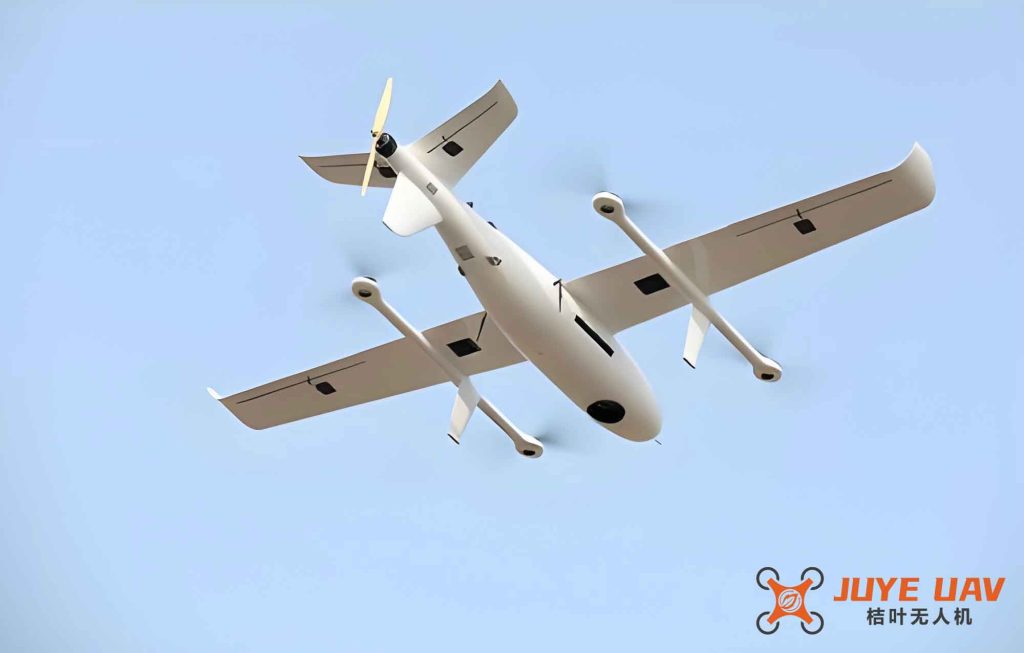
1. Introduction
The increasing stealth capabilities of modern submarines necessitate the development of rapid and efficient search strategies. Fixed-wing drones, with their high speed, long endurance, and flexible payload capacity, have become ideal platforms for maritime reconnaissance. When conducting coverage search for submarines, the fixed-wing drone must traverse the entire designated area while adhering to its kinematic constraints, particularly the minimum turning radius. Unlike multi-rotor drones, a fixed-wing drone cannot hover or perform on-the-spot turns; instead, it must follow curved paths such as Dubins curves to change direction. In practice, the search region is often an irregular polygon with concave boundaries, which complicates path planning. Traditional methods that simply “violently” remove all concave points to create a convex hull may introduce excessive redundant search areas. To address this, we introduce a selective concave point removal technique that uses edge length thresholds and angle thresholds, combined with a Dubins curve trajectory planning algorithm, to optimize the search path for a fixed-wing drone.
2. Problem Formulation
2.1 Motion model of the fixed-wing drone
The fixed-wing drone is modeled as a point mass moving at a constant altitude. Its state is described by position coordinates \((x,y)\) and heading angle \(\phi\). The kinematic equations are:
$$
\begin{aligned}
\dot{x}(t) &= v(t) \cos\phi(t) \\
\dot{y}(t) &= v(t) \sin\phi(t) \\
\dot{\phi}(t) &= \omega(t) \theta_{\max}
\end{aligned}
$$
where \(v\) is the constant speed, \(\omega\) is the normalized yaw rate, and \(\theta_{\max}\) is the maximum yaw rate. The fixed-wing drone’s minimum turning radius \(R_t\) is given by \(R_t = v / \theta_{\max}\).
2.2 Sensor detection model
The onboard sensor footprint is approximated by a rectangle of length \(D_l\) and width \(D_s\). The footprint dimensions depend on the fixed-wing drone’s altitude \(h\) and sensor angles:
$$
\begin{aligned}
D_l &= h \left[ \cot(\eta – \lambda) – \cot(\eta + \lambda) \right] \\
D_s &= \frac{2h \tan\gamma}{\sin\eta}
\end{aligned}
$$
where \(\gamma\) is the half-width detection angle, \(\lambda\) is the half-length detection angle, and \(\eta\) is the sensor depression angle. During search, the fixed-wing drone flies at a constant altitude, so \(D_s\) is fixed.
2.3 Search cost model
The total search cost \(C\) comprises three components: travel cost (distance) \(L\), time cost \(T\), and energy cost \(P\). The composite cost is:
$$
C = \omega_1 L + \omega_2 T + \omega_3 P
$$
where \(\omega_1,\omega_2,\omega_3\) are weighting factors. The distance \(L\) consists of straight flight segments \(L_s\) (approach), \(L_l\) (linear search), and curved segments \(L_c\). Similarly, time and energy are computed separately for straight and turning phases:
$$
\begin{aligned}
T &= \frac{L_s + L_l}{v_l} + \frac{L_c}{v_t} \\
P &= \int_{0}^{(L_s+L_l)/v_l} P_l(t) dt + \int_{0}^{L_c/v_t} P_t(t) dt
\end{aligned}
$$
where \(v_l\) and \(v_t\) are speeds during straight and turning flight, and \(P_l(t), P_t(t)\) are the corresponding power consumptions.
3. Methodology
3.1 Convex polygon search strategy
For a convex polygonal region, the optimal search direction is perpendicular to the polygon’s width (minimum span). The number of turns required by the fixed-wing drone is:
$$
N_t = \left\lceil \frac{D_w}{D_s} \right\rceil – 1
$$
where \(D_w\) is the width of the region. To compute the polygon width, we use the “point-edge” algorithm: for each edge, the maximum perpendicular distance to any vertex is the span for that orientation. The minimum of these spans is the polygon’s width. The fixed-wing drone then follows a sweeping pattern (S-shaped) with Dubins curves at the turn boundaries.
3.2 Dubins curve trajectory for fixed-wing drone
When the fixed-wing drone’s minimum turning radius \(R_t > D_s/2\), a simple semi-circular turn would leave uncovered gaps. To avoid blind spots, we adopt Dubins curves. The Dubins set consists of six elementary path types: LSL, RSR, RSL, LSR, RLR, LRL, where L and R denote left and right turns with radius \(R_t\), and S denotes a straight segment. The shortest path between two configurations \((x_s,y_s,\alpha)\) and \((x_e,y_e,\beta)\) is found by solving for the lengths of the three segments. The path length \(\Omega\) is:
$$
\Omega = s + p + q
$$
where \(s,p,q\) are the lengths of the three constituent maneuvers. The optimal Dubins path ensures that the fixed-wing drone completes a turn while fully covering the adjacent swath without overlap or gap.
3.3 Selective concave point removal for irregular polygons
Directly applying convex search to irregular concave polygons leads to excessive turns due to narrow “arms”. We propose a selective concave point removal method that avoids “violent” removal of all concave vertices. Instead, we define two thresholds:
- Edge length ratio threshold \(N\): For a concave vertex \(p\) with adjacent vertices \(q_1,q_2\), compute the decision distance \(D_d(p,q) = \min\{ \text{dist}(p,q_1), \text{dist}(p,q_2) \}\). If the ratio \(\frac{\text{length of selected edge}}{D_d(p,q)} < N\), remove the concave point.
- Angle threshold \(\Theta\): For cases where the ratio condition fails, we check the internal angle \(\theta\) at the concave point. If \(\theta < \Theta\), the point is removed; otherwise it is kept.
This selective removal produces a refined convex hull that closely approximates the original concave region while minimizing redundant search area. The algorithm iterates until no further concave points can be removed. The resulting polygon is then searched using the Dubins-based convex method.
4. Experimental Results
4.1 Simulation setup
We simulate a fixed-wing drone with the following parameters:
| Parameter | Value |
|---|---|
| Sensor width \(D_s\) | 2 km |
| Sensor length \(D_l\) | 5 km |
| Minimum turning radius \(R_t\) | 1.5 km |
| Straight speed \(v_l\) | 600 km/h |
| Turning speed \(v_t\) | 350 km/h |
| Straight power \(P_l\) | 2 kW |
| Turning power \(P_t\) | 6.5 kW |
The search region is an irregular concave polygon as shown in Figure 1 (placeholder). We compare four scenarios: (a) original concave region with non-span search direction; (b) original concave region with span direction (Dubins); (c) concave region after “violent” point removal (non-span); (d) concave region after selective point removal (span direction).
4.2 Comparison of search performance
Table 2 summarizes the results for different search strategies applied to the fixed-wing drone.
| Scenario | Total path length (km) | Invalid turning time (h) | Invalid turning energy (a.u.) |
|---|---|---|---|
| Original concave, non-span | 2409 | 1.11 | 1.03×10⁵ |
| Original concave, span (Dubins) | 2443 | 1.06 | 9.72×10⁴ |
| After “violent” removal, non-span | 3247 | 0.94 | 9.84×10⁴ |
| After selective removal, span (Dubins) | 3085 | 0.88 | 9.16×10⁴ |
From the table, the following observations can be made:
- Applying the span-direction Dubins search to the original concave region (second row) reduces invalid turning time and energy compared to non-span search (first row), even though total path length slightly increases due to transition segments.
- After concave point removal (violent or selective), the total path length increases because the convex hull covers more area, but the number of turns decreases significantly.
- Our selective removal method (fourth row) achieves the lowest invalid turning time (0.88 h) and energy (9.16×10⁴ a.u.), outperforming the “violent” removal (0.94 h, 9.84×10⁴ a.u.).
Figure 2 (placeholder) shows the relationship between search direction rotation angle and various trajectory metrics. The curves confirm that the span direction (90° rotation) yields the shortest forward/backward distances and minimum turn counts. The Dubins approach produces symmetric left and right turn lengths, confirming the balance of the algorithm.
4.3 Impact of concave point removal on turn count
The number of turns is a critical factor for the fixed-wing drone since each turn incurs energy and time costs. Figure 3 (placeholder) illustrates the number of turns versus search direction for the original concave region and after selective removal. The turn count is minimized at the span direction, and the selective removal further reduces the total turns by approximately 15% compared to the original concave region.
5. Conclusion
In this paper, we have presented a comprehensive path planning framework for coverage search using a fixed-wing drone in complex irregular sea areas. The key contributions include: (1) a selective concave point removal algorithm that avoids unnecessary expansion of the search area, (2) integration of Dubins curves to handle the fixed-wing drone’s turning constraints without creating blind spots, and (3) a cost model that allows quantitative comparison of different strategies. Simulation results demonstrate that combining selective concave removal with span-direction Dubins search significantly reduces invalid turning time and energy consumption, making it a highly efficient solution for submarine search missions. Future work will extend the approach to multi-drone cooperative search and dynamic environments with moving targets.