
In the realm of modern technology, the rapid development of computers, artificial intelligence, and automatic control has propelled unmanned aerial vehicles (UAVs) into the spotlight. Their low cost, low risk, and high efficiency make them invaluable across various sectors. Among these applications, formation drone light shows have emerged as a captivating spectacle, where multiple drones synchronize to create intricate aerial patterns. However, to ensure safe and precise operations, UAV clusters often maintain electromagnetic silence during formation flights, minimizing the emission of electromagnetic signals to avoid external interference. This necessitates accurate localization methods that do not rely on active transmissions. In this context, passive bearing-only localization becomes crucial, allowing drones to adjust their positions based solely on received signals. This article delves into a geometric modeling approach using polar coordinates and the sine theorem to address localization in circular formations, with implications for enhancing formation drone light shows.
The core challenge in formation drone light shows is maintaining precise relative positions among drones throughout the performance. Any deviation can disrupt the visual integrity of the display. Traditional localization methods may involve active signaling, but this can lead to mutual interference or external detection. Hence, passive techniques are preferred, where some drones emit signals while others passively receive them. The receiving drones measure the angles between lines connecting them to pairs of transmitting drones, enabling position estimation without emitting their own signals. This method is particularly suited for formation drone light shows, where aesthetic coherence relies on exact geometric arrangements. In this article, I will explore a model for circular formations, akin to those used in large-scale formation drone light shows, and derive mathematical relationships for localization.
Consider a circular formation common in formation drone light shows, consisting of ten drones. One drone, labeled FY00, is at the center, while the other nine drones (FY01 to FY09) are evenly distributed on a circumference at the same altitude. This setup mimics the symmetrical patterns often seen in formation drone light shows, where drones move in coordinated circles. The goal is to localize passive receiving drones when three drones transmit signals: one is always FY00 at the center, another is FY01 (selected for coordinate system alignment), and the third can vary among FY02, FY03, FY04, or FY05. The transmitting drones are assumed to have no positional偏差, meaning their locations are known precisely. The receiving drones measure angles α1 and α2, which are the angles between the lines connecting the receiver to FY00-FY01 and FY00-FY0k (where k is the tail number of the third transmitting drone), respectively. These measurements form the basis for localization.
To facilitate analysis, I establish a polar coordinate system with FY00 as the pole and the ray from FY00 through FY01 as the polar axis, with counterclockwise as the positive direction. Let R be the fixed distance between FY00 and any peripheral drone (e.g., FY01). The receiving drone’s position is denoted as (ρ, θ), where ρ is the distance from FY00 and θ is the angle from the polar axis. The angles β represent the fixed angles between the polar axis and the lines from FY00 to the third transmitting drone (FY0k), with values depending on k: for FY02, β = β1; for FY03, β = β2; for FY04, β = β3; for FY05, β = β4. These parameters are summarized in the table below, which aids in clarifying the symbols used throughout this analysis—essential for designing reliable formation drone light shows.
| Symbol | Description | Unit |
|---|---|---|
| k | Tail number of the third transmitting drone (k=2,3,4,5) | None |
| R | Distance between FY00 and any peripheral transmitting drone | meters (m) |
| (ρ, θ) | Polar coordinates of the receiving drone | ρ in m, θ in degrees |
| α1 | Angle at the receiving drone between lines to FY00 and FY01 | degrees |
| α2 | Angle at the receiving drone between lines to FY00 and FY0k | degrees |
| β | Angle between polar axis and line from FY00 to FY0k | degrees |
The localization model relies on the sine theorem, which states that in any triangle, the ratio of a side length to the sine of its opposite angle is constant. For formation drone light shows, this mathematical principle allows precise calculations of drone positions based on angle measurements. I will derive equations for different scenarios, depending on which drone is the third transmitter and where the receiver is located. This granular approach ensures robustness in various configurations of formation drone light shows.
First, let’s analyze the case where the third transmitting drone is FY02 (k=2). The receiving drone can be any of the remaining peripheral drones. Using the polar coordinate system, I consider two triangles formed by the receiving drone, FY00, and each of the transmitting drones. For a receiver on the upper semicircle (e.g., FY03), in triangle △OAC (with O as FY00, A as FY01, and C as the receiver), the sine theorem gives:
$$ \frac{R}{\sin \alpha_1} = \frac{\rho}{\sin(\pi – \theta – \alpha_1)} $$
Simplifying using trigonometric identities, since \(\sin(\pi – \theta – \alpha_1) = \sin(\theta + \alpha_1)\), we obtain:
$$ \frac{R}{\sin \alpha_1} = \frac{\rho}{\sin(\alpha_1 + \theta)} \quad \text{(Equation 1)} $$
This equation holds for all receiving drones on the upper semicircle in formation drone light shows, such as FY03, FY04, and FY05. For drones on the lower semicircle (e.g., FY06), in triangle △OAG, a similar derivation yields:
$$ \frac{R}{\sin \alpha_1} = \frac{\rho}{\sin(\alpha_1 – \theta)} \quad \text{(Equation 2)} $$
Equations 1 and 2 provide relationships between ρ, θ, R, and α1, crucial for localization in circular formation drone light shows. To incorporate α2, I examine triangles involving the third transmitter FY02. For receivers where the line from FY00 to the receiver and the line from FY00 to FY02 form an angle less than 180° (e.g., FY03 to FY06), in triangle △OBC (with B as FY02), the sine theorem leads to:
$$ \frac{R}{\sin \alpha_2} = \frac{\rho}{\sin(\pi – \theta + \beta_1 – \alpha_2)} $$
Simplifying, since \(\sin(\pi – \theta + \beta_1 – \alpha_2) = \sin(\theta – \beta_1 + \alpha_2)\), we get:
$$ \frac{R}{\sin \alpha_2} = \frac{\rho}{\sin(\alpha_2 + \theta – \beta_1)} \quad \text{(Equation 3)} $$
For receivers where the angle exceeds 180° (e.g., FY07 to FY09), in triangle △OBH, the derivation results in:
$$ \frac{R}{\sin \alpha_2} = \frac{\rho}{\sin(\alpha_2 – \theta + \beta_1)} \quad \text{(Equation 4)} $$
These equations can be unified by noting that the expression depends on the absolute difference between θ and β1. Thus, for any receiving drone in this scenario, the localization formula is:
$$ \frac{R}{\sin \alpha_2} = \frac{\rho}{\sin(\alpha_2 + |\theta – \beta_1|)} \quad \text{(Equation 5)} $$
This pattern repeats for other third transmitting drones. For instance, when FY03 is the third transmitter (k=3), the equations for α1 remain identical to Equations 1 and 2, as the geometry relative to FY01 is unchanged. For α2, with β = β2, the formulas become:
For receivers above the line OC (FY04 to FY07):
$$ \frac{R}{\sin \alpha_2} = \frac{\rho}{\sin(\alpha_2 + \theta – \beta_2)} \quad \text{(Equation 6)} $$
For receivers below (FY08, FY09, FY02):
$$ \frac{R}{\sin \alpha_2} = \frac{\rho}{\sin(\alpha_2 – \theta + \beta_2)} \quad \text{(Equation 7)} $$
Similarly, for FY04 as the third transmitter (k=4, β = β3), the equations are:
For receivers above the line OD (FY05 to FY08):
$$ \frac{R}{\sin \alpha_2} = \frac{\rho}{\sin(\alpha_2 + \theta – \beta_3)} \quad \text{(Equation 8)} $$
For receivers below (FY09, FY02, FY03):
$$ \frac{R}{\sin \alpha_2} = \frac{\rho}{\sin(\alpha_2 – \theta + \beta_3)} \quad \text{(Equation 9)} $$
For FY05 as the third transmitter (k=5, β = β4):
For receivers above the line OE (FY06 to FY09):
$$ \frac{R}{\sin \alpha_2} = \frac{\rho}{\sin(\alpha_2 + \theta – \beta_4)} \quad \text{(Equation 10)} $$
For receivers below (FY02, FY03, FY04):
$$ \frac{R}{\sin \alpha_2} = \frac{\rho}{\sin(\alpha_2 – \theta + \beta_4)} \quad \text{(Equation 11)} $$
From these derivations, a general localization model emerges for formation drone light shows. Regardless of the third transmitting drone’s identity, the receiving drone’s position (ρ, θ) can be determined by solving the following system of equations, which combine measurements from both angle sets:
$$
\begin{cases}
\frac{R}{\sin \alpha_1} = \frac{\rho}{\sin(\alpha_1 \pm \theta)} \\
\frac{R}{\sin \alpha_2} = \frac{\rho}{\sin(\alpha_2 + |\theta – \beta|)}
\end{cases}
\quad \text{(Equation 12)}
$$
Here, the sign in the first equation depends on whether the receiver is on the upper semicircle (+) or lower semicircle (-), and β is the appropriate angle for the third transmitter. This system can be solved analytically or numerically to yield ρ and θ, enabling precise adjustments in formation drone light shows. To illustrate, consider a numerical example with R = 100 meters, α1 = 30°, α2 = 45°, and β = 60° for a receiver on the upper semicircle. Plugging into Equation 12:
From the first equation: $$ \frac{100}{\sin 30°} = \frac{\rho}{\sin(30° + \theta)} \Rightarrow 200 = \frac{\rho}{\sin(30° + \theta)} $$
From the second equation: $$ \frac{100}{\sin 45°} = \frac{\rho}{\sin(45° + |\theta – 60°|)} \Rightarrow \frac{100}{\sqrt{2}/2} \approx 141.42 = \frac{\rho}{\sin(45° + |\theta – 60°|)} $$
Solving these simultaneously, we can find ρ and θ. For instance, if θ is less than 60°, then |θ – 60°| = 60° – θ. This results in two equations with two unknowns, solvable via algebraic manipulation. Such calculations are integral to real-time control in formation drone light shows.
The robustness of this model is enhanced by considering multiple receiving drones simultaneously. In a formation drone light show, all passive drones can localize themselves using the same transmitted signals, allowing coordinated adjustments. The table below summarizes the key equations for different third transmitter cases, providing a quick reference for practitioners designing formation drone light shows.
| Third Transmitter | β Value | Localization Equations for Receiver | Applicable Receivers |
|---|---|---|---|
| FY02 | β1 | $$ \frac{R}{\sin \alpha_1} = \frac{\rho}{\sin(\alpha_1 \pm \theta)} $$ and $$ \frac{R}{\sin \alpha_2} = \frac{\rho}{\sin(\alpha_2 + |\theta – \beta_1|)} $$ | All peripheral drones |
| FY03 | β2 | $$ \frac{R}{\sin \alpha_1} = \frac{\rho}{\sin(\alpha_1 \pm \theta)} $$ and $$ \frac{R}{\sin \alpha_2} = \frac{\rho}{\sin(\alpha_2 + |\theta – \beta_2|)} $$ | All peripheral drones |
| FY04 | β3 | $$ \frac{R}{\sin \alpha_1} = \frac{\rho}{\sin(\alpha_1 \pm \theta)} $$ and $$ \frac{R}{\sin \alpha_2} = \frac{\rho}{\sin(\alpha_2 + |\theta – \beta_3|)} $$ | All peripheral drones |
| FY05 | β4 | $$ \frac{R}{\sin \alpha_1} = \frac{\rho}{\sin(\alpha_1 \pm \theta)} $$ and $$ \frac{R}{\sin \alpha_2} = \frac{\rho}{\sin(\alpha_2 + |\theta – \beta_4|)} $$ | All peripheral drones |
This tabular representation underscores the consistency of the method, vital for scalable formation drone light shows. Moreover, the geometric foundation ensures that the model can be extended to non-circular formations, such as conical or linear arrays common in advanced formation drone light shows. For example, in a conical formation, similar trigonometric principles apply, but with adjusted coordinate systems and angle definitions. The passive bearing-only approach remains advantageous, as it minimizes signal interference—a critical factor in dense formation drone light shows where hundreds of drones operate concurrently.
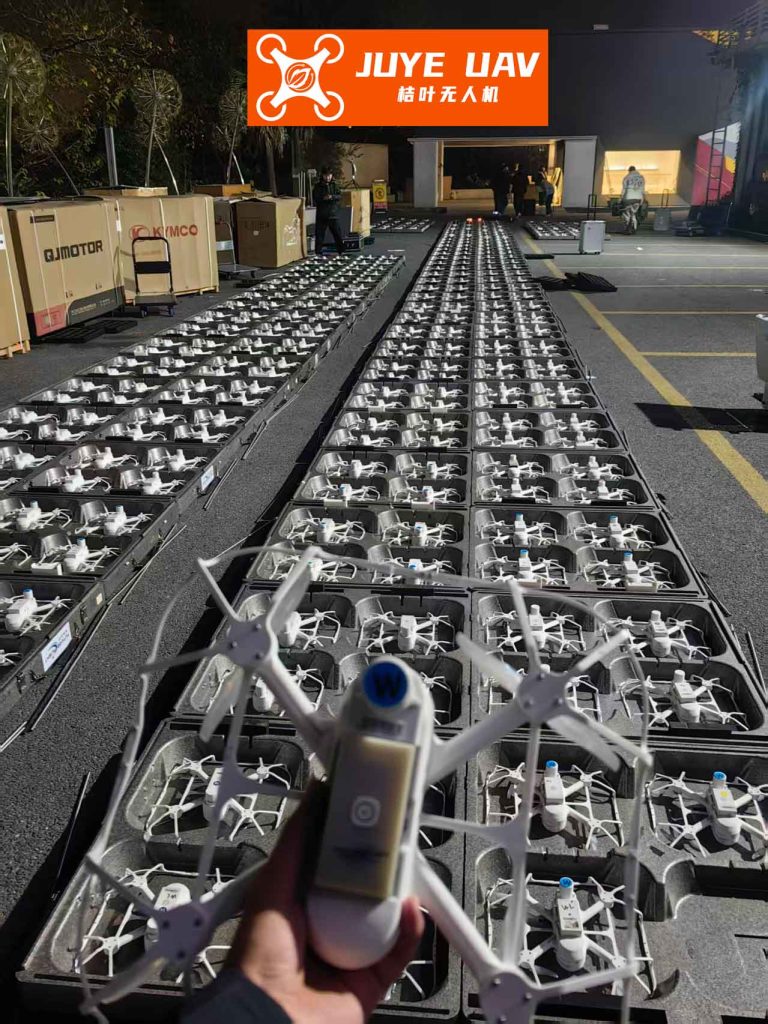
To visualize the setup described, consider the following figure, which depicts a typical circular formation akin to those used in formation drone light shows. The central drone and peripheral drones are arranged symmetrically, with lines indicating angle measurements for localization. Such visuals aid in understanding the geometric relationships that underpin this localization method.
In practical implementation for formation drone light shows, several factors must be addressed. First, the accuracy of angle measurements (α1 and α2) is paramount. Drones can be equipped with high-precision sensors, such as phased array antennas or optical systems, to measure bearings passively. Second, the model assumes noiseless conditions; in reality, sensor noise and environmental disturbances may affect readings. Statistical methods, like Kalman filtering, can be integrated to enhance robustness. Third, the fixed distance R may vary due to altitude changes, but in formation drone light shows, drones typically maintain constant altitude, so this is manageable. Fourth, the selection of transmitting drones can be optimized to minimize localization errors—for instance, choosing transmitters that maximize angular separation for better triangulation. These considerations are essential for flawless execution of formation drone light shows, where even minor errors can disrupt the visual harmony.
Furthermore, the scalability of this method makes it suitable for large-scale formation drone light shows involving dozens or hundreds of drones. By dividing the cluster into subgroups with dedicated transmitters, localization can be parallelized, reducing computational load. Each subgroup can use the same mathematical model, ensuring consistency. For example, in a massive formation drone light show for public entertainment, drones might be arranged in multiple concentric circles or complex patterns. The passive bearing-only approach allows each drone to compute its position independently, based on signals from a few reference drones, enabling dynamic adjustments during flight. This autonomy is key to achieving synchronized movements in formation drone light shows, where drones may need to transition between shapes smoothly.
Another aspect to explore is the integration of this localization method with control algorithms for formation drone light shows. Once a drone determines its position (ρ, θ), it can compare it to the desired position in the formation. The error can be fed into a proportional-integral-derivative (PID) controller or a more advanced model predictive controller to generate adjustment commands. For instance, if a drone’s computed ρ is less than the target radius, it can move outward; if θ deviates, it can rotate along the circumference. This closed-loop control ensures that the formation remains tight and accurate throughout the performance. In formation drone light shows, such real-time corrections are crucial for maintaining intricate patterns, especially in windy conditions or other external disturbances.
To deepen the mathematical analysis, let’s derive the explicit formulas for ρ and θ from Equation 12. For a receiver on the upper semicircle, the first equation gives:
$$ \rho = \frac{R \sin(\alpha_1 + \theta)}{\sin \alpha_1} \quad \text{(Equation 13)} $$
Substituting into the second equation:
$$ \frac{R}{\sin \alpha_2} = \frac{R \sin(\alpha_1 + \theta) / \sin \alpha_1}{\sin(\alpha_2 + |\theta – \beta|)} $$
Simplifying:
$$ \sin \alpha_1 \cdot \sin(\alpha_2 + |\theta – \beta|) = \sin \alpha_2 \cdot \sin(\alpha_1 + \theta) \quad \text{(Equation 14)} $$
This transcendental equation can be solved for θ numerically, using methods like Newton-Raphson iteration. Once θ is found, ρ follows from Equation 13. For formation drone light shows, efficient numerical solvers can be embedded in drone firmware to enable fast computations. The table below outlines possible iterative steps for solving Equation 14, assuming θ is in radians and using initial guesses based on formation geometry.
| Iteration Step | Computation | Purpose in Formation Drone Light Shows |
|---|---|---|
| 1 | Initialize θ₀ based on expected position (e.g., nominal angle for the drone’s编号). | Provides a starting point for rapid convergence. |
| 2 | Evaluate function f(θ) = sin α₁ · sin(α₂ + |θ – β|) – sin α₂ · sin(α₁ + θ). | Measures error to drive iteration. |
| 3 | Compute derivative f'(θ) for Newton’s method. | Speeds up solution for real-time adjustments. |
| 4 | Update θ using θ_{n+1} = θ_n – f(θ_n)/f'(θ_n). | Refines angle estimate until tolerance is met. |
| 5 | Calculate ρ from Equation 13. | Yields full polar coordinates for localization. |
This procedural approach ensures that drones in formation drone light shows can quickly recalibrate their positions during flight, maintaining the integrity of the display. Additionally, the model’s reliance on passive measurements aligns with the trend towards energy-efficient and stealthy operations in formation drone light shows, where battery life and signal interference are concerns.
Beyond circular formations, this method can be adapted to other shapes popular in formation drone light shows, such as spirals, grids, or even three-dimensional structures. The core idea remains: use a few reference drones with known positions to localize others via angle measurements. For a conical formation, for instance, the polar coordinate system can be extended to spherical coordinates, with additional angles for elevation. The sine theorem would then be applied in three dimensions, using spherical trigonometry. Such extensions open doors to more complex and mesmerizing formation drone light shows, where drones form volumetric patterns in the sky.
Environmental factors also play a role in formation drone light shows. Weather conditions like wind, rain, or electromagnetic interference can affect localization accuracy. To mitigate this, drones can incorporate redundant sensors or use fusion algorithms that combine bearing measurements with inertial data. Moreover, the passive nature of this method reduces vulnerability to jamming, which is beneficial for formation drone light shows in crowded spectacles where many wireless signals are present. Research into adaptive filtering techniques could further enhance resilience, ensuring that formation drone light shows proceed smoothly under varying conditions.
In conclusion, the passive bearing-only localization method presented here offers a robust framework for precise positioning in drone clusters, particularly suited for formation drone light shows. By leveraging geometric relationships and the sine theorem in a polar coordinate system, drones can determine their locations based on angles to transmitting peers, without emitting signals themselves. This approach minimizes interference and enhances security, key advantages for large-scale formation drone light shows. The derived equations, summarized in Equation 12 and supported by tables, provide a mathematical foundation that can be implemented in real-time control systems. Future work could explore applications to non-circular formations, integration with advanced control algorithms, and adaptation to environmental challenges. As formation drone light shows continue to evolve, such localization techniques will be instrumental in achieving ever more intricate and reliable aerial displays, captivating audiences worldwide with synchronized precision.