
In the context of global carbon neutrality, the development of green aviation technologies has become a critical pathway for reducing emissions in the aerospace sector. Our research focuses on a particular class of aerial platforms known as vertical takeoff and landing (VTOL) fixed-wing drones, which combine the operational flexibility of multirotor aircraft with the aerodynamic efficiency of conventional fixed-wing drones. The key challenge we addressed is the parameter matching of a fuel cell hybrid power system that enables these fixed-wing drones to achieve extended endurance while maintaining zero-emission operation.
The motivation behind our work stems from the inherent limitations of battery-powered fixed-wing drones. While lithium-ion batteries offer high power density suitable for takeoff and climb phases, their low energy density severely restricts the flight endurance of electric fixed-wing drones. Proton exchange membrane fuel cells (PEMFCs), on the other hand, provide significantly higher energy density and cleaner emissions, making them ideal candidates for the primary power source of long-endurance fixed-wing drones. However, the soft output characteristics and relatively low power density of fuel cells necessitate hybridization with a secondary power source such as lithium batteries to meet the instantaneous power demands during flight maneuvers.
System Architecture of Hybrid Power System
We designed a parallel hybrid power system topology for our VTOL fixed-wing drones, as illustrated in the system configuration. In this architecture, the fuel cell is connected to the DC bus through a unidirectional DC/DC converter, while the lithium battery is directly connected to the same bus. This configuration allows the fuel cell to provide steady-state power during cruise phases and charge the battery when its state of charge (SOC) falls below a threshold, while the lithium battery handles transient power demands during takeoff, transition, and gust conditions.
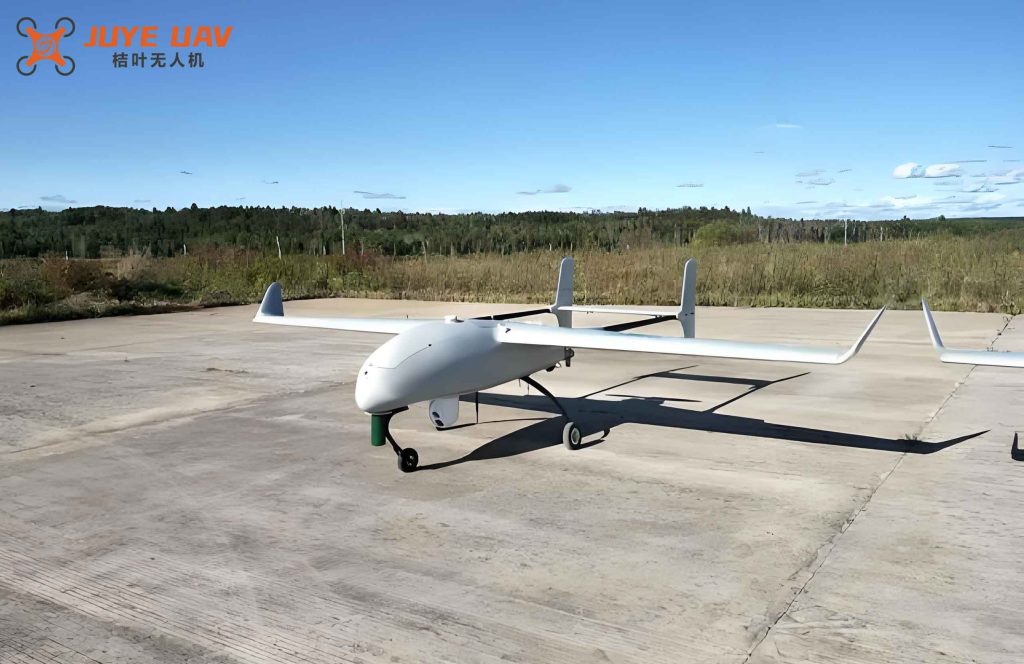
The hybrid power system for our fixed-wing drones employs a finite state machine (FSM) energy management strategy to coordinate power distribution between the fuel cell and the lithium battery. The technical specifications of the reference VTOL fixed-wing drones are summarized in the table below.
| Parameter | Value |
|---|---|
| Maximum takeoff mass (kg) | 85 |
| Cruise speed (m/s) | 33.34 |
| Maximum flight speed (m/s) | 41.67 |
| Number of brushless DC motors | 5 |
| Wing loading (kg/m²) | 35.66 |
| Lift-to-drag ratio | 12 |
| Vertical takeoff acceleration (m/s²) | 0.125 |
Parameter Matching of Power System Components
The parameter matching process for our hybrid power system was carried out based on the mission profile of the VTOL fixed-wing drones, which includes vertical takeoff, climb, hover, transition to cruise mode, horizontal cruise, and vertical landing. Each phase imposes different power requirements on the propulsion system.
Brushless DC Motor and Propeller Selection
For the rotor propellers of our fixed-wing drones, we selected two-blade fixed-pitch propellers due to their high efficiency and low manufacturing complexity. During hover, the four rotor propellers provide upward thrust that must balance the weight of the fixed-wing drones. The thrust requirement is given by:
$$T = \frac{m_{copter}}{n_p} g$$
$$T_{hover} = a_{safe} T$$
where \(T\) is the lift generated by a single rotor propeller during hover, \(n_p\) is the number of rotor propellers, \(m_{copter}\) is the maximum takeoff mass, \(g = 9.81 \, \text{m/s}^2\), and \(a_{safe} = 1.6\) is the safety factor. From these equations, we calculated the hover thrust requirement as 333.54 N per rotor.
During vertical ascent with an acceleration of 0.125 m/s², the thrust requirement becomes:
$$T_1 = \frac{m_{copter}}{n_p} (g + a)$$
$$T_{max} = a_{safe} T_1$$
The calculated thrust per rotor during vertical ascent is 337.79 N, leading to a maximum required thrust of 34.4 kg per motor. Based on this requirement, we selected the T-motor U15Ⅱ KV100 brushless DC motor paired with T-motor 40×13.1 propellers for the rotor system, and the same motor type for the pusher propeller used in fixed-wing mode.
The total propulsion efficiency of the motor and propeller combination is expressed as:
$$\eta^{mp}_t = \frac{1}{\frac{\pi C_M D_P}{30 K_E C_T^2} R_m T + \frac{2\pi C_M}{D_P \rho C_T^3} T}$$
where \(C_T = 0.0996\) is the thrust coefficient, \(C_M = 0.0054\) is the torque coefficient, \(D_P\) is the propeller diameter, \(R_m\) is the motor internal resistance, and \(K_E\) is the motor characteristic parameter defined as:
$$K_E = \frac{U_{m0} – I_{m0} R_m}{K_V U_{m0}}$$
Substituting the values yields a propulsion efficiency of 0.0449 N/W, meaning 44.9 N of thrust per kW of input power. The power required during vertical ascent is:
$$P_{Load\,max} = \frac{T_{max}}{\eta^{mp}_t}$$
This gives 7.52 kW per rotor during acceleration, totaling 30.09 kW for all four rotors during vertical takeoff.
| Parameter | Value |
|---|---|
| Voltage (V) | 50 |
| No-load current (A) | 4.5 |
| KV (rpm/V) | 100 |
| Internal resistance (mΩ) | 20 |
| Mass (g) | 1740 |
| Maximum current (A) | 171 |
Proton Exchange Membrane Fuel Cell Sizing
The fuel cell in our hybrid system is designed to provide the primary power for sustained cruise flight. For fixed-wing drones, the cruise power requirement is calculated as:
$$P_{V_C} = \frac{m_{copter} g}{(L/D)_{V_C}} V_C$$
With a cruise speed of 33.34 m/s, lift-to-drag ratio of 12, and a safety factor of 1.6, the cruise power requirement is 3.71 kW. The maximum level flight power at 41.67 m/s is:
$$P_{V_{C\,max}} = \frac{m_{copter} g}{(L/D)_{V_{C\,max}}} V_{C\,max}$$
Applying the same safety factor yields 4.64 kW. Therefore, the fuel cell output power must satisfy:
$$P_{fc} = \max(P_{V_C}, P_{V_{C\,max}})$$
We selected a fuel cell with a rated power of 4.8 kW to ensure operation near its peak efficiency point during cruise, with the capability to provide up to 10 kW peak power for transient demands.
| Parameter | Value |
|---|---|
| Rated power (kW) | 4.8 |
| Peak power (kW) | 10 |
| Maximum current (A) | 300 |
| Operating temperature (°C) | -40 to 60 |
Lithium Battery Sizing
The lithium battery in our hybrid system must provide the peak power deficit during high-demand phases. The maximum battery power requirement is:
$$P_{Li\,max} \geq P_{Load\,max} – P_{fc}$$
With \(P_{Load\,max} = 30.09 \, \text{kW}\) and \(P_{fc} = 4.8 \, \text{kW}\), the required battery power is 25.28 kW. To account for the fuel cell’s slow response during vertical takeoff, we selected a lithium battery with a peak power rating of 30 kW.
The battery capacity was estimated based on the energy consumed during the takeoff and transition phases. During the 60-second takeoff phase:
$$Q_1 = m_1 \cdot I_{motor} \cdot t_1 = 4 \times 171 \times \frac{60}{3600 \times 1000} = 11,400 \, \text{mAh}$$
During the 100-second transition phase:
$$Q_2 = m_2 \cdot I_{motor} \cdot t_2 = 5 \times 171 \times \frac{100}{3600 \times 1000} = 23,750 \, \text{mAh}$$
The total required capacity is \(Q > Q_1 + Q_2 = 35,150 \, \text{mAh}\). We selected two Gens ACE 22,000 mAh 6S 25C lithium batteries connected in series (2S) and then in parallel (2P), providing a total capacity of 44 Ah at 50 V.
| Parameter | Value |
|---|---|
| Voltage (V) | 50 |
| Capacity (Ah) | 44 |
| Series-parallel configuration | 2S2P |
| Number of cells | 4 |
| Mass per cell (kg) | 2.325 |
DC/DC Converter Selection
The unidirectional DC/DC converter boosts the fuel cell output voltage to the 50 V DC bus voltage. The converter power rating must equal the fuel cell output power, with safety margin considered:
| Parameter | Value |
|---|---|
| Voltage (V) | >50 |
| Current (A) | >300 |
| Power (kW) | 16 |
| Efficiency (%) | 98 |
Energy Management Strategy
We developed a finite state machine (FSM) energy management strategy to coordinate power distribution between the fuel cell and lithium battery in our fixed-wing drones. The control strategy is based on the following constraints:
1. The lithium battery SOC must be maintained between 60% and 85% during flight.
2. During takeoff, the lithium battery provides short-duration peak power, while during cruise, the fuel cell operates near its rated power.
3. Transient load changes are handled by the lithium battery due to its fast response characteristics.
The FSM strategy defines operational states based on battery SOC and load power demand. When the SOC is above 60%, the fuel cell provides base load power while the battery handles peaks. When SOC drops below 60%, the fuel cell increases output to charge the battery while still meeting load demands. This approach ensures that the fuel cell operates in its high-efficiency region while maintaining battery health.
Simulation Modeling and Hardware-in-the-Loop Validation
We developed a comprehensive simulation model using MATLAB/Simulink to validate our parameter matching methodology for the hybrid power system of VTOL fixed-wing drones. The model includes fuel cell dynamics, lithium battery behavior, DC/DC converter characteristics, energy management control logic, and load power profiles based on the mission profile.
The load power profile for our fixed-wing drones was constructed to represent the power demands during each flight phase. This profile includes vertical takeoff (high power demand), cruise mode transition, horizontal cruise (steady power), and transient loads representing gust disturbances or flight maneuvers.
To further validate our approach, we implemented the FSM energy management strategy on an M2C controller development platform using the Freescale MPC5634M microcontroller. The controller hardware-in-the-loop (HIL) experimental setup integrated the vehicle control unit (VCU) and hybrid control unit (HCU) functions, allowing real-time testing of the control algorithms.
The simulation results and HIL experimental data showed excellent agreement. When the lithium battery initial SOC was set to 80%, the hybrid system effectively managed power distribution throughout the flight profile. During startup, the lithium battery provided the initial power demand due to the fuel cell’s slower response, followed by coordinated operation of both power sources. When the SOC dropped below 60%, the fuel cell increased its output to simultaneously meet load demand and charge the battery.
Key results from our simulation and HIL experiments for the fixed-wing drones include:
| Flight Phase | Load Power (kW) | Fuel Cell Power (kW) | Battery Power (kW) | Battery SOC Change (%) |
|---|---|---|---|---|
| Vertical takeoff | 30.09 | 4.8 | 25.29 | -8.5 |
| Cruise | 3.71 | 3.71 | 0 | +0.2 |
| Maximum level flight | 4.64 | 4.64 | 0 | 0 |
| Transient load increase | 8.50 | 4.80 | 3.70 | -1.2 |
| Vertical landing | 12.00 | 4.80 | 7.20 | -3.8 |
The battery current and voltage profiles observed during the experiments confirmed that the hybrid power system designed through our parameter matching methodology successfully met all load demands while maintaining stable bus voltage. The fuel cell operated at its maximum efficiency point during extended cruise phases, demonstrating the effectiveness of our approach for long-endurance fixed-wing drones.
Comparative Analysis and Discussion
Compared to conventional battery-powered fixed-wing drones, our fuel cell hybrid system offers significant advantages in terms of energy density and endurance. The specific energy of our hybrid system is calculated as:
$$\text{Specific Energy} = \frac{E_{fuel\,cell} + E_{battery}}{m_{total}}$$
Where \(E_{fuel\,cell} = P_{fc} \cdot t_{cruise}\) is the energy available from the hydrogen fuel, and \(E_{battery} = V_{bat} \cdot C_{bat} \cdot SOC_{usable}\) is the usable energy from the lithium battery. The total system mass includes the fuel cell stack, hydrogen storage, battery pack, and power electronics.
For our fixed-wing drones, the hybrid system achieves a specific energy of approximately 450 Wh/kg during cruise, compared to approximately 200 Wh/kg for a battery-only system. This translates to a theoretical endurance increase of more than 100% for the same takeoff mass, making our fuel cell hybrid fixed-wing drones suitable for missions requiring extended flight times such as surveillance, mapping, and communications relay.
The parameter matching methodology we developed is summarized in the following design flow:
| Step | Description | Key Equations |
|---|---|---|
| 1 | Determine mission profile and power requirements | \(P = \frac{mg}{(L/D)} V\) |
| 2 | Select propulsion motor and propeller | \(T = \frac{m}{n_p} g \cdot a_{safe}\) |
| 3 | Calculate propulsion efficiency | \(\eta^{mp}_t = \left[\frac{\pi C_M D_P}{30 K_E C_T^2} R_m T + \frac{2\pi C_M}{D_P \rho C_T^3} T\right]^{-1}\) |
| 4 | Size fuel cell for cruise power | \(P_{fc} = \max(P_{cruise}, P_{max\,level})\) |
| 5 | Size battery for peak power deficit | \(P_{Li\,max} \geq P_{takeoff} – P_{fc}\) |
| 6 | Estimate battery capacity from mission energy | \(Q = \sum m_i \cdot I_i \cdot t_i\) |
| 7 | Select DC/DC converter for fuel cell interface | \(P_{DCDC} \geq P_{fc\,max}\) |
| 8 | Design energy management strategy | FSM logic with SOC constraints |
Our validation through both simulation and hardware-in-the-loop testing confirms that this design flow produces a well-balanced hybrid power system for VTOL fixed-wing drones. The key advantage of our approach is that it systematically addresses the complementary characteristics of fuel cells (high energy density) and lithium batteries (high power density), resulting in a power system that is both energy-efficient and responsive to dynamic load demands.
The experimental results demonstrated that the fuel cell operated at an average efficiency of 52% during cruise phases, significantly higher than the 35-40% efficiency typical of internal combustion engines used in conventional fixed-wing drones. Furthermore, the zero-emission operation of our hybrid system aligns with the growing environmental regulations in the aviation sector.
Conclusion
Our research presents a comprehensive methodology for parameter matching of fuel cell hybrid power systems specifically designed for VTOL fixed-wing drones. The key findings and contributions of our work are:
1. We developed a systematic design flow for sizing the components of a fuel cell-lithium battery hybrid power system for fixed-wing drones, including the brushless DC motor, propeller, fuel cell, lithium battery, and DC/DC converter.
2. The parameter matching process is directly linked to the mission profile of the fixed-wing drones, ensuring that the hybrid system can meet the power demands of all flight phases including vertical takeoff, transition, cruise, and landing.
3. The finite state machine energy management strategy we implemented effectively coordinates power distribution between the fuel cell and battery, maintaining the battery SOC within the optimal range while allowing the fuel cell to operate at peak efficiency during cruise.
4. Both simulation and hardware-in-the-loop validation confirmed that our parameter matching methodology produces a hybrid power system that satisfies all load requirements of the fixed-wing drones, demonstrating excellent power tracking performance and system stability.
The proposed methodology provides a practical framework for the preliminary design of hybrid electric propulsion systems for fixed-wing drones, contributing to the advancement of green aviation technology. Future work will focus on optimizing the energy management strategy using adaptive control algorithms and exploring the integration of solar cells to further extend the endurance of our fixed-wing drones.