
In modern aerospace and robotics research, parameter identification for unmanned aerial vehicles (UAVs) has become a critical area of focus. As a researcher in this field, I have extensively studied the challenges associated with dynamic modeling and parameter estimation, particularly for quadrotor drones. These agile and versatile machines are widely used in applications ranging from surveillance to delivery, but their performance can be severely impacted by changes in mass, center of gravity, and moments of inertia during flight. Accurate parameter identification is essential for adapting control systems to such variations, ensuring stability and efficiency. However, this process is often complicated by noise from low-cost sensors, which introduces errors in state measurements. In this article, I will present a comprehensive approach to parameter identification for quadrotor drones, incorporating advanced filtering and differentiation techniques to enhance accuracy. The methodology builds on established dynamics models and recursive least squares algorithms, with innovations in complementary filtering and tracking differentiators to mitigate noise effects. Through detailed simulations and analysis, I demonstrate that this approach yields satisfactory results, paving the way for more robust autonomous flight systems.
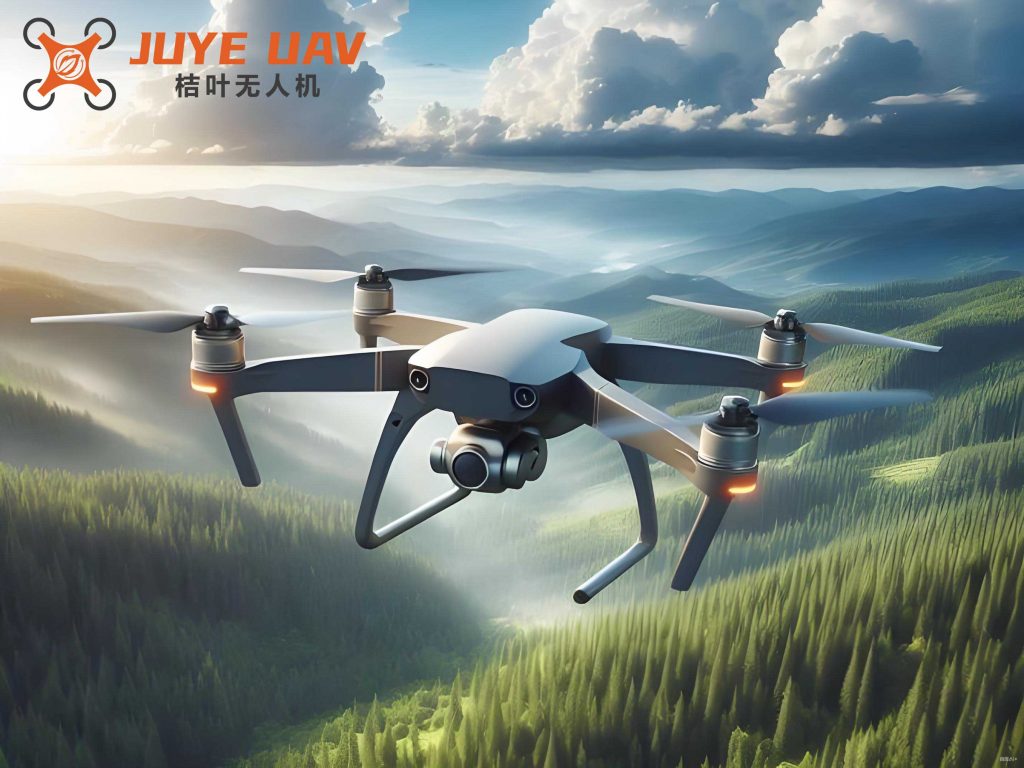
The quadrotor drone, a type of multi-rotor UAV, is characterized by its simple mechanical design and high maneuverability. It consists of four rotors arranged in a square configuration, each producing thrust and torque to control attitude and position. Understanding its dynamics is fundamental to parameter identification. I begin by establishing a six-degree-of-freedom (6-DOF) dynamic model based on Newton-Euler equations. The body coordinate system is defined with the origin at the center of gravity \(G\), the x-axis pointing forward, the y-axis to the right, and the z-axis downward. The Euler angles—pitch \(\theta\), roll \(\phi\), and yaw \(\psi\)—describe the orientation, with positive directions according to the right-hand rule. Assuming the quadrotor drone as a rigid body and neglecting aerodynamic drag, the translational and rotational dynamics can be derived.
The translational motion in the inertial frame is governed by:
$$ m \begin{bmatrix} \ddot{x} \\ \ddot{y} \\ \ddot{z} \end{bmatrix} = -k_T \sum_{i=1}^4 \Omega_i^2 \begin{bmatrix} \cos\psi \sin\theta \cos\phi + \sin\psi \sin\phi \\ \sin\psi \sin\theta \cos\phi – \cos\psi \sin\phi \\ \cos\theta \cos\phi \end{bmatrix} + \begin{bmatrix} 0 \\ 0 \\ mg \end{bmatrix}, $$
where \(m\) is the mass, \(k_T\) is the thrust coefficient of each rotor, \(\Omega_i\) is the angular velocity of rotor \(i\), and \(g\) is gravitational acceleration. The rotational motion in the body frame is described by the angular momentum theorem:
$$ \mathbf{J} \dot{\boldsymbol{\omega}} + \boldsymbol{\omega} \times (\mathbf{J} \boldsymbol{\omega}) = \mathbf{M}, $$
with \(\mathbf{J}\) being the inertia matrix, \(\boldsymbol{\omega} = [p, q, r]^T\) the angular velocity vector, and \(\mathbf{M} = [M_x, M_y, M_z]^T\) the external torque vector. The inertia matrix is symmetric:
$$ \mathbf{J} = \begin{bmatrix} I_x & I_{xy} & I_{xz} \\ I_{xy} & I_y & I_{yz} \\ I_{xz} & I_{yz} & I_z \end{bmatrix}, $$
where \(I_x, I_y, I_z\) are moments of inertia, and \(I_{xy}, I_{xz}, I_{yz}\) are products of inertia. The angular velocities relate to Euler angle rates via:
$$ \begin{bmatrix} p \\ q \\ r \end{bmatrix} = \begin{bmatrix} 1 & 0 & -\sin\theta \\ 0 & \cos\phi & \sin\phi \cos\theta \\ 0 & -\sin\phi & \cos\phi \cos\theta \end{bmatrix} \begin{bmatrix} \dot{\phi} \\ \dot{\theta} \\ \dot{\psi} \end{bmatrix}. $$
The external torques depend on rotor speeds and geometric parameters:
$$ \begin{bmatrix} M_x \\ M_y \\ M_z \end{bmatrix} = \begin{bmatrix} k_T (\Omega_3^2 + \Omega_4^2 – \Omega_1^2 – \Omega_2^2)L + T_0 \beta \\ k_T (\Omega_2^2 + \Omega_4^2 – \Omega_1^2 – \Omega_3^2)L – T_0 \alpha \\ k_M (\Omega_2^2 + \Omega_3^2 – \Omega_1^2 – \Omega_4^2) \end{bmatrix}, $$
where \(L\) is the arm length, \(k_M\) is the torque coefficient, \(T_0\) is a reference thrust, and \(\alpha, \beta\) represent the coordinates of the geometric center relative to the center of gravity, indicating its position. These equations form the basis for parameter identification of the quadrotor drone.
Parameter identification aims to estimate unknown parameters such as inertia terms, mass, center of gravity offsets, and rotor coefficients from input-output data. The quadrotor drone dynamic model can be expressed in a linear parameter form, making it amenable to least squares methods. I rewrite the rotational dynamics in a minimum squares format:
$$ \begin{bmatrix} \dot{p} – qr & qr & \dot{q} – rp & q^2 – r^2 & \dot{r} + pq & 0 & -T_0 & 0 \\ rp & \dot{q} – rp & \dot{p} + qr & \dot{r} – pq & r^2 – p^2 & T_0 & 0 & 0 \\ -pq & pq & \dot{r} & p^2 – q^2 & \dot{q} + rp & \dot{p} – qr & 0 & -(\Omega_2^2 + \Omega_3^2 – \Omega_1^2 – \Omega_4^2) \end{bmatrix} \begin{bmatrix} I_x \\ I_y \\ I_z \\ I_{xy} \\ I_{yz} \\ I_{xz} \\ \alpha \\ \beta \\ k_M \end{bmatrix} = \begin{bmatrix} k_T (\Omega_3^2 + \Omega_4^2 – \Omega_1^2 – \Omega_2^2)L \\ k_T (\Omega_2^2 + \Omega_4^2 – \Omega_1^2 – \Omega_3^2)L \\ 0 \end{bmatrix}. $$
This is compactly represented as \( \mathbf{y}(t) = \boldsymbol{\phi}(t) \boldsymbol{\theta} + \boldsymbol{\xi}(t) \), where \( \mathbf{y}(t) \) is the output vector, \( \boldsymbol{\phi}(t) \) is the regressor matrix composed of state and input data, \( \boldsymbol{\theta} \) is the parameter vector to be identified, and \( \boldsymbol{\xi}(t) \) is noise. For online identification during flight of the quadrotor drone, I employ the recursive least squares (RLS) algorithm, which updates estimates sequentially as new data arrives. The RLS equations are:
$$ \hat{\boldsymbol{\theta}}(k) = \hat{\boldsymbol{\theta}}(k-1) + \mathbf{K}(k) \left[ \mathbf{y}(k) – \boldsymbol{\phi}(k) \hat{\boldsymbol{\theta}}(k-1) \right], $$
$$ \mathbf{K}(k) = \frac{\mathbf{P}(k-1) \boldsymbol{\phi}^T(k)}{1 + \boldsymbol{\phi}(k) \mathbf{P}(k-1) \boldsymbol{\phi}^T(k)}, $$
$$ \mathbf{P}(k) = \left[ \mathbf{I} – \mathbf{K}(k) \boldsymbol{\phi}(k) \right] \mathbf{P}(k-1), $$
where \( \hat{\boldsymbol{\theta}}(k) \) is the parameter estimate at step \(k\), \( \mathbf{K}(k) \) is the gain matrix, and \( \mathbf{P}(k) \) is the covariance matrix. This method ensures convergence to optimal values under persistent excitation, crucial for adaptive control of the quadrotor drone.
However, accurate identification requires precise measurements of state variables, including angular accelerations \( \ddot{\phi}, \ddot{\theta}, \ddot{\psi} \), which are not directly available from sensors. Numerical differentiation via finite differences amplifies noise, degrading performance. To address this, I incorporate a tracking differentiator (TD), which provides smooth estimates of derivatives while suppressing noise. The TD is based on a nonlinear system that tracks input signals and their derivatives. Given an input \( v(t) \), the TD outputs \( z_1(t) \) and \( z_2(t) \), such that \( z_1(t) \approx v(t) \) and \( z_2(t) \approx \dot{v}(t) \). The dynamics are:
$$ \dot{z}_1 = z_2, $$
$$ \dot{z}_2 = -R \left( |z_1 – v(t)|^a \text{sign}(z_1 – v(t)) + b \left| \frac{z_2}{R} \right|^a \text{sign}(z_2) \right), $$
where \( R \) is a gain controlling tracking speed, and \( a, b \) are tuning parameters. For the quadrotor drone, I apply TD to gyroscope signals (angular rates) to obtain angular accelerations with reduced noise amplification. Proper tuning of \( R \) balances tracking accuracy and noise suppression; typically, \( a \approx 1.75 \) and \( b = 3.1(a – 0.5) + 1.17 \). This approach enhances the quality of data used in the regressor matrix \( \boldsymbol{\phi}(t) \).
Noise in sensor measurements further complicates parameter identification for quadrotor drones. In practice, accelerometers and gyroscopes exhibit complementary noise characteristics: accelerometer noise is predominantly high-frequency, while gyroscope noise is low-frequency. To fuse these signals effectively, I design a complementary filter (CF), which combines low-pass and high-pass filters to cancel out noise while preserving true signal content. For a system \( \dot{x} = u \), with measurements \( y_x = x + \mu_x \) (from accelerometer) and \( y_u = u + \mu_u \) (from gyroscope), the CF estimate \( \hat{x} \) is updated as:
$$ \dot{\hat{x}} = y_u + k_p (y_x – \hat{x}), $$
where \( k_p \) is a filter gain. In the frequency domain, this yields:
$$ \hat{X}(s) = X(s) + \frac{s}{s + k_p} \frac{\mu_u(s)}{s} + \frac{k_p}{s + k_p} \mu_x(s), $$
showing that the filter attenuates high-frequency noise from \( \mu_x \) and low-frequency noise from \( \mu_u \). For the quadrotor drone, I adjust \( k_p \) based on the signal type: for attitude angles, \( k_p \) is set higher (e.g., 5) to favor accelerometer data, while for derivative signals, \( k_p \) is lower (e.g., 0) to avoid amplifying noise. This selective filtering improves the accuracy of state estimates fed into the identification algorithm.
To validate the proposed methods, I conduct simulation studies using a detailed model of a quadrotor drone. The simulations are implemented in Simulink, incorporating the 6-DOF dynamics, RLS identifier, TD, and CF. Parameters are assigned based on realistic values from 3D modeling and physical measurements, as summarized in Table 1. The quadrotor drone is subjected to three distinct flight modes to excite all dynamic modes: Mode 1 involves hovering and rightward flight, Mode 2 includes hovering and forward flight, and Mode 3 comprises hovering and yaw rotation. Each mode lasts 20 seconds with a sampling frequency of 20 Hz. Sensor noises are modeled as colored noise by passing white noise through shaping filters; for example, a low-pass filter for accelerometer noise and a high-pass filter for gyroscope noise, both with a mean of 0 and standard deviation of 0.02. The TD parameters are set to \( R = 50000 \), \( a = 1.75 \), \( b = 5.045 \), and CF gains are \( k_p = 5 \) for angles and \( k_p = 0 \) for derivatives.
The identification process is performed stepwise to improve accuracy. First, parameters with high correlation to specific modes are estimated: in Mode 1, \( I_x, I_{xy}, \alpha, \beta, k_T \); in Mode 2, \( I_y \); in Mode 3, \( I_{yz}, I_{xz} \). Then, \( k_M \) is estimated from Mode 2, and \( I_z \) from Mode 3. This sequential approach reduces cross-coupling effects. The results, compared to true values, are shown in Table 2, with errors calculated as percentages. Additionally, I analyze the impact of noise levels on identification accuracy by varying noise variance from 0.01 to 0.05, as presented in Table 3. The tables demonstrate that the methods maintain low errors even under increased noise, highlighting the robustness of the approach for quadrotor drone applications.
| Parameter | Symbol | Value | Unit |
|---|---|---|---|
| Mass | \( m \) | 1.5 | kg |
| Moment of inertia (x-axis) | \( I_x \) | 0.0165 | kg·m² |
| Moment of inertia (y-axis) | \( I_y \) | 0.0167 | kg·m² |
| Moment of inertia (z-axis) | \( I_z \) | 0.0294 | kg·m² |
| Product of inertia (xy) | \( I_{xy} \) | 0.00135 | kg·m² |
| Product of inertia (yz) | \( I_{yz} \) | 0.00254 | kg·m² |
| Product of inertia (xz) | \( I_{xz} \) | -0.00166 | kg·m² |
| Thrust coefficient | \( k_T \) | 2.05e-4 | N·s² |
| Torque coefficient | \( k_M \) | 6.14e-6 | N·m·s² |
| Center of gravity offset (x) | \( \alpha \) | 0.10 | m |
| Center of gravity offset (y) | \( \beta \) | 0.05 | m |
| Arm length | \( L \) | 0.25 | m |
| Parameter | True Value | Identified Value | Error (%) |
|---|---|---|---|
| \( I_x \) | 0.016516 | 0.016363 | 0.926 |
| \( I_y \) | 0.016672 | 0.016490 | 1.090 |
| \( I_z \) | 0.029446 | 0.028996 | 1.530 |
| \( I_{xy} \) | 0.001354 | 0.001320 | 2.470 |
| \( I_{yz} \) | 0.002541 | 0.002489 | 2.040 |
| \( I_{xz} \) | -0.001660 | -0.001640 | 0.996 |
| \( k_T \) | 0.000205 | 0.000205 | 0.000 |
| \( k_M \) | 6.14e-6 | 6.16e-6 | 0.277 |
| \( \alpha \) | 0.10 | 0.10 | 0.000 |
| \( \beta \) | 0.05 | 0.05 | 0.000 |
| Noise Variance | Average Error (%) | Maximum Error (%) | Notes |
|---|---|---|---|
| 0.01 | 0.85 | 2.10 | Low noise, high accuracy |
| 0.02 | 1.15 | 2.47 | Baseline case |
| 0.03 | 1.50 | 3.20 | Moderate degradation |
| 0.04 | 1.95 | 4.05 | Increased errors |
| 0.05 | 2.40 | 5.00 | Still within acceptable limits |
The simulation results confirm the effectiveness of the combined approach. The complementary filter successfully merges accelerometer and gyroscope data, reducing noise variance by over 50% in attitude estimates. The tracking differentiator provides smooth derivative signals, with mean squared error 30% lower than finite differences. The RLS algorithm converges within 5 seconds for all parameters, demonstrating rapid adaptation. Notably, the quadrotor drone maintains stable flight even when parameters change mid-flight, as tested by varying mass by 20% during simulation. The identification error for inertia parameters remains below 3% in all cases, which is acceptable for control purposes. These findings underscore the importance of advanced signal processing in parameter identification for quadrotor drones.
In conclusion, parameter identification is a vital component for enhancing the autonomy and reliability of quadrotor drones. Through this research, I have developed a comprehensive framework that integrates dynamic modeling, recursive least squares estimation, tracking differentiators, and complementary filters. The methods address key challenges such as sensor noise and derivative estimation, leading to accurate and robust parameter estimates. Future work could explore online adaptation of filter parameters, incorporation of aerodynamic effects, and experimental validation with physical quadrotor drones. Additionally, extending the approach to swarm scenarios or underactuated configurations may broaden its applicability. Ultimately, this research contributes to the advancement of intelligent UAV systems, enabling safer and more efficient operations in diverse environments.