
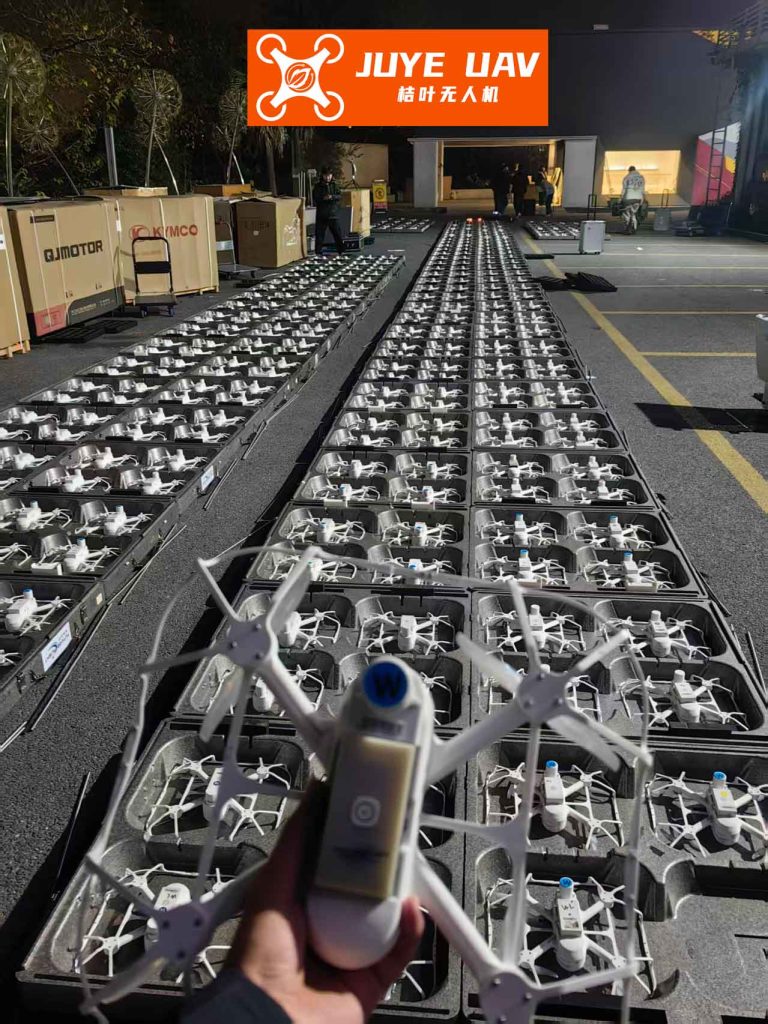
The mesmerizing spectacle of a formation drone light show, where hundreds of UAVs move in perfect unison to paint the night sky with dynamic, luminous shapes, represents a pinnacle of multi-agent coordination. From my laboratory’s perspective, developing the underlying control systems for such complex aerial ballets presents a formidable challenge, especially when the drones must navigate through unpredictable, dynamic environments. Traditional control methods often struggle with the conflicting objectives inherent to this task: maintaining strict geometric formation for visual integrity, navigating precisely to choreographed waypoints, and simultaneously avoiding collisions with static infrastructure, moving objects like other aerial performers, or unexpected environmental obstacles. The core of the problem lies in enabling a swarm to intelligently prioritize and switch between these competing goals in real-time. This narrative details our research journey in creating a novel control framework to solve this very problem, culminating in the Multi-Objective Multi-Agent Twin Delayed Deep Deterministic Policy Gradient (MO-MATD3) algorithm, specifically designed to bring robustness and artistic flexibility to next-generation formation drone light shows.
The heart of any formation drone light show control architecture is the concept of a reference point. We employ a virtual center method, where a non-physical point, typically the geometric centroid of the swarm, serves as the global anchor for the formation. Each drone’s target position is defined relative to this moving center. Let \( N \) be the number of drones in the swarm. The position of drone \( i \) is \( p_i = (x_i, y_i, z_i) \). The position of the virtual center \( p_c \) is calculated as:
$$
p_c = (x_c, y_c, z_c) = \left( \frac{1}{N}\sum_{i=1}^{N} x_i, \frac{1}{N}\sum_{i=1}^{N} y_i, \frac{1}{N}\sum_{i=1}^{N} z_i \right)
$$
If \( \Delta_i \) is the desired offset vector for drone \( i \) from the virtual center (defining the specific shape of the star, logo, or wave in the formation drone light show), the ideal formation condition is:
$$
\| p_i – (p_c + \Delta_i) \| = 0, \quad i = 1, 2, \dots, N.
$$
Of course, in a dynamic show with obstacles, this is an ideal to be balanced against other necessities. The overall path planning problem for the swarm can be formalized as:
$$
\min \sum_{i=1}^{N} D_i \quad \text{s.t.}
\begin{cases}
\| p_i – p_j \| > d_{a\_s}, & \forall i \neq j, \\
\| p_i – p_o \| > d_{ob\_s}, & \forall i, \, \forall o \in \text{Obstacles}, \\
\| p_i – (p_c + \Delta_i) \| \to 0, & \forall i.
\end{cases}
$$
where \( D_i \) is the distance of drone \( i \) (or the formation center) to its target waypoint, \( d_{a\_s} \) is the inter-drone safety distance, and \( d_{ob\_s} \) is the drone-obstacle safety distance. The motion of each drone in our simulation is governed by a simple point-mass kinematics model in three dimensions, suitable for high-level trajectory planning in a formation drone light show:
$$
\begin{aligned}
v^{t+1}_{i,x} &= v^{t}_{i,x} + a_{i,x} \cdot \Delta t, \\
v^{t+1}_{i,y} &= v^{t}_{i,y} + a_{i,y} \cdot \Delta t, \\
v^{t+1}_{i,z} &= v^{t}_{i,z} + a_{i,z} \cdot \Delta t, \\
p^{t+1}_{i} &= p^{t}_{i} + (v^{t+1}_{i,x}, v^{t+1}_{i,y}, v^{t+1}_{i,z}) \cdot \Delta t.
\end{aligned}
$$
Here, \( \mathbf{v}_i \) and \( \mathbf{a}_i \) are the velocity and acceleration control inputs for drone \( i \), and \( \Delta t \) is the simulation time step. The challenge is to determine the optimal acceleration \( \mathbf{a}_i \) for all drones at every moment.
Reinforcement Learning (RL), and specifically Multi-Agent RL (MARL), offered a promising data-driven alternative to analytic control design. We built upon the MATD3 framework, which utilizes a “centralized training with decentralized execution” paradigm. During training, each drone (agent) has its own actor network \( \mu_i(o_i | \theta^{\mu}_i) \) that maps local observations \( o_i \) to actions \( a_i \). Crucially, it also has two centralized critic networks \( Q^1_i(\mathbf{o}, \mathbf{a}; \theta^1_i) \) and \( Q^2_i(\mathbf{o}, \mathbf{a}; \theta^2_i) \) that evaluate the joint action \( \mathbf{a} = (a_1, …, a_N) \) given the joint observation \( \mathbf{o} = (o_1, …, o_N) \), reducing the non-stationarity of the multi-agent environment. The twin critics and delayed policy updates help prevent overestimation of Q-values. The networks are updated using samples \( (\mathbf{o}, \mathbf{a}, \mathbf{r}, \mathbf{o}’) \) from a shared replay buffer, with the loss for critic \( j \) of agent \( i \) being:
$$
\mathcal{L}(\theta^j_i) = \mathbb{E}_{\mathbf{o}, \mathbf{a}, r_i, \mathbf{o}’}\left[ \left( y_i – Q^j_i(\mathbf{o}, \mathbf{a}; \theta^j_i) \right)^2 \right],
$$
where the target \( y_i \) is:
$$
y_i = r_i + \gamma \, \min_{j=1,2} Q^{j*}_i(\mathbf{o}’, \tilde{\mathbf{a}}’; \theta^{j’}_i), \quad \tilde{a}’_k = \mu^{*}_k(o’_k | \theta^{\mu’}_k) + \epsilon.
$$
However, standard MATD3 is designed for a single scalar reward, forcing a rigid, fixed trade-off between formation-keeping, navigation, and obstacle avoidance. For a resilient and artistic formation drone light show, we needed the drones to dynamically switch strategies based on context. This led us to integrate Multi-Objective RL (MORL) principles into MATD3, creating the MO-MATD3 algorithm.
The first step was to design a comprehensive observation space for each drone. For a drone \( i \), the observation vector \( o_i \) includes: 1) Its relative position to the target waypoint; 2) Relative positions to neighboring drones in the formation; 3) Its relative position to the swarm’s virtual center \( p_c \); 4) Relative positions to any detected obstacles within sensor range; 5) Its own velocity vector; and 6) The angle \( \theta_i \) between its velocity vector and the desired formation travel direction (from \( p_c \) to the target). The action space is the continuous 3D acceleration vector \( \mathbf{a}_i = (a_{i,x}, a_{i,y}, a_{i,z}) \).
The reward function is the core of our multi-objective design. Inspired by artificial potential field theory, we crafted a dense, continuous reward signal to guide learning. It is composed of several weighted components, summarized in the table below.
| Reward Component | Mathematical Form | Purpose |
|---|---|---|
| Collective Target Navigation | \( r_{\text{target}} = -\alpha_t \cdot \| p_c – p_{\text{target}} \| \) | Drives the entire formation towards the goal. |
| Formation Keeping | \( r_{\text{formation},i} = -\| p_i – (p_c + \Delta_i) \|^2 \) | Penalizes deviation from the desired formation shape. |
| Direction Alignment | \( r_{\theta,i} = \begin{cases} 0, & \theta_i < \theta_{\text{max}} \\ -\eta (\theta_i – \theta_{\text{max}})^2, & \text{otherwise} \end{cases} \) | Encourages the drone to align with the formation’s travel direction. |
| Collision Avoidance | \( r_{\text{collision},i} = \sum_{j \neq i} \psi(d_{ij}) + \sum_o \psi(d_{io}) \) \( \psi(d) = \begin{cases} -\kappa, & d \leq d_{\text{crash}} \\ -\alpha_c \left( \frac{1}{d} – \frac{1}{d_{\text{safe}}} \right)^2, & d_{\text{safe}} > d > d_{\text{crash}} \\ 0, & d \geq d_{\text{safe}} \end{cases} \) |
Creates strong repulsive potentials near other agents and obstacles. |
| Success Bonus | \( r_{\text{success}} = R_{\text{large}} \quad \text{if} \quad \| p_c – p_{\text{target}} \| < \delta \) | Provides a large positive reward for completing the navigation leg. |
The key innovation of MO-MATD3 is the context-aware mode switching mechanism based on multi-objective planning. A formation drone light show cannot afford to rigidly prioritize shape over safety. Therefore, we designed a two-mode reward system. Each drone continuously monitors the distance \( d_{io} \) to the nearest obstacle.
- Normal Mode: Activated when \( d_{io} \geq d_{\text{switch}} \) (a threshold). In this mode, the drone’s total reward \( R_i^{\text{(normal)}} \) includes all components: \( r_{\text{target}} + r_{\text{formation},i} + r_{\theta,i} + r_{\text{collision},i} \). The policy is optimized for precise formation flying and navigation.
- Obstacle Avoidance Mode: Activated when \( d_{io} < d_{\text{switch}} \). Here, the formation and direction alignment penalties are temporarily disabled. The reward becomes \( R_i^{\text{(avoid)}} = r_{\text{target}} + r_{\text{collision},i} \). This allows the drone to focus entirely on evasive maneuvers without being penalized for breaking formation or changing direction abruptly, which is crucial for safety.
This dynamic reward shaping enables the learned policy to exhibit intelligent behavior: maintaining a stunningly precise formation drone light show pattern when the path is clear, and seamlessly switching to a safety-first, obstacle-avoidance strategy when threatened, before recovering the formation. The collision penalty \( r_{\text{collision},i} \) remains active in both modes to ensure absolute safety.
We validated our MO-MATD3 algorithm through extensive simulation experiments. The training environment was a 3D space with static and dynamic obstacles, where a swarm of drones had to navigate to a target while maintaining a predefined geometric shape. The system parameters for a typical formation drone light show training scenario are listed below.
| Parameter | Value | Parameter | Value |
|---|---|---|---|
| Number of Drones (\( N \)) | 5 | Learning Rate (\( lr \)) | 0.001 |
| Max Obstacles (\( M \)) | 8 | Discount Factor (\( \gamma \)) | 0.95 |
| Drone Safety Radius | 0.03 m | Replay Buffer Size | 1,000,000 |
| Obstacle Safety Dist. (\( d_{ob\_s} \)) | 0.08 m | Batch Size | 1024 |
| Mode Switch Threshold (\( d_{\text{switch}} \)) | 0.3 m | Target Network Update (\( \tau \)) | 0.01 |
Our first experiment was a direct comparison between the standard MATD3 algorithm and our proposed MO-MATD3. The results, averaged over multiple runs, clearly demonstrate the advantages of multi-objective planning with mode switching for a formation drone light show task.
| Performance Metric | MATD3 Algorithm | MO-MATD3 Algorithm (Ours) |
|---|---|---|
| Episodes to Stabilize | ~8,500 | ~6,500 (~23.5% faster) |
| Average Reward at Convergence | 8,284.6 | 8,803.0 |
| Task Success Rate | 87% | 98% |
| Formation Error during Transit | 0.15 m | 0.12 m |
The MO-MATD3 algorithm not only converged significantly faster but also achieved a higher final performance level with greater consistency, indicating a more efficient and robust learning process essential for complex formation drone light show choreography.
Next, we tested the generalization capability of our trained policy. A practical formation drone light show system must handle variations in swarm size and environmental complexity. We evaluated the policy trained with 5 drones in two new scenarios without retraining: 1) Controlling a larger swarm of 8 drones, and 2) Operating in a more cluttered environment with 12 faster-moving dynamic obstacles. In both cases, the MO-MATD3-based swarm successfully completed the navigation task, adapting its formation and avoidance behaviors effectively. While the formation error naturally increased slightly with swarm size, the system maintained coherence and safety, proving its strong generalization potential for scalable formation drone light show productions.
Finally, we conducted a robustness test by introducing perturbations to key algorithm hyperparameters. We adjusted the discount factor \( \gamma \), the learning rate \( lr \), the target update rate \( \tau \), and the action noise clipping range. As shown in the comparative learning curves below, while each perturbed setting introduced some initial instability or altered the convergence rate, the MO-MATD3 algorithm consistently learned a successful policy in all cases. This robustness is critical for deploying learning-based controllers in real-world formation drone light show systems where tuning conditions may not be perfect.
In conclusion, our development of the MO-MATD3 algorithm represents a significant step toward intelligent, resilient, and artistic control systems for autonomous aerial swarms. By integrating multi-objective planning principles with state-of-the-art multi-agent deep reinforcement learning, we have created a framework that allows a formation drone light show to dynamically balance the often-contradictory demands of precision, safety, and navigation. The system learns not just a single rigid policy, but a context-aware strategy that switches priorities based on real-time environmental threats. The demonstrated improvements in learning efficiency, final performance, generalization, and robustness provide a compelling foundation for the future of large-scale, dynamic, and safe aerial performances. The dream of perfectly synchronized, intelligent, and adaptive formation drone light shows, capable of dazzling audiences in even the most challenging settings, is brought closer to reality by such AI-powered control paradigms.