
Rice is one of the most critical staple crops globally, playing an indispensable role in ensuring food security. However, the growth, yield, and quality of rice are often compromised by various pests and diseases, among which rice sheath blight, caused by fungal pathogens, stands out as one of the three major rice diseases. This disease exhibits strong parasitic and saprophytic characteristics, capable of occurring throughout the entire rice growth cycle. In recent years, factors such as climate change, adjustments in cultivation practices, ecological shifts, and the introduction of new rice varieties have contributed to an increasing prevalence and severity of rice sheath blight. To address these challenges, the adoption of modern agricultural technologies has become essential, with crop spraying drones emerging as a pivotal tool in integrated pest management due to their efficiency, precision, and safety.
The use of spraying UAVs in agriculture has revolutionized pesticide application by offering superior coverage, reduced labor costs, and enhanced operational flexibility. However, the effectiveness of these drones is highly dependent on various operational parameters, with water volume being a key factor influencing the deposition and distribution of pesticides on rice plants. Insufficient water volume may lead to inadequate coverage, particularly in dense crop canopies, while excessive volume can result in inefficiencies and increased costs. Therefore, optimizing water application rates for crop spraying drones is crucial for achieving sustainable and economically viable disease control. In this study, we systematically evaluated the impact of different water volumes on the control efficacy against rice sheath blight and associated economic benefits, aiming to provide a scientific basis for precision agriculture applications.
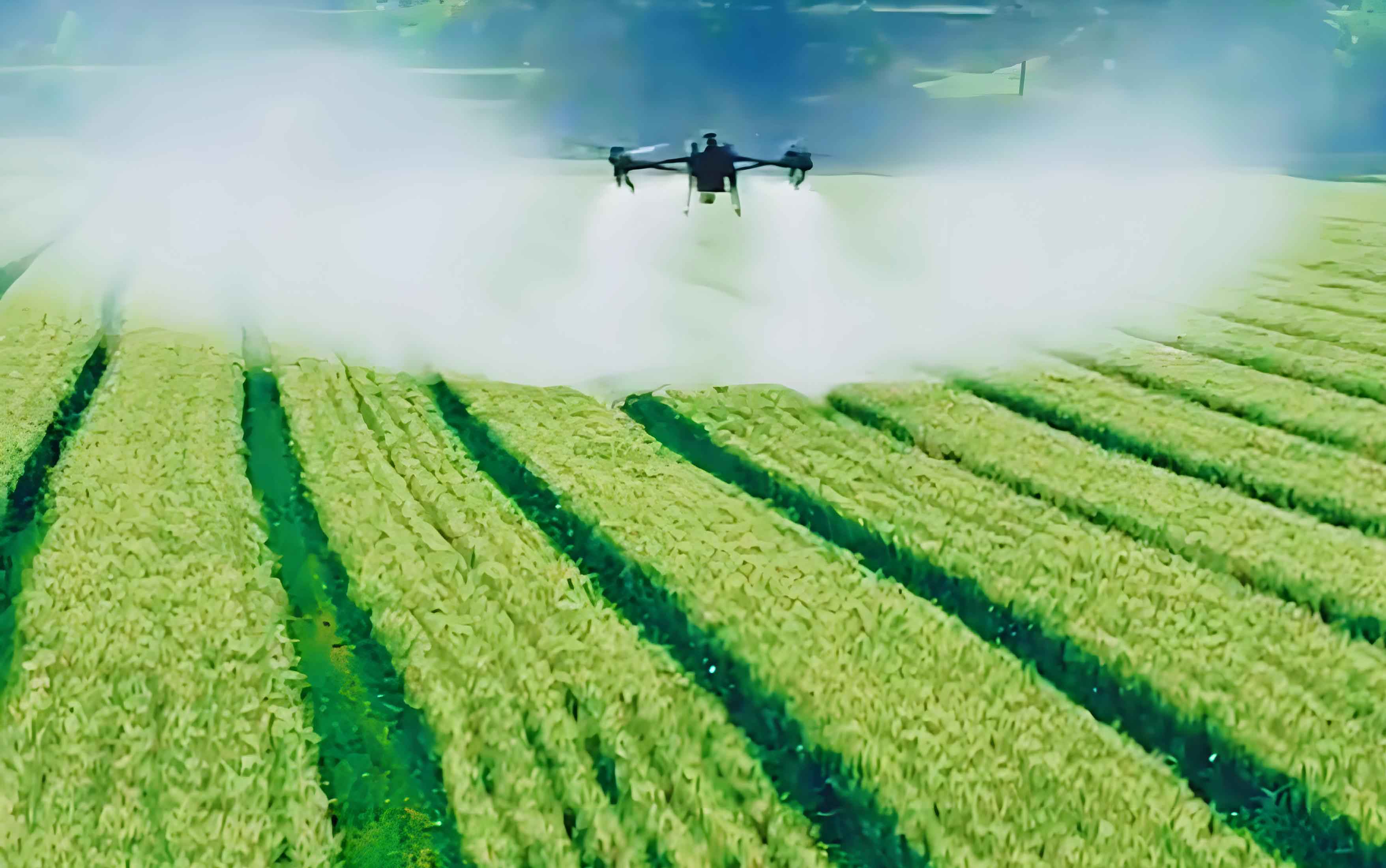
Our research was conducted over two years in a representative rice-growing region, focusing on the effects of water volume on disease control at different growth stages. We employed a widely used crop spraying drone model, the DJI T40, which is known for its reliability and advanced features in agricultural spraying. The drone was operated at a constant height of 3 meters and a speed of 6 meters per second, with a spray width of 5 meters. These parameters were kept consistent to isolate the effect of water volume variations. The rice variety used in the experiments was ‘Songjing 1018’, chosen for its susceptibility to sheath blight and relevance to local cultivation practices. The experimental field was characterized by medium soil fertility and efficient irrigation systems, ensuring uniform growing conditions across all treatments.
We designed a randomized block experiment with three water volume treatments: 30 L/hm², 45 L/hm², and 67.5 L/hm². Each treatment was replicated three times, and a control plot without pesticide application was included for comparison. The total experimental area spanned 2 hectares, with individual treatment plots covering approximately 0.2 hectares. Pesticide applications were timed at critical growth stages: the jointing stage and the heading stage. The pesticides used included a combination of 75% tebuconazole and azoxystrobin water-dispersible granules and 250 g/L azoxystrobin suspension, applied at standard rates to ensure comparability. Disease assessment was conducted using a linear sampling method, with fixed points in each plot evaluated for disease incidence and severity based on established grading criteria.
The grading scale for rice sheath blight severity was defined as follows: 0级: no disease; 1级: infection on the fourth leaf and below; 3级: infection on the third leaf and below; 5级: infection on the second leaf and below; 7级: infection on the first leaf and below; 9级: plant death. Disease incidence and index were calculated using the formulas below, which are standard in phytopathology studies:
Disease incidence (DI) is given by:
$$ DI = \frac{\text{Number of infected plants}}{\text{Total plants surveyed}} \times 100\% $$
Disease index (DX) is calculated as:
$$ DX = \frac{\sum (\text{Number of plants per grade} \times \text{Grade value})}{\text{Total plants surveyed} \times 9} \times 100 $$
Control efficacy for disease incidence (CE_DI) and disease index (CE_DX) were derived using Abbott’s formula:
$$ CE_{DI} = \left(1 – \frac{DI_{\text{control, after}} \times DI_{\text{treatment, before}}}{DI_{\text{control, before}} \times DI_{\text{treatment, after}}}\right) \times 100\% $$
$$ CE_{DX} = \left(1 – \frac{DX_{\text{control, after}} \times DX_{\text{treatment, before}}}{DX_{\text{control, before}} \times DX_{\text{treatment, after}}}\right) \times 100\% $$
These formulas allowed us to quantify the effectiveness of each treatment accurately. Data were analyzed using statistical software to determine significant differences between treatments, with a significance level of P < 0.05.
In the first year of the study, we focused on the control efficacy at both jointing and heading stages. The results revealed that at the jointing stage, there were no significant differences in control efficacy among the three water volume treatments. Disease incidence control efficacy ranged from 85.57% to 87.68%, while disease index control efficacy varied between 89.86% and 91.34%. This suggests that lower water volumes are sufficient during this growth phase, likely due to the less dense canopy structure, which allows for better penetration and coverage even with reduced spray volumes. However, at the heading stage, significant differences emerged. The treatment with 30 L/hm² water volume showed notably lower efficacy compared to the higher volumes, with disease incidence control at 79.71% and disease index control at 89.47%. In contrast, the 45 L/hm² and 67.5 L/hm² treatments achieved control efficacies of 88.33% and 91.99% for disease incidence, and 93.73% and 94.95% for disease index, respectively, with no significant difference between them. This highlights the increased demand for water volume during the heading stage, when the rice canopy is denser and diseases like sheath blight are more aggressive.
| Year | Treatment | Water Volume (L/hm²) | Growth Stage | Disease Incidence Control (%) | Disease Index Control (%) |
|---|---|---|---|---|---|
| 2023 | A1 | 30 | Jointing | 85.57 | 89.86 |
| 2023 | A2 | 45 | Jointing | 87.68 | 91.34 |
| 2023 | A3 | 67.5 | Jointing | 87.37 | 91.13 |
| 2023 | A1 | 30 | Heading | 79.71 | 89.47 |
| 2023 | A2 | 45 | Heading | 88.33 | 93.73 |
| 2023 | A3 | 67.5 | Heading | 91.99 | 94.95 |
In the second year, we concentrated on the heading stage to validate and extend the findings. The results confirmed the trends observed previously. At 7 days after application, the 30 L/hm² treatment resulted in disease incidence control of 78.86% and disease index control of 85.30%, which were significantly lower than the higher volumes. The 45 L/hm² and 67.5 L/hm² treatments achieved control efficacies of 94.01% and 95.01% for disease incidence, and 93.91% and 94.93% for disease index, respectively, with no statistical difference between them. At 15 days after application, the efficacy of the 30 L/hm² treatment declined further to 73.17% for disease incidence and 77.38% for disease index, while the higher volumes maintained robust control, with efficacies above 90% for both parameters. This underscores the persistence of control achieved with adequate water volumes, which is critical for long-term disease management.
| Year | Treatment | Water Volume (L/hm²) | Days After Application | Disease Incidence Control (%) | Disease Index Control (%) |
|---|---|---|---|---|---|
| 2024 | B1 | 30 | 7 | 78.86 | 85.30 |
| 2024 | B2 | 45 | 7 | 94.01 | 93.91 |
| 2024 | B3 | 67.5 | 7 | 95.01 | 94.93 |
| 2024 | B1 | 30 | 15 | 73.17 | 77.38 |
| 2024 | B2 | 45 | 15 | 91.49 | 90.92 |
| 2024 | B3 | 67.5 | 15 | 93.12 | 92.46 |
Beyond efficacy, we analyzed the economic implications of varying water volumes for crop spraying drone operations. The efficiency of drone spraying is inversely related to water volume; as volume increases, the operational time required per unit area also rises due to more frequent refilling and landing cycles. For instance, with a crop spraying drone like the DJI T40, operating at 30 L/hm² allows for an efficiency of 4.0 hectares per hour. However, increasing the volume to 45 L/hm² reduces efficiency to 3.33 hectares per hour, and at 67.5 L/hm², it drops further to 2.67 hectares per hour. This reduction is attributed to the increased number of refilling events: 7.5 times for 30 L/hm², 11.25 times for 45 L/hm², and 16.875 times for 67.5 L/hm² over a 10-hectare area, with each refill and landing taking approximately 8 minutes. Consequently, the total operational time escalates from 150 minutes at 30 L/hm² to 225 minutes at 67.5 L/hm².
The cost analysis further emphasizes the trade-offs. Based on surveys of local service providers, the standard fee for drone spraying at 30 L/hm² is 1050 yuan per application for 10 hectares. Each additional liter of water volume increases the cost by approximately 2 yuan per hectare. Thus, at 45 L/hm², the cost rises to 1350 yuan per application, and at 67.5 L/hm², it reaches 1800 yuan. Over three applications per season, the total cost increases by 28.6% from 30 L/hm² to 45 L/hm², and by 33.3% from 45 L/hm² to 67.5 L/hm². This highlights the economic pressure to optimize water volume without compromising control efficacy, especially for large-scale farming operations where cost-effectiveness is paramount.
| Water Volume (L/hm²) | Total Liquid (L) | Refill Events | Operational Time (min) | Efficiency (hm²/h) | Cost per Application (yuan) | Total Cost for 3 Applications (yuan) |
|---|---|---|---|---|---|---|
| 30 | 300 | 7.5 | 150 | 4.00 | 1050 | 3150 |
| 45 | 450 | 11.25 | 180 | 3.33 | 1350 | 4050 |
| 67.5 | 675 | 16.875 | 225 | 2.67 | 1800 | 5400 |
The discussion of our findings revolves around the mechanistic understanding of how water volume influences pesticide deposition and efficacy. In the jointing stage, the rice plants are less dense, allowing spray droplets from the crop spraying drone to penetrate easily and cover the target areas. This explains why lower water volumes suffice. However, during the heading stage, the canopy is thick and layered, creating a barrier that impedes droplet penetration to the lower stems where sheath blight primarily thrives. Higher water volumes enhance droplet density and coverage, ensuring that pesticides reach the critical infection sites. This is consistent with previous studies on spraying UAVs, which have shown that increased spray volume improves deposition in dense canopies. Nonetheless, our results indicate that beyond 45 L/hm², the marginal gains in efficacy diminish, making it an optimal threshold for the heading stage.
Moreover, the inter-annual variability in results, such as the differences in significance levels between years, underscores the influence of environmental factors. Variables like wind speed, temperature, humidity, and rainfall can affect droplet evaporation, drift, and deposition, thereby altering the effectiveness of crop spraying drone applications. For example, higher wind speeds may cause droplet dispersal away from the target, while high temperatures can accelerate evaporation, reducing the active ingredient concentration on plant surfaces. Future research should incorporate these variables into predictive models to enhance the precision of spraying UAV operations. The development of such models could enable real-time adjustments based on environmental conditions, further optimizing water use and efficacy.
From a practical perspective, we propose a differentiated water volume strategy for crop spraying drone applications in rice sheath blight control. For the jointing stage, we recommend a water volume of 30 L/hm², as it provides adequate control (over 85% efficacy) while maximizing operational efficiency and minimizing costs. For the heading stage, 45 L/hm² is the preferred option, as it balances high efficacy (above 90%) with reasonable efficiency and cost. This approach not only ensures effective disease management but also supports the economic sustainability of drone-based spraying services. The adoption of such tailored strategies can enhance the integration of spraying UAVs into modern agricultural systems, contributing to food security and environmental health.
In conclusion, our study demonstrates that water volume is a critical parameter in crop spraying drone operations for controlling rice sheath blight. While higher volumes generally improve efficacy, the relationship is not linear, and excessive volumes yield diminishing returns. By aligning water volume with growth stage-specific needs, farmers and service providers can achieve optimal outcomes. The crop spraying drone technology, when properly calibrated, offers a powerful tool for precision agriculture, reducing chemical usage and environmental impact while maintaining high productivity. As the adoption of spraying UAVs continues to grow, further innovations in sensor technology and data analytics will likely enhance their capabilities, paving the way for more resilient and sustainable rice production systems.