
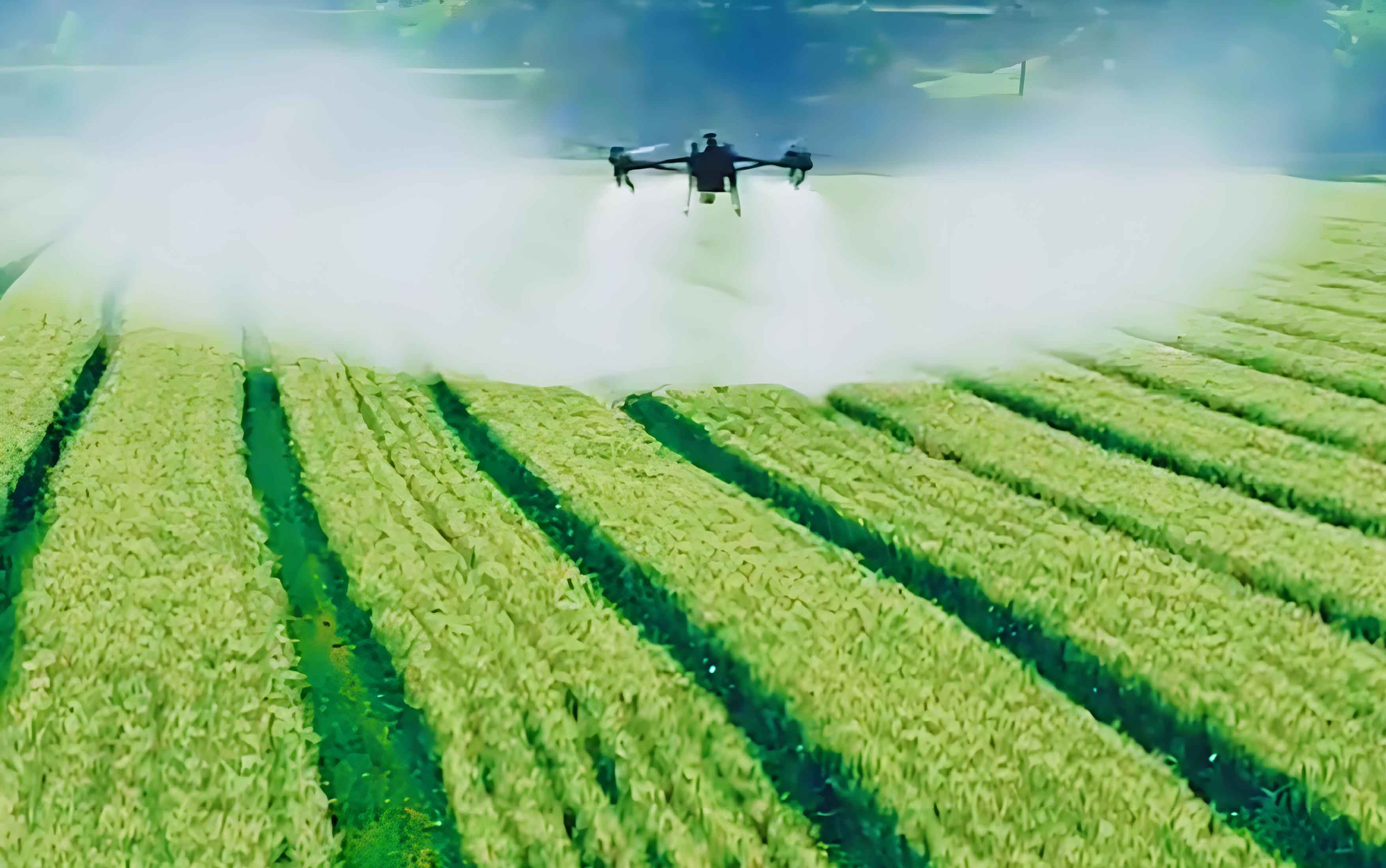
Chemical application remains vital for ensuring crop yield stability, yet traditional ground-based methods suffer from inefficiency, poor terrain adaptability, crop damage, and operator health risks. Agricultural UAV technology addresses these limitations through its operational flexibility and efficiency, emerging as a cornerstone of precision agriculture. However, droplet deposition in near-ground environments involves complex interactions between atmospheric conditions, spray characteristics, and rotor downwash dynamics. Suboptimal deposition reduces pesticide utilization efficiency by 30-60%, compromises pest control, and creates environmental hazards through drift. We analyze deposition distribution patterns, identify influencing parameters, and present optimization strategies to enhance agricultural drone efficacy.
Characteristics of Droplet Deposition Distribution
Agricultural UAV deposition is dominated by rotor downwash, creating unique vertical and horizontal distribution patterns. Vertically, deposition follows an exponential decay model:
$$D_v(z) = D_0 \cdot e^{-kz}$$
where $D_v(z)$ is deposition density at canopy depth $z$, $D_0$ is top-layer deposition, and $k$ is the attenuation coefficient. Horizontally, deposition forms a Gaussian distribution perpendicular to the flight path:
$$D_h(y) = \frac{D_{max}}{\sigma\sqrt{2\pi}} e^{-\frac{(y-\mu)^2}{2\sigma^2}}$$
where $D_{max}$ is peak deposition along centerline $y=\mu$, and $\sigma$ determines distribution spread. Asymmetry occurs due to crosswinds ($v_w$) and flight direction ($\theta$), modeled by:
$$D_a(y) = D_h(y) \cdot \left(1 + \beta \cdot v_w \cdot \sin\theta\right)$$
with $\beta$ as wind sensitivity coefficient. This distribution complexity necessitates multi-factor optimization for agricultural UAV operations.
| Canopy Layer | Deposition Density (%) | Penetration Efficiency |
|---|---|---|
| Upper (0-20%) | 45-65 | 100% (Reference) |
| Middle (20-50%) | 20-35 | 48±7% |
| Lower (50-100%) | 5-15 | 18±5% |
Critical Factors Influencing Deposition Efficacy
Operational Parameters
Flight Velocity ($v_f$): Governs droplet residence time and downwash intensity. Optimal $v_f$ balances deposition and efficiency:
$$v_{f,opt} = \sqrt[3]{\frac{C_d \cdot Q \cdot g}{2\rho_a \cdot W}}$$
where $Q$ is flow rate, $W$ is swath width, $\rho_a$ is air density, $g$ is gravity, and $C_d$ is drag coefficient. Agricultural drones exhibit deposition loss exceeding 25% when $v_f$ > 8 m/s in moderate winds.
Flight Altitude ($h$): Affects droplet dispersion and drift potential. Effective height correlates with rotor diameter ($D_r$):
$$h_{opt} = 0.3 \cdot D_r + 0.2 \cdot H_c$$
where $H_c$ is canopy height. Deviation beyond ±0.2 $h_{opt}$ increases VMD (Volume Median Diameter) variation by >40%.
Spray and Environmental Factors
Droplet Size (VMD): The governing equation for terminal velocity ($v_t$) demonstrates size-dependent behavior:
$$v_t = \sqrt{\frac{4gD_p(\rho_p – \rho_a)}{3C_d\rho_a}}$$
where $D_p$ is droplet diameter and $\rho_p$ is droplet density. Field tests confirm agricultural UAV applications achieve optimal deposition when 150μm < VMD < 250μm.
Environmental Conditions: Evaporation rate ($E_v$) follows:
$$E_v = k_e \cdot (P_s – P_a) \cdot D_p^{-1}$$
where $k_e$ is evaporation coefficient, $P_s$ is saturation vapor pressure, and $P_a$ is ambient vapor pressure. Temperature increases of 10°C triple $E_v$, while humidity below 40% causes up to 50% droplet mass loss before deposition.
| Wind Speed (m/s) | Drift Potential (%) | Deposition CV | UAV Correction Strategy |
|---|---|---|---|
| 0-1.5 | <5 | 15-25% | Standard operation |
| 1.5-3.0 | 5-15 | 25-40% | Reduce $h$ by 20% |
| 3.0-4.5 | 15-35 | 40-60% | Increase VMD by 30% |
| >4.5 | >35 | >60% | Suspend operation |
Deposition Enhancement Methodologies
Nozzle System Optimization
Agricultural UAV nozzle configuration requires precise angular alignment ($\alpha$) and spacing ($s_n$):
$$\alpha = \tan^{-1}\left(\frac{W}{2h}\right) \pm 5^\circ, \quad s_n \leq 0.75 \cdot R_s$$
where $R_s$ is spray swath radius. Air-induction nozzles reduce drift-prone fines by 40% compared to conventional flat-fans while maintaining deposition uniformity (CV < 15%).
Electrostatic Charging Systems
Charge-to-mass ratio ($q/m$) determines deposition enhancement:
$$\frac{q}{m} = \frac{3\epsilon_0 E_c}{\rho_p r_p} \left(\frac{\epsilon_r – 1}{\epsilon_r + 2}\right)$$
where $E_c$ is charging field strength, $\epsilon_r$ is dielectric constant, and $r_p$ is droplet radius. Optimal $q/m$ = 1-2 mC/kg improves deposition on leaf undersides by 35-70% while reducing drift by 30%.
CFD-Guided Spray Modeling
Computational Fluid Dynamics (CFD) solves the Navier-Stokes equations for air-droplet interactions:
$$\frac{\partial \rho}{\partial t} + \nabla \cdot (\rho \mathbf{v}) = 0$$
$$\frac{\partial (\rho \mathbf{v})}{\partial t} + \nabla \cdot (\rho \mathbf{v} \mathbf{v}) = -\nabla p + \nabla \cdot \mathbf{\tau} + \rho \mathbf{g}$$
Droplet motion follows Newton’s law with Lagrangian tracking:
$$m_p\frac{d\mathbf{v_p}}{dt} = \mathbf{F_d} + \mathbf{F_g} + \mathbf{F_e}$$
where $\mathbf{F_d}$ is drag force, $\mathbf{F_g}$ is gravity, and $\mathbf{F_e}$ is electrostatic force. CFD optimization reduces field validation costs by 60% while identifying deposition “cold spots” within crop canopies.
Conclusion and Future Perspectives
Agricultural drone deposition efficiency hinges on dynamic coupling between operational parameters, spray characteristics, and environmental factors. Our analysis confirms that nozzle optimization, electrostatic augmentation, and CFD modeling collectively improve deposition uniformity by 40-65% while reducing drift by 30-50%. Future agricultural UAV systems will integrate:
- Real-time multispectral canopy sensors adjusting $h$ and $v_f$
- Machine learning algorithms predicting optimal spray windows using micro-weather data
- Adaptive nozzle arrays modulating VMD based on LiDAR-detected canopy density
These advancements will establish closed-loop “sense-decide-act” systems, positioning agricultural UAVs as indispensable tools for sustainable crop protection. Continued research should quantify long-term environmental impacts while standardizing deposition assessment protocols across diverse cropping systems.