
The rise of the low-altitude economy represents a transformative shift in regional development strategies, integrating advanced aviation technologies with traditional industries to create new economic paradigms. As a vast region with unique geographical and strategic importance, the development of this sector is particularly significant. Its expansive airspace, accounting for approximately one-sixth of the national total, and over 320 days of annual flight-suitable weather provide an unparalleled natural endowment for unmanned aerial vehicle (UAV) operations. The deepening of trade and logistics cooperation under major international initiatives further amplifies the demand for efficient, short-distance transport solutions, including cross-border services and emergency response. Application scenarios are diverse and critical: low-altitude tourism leverages stunning landscapes, agricultural drones enhance crop management and weather modification, and energy sector inspections rely on specialized aerial patrols. This rapid industrial expansion has precipitated an urgent and substantial demand for skilled professionals. National estimates indicate a talent gap exceeding one million positions for drone pilots and technicians, a shortage acutely felt in regions actively cultivating their low-altitude economies. Consequently, strengthening drone training has become a pivotal task for sustaining this growth. While vocational institutions have begun establishing relevant programs, these nascent offerings face significant challenges, often featuring curricula that lag 1-2 years behind evolving industry standards. This study explores the current landscape, identifies persistent gaps, and proposes a comprehensive framework for optimizing drone training pathways within vocational education systems.
The low-altitude economy is an emerging, interdisciplinary commercial ecosystem where drone flight activities are deeply integrated with industrial processes. This fusion creates a unique economic model with specific, elevated demands for the workforce. The need for drone professionals is characterized by contemporaneity, diversification, and specialization, requiring continuous knowledge updates and adaptive skill sets. The following table delineates the core competency requirements across different talent categories.
| Talent Category | Specific Role | Core Competency Requirements |
|---|---|---|
| Technical Professionals | Drone Assembly & Debugging Technician | Ability to perform assembly per technical specifications, comprehensively debug flight control systems, and calibrate sensors (e.g., gyroscopes, accelerometers). |
| Flight Operations Pilot | Proficiency in piloting techniques, precise operational skills, and adaptability to various flight environments (e.g., diverse meteorological conditions, terrain). | |
| Maintenance & Repair Technician | Capability to accurately diagnose malfunctions and perform efficient repairs and scheduled maintenance. | |
| Management & Operations Professionals | Project Manager | Skills in drone project planning, coordination, progress control, and cost management, with an understanding of industry-specific technical characteristics and market needs. |
| Enterprise Operations Manager | Knowledge of drone technology and marketing to formulate business strategies, enhancing operational efficiency and market competitiveness. | |
| Industry Application Professionals | Data Processing & Analysis Specialist | Expertise in processing and analyzing large volumes of data generated during drone missions (e.g., aerial imagery, geospatial information, sensor telemetry). |
In response to this demand, vocational institutions have initiated drone training programs. The curriculum typically encompasses foundational modules such as aviation regulations, mechanical structure, and flight principles, with courses like “UAV Operation Standards,” “Aircraft Assembly and Debugging,” and “Fundamentals of Aerodynamics.” The stated goal is to equip students with systematic knowledge of multi-rotor drone mechanics, piloting skills, and professional capabilities in mission planning, equipment maintenance, aerial survey data processing, and product assembly.
However, the pace of talent cultivation demonstrably lags behind industrial growth. The inclusion of “low-altitude economy” as a national strategic growth engine underscores its future significance, predicting a continuous surge in demand for drone operators and technicians. A structural contradiction exists between the output of vocational graduates and market needs, revealing several critical shortcomings in current drone training models.
Firstly, curricular content is often disconnected from practical requirements. Textbook knowledge and taught technologies frequently exhibit a time lag compared to rapid market advancements, leaving graduates requiring a prolonged adaptation period before meeting employer expectations effectively.
Secondly, practical training components are notably weak. Drone training is inherently hands-on, requiring substantial operational practice to master flight skills, maintenance techniques, and application prowess. Many institutions suffer from inadequate investment in this area: insufficient facilities, lagging实训基地 construction, and limited student hands-on opportunities hinder the translation of theory into practice. Furthermore, establishing a competent drone training program demands significant investment in specialized equipment—flight simulators, various drone models, repair tools, and testing apparatus. The high procurement cost, coupled with the rapid technological obsolescence cycle, strains limited institutional budgets. This often results in training on outdated hardware, preventing students from engaging with前沿 sensors and flight control systems, thereby diminishing the relevance and quality of their drone training.
Thirdly, building a qualified teaching faculty is challenging. Effective drone training instructors require a robust theoretical foundation in aerospace or electronics paired with rich practical experience in drone operation and application. Such复合型 talent is scarce, making recruitment and development difficult and resource-intensive. Moreover, the industry’s fast evolution demands continuous knowledge更新 from teachers. The lack of structured professional development mechanisms and resources impedes instructors’ ability to stay current, directly affecting the quality of drone training delivered.
Finally, mechanisms for industry-education integration and school-enterprise cooperation remain underdeveloped. While crucial for modern vocational education, collaboration often stays at superficial levels like equipment donation or实习基地挂牌, failing to evolve into a deep, synergistic “co-education, co-management, and shared outcomes” model. In the context of drone training, this manifests as a lack of collaborative curriculum development, low enterprise involvement in course design, and实训条件 that poorly align with actual industry developments.
To address these gaps and cultivate a workforce capable of supporting a vibrant low-altitude economy, a multi-faceted optimization strategy for vocational drone training is essential.
1. Curricular Optimization and Innovation
The curriculum is the cornerstone of effective drone training. It must be dynamic, closely aligned with technological frontiers, and structured around the competency requirements of target industries. A modular approach allows for flexibility and focus. The theoretical component must integrate the latest knowledge on sensors, flight control algorithms, and data-link technologies. Furthermore, cross-disciplinary knowledge fusion is critical; courses should incorporate relevant aspects of agriculture (e.g., crop spectral analysis), logistics (e.g., route optimization and package delivery systems), and geographic information science (e.g., photogrammetry principles). This cultivates the comprehensive素养 needed for industry applications. The practical component’s weight must be significantly increased. A proposed modular structure is outlined below:
| Module Category | Core Courses / Content | Industry Alignment Goal |
|---|---|---|
| Core Theory & Regulation | Aviation Law & UAV Regulations, Aerodynamics, Flight Control Principles, Communication & Navigation Systems | Foundational knowledge for certification and safe operation. |
| Technical Operations | UAV Assembly & Debugging Practice, Maintenance & Repair Technology, Sensor Technology & Application | Skills for technical support and field service roles. |
| Flight & Mission Operations | Simulated Flight Training, Actual Flight Training (VLOS/BVLOS), Mission Planning & Execution, Emergency Procedures | Competency for piloting and operational management roles. |
| Data & Application Specialization | Aerial Photography & Videography, Surveying & Mapping Data Processing, Agriculture/Inspection Application Software | Expertise for specific industry application sectors. |
2. Enhancing Practical Training Components
Substantial investment in practical facilities is non-negotiable for quality drone training. Institutions should aim to establish a comprehensive on-campus实训中心 that mimics real-world workflows. This center should include dedicated zones for assembly/debugging, flight control simulation, maintenance/repair, and a controlled outdoor flight area. Increasing the ratio of practical to theoretical hours is essential. Students must have ample opportunity for hands-on repetition. Engaging students in drone competitions and applied research projects further stimulates innovation and problem-solving skills. For instance, a project optimizing a flight path for agricultural spraying involves both operational practice and data analysis, embodying the applied nature of drone training.
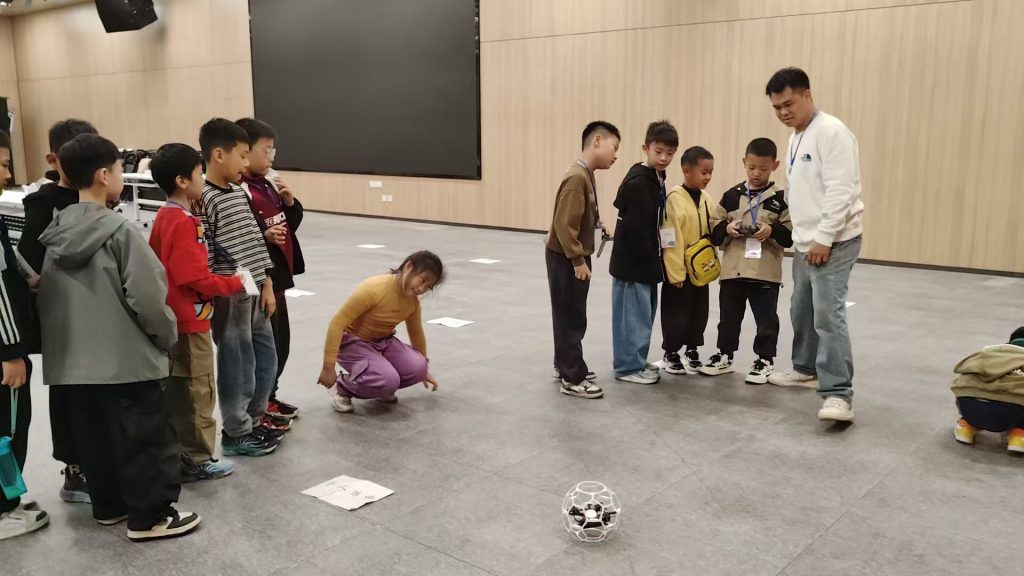
The operational performance of a training drone can be modeled considering key parameters crucial for practical drone training scenarios:
$$ \text{Flight Efficiency Score } (F_e) = \frac{T_{flight} \cdot P_{payload}}{C_{power} \cdot W_{total}} \cdot S_{stability} $$
where:
$T_{flight}$ = Maximum flight time (minutes),
$P_{payload}$ = Payload capacity (kg),
$C_{power}$ = Power consumption rate (W/min),
$W_{total}$ = Total weight (kg),
$S_{stability}$ = Stability factor (derived from wind resistance tests).
Students can use this model during drone training to compare and select appropriate platforms for different simulated tasks (e.g., long-duration mapping vs. heavy-lift payload delivery).
3. Strengthening the Teaching Faculty
The quality of drone training is directly proportional to instructor capability. A dual-strategy focusing on upskilling existing teachers and infusing industry expertise is vital.
Upskilling In-House Faculty: Institutions must establish systematic professional development programs. This includes sponsoring teachers to attend advanced drone training workshops and academic conferences hosted by leading manufacturers or research bodies. Statistics suggest such engagement can update 30% of a teacher’s专业知识 annually. More impactful is implementing a mandatory enterprise secondment system, where teachers spend designated periods (e.g., one month annually) working within drone companies on real R&D, production, or application projects. This direct immersion builds invaluable practical experience. Performance-based incentives for professional development can motivate continuous learning.
Infusing Industry Expertise: Inviting seasoned professionals—such as engineering leads, senior pilots, and data analysts—as adjunct faculty or guest lecturers bridges the theory-practice gap. They bring current case studies, operational nuances, and emerging trends directly into the classroom. For example, a maintenance engineer can teach advanced diagnostic techniques, while an agronomy specialist can lecture on integrating drone data with crop models. Establishing formal collaboration mechanisms between these experts and academic staff fosters mutual growth: teachers gain practical insights, while experts may benefit from theoretical frameworks. Reports indicate that involving industry experts in drone training can increase student satisfaction with practical courses by approximately 20% and enhance graduate employability.
A structured development pathway for a drone training instructor can be visualized as a progression through competency stages:
| Development Stage | Key Activities | Target Outcome |
|---|---|---|
| Foundation | Complete basic UAV pilot certification; attend pedagogy workshops for technical subjects. | Ability to teach core theory and introductory operations. |
| Skill Enhancement | Attend advanced technical workshops (e.g., LiDAR, multispectral); obtain industry-recognized skill certificates. | Ability to teach specialized application modules and advanced operations. |
| Industry Immersion | Undertake a 3-6 month secondment at a partner enterprise; participate in a live commercial drone project. | Deep practical knowledge; ability to design curriculum based on real workflow. |
| Leadership & Innovation | Lead student competition teams; collaborate with industry on applied R&D projects; publish case studies. | Ability to drive program innovation, mentor junior faculty, and strengthen industry links. |
4. Deepening Industry-Education Integration and Collaboration
Moving beyond symbolic partnerships to substantive collaboration is the most effective way to enhance institutional capacity and align drone training with market needs. This solves critical issues like access to advanced equipment and ensures curriculum relevance.
Successful models involve enterprises in the entire talent cultivation cycle. Joint curriculum development teams comprising industry experts and academic staff can design courses that reflect actual job competencies. The training model should integrate “vocational skills + professional literacy” as dual pillars. Beyond technical skills, modern enterprise management systems, safety protocols, and operational standards (like 6S management) should be embedded into project-based learning. Collaborative construction of training environments—such as simulated mission control rooms, assembly/debugging labs, and certified flight fields—creates an authentic learning ecosystem. Enterprises can also contribute by providing access to cutting-edge software for mission planning and data analysis, which might be cost-prohibitive for schools to license independently.
A mature collaborative framework for drone training should be multi-faceted, as illustrated below. A successful case involves vocational schools partnering with drone service companies and manufacturers to establish a talent development model based on the integration of “Post, Course, Competition, and Certification.” This collaboration spans curriculum co-development, instructor training, certification preparation, competition coaching, and internship/job placement. This ecosystem creates a talent fast-track for the low-altitude economy, achieving a tripartite win for the institution (effective education), the student (meaningful employment), and the industry (skilled workforce).
The financial and pedagogical benefits of deep校企合作 can be modeled. The total effectiveness \( E_{total} \) of a drone training program under a strong partnership model is a function of shared resources:
$$ E_{total} = \alpha \cdot R_{facility} + \beta \cdot R_{curriculum} + \gamma \cdot R_{instructor} + \delta \cdot R_{placement} $$
where:
$R_{facility}$ = Value of shared facility/equipment access (monetized),
$R_{curriculum}$ = Measure of curriculum alignment with industry standards (0-1 index),
$R_{instructor}$ = Composite score of instructor industry experience,
$R_{placement}$ = Graduate employment rate in relevant fields,
and \( \alpha, \beta, \gamma, \delta \) are weighting coefficients determined by program priorities.
Furthermore, the learning curve for students in a robust, industry-integrated drone training program can be described using a modified model that accounts for accelerated skill acquisition through real-world exposure:
$$ P(t) = P_{max} – (P_{max} – P_0) \cdot e^{-k \cdot (t + I_{factor} \cdot t^2)} $$
Here, \( P(t) \) is the performance proficiency at time \( t \), \( P_{max} \) is the maximum achievable proficiency, \( P_0 \) is initial proficiency, \( k \) is the base learning rate, and \( I_{factor} \) is an “industry integration factor” that accelerates learning through exposure to authentic projects and mentors, making the curve steeper than in a purely academic setting.
The collaboration framework encompasses several synergistic pillars:
| Collaboration Pillar | Concrete Actions | Expected Impact on Drone Training |
|---|---|---|
| Curriculum & Talent Development | Co-develop course content & training plans; establish joint technical committees. | Ensures training relevance; creates clear “Post-Course” alignment. |
| Faculty Development | Enterprise provides trainer-the-trainer programs; hosts teacher secondments. | Rapidly upskills faculty with current industry practices. |
| Certification & Competition | Jointly prepare students for official pilot licenses and技能等级 certificates; co-coach for national drone competitions. | Enhances student qualifications (“Certification”); builds practical prowess (“Competition”). |
| Infrastructure & Platform | Co-build实训基地; donate/loan latest equipment; provide access to enterprise software platforms. | Solves facility funding gap; provides access to industrial-grade technology. |
| Employment & Innovation | Offer guaranteed internships & priority hiring; establish joint R&D labs for applied projects. | Closes the loop with employment (“Placement”); fosters innovation culture. |
In conclusion, the vigorous development of the low-altitude economy presents both a substantial challenge and a remarkable opportunity for vocational education systems. The current state of drone training, while initiated, is hampered by curricular delays, insufficient practical focus, faculty shortages, and superficial industry links. Addressing these issues requires a concerted, strategic effort. By implementing dynamic and modular curriculum design, making substantial investments in authentic practical training facilities, pursuing aggressive dual-track faculty development, and—most crucially—forging deep, multifaceted partnerships with industry, vocational institutions can transform their drone training pathways. The proposed models for collaboration, instructor development, and performance measurement provide a blueprint for this transformation. Through such optimization, vocational schools can reliably produce a stream of highly skilled, industry-ready drone professionals. This workforce will be the fundamental engine powering the safe, efficient, and innovative growth of the low-altitude economy, contributing significantly to future regional economic vitality and societal progress. The journey of refining drone training is continuous, demanding constant adaptation to technological and market shifts, but its strategic importance for the future of transportation, logistics, and countless other industries cannot be overstated.