
In modern agriculture, the integration of advanced technologies is crucial for sustainable crop protection. As a researcher focused on precision agriculture, I have observed that tea plantations face significant challenges from pests like the tea green leafhopper (Empoasca pirisuga), which can severely impact yield and quality. Traditional spraying methods, such as backpack sprayers, often result in low pesticide deposition efficiency and uneven distribution, leading to environmental concerns and resistance issues. In recent years, the adoption of agricultural UAVs (unmanned aerial vehicles) has revolutionized pest control by offering high efficiency, reduced labor costs, and improved coverage. However, spray drift and inconsistent droplet deposition remain critical limitations for agricultural UAV operations. To address this, adjuvants are increasingly used to enhance spray performance. In this study, we explore how different adjuvants—specifically plant oil, neem oil, and an organosilicon-based additive—affect the atomization characteristics, deposition patterns, and control efficacy of a botanical insecticide (azadirachtin) when applied via agricultural UAVs in tea plantations. Our goal is to provide insights into optimizing agricultural UAV spray systems for sustainable tea production.
The use of agricultural UAVs for crop protection has grown exponentially due to their ability to cover large areas quickly and minimize crop damage. These systems typically employ multi-rotor designs, such as the DJI MG-1P model, which allows for precise flight control and adjustable spraying parameters. However, the effectiveness of agricultural UAV applications heavily depends on droplet size, coverage density, and deposition uniformity. Small droplets are prone to drift, while large droplets may bounce off leaves, reducing efficacy. Adjuvants can modify the physicochemical properties of spray solutions, influencing droplet formation and target adhesion. For instance, oil-based adjuvants may reduce surface tension, promoting better spread and retention on tea leaves. This study aims to quantify these effects through field trials, using advanced measurement techniques to evaluate droplet parameters and pest control outcomes.
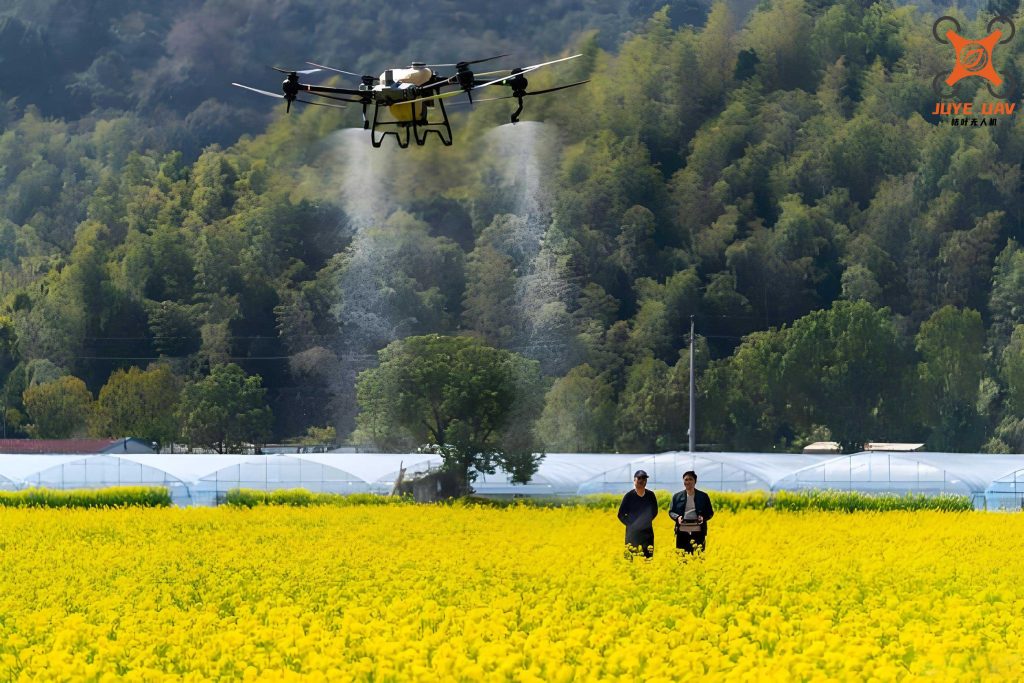
In our field experiment, we conducted trials in a tea plantation to assess the impact of adjuvants on agricultural UAV spray performance. We selected a common agricultural UAV model equipped with anti-drift nozzles (XR110-015 type) to minimize off-target movement. The spray solution included 0.3% azadirachtin emulsion as the primary insecticide, with three adjuvants added separately: plant oil, neem oil, and an organosilicon adjuvant (referred to as Red Sun). A control treatment used only azadirachtin without adjuvants, and a synthetic insecticide (2.5% beta-cyfluthrin) was included for comparison. All treatments were applied at a rate of 4 L per acre, with the agricultural UAV flying at 2 m/s at a height of 1 m above the tea canopy. To trace droplet deposition, we added allure red dye to the spray mixtures and placed water-sensitive papers and polyester cards at three canopy layers—upper, middle, and lower—to collect data on droplet distribution. We analyzed parameters such as droplet size (expressed as D10, D50, D90), coverage rate, droplet density, and deposition amount. Additionally, we monitored tea green leafhopper populations before and after spraying to calculate control efficacy, and we measured azadirachtin residues in tea leaves using high-performance liquid chromatography (HPLC).
To understand droplet dynamics, we employed several mathematical models. The droplet size distribution is often characterized by the volume median diameter (D50), which represents the diameter where 50% of the total droplet volume is contained in smaller droplets. The span of the distribution, indicating uniformity, is calculated as:
$$ S = \frac{D_{90} – D_{10}}{D_{50}} $$
where a lower S value denotes a more uniform droplet size. Deposition variability across canopy layers was assessed using the coefficient of variation (CV):
$$ CV = \frac{s}{\bar{x}} $$
with \( s \) being the standard deviation and \( \bar{x} \) the mean deposition amount. For pest control, efficacy was determined by:
$$ \text{Efficacy} (\%) = \frac{\text{Reduction in treated plot} – \text{Reduction in control plot}}{100 – \text{Reduction in control plot}} \times 100\% $$
These formulas allowed us to quantitatively evaluate how adjuvants influence agricultural UAV spray outcomes.
The results from our field trials revealed significant differences in spray performance with various adjuvants. Droplet deposition was highest in the upper canopy layer, decreasing towards the lower layers, but adjuvants improved deposition across all strata. For example, the addition of plant oil increased coverage rate and deposition amount, while neem oil enhanced droplet density. The following table summarizes key atomization parameters at the canopy level for each treatment:
| Treatment | D50 (μm) | Droplet Coverage (%) | Droplet Density (cm-2) | Deposition Amount (μL/cm2) | Span (S) |
|---|---|---|---|---|---|
| Azadirachtin + Plant Oil | 349.60 | 33.60 | 114.58 | 3.83 | 1.11 |
| Azadirachtin + Neem Oil | 324.60 | 30.00 | 120.58 | 3.24 | 1.27 |
| Azadirachtin + Organosilicon | 335.40 | 26.50 | 109.50 | 2.78 | 1.50 |
| Azadirachtin Only | 321.40 | 23.75 | 106.82 | 2.08 | 1.41 |
| Beta-cyfluthrin | 319.80 | 21.99 | 105.58 | 1.83 | 1.45 |
As shown, plant oil adjuvant produced the largest D50 value and highest deposition, indicating that it promotes larger droplets that resist drift and settle effectively. The span value was lowest for plant oil, suggesting more uniform droplet distribution. In contrast, neem oil led to the highest droplet density, which may improve insecticide contact with pests. These findings underscore the role of adjuvants in optimizing agricultural UAV spray characteristics.
Deposition amounts across canopy layers further highlighted adjuvant effects. We measured the allure red tracer on polyester cards to estimate pesticide deposition, with results in μg/cm2:
| Treatment | Upper Layer | Middle Layer | Lower Layer |
|---|---|---|---|
| Azadirachtin + Plant Oil | 1.25 | 0.41 | 0.09 |
| Azadirachtin + Neem Oil | 1.02 | 0.30 | 0.05 |
| Azadirachtin + Organosilicon | 1.09 | 0.32 | 0.05 |
| Azadirachtin Only | 0.47 | 0.17 | 0.04 |
| Beta-cyfluthrin | 0.28 | 0.10 | 0.01 |
Plant oil adjuvant consistently increased deposition in all layers, demonstrating its ability to enhance penetration and retention in dense tea canopies. This is critical for agricultural UAV applications, as uniform deposition is key to effective pest control. The coefficient of variation (CV) for deposition across layers was lower in adjuvant-treated plots, indicating improved uniformity. For instance, the CV for azadirachtin with plant oil was 0.76, compared to 1.00 for azadirachtin alone, meaning adjuvants reduced variability in spray distribution.
The control efficacy against tea green leafhopper was significantly influenced by adjuvants. After 10 days, the combination of azadirachtin with plant oil achieved 62.97% efficacy, followed by azadirachtin with organosilicon at 60.38%. After 20 days, these treatments maintained high efficacy (57.74% and 59.95%, respectively), showing persistent action. In comparison, azadirachtin alone had 54.53% efficacy at 10 days and 53.38% at 20 days, while the synthetic insecticide showed lower efficacy over time. This suggests that adjuvants not only improve initial deposition but also prolong the insecticide’s activity, possibly by enhancing rainfastness or reducing degradation. The table below summarizes the efficacy data:
| Treatment | Efficacy at 10 Days (%) | Efficacy at 20 Days (%) |
|---|---|---|
| Azadirachtin + Plant Oil | 62.97 | 57.74 |
| Azadirachtin + Organosilicon | 60.38 | 59.95 |
| Azadirachtin + Neem Oil | 52.20 | 51.60 |
| Azadirachtin Only | 54.53 | 53.38 |
| Beta-cyfluthrin | 52.59 | 49.50 |
Residue analysis of azadirachtin in tea leaves revealed minimal levels: 0.0014 mg/kg after 10 days and 0.0009 mg/kg after 20 days, well below safety thresholds for botanical pesticides. This highlights the environmental friendliness of using adjuvants with agricultural UAVs, as they can reduce chemical usage while maintaining efficacy.
From a mechanistic perspective, adjuvants modify the spray solution’s properties, affecting droplet formation and behavior. For agricultural UAV applications, droplet size is a key factor influenced by adjuvant type. Oil-based adjuvants like plant oil can increase viscosity and surface tension reduction, leading to larger droplets that are less prone to drift. This can be described by the Ohnesorge number (Oh), which relates viscous forces to surface tension and inertia:
$$ Oh = \frac{\mu}{\sqrt{\rho \sigma D}} $$
where \( \mu \) is dynamic viscosity, \( \rho \) is density, \( \sigma \) is surface tension, and \( D \) is droplet diameter. Adjuvants that lower \( \sigma \) can increase Oh, promoting droplet stability and deposition. Additionally, adjuvants may enhance spreadability on leaf surfaces, as quantified by the spreading coefficient (Sc):
$$ S_c = \sigma_{sv} – \sigma_{sl} – \sigma_{lv} $$
where \( \sigma_{sv} \), \( \sigma_{sl} \), and \( \sigma_{lv} \) are solid-vapor, solid-liquid, and liquid-vapor interfacial tensions, respectively. Positive Sc values indicate better spreading, which adjuvants can achieve by reducing \( \sigma_{lv} \). In our study, plant oil likely improved spreading, increasing coverage and efficacy.
The integration of adjuvants with agricultural UAV systems offers practical benefits for tea plantations. By optimizing droplet parameters, farmers can achieve more consistent pest control with lower environmental impact. For example, larger droplets from plant oil adjuvant reduce off-target drift, a common issue in agricultural UAV operations. This aligns with sustainable agriculture goals, as it minimizes pesticide exposure to non-target areas. Moreover, the use of botanical insecticides like azadirachtin, enhanced by adjuvants, supports organic tea production. Future research could explore adjuvant combinations or smart spraying technologies to further refine agricultural UAV applications.
In conclusion, our study demonstrates that adjuvants significantly improve the spray performance of agricultural UAVs in tea plantations. Plant oil and organosilicon adjuvants enhanced droplet deposition, uniformity, and control efficacy against tea green leafhopper, while maintaining low residue levels. These findings emphasize the importance of adjuvant selection in precision agriculture, where agricultural UAVs are becoming indispensable tools. By leveraging adjuvants, we can maximize the efficiency of agricultural UAV sprays, contributing to safer and more effective pest management strategies for tea crops and beyond.