
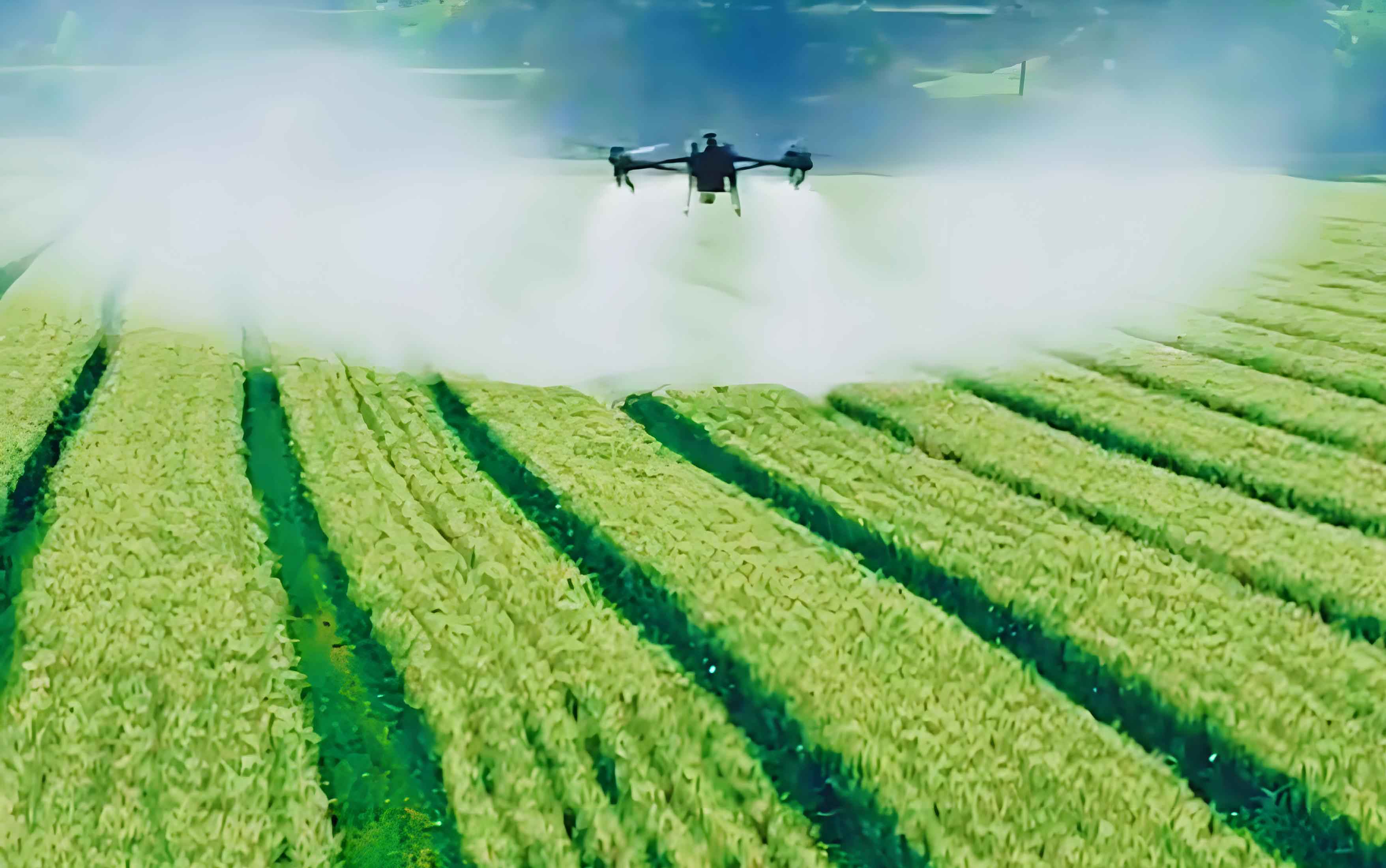
In modern agricultural production, the protection of staple crops like maize from pests and diseases is paramount for ensuring yield and quality. Traditional methods of chemical application, often reliant on backpack sprayers or tractor-mounted equipment, present significant challenges. These include high labor intensity, uneven chemical distribution, low operational efficiency, and potential health risks to operators due to direct exposure. The advent of the agricultural UAV (Unmanned Aerial Vehicle), or crop-spraying drone, has revolutionized this domain. Agricultural UAVs offer unparalleled operational flexibility, high spraying efficiency, and most importantly, enhance the safety of personnel by removing them from direct contact with chemicals. This technology represents a significant step forward in precision agriculture, promising better economic and environmental outcomes.
The core principle of an agricultural UAV involves carrying a payload tank and a precision spraying system. It is typically equipped with advanced navigation systems, such as GPS and RTK, for autonomous flight along pre-programmed routes. The spraying mechanism, often a set of centrifugal or pressure nozzles, generates fine droplets. A critical aerodynamic feature is the downwash airflow created by the UAV’s rotors. This downward force helps to press the spray cloud into the crop canopy, improving droplet penetration and deposition on the underside of leaves, which are common pest habitats. The effectiveness of this process, and consequently the quality of crop protection, is highly sensitive to the operational parameters of the agricultural UAV, primarily its flight altitude and forward speed. Selecting inappropriate parameters can lead to suboptimal droplet deposition, resulting in poor pest control, chemical waste, or environmental contamination through drift. Therefore, a systematic investigation into the influence of these parameters is essential for optimizing agricultural UAV applications in maize fields.
Advantages of Agricultural UAVs in Crop Protection
The integration of agricultural UAV technology brings forth a multitude of benefits over conventional methods:
- Autonomous and Precise Operation: Agricultural UAVs can operate autonomously following pre-defined flight paths. Operators use ground control station (GCS) software to map field boundaries and plan efficient routes. The UAV then executes the mission with high spatial accuracy, ensuring uniform coverage and minimizing missed or overlapped areas.
- High Efficiency and Safety: The operational speed and swath width of an agricultural UAV far exceed manual methods. For instance, a typical model can cover 8-10 hectares per hour. Crucially, it isolates the human operator from the hazardous spraying environment, significantly reducing the risk of pesticide exposure.
- Resource Conservation (Water and Chemicals): Agricultural UAVs employ ultra-low volume (ULV) or low volume (LV) spraying techniques, which use much finer droplets and significantly less carrier water (often 90-95% less) compared to high-volume traditional sprays. The enhanced targeting and canopy penetration can also lead to a reduction in the total volume of active ingredient required, typically saving 20-30% of chemicals while maintaining efficacy.
- Superior Application Quality and Efficacy: The combination of fine droplet generation and rotor downwash facilitates excellent droplet distribution and deposition within the dense maize canopy. Higher droplet density on target surfaces translates directly to improved biological efficacy against pests and diseases.
Experimental Analysis of Flight Parameters on Application Quality
To quantitatively assess the impact of flight parameters, a controlled field experiment was designed and executed. The primary metrics for evaluating agricultural UAV spray quality are Deposition Coverage Rate and Droplet Density.
1. Key Performance Indicators (KPIs):
- Deposition Coverage Rate (Dcr): This measures the percentage of the target leaf area effectively covered by spray droplets. For reliable pest control in maize, a minimum Dcr of 95% is generally required.
$$ D_{cr} = \frac{\sum_{i=1}^{4} (N_i \times i)}{N_{total} \times 4} \times 100\% $$
Where:- $N_1$: Number of sample cards with coverage < 25%
- $N_2$: Number of sample cards with coverage < 50%
- $N_3$: Number of sample cards with coverage < 75%
- $N_4$: Number of sample cards with coverage ≈ 100%
- $N_{total}$: Total number of sample cards observed
- $i$: Coverage grade (1 to 4)
- Droplet Density (Dd, in droplets/cm²): This is the average number of droplets deposited per unit area on the target surface. For low-volume sprays in maize, an optimal range is 25-45 droplets/cm². Density below this may lead to insufficient pest contact, while excessive density indicates wasteful overlap.
2. Influence of Flight Altitude (H)
Flight altitude, defined as the distance between the agricultural UAV’s spray release point and the top of the maize canopy, is a critical parameter. It directly affects the width of the spray swath, the intensity of the downwash airflow at the canopy level, and the potential for droplet evaporation and drift.
| Altitude Range (H) | Average Deposition Coverage Rate (Dcr) | Average Droplet Density (Dd, droplets/cm²) | Evaluation & Analysis |
|---|---|---|---|
| H < 1.8 m | ~98.0% | ~49.8 | Coverage: Excellent, meets the >95% requirement. Density: Too high, significantly above the 45 droplets/cm² upper threshold. This indicates severe droplet overlap and inefficient use of chemical, leading to waste and potential phytotoxicity risk. |
| 1.8 m ≤ H ≤ 2.3 m | ~96.2% | ~39.9 | Optimal Range. Both KPIs fall within the target specifications. Coverage is sufficient for effective pest control, and density is in the ideal range, ensuring efficient chemical use without significant waste. The downwash is effectively coupled with the canopy. |
| H > 2.3 m | ~92.3% | ~21.3 | Suboptimal. Coverage drops below the 95% threshold, compromising efficacy. Density falls below the 25 droplets/cm² minimum, indicating a sparse, ineffective spray pattern. Higher altitude leads to increased droplet evaporation, wider swath (potential gaps), and greater susceptibility to wind drift. |
The data clearly demonstrates a non-linear relationship between altitude and spray quality. The optimal altitude window of 1.8-2.3 meters balances sufficient canopy penetration and deposition force from the downwash with a droplet density that maximizes biological efficacy and chemical utilization. This can be conceptually modeled, where application quality $Q$ is a function of altitude $H$, with an optimal peak in the stated range:
$$ Q(H) = -k_1(H – H_{opt})^2 + Q_{max} $$
where $k_1$ is a constant related to environmental conditions, $H_{opt}$ is the optimal altitude (~2.0 m), and $Q_{max}$ is the maximum achievable quality.
3. Influence of Forward Speed (V)
The forward speed of the agricultural UAV determines the exposure time of a given crop area to the spray cloud. It directly influences the application rate (volume per hectare) and the spatial distribution of droplets.
| Speed Range (V) | Average Deposition Coverage Rate (Dcr) | Average Droplet Density (Dd, droplets/cm²) | Evaluation & Analysis |
|---|---|---|---|
| V < 3.5 m/s | ~98.5% | ~48.4 | Coverage: Excellent. Density: Excessive, similar to the very low altitude scenario. The slow speed results in a very high volume application per unit area, causing droplet runoff and waste. It also drastically reduces operational efficiency (area covered per hour). |
| 3.5 m/s ≤ V ≤ 6.5 m/s | ~97.5% | ~37.1 | Optimal Range. This speed range allows the spray system to deliver the correct volume per hectare to achieve both target coverage and ideal droplet density. It represents the best compromise between application quality and field operational efficiency for the agricultural UAV. |
| V > 6.5 m/s | ~88.5% | ~17.2 | Suboptimal. Excessive speed leads to poor outcomes. Coverage becomes inadequate as the spray cloud has insufficient time to settle onto the foliage. Droplet density plummets, failing to meet the minimum requirement for pest control. High speed also increases the risk of spray drift. |
The forward speed must be synchronized with the flow rate of the spray system to maintain a constant application volume per hectare. The relationship can be expressed as:
$$ R = \frac{q \times 600}{V \times W} $$
Where:
- $R$ is the application rate (L/ha)
- $q$ is the total flow rate from all nozzles (L/min)
- $V$ is the forward speed (m/s)
- $W$ is the effective swath width (m)
For a desired $R$ and a fixed $W$, increasing $V$ requires a proportional increase in $q$. However, nozzle technology limits how finely droplets can be produced at very high flow rates, often leading to larger, drift-prone droplets at excessive speeds. Therefore, the 3.5-6.5 m/s range is optimal for standard agricultural UAV spraying systems.
Interaction Effects and Parameter Optimization
While altitude and speed have been analyzed independently, in practice, they interact. For example, a higher flight altitude might be partially compensated for by a slower speed to increase droplet settlement time, but this interaction has limits and trade-offs with efficiency. The optimal operational “sweet spot” for an agricultural UAV in maize is therefore defined by a combination of parameters.
A generalized model for effective droplet deposition ($D_{eff}$) considering both major parameters and environmental wind speed ($W_s$) can be proposed:
$$ D_{eff} = \alpha \cdot \left(\frac{1}{H^β}\right) \cdot \left(\frac{1}{V^γ}\right) \cdot e^{-\delta \cdot W_s} + C $$
Where $\alpha, β, γ, \delta$ are empirical constants determined by the specific agricultural UAV model, nozzle type, and spray formulation, and $C$ is a baseline constant. $β$ and $γ$ are positive exponents, indicating the negative correlation of deposition with increasing $H$ and $V$ within the typical operational ranges.
The following matrix synthesizes the findings to guide parameter selection for an agricultural UAV in maize:
| Parameter | Recommended Range | Rationale & Impact | Consequence of Deviation |
|---|---|---|---|
| Flight Altitude (H) | 1.8 m – 2.3 m above crop canopy | Maximizes downwash force for canopy penetration while maintaining optimal droplet density (25-45 drops/cm²) and >95% coverage. Minimizes drift potential. | Too Low: Chemical waste, runoff risk. Too High: Poor coverage, low density, high drift. |
| Forward Speed (V) | 3.5 m/s – 6.5 m/s (approx. 12.6 – 23.4 km/h) | Ensures correct application rate and sufficient droplet settling time. Balances high-quality deposition with operational efficiency. | Too Slow: Extreme over-application, inefficiency. Too Fast: Inadequate coverage, very low density, high drift. |
| Parameter Synergy | H ≈ 2.0 m, V ≈ 5.0 m/s (as a starting point) | Represents a robust central point within both optimal ranges, providing a buffer against minor variations in crop height or field conditions. | Fine-tuning within the recommended ranges is necessary based on specific crop growth stage, density, and pest pressure. |
Conclusion
The agricultural UAV is a transformative tool for maize crop protection, offering a superior blend of efficiency, safety, and precision compared to traditional methods. However, its performance is not automatic; it is profoundly governed by key operational parameters. This analysis conclusively demonstrates that flight altitude and forward speed are primary determinants of spray application quality, quantified through deposition coverage rate and droplet density.
The experimental data and derived models establish clear optimal operational windows: a flight altitude of 1.8 to 2.3 meters above the maize canopy and a forward speed of 3.5 to 6.5 meters per second. Operating within these parameters ensures that the agricultural UAV delivers pesticide droplets with sufficient density and coverage to achieve effective pest and disease control, while simultaneously conserving chemicals, preventing environmental drift, and maintaining high field efficiency. Deviations outside these ranges lead to either wasteful over-application or ineffective under-application, both of which are economically and agronomically undesirable.
Therefore, for successful maize fly-and-protect operations, practitioners must prioritize the meticulous setting and real-time adjustment of these parameters. The recommended values serve as a foundational guideline, which should be further refined based on local conditions, specific agricultural UAV and nozzle characteristics, and the growth stage of the maize crop. By adhering to this science-based approach, the full potential of agricultural UAV technology can be realized, leading to more sustainable, productive, and profitable maize farming systems.