
In recent years, the advancement of multirotor drone technology has led to widespread applications in military and civilian fields, such as surveillance, delivery, and environmental monitoring. However, the limited energy density of conventional batteries restricts the flight time of multirotor drones, posing a significant challenge for long-duration missions. Laser wireless power transmission (LWPT) has emerged as a promising solution to extend the endurance of multirotor drones by providing continuous energy through laser beams. This study focuses on optimizing the laser power supply system for lightweight multirotor drones, specifically addressing the design of the receiver array and beam expansion-collimation system. We propose a comprehensive methodology to quantify power transmission losses and efficiency factors, utilizing joint simulations in Matlab and Simulink. By defining a scaling factor and decomposing total energy transfer efficiency into atmospheric transmission, truncation, Gaussian filling, and photoelectric conversion efficiencies, we aim to enhance the performance of laser-powered multirotor drones in hovering conditions.
The laser power supply system comprises a fiber-coupled semiconductor laser, a beam expansion-collimation system, a dual-axis tracker, and a photovoltaic (PV) receiver array mounted on the multirotor drone. The laser generates a Gaussian-distributed beam, which is expanded and collimated to reduce divergence over long distances. The dual-axis tracker ensures precise alignment with the multirotor drone, while the PV array converts optical energy into electrical power for charging the drone’s battery. This integrated approach allows for efficient energy transfer, addressing the critical limitation of battery capacity in multirotor drones.
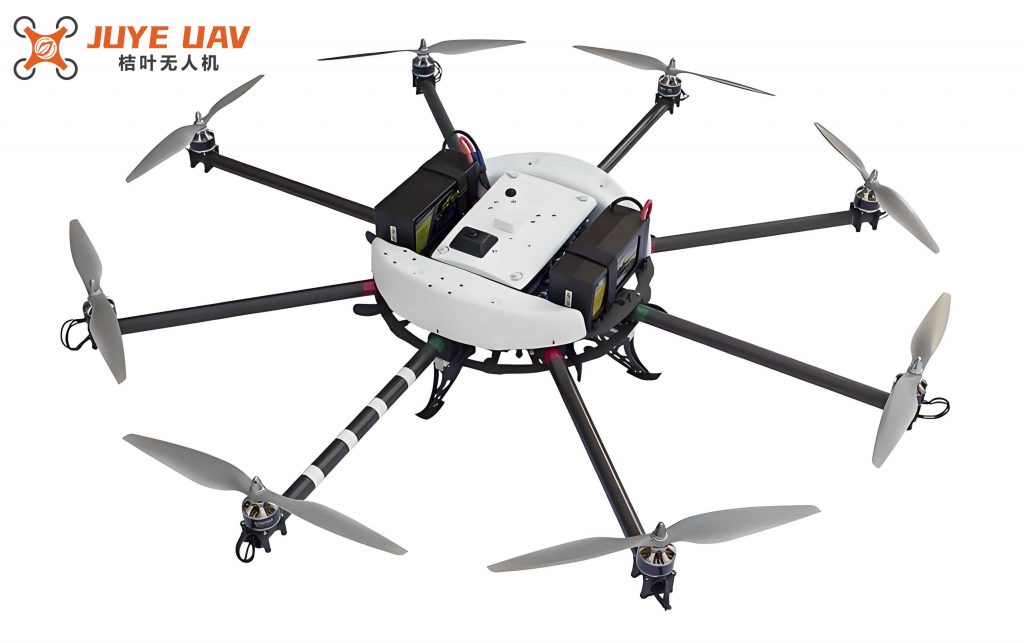
To design the receiver array for a multirotor drone, we consider a quadcopter with a frame axle distance of 450 mm, which is representative of common lightweight models. The design radius of the PV array, denoted as \( r_d \), is calculated to minimize aerodynamic interference and ensure safety during operation. The formula for \( r_d \) is given by:
$$ r_d = \frac{d_f – k \cdot d_p}{2} $$
where \( d_f \) is the frame axle distance, \( d_p \) is the propeller diameter, and \( k \) is a safety coefficient set to 1.25 to provide adequate clearance. For our multirotor drone model, the parameters are summarized in Table 1.
| Parameter | Symbol | Value |
|---|---|---|
| Takeoff Weight | \( m \) | 1 kg |
| Frame Axle Distance | \( d_f \) | 450 mm |
| Propeller Diameter | \( d_p \) | 254 mm |
| Hovering Power | \( P_{\text{hover}} \) | 111.68 W |
Based on this, the PV array design radius is determined to be 6.71 cm, with a layout ratio of 5:1 for the array radius to battery unit length, optimizing optical reception efficiency. The PV array consists of gallium arsenide (GaAs) single-junction cells, each providing approximately 1 V at the maximum power point. Four quadrant sub-arrays are connected in series to output around 4 V, meeting the input requirements of a boost converter. The electrical model employs a five-parameter approach, incorporating experimental data to account for variations in series resistance, shunt resistance, and saturation current with incident irradiance. Temperature effects are modeled using simulation data from studies on heat dissipation with fins, ensuring accurate performance predictions under operational conditions.
The beam expansion-collimation system is designed to handle the output from a fiber-coupled semiconductor laser with a central wavelength of 808 nm and an output power of 500 W. Key parameters of the laser are listed in Table 2.
| Parameter | Symbol | Value |
|---|---|---|
| Output Optical Power | \( P_0 \) | 500 W |
| Central Wavelength | \( \lambda \) | 808 nm |
| Fiber Core Diameter | \( D_f \) | 400 μm |
| Numerical Aperture | NA | 0.22 |
The divergence half-angle of the laser beam exiting the fiber, \( \theta_f \), is calculated as:
$$ \theta_f = \arcsin\left(\frac{\text{NA}}{n_0}\right) $$
where \( n_0 = 1 \) for air, resulting in \( \theta_f = 0.22 \) rad. To achieve a smaller divergence angle for long-distance transmission, the beam is expanded and collimated. The magnification factor \( M_P \) relates the initial beam waist radius \( w_f \) (half the fiber core diameter) to the expanded beam waist radius \( w_0 \):
$$ M_P = \frac{w_0}{w_f} $$
The divergence half-angle after expansion, \( \theta’ \), is then:
$$ \theta’ = \frac{\theta_f}{M_P} $$
We define the scaling factor \( s \) as the ratio of the PV array design radius to the expanded beam waist radius:
$$ s = \frac{r_d}{w_0} $$
The beam waist radius at a distance \( \rho \) from the expansion lens, \( w(\rho) \), is given by:
$$ w(\rho) = w_0 + \rho \cdot \tan(\theta’) = \frac{r_d}{s} + \rho \cdot \tan\left( \frac{\theta_f \cdot w_f \cdot s}{r_d} \right) $$
The focal length \( f \) of the expansion lens is derived as:
$$ f = \frac{w_0 – w_f}{\tan(\theta_f)} $$
To ensure that over 99% of the beam energy is captured, the lens radius is set to four times the beam waist diameter, i.e., \( D_e = 4w_0 \). This design minimizes energy loss and aligns with the requirements for efficient power transmission to the multirotor drone.
The total energy transfer efficiency, \( \text{Eff}(\rho) \), is decomposed into four components: atmospheric transmission efficiency, truncation efficiency, Gaussian filling efficiency, and photoelectric conversion efficiency. This decomposition allows for a detailed analysis of power losses during transmission. The overall efficiency is expressed as:
$$ \text{Eff}(\rho) = \frac{P_{\text{out}}(\rho)}{P_0} = \text{Eff}_{\text{tran}}(\rho) \cdot \text{Eff}_{\text{cut}}(\rho) \cdot \text{Eff}_{\text{fill}}(\rho) \cdot \text{Eff}_{\text{PV}}(\rho) $$
Atmospheric transmission efficiency, \( \text{Eff}_{\text{tran}}(\rho) \), accounts for the attenuation of the laser beam through the air, modeled using an exponential decay function:
$$ \text{Eff}_{\text{tran}}(\rho) = \frac{P(\rho)}{P_0} = \exp(-a \cdot \rho) $$
where \( a = 8.447 \times 10^{-5} \, \text{m}^{-1} \) is the attenuation coefficient, derived from MODTRAN simulations under standard atmospheric conditions. This efficiency remains relatively high over short distances but decreases gradually with range.
Truncation efficiency, \( \text{Eff}_{\text{cut}}(\rho) \), represents the fraction of the transmitted power that falls within the PV array design radius \( r_d \). It is defined as:
$$ \text{Eff}_{\text{cut}}(\rho) = \frac{G(\rho, r_d)}{P(\rho)} = 1 – \exp\left( -\frac{2r_d^2}{w(\rho)^2} \right) $$
where \( G(\rho, r_d) \) is the power incident on the circular area of radius \( r_d \). This efficiency is highly dependent on the scaling factor \( s \) and the transmission distance \( \rho \).
Gaussian filling efficiency, \( \text{Eff}_{\text{fill}}(\rho) \), quantifies the proportion of energy captured by the actual PV array layout compared to the ideal circular area. It is computed as:
$$ \text{Eff}_{\text{fill}}(\rho) = \frac{G_{\text{in}}(\rho)}{G(\rho)} = \frac{\iint_D I(\rho, r, \theta) \, dA}{G(\rho)} $$
where \( I(\rho, r, \theta) \) is the irradiance distribution, and the integral is over the array domain \( D \). This efficiency accounts for geometric losses due to the discrete arrangement of PV cells.
Photoelectric conversion efficiency, \( \text{Eff}_{\text{PV}}(\rho) \), relates the electrical power output \( P_{\text{out}}(\rho) \) to the incident optical power on the array \( G_{\text{in}}(\rho) \):
$$ \text{Eff}_{\text{PV}}(\rho) = \frac{P_{\text{out}}(\rho)}{G_{\text{in}}(\rho)} $$
This efficiency is influenced by factors such as irradiance level and temperature, which are modeled using Simulink-based thermal-electrical simulations. For instance, higher irradiance increases output but may raise cell temperature, reducing efficiency slightly due to thermal effects.
To optimize the system, we analyze the relationship between truncation efficiency and the scaling factor \( s \) for a fixed PV array design radius \( r_d = 6.71 \, \text{cm} \). Figure 1 illustrates how \( \text{Eff}_{\text{cut}} \) varies with \( s \) at different transmission distances. The results show that for longer distances (e.g., beyond 100 m), truncation efficiency drops below 40%, highlighting the challenge of maintaining high efficiency in far-range operations for multirotor drones.
The optimal scaling factor \( s \) is determined by solving the derivative equation for \( \text{Eff}_{\text{cut}} \) with respect to \( s \). Setting \( \frac{d\text{Eff}_{\text{cut}}}{ds} = 0 \) yields:
$$ \frac{d\text{Eff}_{\text{cut}}}{ds} = \frac{4r_d^2}{w(\rho)^3} \cdot \exp\left( -\frac{2r_d^2}{w(\rho)^2} \right) \cdot \left[ -\frac{r_d}{s^2} + \frac{\rho \cdot \theta_f \cdot w_f}{r_d} \cdot \sec^2\left( \frac{\theta_f \cdot w_f \cdot s}{r_d} \right) \right] = 0 $$
This simplifies to the transcendental equation:
$$ s = \frac{r_d}{\rho \cdot \theta_f \cdot w_f} \cdot \cos\left( \frac{\theta_f \cdot w_f \cdot s}{r_d} \right) $$
Numerical solutions for a design transmission distance of \( \rho = 30 \, \text{m} \) give \( s = 1.84 \), corresponding to an expanded beam waist radius of \( w_0 = 3.65 \, \text{cm} \) and a truncation efficiency of 81.58%. This optimization ensures that the laser spot size matches the PV array dimensions effectively, maximizing energy capture for the multirotor drone.
We further evaluate the power transmission losses and efficiencies across distances from 5 m to 100 m. The contributions of each loss type to the total energy are summarized in Figure 2, while Figure 3 plots the individual efficiencies versus distance. Atmospheric transmission loss is minimal, but truncation loss dominates, especially as distance increases. Gaussian filling efficiency decreases with beam expansion, whereas photoelectric conversion efficiency improves slightly due to reduced irradiance and lower cell temperatures. However, beyond 49.5 m, the electrical power output falls below the hovering power requirement of 111.68 W for the multirotor drone, indicating the need for higher-power lasers or larger PV arrays for extended-range applications.
| Distance \( \rho \) (m) | Atmospheric Efficiency | Truncation Efficiency | Gaussian Filling Efficiency | Photoelectric Efficiency | Total Efficiency |
|---|---|---|---|---|---|
| 5 | 0.9996 | 0.950 | 0.980 | 0.550 | 0.512 |
| 30 | 0.9975 | 0.816 | 0.950 | 0.560 | 0.441 |
| 50 | 0.9958 | 0.650 | 0.920 | 0.565 | 0.336 |
| 100 | 0.9916 | 0.350 | 0.850 | 0.570 | 0.168 |
The analysis demonstrates that truncation efficiency is the most critical factor in determining the overall performance of the laser power supply system for multirotor drones. As transmission distance increases, the beam expands, reducing the fraction of energy captured by the PV array. This underscores the importance of optimizing the scaling factor and PV array design to achieve practical energy transfer for multirotor drones in various operational scenarios.
In conclusion, our study presents an optimized design for laser power supply systems in lightweight multirotor drones, emphasizing the role of the scaling factor in maximizing efficiency. By decomposing total efficiency into distinct components and using numerical simulations, we provide a framework for assessing and improving laser-based energy transmission. The results indicate that for multirotor drones, truncation efficiency limits long-distance performance, necessitating careful system design. Future work could focus on adaptive focal length adjustment systems to maintain optimal truncation efficiency across varying distances, further enhancing the viability of laser-powered multirotor drones for extended missions. This approach is generalizable to other moving targets and Gaussian beam profiles, offering broad applicability in wireless power transmission technologies.