
In the context of smart agriculture, the use of VTOL drones for rapid crop information acquisition has become a mainstream approach. These VTOL drones combine the advantages of fixed-wing and multi-rotor configurations, enabling high-speed horizontal cruising and vertical take-off and landing in complex terrains like hilly and mountainous areas. However, existing VTOL drones often rely on control surfaces for attitude transition, which can lead to instability. To address this issue and meet the demands of low-altitude remote sensing in agriculture, this study focuses on optimizing the propeller installation position to minimize aerodynamic interference. The core innovation involves designing a vector bracket that connects the propeller to the drone’s tail, allowing for adjustable propeller orientation to facilitate vertical-to-horizontal or horizontal-to-vertical transitions. Since the propeller and vector bracket interact aerodynamically, determining their relative position is crucial for reducing such interference and enhancing overall performance. This research employs computational fluid dynamics (CFD) simulations, coupled with surrogate modeling and multi-objective optimization algorithms, to identify the optimal installation height for the support rod in the vector bracket. The findings aim to improve the thrust coefficient of the propeller and the lift-to-drag ratio of the VTOL drone, ensuring stable and efficient operation during agricultural missions.
The design of VTOL drones is pivotal for applications in precision agriculture, where efficient data collection over large areas is required. Traditional fixed-wing drones excel in high-speed cruising but struggle in confined or uneven terrains, while multi-rotor drones offer excellent maneuverability at the cost of limited endurance and speed. VTOL drones bridge this gap, but their aerodynamic performance can be compromised by interactions between components, such as the propeller and airframe. In this study, we investigate a pusher-propeller configuration integrated with a vector bracket to mitigate these issues. The vector bracket consists of components like support rods, linkages, and servos, enabling dynamic adjustment of the propeller’s angle. However, the proximity of the propeller to the bracket introduces aerodynamic disturbances, affecting both the propeller’s thrust generation and the drone’s overall lift and drag characteristics. Therefore, optimizing the support rod height—defined as the distance between the propeller and the drone’s tail—is essential to balance these effects. We explore a range of heights from 40 mm to 200 mm, based on prior research on propeller-airframe interactions, and use advanced numerical methods to model and optimize the system. This approach ensures that the VTOL drone achieves superior aerodynamic efficiency, crucial for prolonged flight missions in agricultural settings.
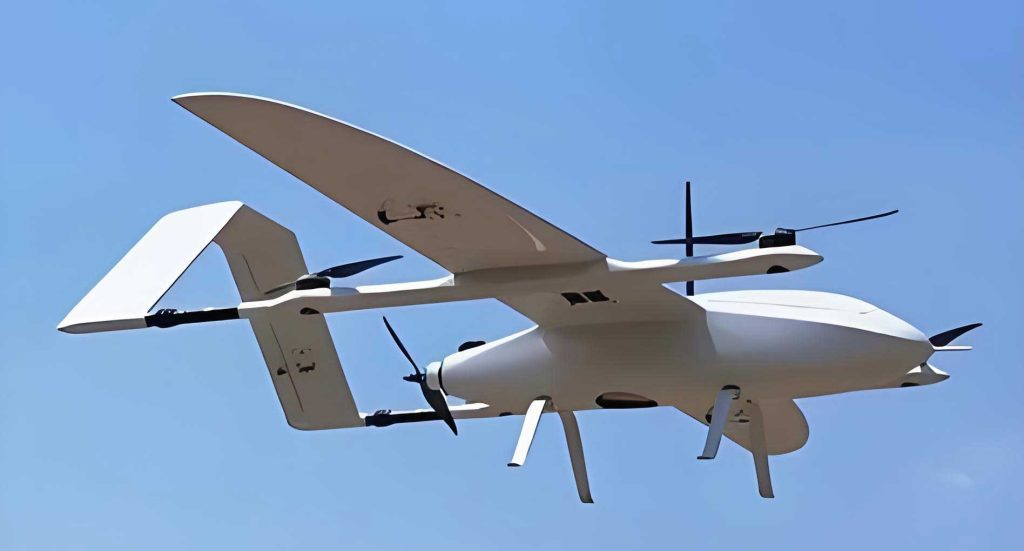
To begin, we developed a computational model of the VTOL drone, which features a flying-wing layout with a single pusher propeller mounted via the vector bracket at the rear. The drone has a total length of 1.2 meters, with symmetric wings and winglets. The vector bracket includes a support rod that connects the motor and propeller to the airframe, and its height is the primary variable in this optimization. We selected 11 sample points for the support rod height within the 40–200 mm range to ensure adequate coverage for modeling. The aerodynamic properties of interest are the lift-to-drag ratio of the VTOL drone and the thrust coefficient of the propeller, both of which are critical for performance evaluation. The lift-to-drag ratio, denoted as $L/D$, indicates the aerodynamic efficiency of the VTOL drone, while the thrust coefficient, $C_T$, measures the propeller’s effectiveness in generating thrust. These parameters are calculated using CFD simulations under specific operating conditions: an inflow velocity of 20 m/s, an angle of attack of 4°, and a propeller rotational speed of 6,000 revolutions per minute. The computational domain is constructed with a static region surrounding the airframe and a dynamic region encapsulating the propeller to account for rotational effects. Mesh refinement is applied near the wing and propeller surfaces to capture boundary layer details, resulting in a total grid count of approximately 700,404 elements with satisfactory quality metrics.
The optimization methodology combines Kriging surrogate modeling and multi-objective genetic algorithms (MOGA). Kriging is a statistical interpolation technique that constructs a response surface based on sample data, allowing for predictions of aerodynamic responses at unsampled points. The Kriging model assumes that the response $y(x)$ can be expressed as a combination of a global polynomial trend $f(x)$ and a local deviation $Z(x)$ following a Gaussian process:
$$y(x) = f(x) + Z(x)$$
Here, $x$ represents the design variable (support rod height), and $Z(x)$ has zero mean and a covariance defined by:
$$\text{Cov}[Z(x_i), Z(x_j)] = \sigma^2 R([r(x_i, x_j)])$$
where $\sigma^2$ is the variance, $R$ is the correlation matrix, and $r(x_i, x_j)$ is the Gaussian correlation function:
$$r(x_i, x_j) = \exp\left[-\sum_{k=1}^{M} \theta_k |x_i^k – x_j^k|^2\right]$$
In this case, $M=1$ since we have a single variable, and $\theta_k$ are parameters fitted to the data. We use the sample points to build separate Kriging models for the lift-to-drag ratio and thrust coefficient of the VTOL drone. These models are then used as objective functions in a multi-objective genetic algorithm, specifically the NSGA-II (Non-dominated Sorting Genetic Algorithm II), which searches for Pareto-optimal solutions that maximize both objectives. The MOGA parameters include a population size of 100, 100 generations, a mutation rate of 0.01, and a crossover rate of 0.98, with single-point crossover and simple mutation operators. This approach enables efficient global optimization without requiring exhaustive CFD simulations.
Before proceeding with the optimization, we validated the CFD methodology to ensure reliability. For the propeller, we used a standard two-blade model (APC Slow Flyer with a diameter of 254 mm) and compared simulated thrust coefficients against wind tunnel data from previous studies. The thrust coefficient is calculated as:
$$C_T = \frac{T}{\rho n^2 D^4}$$
where $T$ is the thrust, $\rho$ is air density, $n$ is the rotational speed in rev/s, and $D$ is the propeller diameter. As shown in Table 1, the CFD results show minimal error compared to experimental data, with an average error of 1.56% across speeds from 4,000 to 6,000 rev/min, confirming the accuracy of the Moving Reference Frame (MRF) method used for propeller simulation.
| Rotational Speed (rev/min) | Experimental $C_T$ | CFD $C_T$ | Error (%) |
|---|---|---|---|
| 4,000 | 0.058 | 0.0579 | 0.2 |
| 5,000 | 0.055 | 0.0536 | 2.5 |
| 6,000 | 0.052 | 0.0518 | 0.4 |
For the VTOL drone airframe, we validated the lift-to-drag ratio against wind tunnel tests at Reynolds numbers ranging from 350,000 to 750,000. The results, summarized in Table 2, indicate an average error of 0.7%, demonstrating that the CFD setup accurately captures the aerodynamic behavior of the VTOL drone.
| Reynolds Number | Experimental $L/D$ | CFD $L/D$ | Error (%) |
|---|---|---|---|
| 350,000 | 6.50 | 6.55 | 0.8 |
| 550,000 | 7.00 | 7.01 | 0.1 |
| 750,000 | 7.20 | 7.14 | 0.8 |
With the validated CFD approach, we conducted simulations for the 11 sample points of support rod height. The results reveal clear trends in the aerodynamic responses. As the support rod height increases, the lift-to-drag ratio of the VTOL drone improves gradually, while the thrust coefficient of the propeller decreases sharply. This is because a smaller height leads to stronger aerodynamic interference between the propeller and the vector bracket, reducing the efficiency of the VTOL drone. Conversely, a larger height reduces interference but also diminishes the propeller’s thrust due to decreased interaction with the airframe’s wake. To quantify these effects, we present the data in Table 3, which summarizes the simulated lift-to-drag ratios and thrust coefficients for each sample point.
| Support Rod Height (mm) | Lift-to-Drag Ratio ($L/D$) | Thrust Coefficient ($C_T$) |
|---|---|---|
| 40 | 6.57 | 0.056 |
| 50 | 6.65 | 0.054 |
| 60 | 6.78 | 0.053 |
| 70 | 6.92 | 0.052 |
| 80 | 7.00 | 0.051 |
| 90 | 7.05 | 0.050 |
| 100 | 7.10 | 0.049 |
| 120 | 7.15 | 0.048 |
| 140 | 7.18 | 0.047 |
| 160 | 7.20 | 0.046 |
| 200 | 7.21 | 0.044 |
Based on this data, we constructed Kriging models to approximate the relationships between support rod height and the two objectives. The models are expressed as continuous functions, allowing for interpolation and optimization. For the lift-to-drag ratio of the VTOL drone, the Kriging model shows a monotonically increasing trend, while for the thrust coefficient, it shows a decreasing trend. We then applied the NSGA-II algorithm to these models to find the optimal support rod height that maximizes both the lift-to-drag ratio and thrust coefficient simultaneously. The optimization process iteratively evaluates candidate solutions, and after 100 generations, it converges to a Pareto front. From this front, we selected the solution that offers the best compromise between the two objectives. The optimal support rod height is determined to be 67.9 mm. At this height, the predicted lift-to-drag ratio is 7.0264, and the thrust coefficient is 0.052669. We verified this result with an additional CFD simulation, which yielded values of 7.01 for $L/D$ and 0.0526 for $C_T$, confirming the accuracy of the Kriging model with errors less than 0.2%.
To assess the improvement, we compared the optimal configuration with three original models at support rod heights of 40 mm, 106 mm, and 200 mm. The average lift-to-drag ratio across these original models is 6.957, and the average thrust coefficient is 0.05. The optimization results in a 1% increase in lift-to-drag ratio and a 5.33% increase in thrust coefficient, as detailed in Table 4. This demonstrates that the optimized installation position significantly enhances the performance of the VTOL drone.
| Parameter | Original Model 1 (40 mm) | Original Model 2 (106 mm) | Original Model 3 (200 mm) | Optimal Point (67.9 mm) | Improvement (%) |
|---|---|---|---|---|---|
| Support Rod Height (mm) | 40 | 106 | 200 | 67.9 | N/A |
| Lift-to-Drag Ratio ($L/D$) | 6.57 | 7.20 | 7.10 | 7.0264 | 1.0 (average) |
| Thrust Coefficient ($C_T$) | 0.056 | 0.05 | 0.044 | 0.052669 | 5.33 (average) |
The aerodynamic analysis provides insights into why this optimal height works well. At lower support rod heights, the propeller is too close to the vector bracket, causing intense aerodynamic interference that disrupts airflow over the VTOL drone’s wings and increases drag. This reduces the lift-to-drag ratio, compromising the efficiency of the VTOL drone. Additionally, the propeller operates in a region influenced by the airframe’s wake, which can enhance thrust due to pressure interactions but at the cost of increased instability. At higher heights, the interference diminishes, allowing for smoother airflow and a better lift-to-drag ratio. However, the propeller becomes more exposed to freestream conditions, reducing its thrust coefficient because it loses the beneficial effects of the airframe’s proximity. The optimal height of 67.9 mm strikes a balance, minimizing interference while maintaining sufficient thrust generation. This is crucial for VTOL drones, which require both efficient cruising and powerful vertical lift capabilities.
Further discussion involves the implications for VTOL drone design in agricultural applications. The optimized propeller installation position ensures stable attitude transitions without relying heavily on control surfaces, reducing the risk of instability during vertical take-off and landing. This is particularly important in windy conditions or uneven terrains common in farming areas. Moreover, the improved aerodynamic efficiency translates to longer flight endurance and better payload capacity, enabling VTOL drones to cover larger fields and carry advanced sensors for crop monitoring. The use of surrogate modeling and genetic algorithms also highlights a cost-effective approach to design optimization, as it reduces the need for extensive physical testing. Future work could explore additional variables, such as the propeller’s tilt angle or the shape of the vector bracket, to further enhance the performance of VTOL drones. Integrating real-time adjustment mechanisms based on flight conditions could also be investigated to adapt the propeller position dynamically.
In conclusion, this study successfully optimized the propeller installation position for a VTOL drone by analyzing the aerodynamic interference between the propeller and a vector bracket. Through CFD simulations, Kriging modeling, and multi-objective genetic algorithms, we determined that a support rod height of 67.9 mm maximizes both the lift-to-drag ratio of the VTOL drone and the thrust coefficient of the propeller. Compared to baseline configurations, this optimization yields a 1% increase in lift-to-drag ratio and a 5.33% increase in thrust coefficient, significantly enhancing the overall performance of the VTOL drone. These improvements contribute to more stable and efficient operations, making VTOL drones better suited for agricultural low-altitude remote sensing tasks. The methodologies developed here can be extended to other VTOL drone designs, promoting advancements in unmanned aerial vehicle technology for precision agriculture and beyond.