
In recent years, the adoption of agricultural UAVs, or unmanned aerial vehicles, has revolutionized precision agriculture, offering a transformative approach to crop protection. As a researcher focused on advancing sustainable farming practices, I have been particularly interested in how these aerial systems can be optimized for specific crops like tobacco. Tobacco, being a high-value economic crop, requires meticulous pest and disease management throughout its growth stages to ensure yield and quality. Traditional spraying methods are often inefficient, with low deposition rates on target areas and significant environmental and health risks. Therefore, my work aims to explore and define the optimal operational parameters for agricultural UAVs in tobacco fields, leveraging modern experimental designs to enhance droplet deposition and minimize resource use.
The core of this study revolves around a systematic investigation into how flight height, flight speed, and application rate influence droplet distribution across different tobacco growth stages: the root extension stage, fast growth stage, and maturity stage. Using a multi-rotor electric agricultural UAV, I conducted a series of field experiments to gather data on droplet coverage, density, and deposition amount. This research not only seeks to provide practical guidelines for UAV operators but also contributes to the broader understanding of aerial application technologies in diverse cropping systems. By integrating statistical analysis with field observations, I hope to establish a foundation for standardized spraying protocols that maximize efficacy while reducing chemical inputs and crop damage.
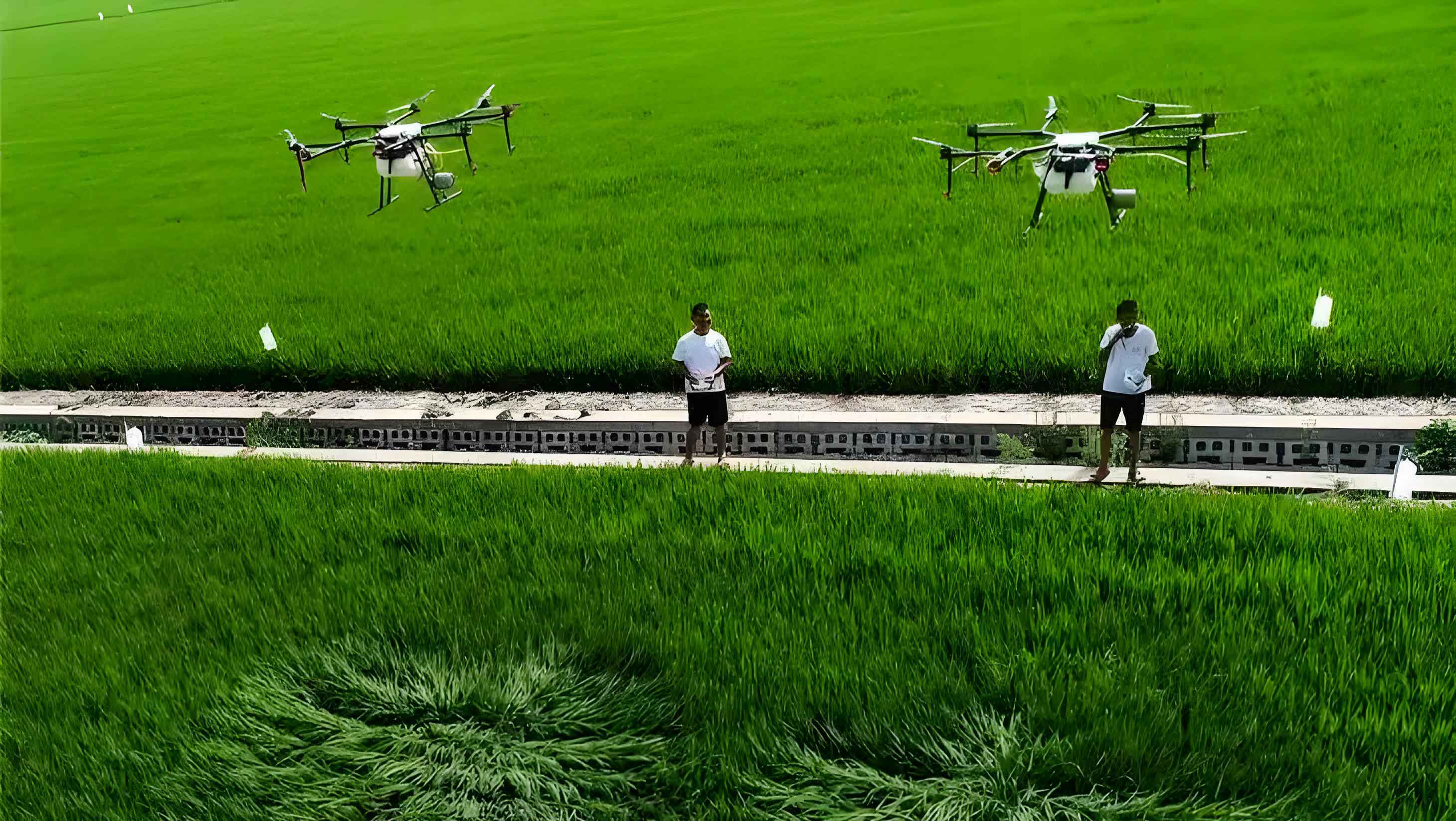
Agricultural UAVs have gained prominence due to their flexibility, efficiency, and ability to operate in challenging terrains, making them ideal for tobacco fields that often feature varied topography. However, without optimized parameters, the performance of an agricultural UAV can be suboptimal, leading to uneven spray distribution, increased drift, and potential leaf damage. In this study, I employed a three-factor, three-level orthogonal experimental design to methodically vary flight height, flight speed, and application rate. This approach allows for a comprehensive analysis of each factor’s impact and their interactions, enabling the identification of the best combinations for each growth stage. The use of an orthogonal design is particularly advantageous as it reduces the number of experimental runs while maintaining statistical robustness, a key consideration in field research where conditions can be unpredictable.
To quantify spray performance, I measured droplet coverage, droplet density, and deposition amount using water-sensitive papers and filter papers treated with a tracer dye. The deposition amount was calculated using a standard formula derived from spectrophotometric analysis. The formula is central to understanding how operational parameters affect chemical delivery:
$$ \beta_{dep} = \frac{(\rho_{smpl} – \rho_{blk}) \times F_{cal} \times V_{dil}}{\rho_{spray} \times A_{col}} $$
where \(\beta_{dep}\) represents the deposition amount in μL/cm², \(\rho_{smpl}\) is the sample absorbance, \(\rho_{blk}\) is the blank absorbance, \(F_{cal}\) is the calibration curve slope, \(V_{dil}\) is the elution volume in mL, \(\rho_{spray}\) is the spray solution absorbance, and \(A_{col}\) is the collection area in cm². This equation underscores the precision required in evaluating agricultural UAV applications, as even minor changes in parameters can significantly alter \(\beta_{dep}\).
The orthogonal experimental scheme included nine treatment combinations, as summarized in Table 1. Each combination was tested in triplicate across different tobacco growth stages to ensure reliability. The factors and levels were chosen based on preliminary trials and existing literature on agricultural UAV operations, aiming to cover a realistic range used in commercial settings.
| Test Number | Flight Height (m) | Flight Speed (m/s) | Application Rate (L/ha) | Treatment Code |
|---|---|---|---|---|
| T1 | 3 | 3 | 15 | A1B1C1 |
| T2 | 3 | 4 | 22.5 | A1B2C2 |
| T3 | 3 | 5 | 30 | A1B3C3 |
| T4 | 4 | 3 | 22.5 | A2B1C2 |
| T5 | 4 | 4 | 30 | A2B2C3 |
| T6 | 4 | 5 | 15 | A2B3C1 |
| T7 | 5 | 3 | 30 | A3B1C3 |
| T8 | 5 | 4 | 15 | A3B2C1 |
| T9 | 5 | 5 | 22.5 | A3B3C2 |
Field trials were conducted under controlled environmental conditions, with wind speeds below 3.2 m/s to minimize drift effects. The agricultural UAV was equipped with standard nozzles and calibrated before each run to ensure consistency. Data collection involved placing sampling cards at strategic positions within the tobacco canopy, followed by laboratory analysis using image processing software and a microplate reader. This meticulous process allowed me to capture subtle variations in spray patterns attributable to different parameter sets.
Results from the root extension stage revealed that flight speed had the most significant influence on droplet coverage and deposition amount, followed by application rate and flight height. The optimal combination for this stage was a flight height of 3 meters, a flight speed of 4 m/s, and an application rate of 15 L/ha. This configuration achieved a balance between adequate deposition and minimal leaf damage, as tobacco leaves at this stage are relatively resilient but still susceptible to physical stress from the agricultural UAV’s downwash. The droplet coverage averaged 6.53%, with a density of 34.0 droplets/cm² and a deposition amount of 0.312 μL/cm² for the best treatment.
In the fast growth stage, the canopy becomes denser, requiring adjustments to ensure penetration. Here, flight height emerged as the primary factor affecting spray distribution, with application rate and flight speed playing secondary roles. The recommended parameters were a flight height of 3 meters, a flight speed of 5 m/s, and an application rate of 15 L/ha. Interestingly, increasing the flight speed to 5 m/s did not compromise efficacy, likely due to the enhanced airflow from the agricultural UAV at lower heights, which improved droplet dispersion within the canopy. This highlights the adaptability of agricultural UAVs to different growth phases when parameters are finely tuned.
The maturity stage presented unique challenges, as tobacco leaves are larger, more fragile, and prone to damage. In this case, application rate was the dominant factor, with flight height and speed having lesser impacts. The ideal setup involved a flight height of 5 meters, a flight speed of 4 m/s, and an application rate of 30 L/ha. Higher flight heights reduced leaf loss rates, which is critical for preserving yield, while the increased application rate compensated for the greater canopy volume. This underscores the importance of stage-specific optimization for agricultural UAV operations, as one-size-fits-all approaches can lead to suboptimal outcomes.
To further validate these findings, I conducted additional tests to determine the effective spray width of the agricultural UAV in tobacco fields. Using water, pesticide, and pesticide with adjuvant, I measured droplet density at various distances from the flight line. The results, summarized in Table 2, show that the effective spray width ranged from 3 to 4 meters under typical operating conditions, which is narrower than manufacturer specifications. This discrepancy emphasizes the need for field-based calibration of agricultural UAVs to avoid gaps in coverage and ensure uniform pest control.
| Flight Height (m) | Treatment | Droplet Density (droplets/cm²) at Distance from Flight Path (m) | ||||||
|---|---|---|---|---|---|---|---|---|
| 0 | 1 | 2 | 3 | 4 | 5 | 6 | ||
| 3 | Water | 58.00 | 19.00 | 17.73 | 9.07 | 7.57 | 2.97 | 2.13 |
| Pesticide | 30.13 | 27.97 | 9.23 | 5.33 | 6.43 | 3.77 | 1.70 | |
| Pesticide + Adjuvant | 39.10 | 36.13 | 7.40 | 4.67 | 4.50 | 1.67 | 1.70 | |
| 4 | Water | 50.50 | 50.93 | 21.37 | 6.90 | 2.40 | 1.40 | 4.77 |
| Pesticide | 55.37 | 23.37 | 11.27 | 13.83 | 9.33 | 7.27 | 8.83 | |
| Pesticide + Adjuvant | 119.70 | 68.00 | 14.37 | 5.37 | 2.37 | 1.67 | 2.23 | |
| 5 | Water | 100.13 | 16.90 | 15.23 | 11.30 | 11.27 | 7.27 | 4.87 |
| Pesticide | 112.50 | 17.73 | 9.43 | 9.64 | 6.36 | 5.15 | 2.13 | |
| Pesticide + Adjuvant | 117.73 | 88.40 | 6.53 | 6.53 | 5.31 | 4.63 | 5.12 | |
The data from Table 2 can be modeled using a decay function to predict droplet density over distance, which is useful for planning flight paths. A simplified equation for droplet density \(D\) as a function of distance \(x\) from the flight line might be:
$$ D(x) = D_0 \cdot e^{-kx} $$
where \(D_0\) is the initial density at \(x = 0\) and \(k\) is a decay constant dependent on flight height and treatment type. For instance, at a flight height of 5 meters with pesticide plus adjuvant, \(D_0\) approximates 117.73 droplets/cm², and \(k\) can be derived from the values at \(x = 1\) m and \(x = 6\) m. This mathematical approach helps in optimizing the overlap between adjacent swaths when using an agricultural UAV, ensuring complete coverage without excessive overlap that wastes chemicals.
Beyond the primary parameters, I also explored the role of environmental factors such as wind speed and humidity. While these were controlled in my experiments, they are critical in real-world applications of agricultural UAVs. For example, higher wind speeds can increase drift, reducing deposition on target areas. A modified deposition model incorporating wind effects could be expressed as:
$$ \beta_{dep,adj} = \beta_{dep} \cdot \left(1 – \alpha \cdot v\right) $$
where \(\beta_{dep,adj}\) is the adjusted deposition amount, \(v\) is the wind speed in m/s, and \(\alpha\) is an empirical coefficient specific to the agricultural UAV and nozzle type. This highlights the need for adaptive systems in agricultural UAVs that can adjust parameters in real-time based on sensor data, a direction for future research.
The integration of adjuvants in spray solutions is another area of interest. In my tests, adding an adjuvant increased droplet density near the flight line but did not significantly expand the effective spray width. However, it improved overall deposition uniformity, which can enhance pesticide efficacy. This suggests that adjuvant use should be considered part of the parameter optimization process for agricultural UAVs, especially for hydrophobic leaf surfaces like those of tobacco.
Comparing my findings with studies on other crops, such as rice or wheat, reveals both similarities and differences. For instance, in rice, lower flight heights often improve deposition due to the dense canopy, similar to tobacco in the fast growth stage. However, tobacco’s leaf fragility necessitates higher flight heights at maturity, a factor less critical in grain crops. This underscores the crop-specific nature of agricultural UAV optimization and the importance of tailored research.
To synthesize the results across growth stages, I developed a comprehensive table (Table 3) summarizing the optimal parameters and key performance indicators. This table serves as a quick reference for practitioners looking to deploy agricultural UAVs in tobacco fields.
| Growth Stage | Optimal Flight Height (m) | Optimal Flight Speed (m/s) | Optimal Application Rate (L/ha) | Average Droplet Coverage (%) | Average Droplet Density (droplets/cm²) | Average Deposition Amount (μL/cm²) | Leaf Loss Rate (‰) |
|---|---|---|---|---|---|---|---|
| Root Extension | 3 | 4 | 15 | 6.53 | 34.0 | 0.312 | 7.23 |
| Fast Growth | 3 | 5 | 15 | 9.01 | 66.9 | 0.544 | 8.89 |
| Maturity | 5 | 4 | 30 | 6.26 | 138.6 | 0.599 | 7.22 |
The leaf loss rate is an often-overlooked metric in agricultural UAV studies, but it is crucial for tobacco due to its leaf-based harvest. My data shows that lower flight heights correlate with higher leaf damage, particularly in later growth stages. Thus, trade-offs between deposition efficiency and physical crop protection must be managed. This can be formulated as an optimization problem:
$$ \text{Maximize } Z = w_1 \cdot \beta_{dep} + w_2 \cdot (1 – L) $$
where \(Z\) is the overall performance score, \(w_1\) and \(w_2\) are weights assigned to deposition amount and leaf loss rate \(L\), respectively, based on economic priorities. For tobacco, \(w_2\) might be higher during maturity to preserve leaf quality, guiding parameter selection for the agricultural UAV.
Looking ahead, there are several avenues to enhance agricultural UAV technologies for tobacco. First, the development of variable-rate spraying systems that adjust application rates based on canopy density, sensed via onboard LiDAR or multispectral cameras, could improve resource use. Second, advanced nozzle designs that produce more uniform droplet spectra may reduce drift and increase target deposition. Third, machine learning algorithms could analyze historical data to predict optimal parameters for specific field conditions, making agricultural UAV operations more intelligent and adaptive.
In conclusion, this research demonstrates that agricultural UAVs can be effectively optimized for tobacco field spraying by carefully selecting flight height, flight speed, and application rate according to growth stage. The recommended parameters—3 m height, 4 m/s speed, and 15 L/ha for root extension; 3 m height, 5 m/s speed, and 15 L/ha for fast growth; and 5 m height, 4 m/s speed, and 30 L/ha for maturity—provide a solid foundation for efficient and sustainable pest control. Additionally, setting the spray width to 3-4 meters ensures adequate coverage without overlap. As agricultural UAVs continue to evolve, ongoing research and field validation will be essential to refine these guidelines and integrate new technologies, ultimately supporting the broader adoption of precision agriculture in tobacco and beyond.
The potential of agricultural UAVs extends beyond mere parameter optimization; they represent a shift towards data-driven farming. By coupling my findings with real-time monitoring systems, farmers can achieve unprecedented levels of control over crop protection. For instance, deploying an agricultural UAV with the parameters I identified, while using IoT sensors to track microclimatic conditions, could dynamically adjust flights to avoid adverse weather, minimizing drift and maximizing efficacy. This holistic approach underscores the transformative power of agricultural UAVs in modern agriculture.
Moreover, economic analyses should accompany technical recommendations. The cost savings from reduced chemical use and labor, combined with yield preservation from minimized leaf damage, can make agricultural UAVs a viable investment for tobacco growers. Future studies could quantify these benefits, perhaps through a formula like:
$$ \text{Net Benefit} = (Y \cdot P) – (C_{chem} + C_{UAV} + C_{lab}) $$
where \(Y\) is yield, \(P\) is price, and \(C\) terms represent costs of chemicals, UAV operation, and labor. Optimizing agricultural UAV parameters directly influences \(Y\) and \(C_{chem}\), highlighting the practical importance of this work.
In summary, my journey into optimizing agricultural UAVs for tobacco has revealed the intricate balance between operational parameters and biological responses. Through rigorous experimentation and analysis, I have provided actionable insights that bridge the gap between technology and agronomy. As I continue to explore this field, I am excited by the prospects of further innovations that will make agricultural UAVs even more integral to sustainable crop production worldwide.