
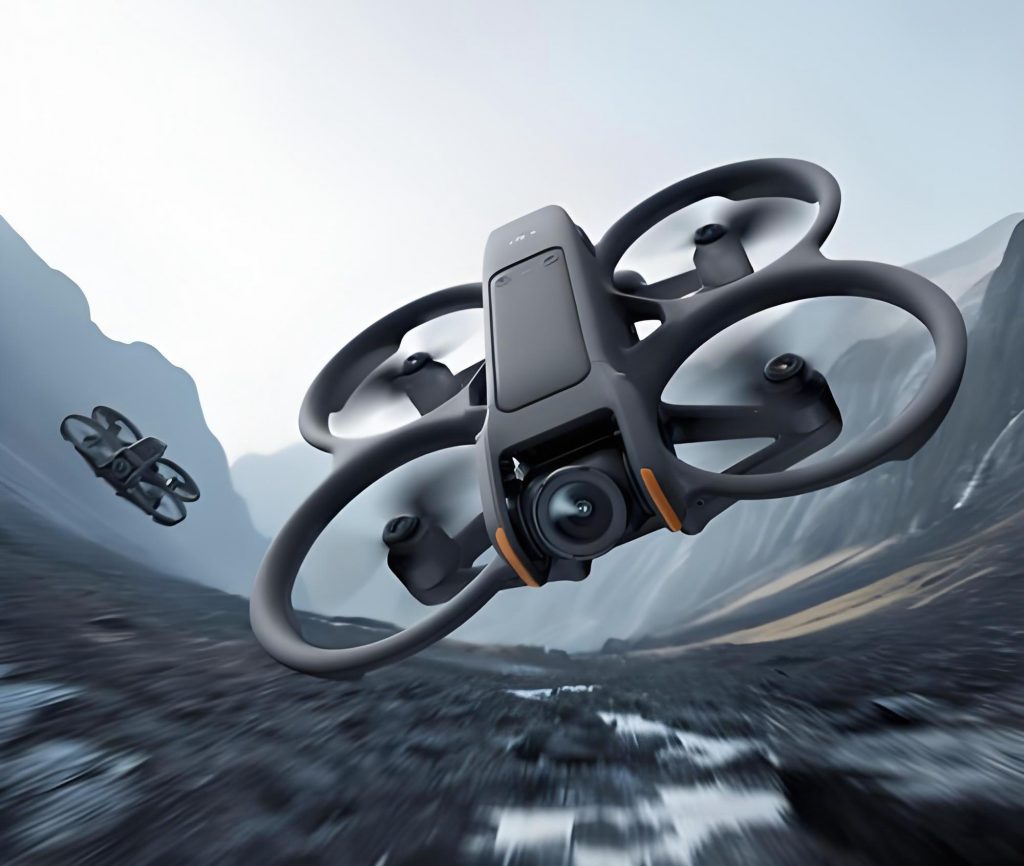
In modern agriculture, the integration of unmanned aerial vehicles (UAVs) has revolutionized practices such as pollination, especially for crops like the Korla fragrant pear, which requires cross-pollination for optimal fruit set. Traditional methods, including manual and bee pollination, face challenges such as labor shortages, high costs, and disease transmission. This study focuses on optimizing the operational parameters of DJI UAVs, specifically the DJI T50 model, to enhance pollination efficiency. We conducted field experiments using an orthogonal design to evaluate factors like flight speed, altitude, and spray volume, with the goal of improving droplet distribution and fruit set rates. The use of DJI drones, including advanced models like the DJI FPV for reconnaissance, underscores the potential of UAV technology in precision agriculture. By leveraging DJI UAV capabilities, we aim to address the limitations of conventional methods and provide a scalable solution for pear orchards.
The Korla fragrant pear, known for its excellent quality and economic value, is predominantly grown in Xinjiang, China. However, its productivity is hindered by poor self-pollination and environmental constraints. DJI UAVs offer a promising alternative due to their high payload capacity, efficiency, and ability to operate in varied terrains. In this research, we employed the DJI T50 drone to administer pollen suspensions, analyzing droplet coverage, density, and deposition across tree canopy layers. The optimization of parameters such as flight speed and altitude is critical for maximizing pollen delivery and ensuring uniform distribution. Furthermore, the integration of DJI FPV technology aids in real-time monitoring and route planning, enhancing the overall efficacy of UAV-based pollination systems.
Our methodology involved a systematic approach to parameter optimization, utilizing orthogonal experiments to minimize the number of trials while capturing the effects of multiple factors. We selected the DJI T50 for its robust performance and compatibility with agricultural applications. The drone was equipped with standard spray nozzles, and we measured environmental conditions to ensure consistency. Data collection included the use of water-sensitive papers to capture droplet patterns, which were then analyzed using image processing software. The mathematical representation of droplet metrics is essential for quantitative analysis. For instance, droplet coverage can be expressed as: $$ \text{Coverage} = \frac{A_d}{A_t} \times 100\% $$ where \( A_d \) is the area covered by droplets and \( A_t \) is the total area. Similarly, droplet density is calculated as: $$ \text{Density} = \frac{N_d}{A_t} $$ where \( N_d \) is the number of droplets per unit area. Deposition volume is given by: $$ \text{Deposition} = \frac{V_d}{A_t} $$ where \( V_d \) is the volume of droplets deposited.
The orthogonal experimental design consisted of three factors—flight speed (A), flight altitude (B), and spray volume per 667 m² (C)—each at three levels, as shown in Table 1. This design allowed us to efficiently explore the parameter space and identify optimal settings for the DJI UAV. The DJI T50 drone was programmed to follow predefined routes using 3D mapping technology, ensuring precise application. Field trials were conducted under controlled wind conditions to minimize external influences. The use of DJI drones in such setups highlights their versatility and reliability in agricultural operations.
| Level | Flight Speed (A) (m/s) | Flight Altitude (B) (m) | Spray Volume per 667 m² (C) (L) |
|---|---|---|---|
| 1 | 4 | 3.5 | 2 |
| 2 | 6 | 4.5 | 3 |
| 3 | 8 | 5.5 | 4 |
Results from the droplet analysis revealed significant variations in coverage, density, and deposition across different canopy layers. For example, the optimal combination of parameters was identified as A1B2C3, corresponding to a flight speed of 4 m/s, altitude of 4.5 m above the tree canopy, and spray volume of 4 L per 667 m². This combination yielded the highest droplet coverage and uniformity. The data were subjected to range analysis to determine the influence of each factor, as summarized in Table 2. The DJI UAV’s performance was consistently superior when spray volume was maximized, underscoring the importance of fluid dynamics in aerial applications. The role of DJI drone technology in achieving these results cannot be overstated, as it provides the necessary stability and control for precise droplet delivery.
| Factor | K1 | K2 | K3 | Range | Optimal Level |
|---|---|---|---|---|---|
| A (Flight Speed) | 9.58 | 8.83 | 6.71 | 2.87 | A1 |
| B (Flight Altitude) | 6.18 | 9.01 | 9.92 | 3.74 | B3 |
| C (Spray Volume) | 3.33 | 5.60 | 13.32 | 9.99 | C3 |
In terms of droplet density, the DJI UAV achieved the best results with the A1B3C3 combination, which also emphasized the critical role of spray volume. The mathematical relationship between operational parameters and droplet density can be modeled using regression analysis. For instance, a linear model might be: $$ \text{Density} = \beta_0 + \beta_1 A + \beta_2 B + \beta_3 C $$ where \( \beta \) coefficients represent the impact of each factor. Our findings indicate that spray volume (C) had the greatest effect, followed by flight speed (A) and altitude (B) for the middle and lower canopy layers. This aligns with the principles of fluid mechanics, where higher volumes enhance droplet penetration and distribution. The use of DJI FPV for aerial surveillance further optimized these parameters by providing real-time data on canopy structure.
Field validation of the optimized parameters demonstrated a fruit set rate of 75.56% for inflorescences and 32.87% for individual flowers, meeting the requirements for commercial pear production. The success of the DJI drone in this context highlights its potential as a reliable tool for orchard management. Comparative analysis with previous studies using other UAV models, such as the DJI FPV for mapping, shows that the DJI T50 offers improvements in payload and flight time, leading to better pollination outcomes. The integration of DJI UAV systems into agricultural practices represents a significant advancement, reducing labor costs and increasing efficiency.
Discussion of the results emphasizes the importance of parameter optimization for DJI UAVs in pollination applications. The dominant influence of spray volume on droplet metrics suggests that fluid management is key to effective pollen delivery. Flight speed and altitude also play crucial roles, particularly in ensuring that droplets reach the lower canopy layers. The orthogonal design efficiently identified the optimal settings, and the field tests confirmed their practicality. The use of DJI drones, including the DJI FPV for auxiliary tasks, provides a comprehensive solution for modern farming challenges. Future work could explore the integration of AI and machine learning with DJI UAV systems to further enhance precision and adaptability.
In conclusion, the optimization of DJI UAV pollination parameters for Korla fragrant pear has yielded significant improvements in fruit set and operational efficiency. The best parameters include a flight speed of 4 m/s, altitude of 4.5 m, and spray volume of 4 L per 667 m². The DJI T50 drone proved to be an effective platform for this application, with spray volume being the most influential factor. The continued development of DJI drone technology, including models like the DJI FPV, will undoubtedly contribute to the advancement of precision agriculture. By adopting these optimized parameters, farmers can achieve higher yields and reduce reliance on traditional pollination methods, paving the way for sustainable and efficient orchard management.
Expanding on the technical aspects, the droplet deposition process can be described using the following equation: $$ D = k \cdot V \cdot \frac{1}{A^2} $$ where \( D \) is deposition, \( k \) is a constant, \( V \) is spray volume, and \( A \) is altitude. This model helps in understanding the inverse relationship between altitude and deposition, which was observed in our experiments. The DJI UAV’s ability to maintain low altitudes while ensuring safety through obstacle avoidance systems is a key advantage. Additionally, the use of DJI FPV for preliminary surveys allows for accurate 3D route planning, minimizing errors during operation.
The economic implications of using DJI drones for pollination are substantial. By reducing the need for manual labor and increasing coverage area, DJI UAV systems offer a cost-effective solution for large-scale orchards. The DJI T50, with its high payload capacity, can cover more ground in less time compared to traditional methods. Moreover, the DJI FPV’s capability for high-resolution imaging aids in monitoring crop health and pollination success. As drone technology evolves, the integration of multispectral sensors and automated flight controls will further enhance the capabilities of DJI UAVs in agriculture.
In summary, this study demonstrates the effectiveness of DJI UAVs in optimizing pollination parameters for Korla fragrant pear. The rigorous experimental design and analysis provide a solid foundation for future applications. The repeated emphasis on DJI drone technology, including the DJI FPV, underscores its transformative potential in modern farming. By leveraging these advancements, agricultural practitioners can achieve greater productivity and sustainability, ultimately contributing to global food security.