
Rice planthoppers are among the most destructive pests in global rice production, leading to significant yield losses and quality degradation through direct feeding and viral transmission. Traditional control methods, such as manual pesticide application, suffer from inefficiencies, including uneven coverage, low pesticide utilization rates, and environmental concerns. In recent years, the adoption of crop spraying drones, also known as spraying UAVs, has revolutionized agricultural pest management by offering high operational efficiency, precision targeting, and adaptability to complex terrains. These unmanned aerial vehicles enable controlled droplet deposition, which is critical for effective pesticide delivery. However, the performance of crop spraying drones is highly dependent on operational parameters, such as flight speed, flight altitude, droplet size, and the inclusion of adjuvants, which influence spray distribution and biological efficacy.
Triflumezopyrim, a novel mesoionic insecticide, has emerged as a promising solution for rice planthopper control due to its unique mode of action targeting nicotinic acetylcholine receptors, high efficacy at low doses, and reduced environmental impact. Despite its potential, optimizing the application parameters for triflumezopyrim using spraying UAVs remains underexplored. This study aims to bridge this gap by systematically evaluating the effects of key factors—flight speed, flight altitude, droplet size, and adjuvant concentration—on droplet deposition characteristics and the subsequent control efficacy against rice planthoppers. By employing an orthogonal experimental design, we identify optimal parameter combinations to enhance spray performance and support sustainable rice production.
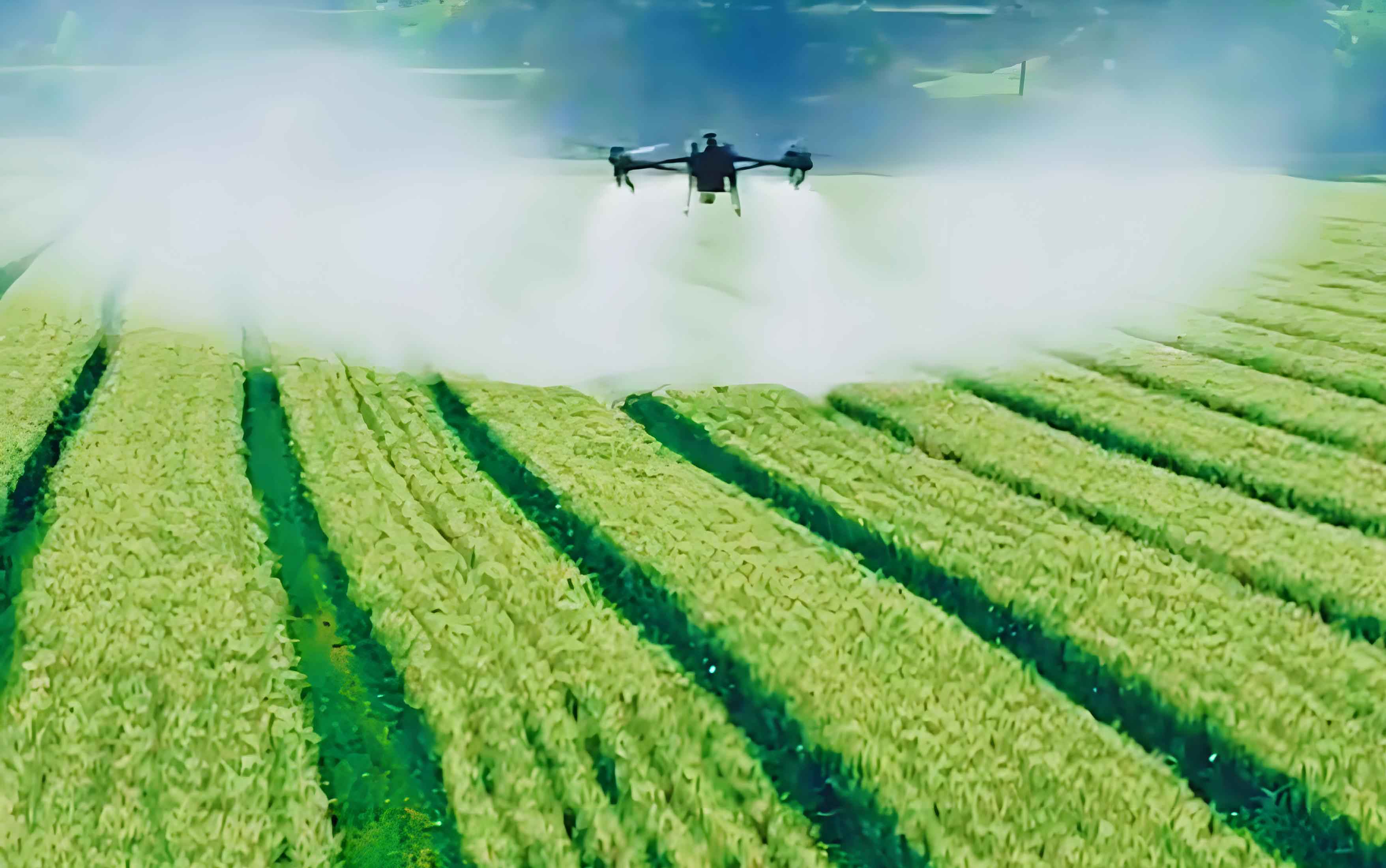
The experiments were conducted in a rice field during the early rice booting stage, using a quadrotor crop spraying drone equipped with centrifugal nozzles. The operational parameters were adjusted within feasible ranges: flight speed from 1.5 to 3.5 m/s, flight altitude from 1.5 to 3.5 m, droplet size from 100 to 200 μm, and adjuvant concentration from 0% to 0.05%. A four-factor, three-level orthogonal array (L9 orthogonal table) was implemented, resulting in nine distinct treatments, each replicated three times to ensure statistical reliability. The spray solution consisted of 10% triflumezopyrim suspension concentrate, with Rhodamine B dye added as a tracer for droplet analysis. Water-sensitive papers were positioned at strategic locations within the rice canopy to capture droplet deposition patterns, which were later scanned and analyzed using image processing software to determine deposition volume and density.
For assessing control efficacy, rice planthopper populations were monitored before application and at 3, 7, and 14 days post-application. The number of live insects was recorded using a standard sampling method, and control efficacy was calculated based on population reduction relative to untreated controls. The data were subjected to analysis of variance (ANOVA) to determine the significance of each factor and their interactions. The mathematical expressions for control efficacy are as follows:
Population reduction rate: $$ R = \frac{N_0 – N_t}{N_0} \times 100\% $$
Control efficacy: $$ E = \frac{R_t – R_c}{1 – R_c} \times 100\% $$
where \( R \) is the population reduction rate, \( N_0 \) is the initial insect count, \( N_t \) is the count post-treatment, \( E \) is the control efficacy, \( R_t \) is the reduction rate in treated plots, and \( R_c \) is the reduction rate in control plots.
The results for droplet deposition volume across the nine treatments are summarized in Table 1. Treatment 3, with a flight speed of 1.5 m/s, flight altitude of 3.5 m, droplet size of 150 μm, and adjuvant concentration of 0.05%, achieved the highest deposition volume of 0.319 μL/cm², while Treatment 6 showed the lowest at 0.165 μL/cm². ANOVA revealed that droplet size had the most significant impact on deposition volume (P < 0.01), followed by flight altitude and adjuvant concentration, whereas flight speed was not statistically significant. The optimal combination for maximizing deposition volume was identified as droplet size of 150 μm, flight altitude of 3.5 m, adjuvant concentration of 0.05%, and flight speed of 1.5 m/s. This underscores the critical role of droplet size in minimizing drift and evaporation, particularly when using crop spraying drones in field conditions.
| Treatment | Flight Speed (m/s) | Flight Altitude (m) | Droplet Size (μm) | Adjuvant Concentration (%) | Deposition Volume (μL/cm²) |
|---|---|---|---|---|---|
| 1 | 1.5 | 1.5 | 100 | 0 | 0.221 |
| 2 | 1.5 | 2.5 | 200 | 0.01 | 0.252 |
| 3 | 1.5 | 3.5 | 150 | 0.05 | 0.319 |
| 4 | 2.5 | 1.5 | 200 | 0.05 | 0.263 |
| 5 | 2.5 | 2.5 | 150 | 0 | 0.310 |
| 6 | 2.5 | 3.5 | 100 | 0.01 | 0.165 |
| 7 | 3.5 | 1.5 | 200 | 0.01 | 0.312 |
| 8 | 3.5 | 2.5 | 100 | 0.05 | 0.248 |
| 9 | 3.5 | 3.5 | 150 | 0 | 0.243 |
Droplet density, which refers to the number of droplets per unit area, varied significantly among treatments, as shown in Table 2. Treatment 8, with a flight speed of 3.5 m/s, flight altitude of 2.5 m, droplet size of 100 μm, and adjuvant concentration of 0.05%, recorded the highest density of 54.13 droplets/cm². In contrast, Treatment 4 had the lowest density of 16.93 droplets/cm². The factors influencing droplet density followed a similar order of significance as deposition volume: droplet size > flight altitude > adjuvant concentration > flight speed. Smaller droplet sizes generally resulted in higher densities due to reduced overlap and better coverage, but this did not always translate to higher deposition volumes because of increased drift potential. The optimal combination for droplet density was droplet size of 100 μm, flight altitude of 2.5 m, adjuvant concentration of 0%, and flight speed of 2.5 m/s, highlighting the trade-offs between coverage and retention when configuring spraying UAVs.
| Treatment | Flight Speed (m/s) | Flight Altitude (m) | Droplet Size (μm) | Adjuvant Concentration (%) | Droplet Density (droplets/cm²) |
|---|---|---|---|---|---|
| 1 | 1.5 | 1.5 | 100 | 0 | 49.26 |
| 2 | 1.5 | 2.5 | 200 | 0.01 | 28.76 |
| 3 | 1.5 | 3.5 | 150 | 0.05 | 26.93 |
| 4 | 2.5 | 1.5 | 200 | 0.05 | 16.93 |
| 5 | 2.5 | 2.5 | 150 | 0 | 44.94 |
| 6 | 2.5 | 3.5 | 100 | 0.01 | 49.61 |
| 7 | 3.5 | 1.5 | 200 | 0.01 | 17.23 |
| 8 | 3.5 | 2.5 | 100 | 0.05 | 54.13 |
| 9 | 3.5 | 3.5 | 150 | 0 | 36.49 |
The control efficacy against rice planthoppers was evaluated over time, with results detailed in Table 3. On day 3 post-application, Treatment 5 (flight speed 1.5 m/s, flight altitude 2.5 m, droplet size 150 μm, no adjuvant) achieved the highest efficacy of 69.25%. By day 7, Treatment 3 (flight speed 1.5 m/s, flight altitude 3.5 m, droplet size 150 μm, adjuvant 0.05%) showed superior efficacy at 81.35%, which further improved to 93.67% by day 14. This progressive increase in efficacy underscores the systemic action of triflumezopyrim, where optimal droplet deposition facilitates gradual insecticide uptake and distribution within the plant. The integration of adjuvants at 0.05% concentration enhanced spray retention and penetration, contributing to sustained control. These findings demonstrate that spraying UAVs can achieve high biological efficacy when parameters are finely tuned, with droplet size and flight altitude being pivotal for ensuring adequate deposition in the rice canopy.
| Treatment | Flight Speed (m/s) | Flight Altitude (m) | Droplet Size (μm) | Adjuvant Concentration (%) | Control Efficacy at 3 Days (%) | Control Efficacy at 7 Days (%) | Control Efficacy at 14 Days (%) |
|---|---|---|---|---|---|---|---|
| 1 | 1.5 | 1.5 | 100 | 0 | 59.73 | 71.26 | 89.80 |
| 2 | 1.5 | 2.5 | 200 | 0.01 | 61.67 | 74.43 | 90.97 |
| 3 | 1.5 | 3.5 | 150 | 0.05 | 68.14 | 81.35 | 93.67 |
| 4 | 2.5 | 1.5 | 200 | 0.05 | 63.67 | 78.04 | 91.43 |
| 5 | 2.5 | 2.5 | 150 | 0 | 69.25 | 79.67 | 92.72 |
| 6 | 2.5 | 3.5 | 100 | 0.01 | 55.83 | 68.52 | 86.09 |
| 7 | 3.5 | 1.5 | 200 | 0.01 | 66.07 | 79.01 | 92.41 |
| 8 | 3.5 | 2.5 | 100 | 0.05 | 64.85 | 78.57 | 91.62 |
| 9 | 3.5 | 3.5 | 150 | 0 | 60.22 | 71.30 | 89.09 |
The discussion of these results emphasizes the complex interplay between operational parameters and spray performance in crop spraying drones. Droplet size emerged as the dominant factor, with medium-sized droplets (150 μm) balancing deposition volume and density effectively. Larger droplets tend to resist drift but may reduce coverage, while smaller droplets increase density but are prone to evaporation and off-target movement. Flight altitude influenced the downwash airflow generated by the spraying UAV; lower altitudes enhanced droplet penetration but risked overspray, whereas higher altitudes reduced deposition due to weakened vertical airflow and increased lateral drift. Adjuvants improved droplet adhesion and spread, particularly at 0.05% concentration, which correlated with higher deposition and control efficacy. Flight speed had a minimal impact, likely because its effects were masked by other factors in the orthogonal design, but slower speeds generally favored deposition by allowing more time for droplet settling.
From a practical perspective, the optimization of crop spraying drone parameters is essential for maximizing the benefits of advanced insecticides like triflumezopyrim. The recommended combination—flight speed of 1.5 m/s, flight altitude of 3.5 m, droplet size of 150 μm, and adjuvant concentration of 0.05%—achieved the highest deposition volume and superior control efficacy over time. This configuration minimizes environmental losses and ensures efficient pesticide delivery, aligning with the principles of precision agriculture. Future research could explore dynamic parameter adjustments during flight or the integration of real-time sensors to adapt to varying field conditions, further enhancing the capabilities of spraying UAVs.
In conclusion, this study demonstrates that optimizing key parameters of crop spraying drones significantly enhances the application of triflumezopyrim for rice planthopper control. The systematic approach using orthogonal experiments provided clear insights into factor influences, with droplet size and flight altitude being critical for deposition quality. The adoption of these optimized settings can lead to improved pest management outcomes, reduced chemical usage, and support for sustainable rice production. As spraying UAV technology continues to evolve, such findings will contribute to the development of standardized protocols for precision pesticide application in diverse agricultural systems.