
Rice is a vital global crop, with production significantly impacting food security. However, pests like rice planthoppers threaten yields by damaging plants and transmitting viruses. Traditional control methods suffer from inefficiency and low pesticide utilization. We explored using agricultural drones to apply triflumezopyrim, optimizing parameters for droplet deposition and control efficacy. This study addresses gaps in parameter optimization for this insecticide, providing data for green pest management in rice fields.
Agricultural UAVs enhance spraying precision and efficiency, but performance depends on flight parameters, droplet size, and adjuvants. Qin et al. found that flight speed and height affect droplet distribution, with optimal settings achieving 74–92% control. Wang et al. demonstrated that adjuvants boost deposition by 20%. S. Chen highlighted that larger droplets improve canopy penetration. Triflumezopyrim, a novel mesoionic insecticide, offers high efficacy with low environmental impact. Yet, UAV-based triflumezopyrim application remains underexplored. We aimed to identify optimal combinations of speed, height, droplet size, and adjuvant concentration for maximum deposition and planthoppers control.
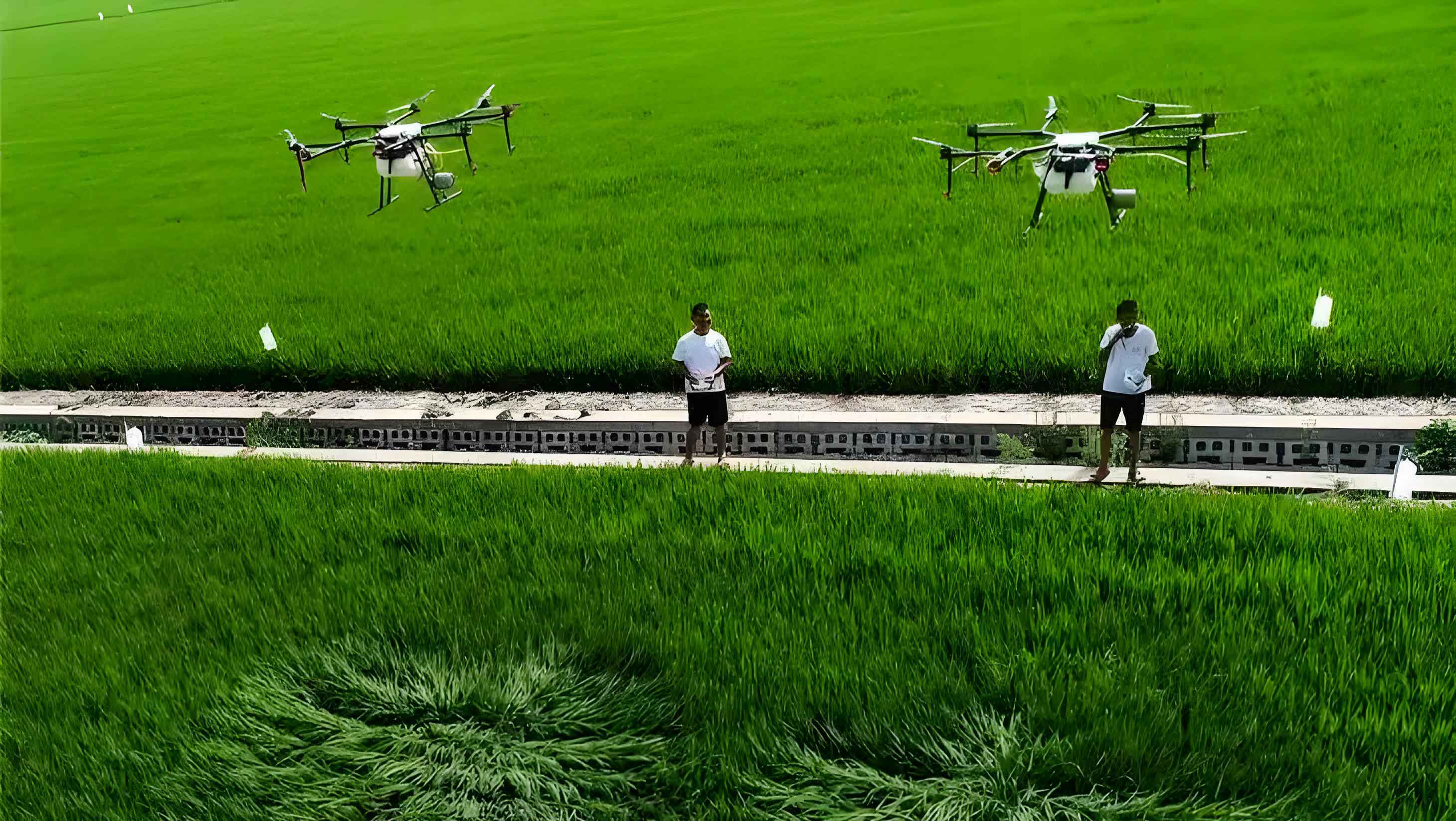
We conducted field trials using a four-rotor agricultural drone (model: XAG P20), with adjustable speed (1–6 m/s), height (1–12 m), and nozzle flow (0.8–3.2 L/min). The 10% triflumezopyrim suspension was mixed with rhodamine B tracer and adjuvant. A four-factor, three-level orthogonal design (L9(3^4)) tested parameters: flight speed (A: 1.5, 2.5, 3.5 m/s), height (B: 1.5, 2.5, 3.5 m), droplet size (C: 100, 150, 200 μm), and adjuvant concentration (D: 0.00%, 0.01%, 0.05%). Each treatment covered 0.6 acres, with 5m buffer zones. Spray volume was fixed at 225 mL/ha. Copper paper cards (30mm × 75mm) were placed at 35cm height across seven sampling points per line to collect droplets. Droplet deposition volume (μL/cm²) and density (droplets/cm²) were analyzed using ImageJ software after scanning. Planthoppers control efficacy was assessed pre- and post-application (days 3, 7, 14) via a white tray method: insects dislodged from rice plants were counted in 40cm × 30cm areas. Reduction rate and control efficacy were calculated as:
Insect reduction rate:
$$ \text{Reduction Rate} (\%) = \left( \frac{N_{\text{before}} – N_{\text{after}}}{N_{\text{before}}} \right) \times 100 $$
Control efficacy:
$$ \text{Control Efficacy} (\%) = \left( \frac{R_{\text{treatment}} – R_{\text{control}}}{1 – R_{\text{control}}} \right) \times 100 $$
where \( N_{\text{before}} \) and \( N_{\text{after}} \) are live insect counts before and after spraying, and \( R \) is the reduction rate. ANOVA and Duncan’s test (α=0.05) evaluated significance.
Droplet deposition varied significantly across treatments. Maximum deposition (0.319 μL/cm²) occurred at 1.5 m/s speed, 3.5 m height, 150 μm droplets, and 0.05% adjuvant. Minimum (0.165 μL/cm²) was at 2.5 m/s, 3.5 m, 100 μm, and 0.01%. ANOVA indicated droplet size as the most influential factor (P=0.00), followed by height (P=0.00) and adjuvant (P=0.001); speed was insignificant (P>0.05). Optimal combination was C2B2D3A3. Droplet size significantly affected deposition: 150 μm droplets averaged 0.291 μL/cm², outperforming 100 μm (0.212 μL/cm²) and 200 μm (0.276 μL/cm²). Height also mattered: 2.5 m yielded highest deposition (0.270 μL/cm²), while 3.5 m had lowest (0.242 μL/cm²). Adjuvant at 0.05% enhanced deposition (0.277 μL/cm²). This agricultural UAV setup demonstrated that larger droplets and moderate heights resist drift, improving target coverage.
| Treatment | Flight Speed (m/s) | Flight Height (m) | Droplet Size (μm) | Adjuvant (%) | Mean Deposition (μL/cm²) |
|---|---|---|---|---|---|
| T1 | 1.5 | 1.5 | 100 | 0.00 | 0.221 |
| T2 | 1.5 | 2.5 | 200 | 0.01 | 0.252 |
| T3 | 1.5 | 3.5 | 150 | 0.05 | 0.319 |
| T4 | 2.5 | 1.5 | 200 | 0.05 | 0.263 |
| T5 | 2.5 | 2.5 | 150 | 0.00 | 0.310 |
| T6 | 2.5 | 3.5 | 100 | 0.01 | 0.165 |
| T7 | 3.5 | 1.5 | 200 | 0.01 | 0.312 |
| T8 | 3.5 | 2.5 | 100 | 0.05 | 0.248 |
| T9 | 3.5 | 3.5 | 150 | 0.00 | 0.243 |
Droplet density peaked at 54.13 droplets/cm² (3.5 m/s, 2.5 m, 100 μm, 0.05% adjuvant), while the minimum was 16.93 droplets/cm². Droplet size was the dominant factor (P=0.00), with height (P=0.001) and adjuvant also significant; speed was not (P>0.05). Optimal density occurred at C1B2D1A2. Smaller droplets (100 μm) averaged higher density (51.10 droplets/cm²) than 150 μm (36.12 droplets/cm²) or 200 μm (20.97 droplets/cm²) due to reduced overlap. Height influenced density: 2.5 m yielded 42.42 droplets/cm², superior to 1.5 m (27.80 droplets/cm²) or 3.5 m (37.50 droplets/cm²). This agricultural drone application showed that fine droplets increase coverage but require careful parameter tuning to minimize drift.
| Treatment | Flight Speed (m/s) | Flight Height (m) | Droplet Size (μm) | Adjuvant (%) | Mean Density (droplets/cm²) |
|---|---|---|---|---|---|
| T1 | 1.5 | 1.5 | 100 | 0.00 | 49.26 |
| T2 | 1.5 | 2.5 | 200 | 0.01 | 28.76 |
| T3 | 1.5 | 3.5 | 150 | 0.05 | 26.93 |
| T4 | 2.5 | 1.5 | 200 | 0.05 | 16.93 |
| T5 | 2.5 | 2.5 | 150 | 0.00 | 44.94 |
| T6 | 2.5 | 3.5 | 100 | 0.01 | 49.61 |
| T7 | 3.5 | 1.5 | 200 | 0.01 | 17.23 |
| T8 | 3.5 | 2.5 | 100 | 0.05 | 54.13 |
| T9 | 3.5 | 3.5 | 150 | 0.00 | 36.49 |
Control efficacy against rice planthoppers varied by treatment and time. At day 3, efficacy ranged from 55.83% to 69.25%, peaking at 1.5 m/s, 2.5 m, 150 μm, and no adjuvant. By day 7, efficacy improved (68.52–81.35%), with best results at 1.5 m/s, 3.5 m, 150 μm, and 0.05% adjuvant. At day 14, efficacy reached 86.09–93.67%, again highest under the same parameters. This confirms that agricultural UAV parameter optimization directly enhances biological outcomes, with triflumezopyrim’s systemic action compensating for lower density in some cases.
| Treatment | Efficacy at Day 3 (%) | Efficacy at Day 7 (%) | Efficacy at Day 14 (%) |
|---|---|---|---|
| T1 | 59.73 | 71.26 | 89.80 |
| T2 | 61.67 | 74.43 | 90.97 |
| T3 | 68.14 | 81.35 | 93.67 |
| T4 | 63.67 | 78.04 | 91.43 |
| T5 | 69.25 | 79.67 | 92.72 |
| T6 | 55.83 | 68.52 | 86.09 |
| T7 | 66.07 | 79.01 | 92.41 |
| T8 | 64.85 | 78.57 | 91.62 |
| T9 | 60.22 | 71.30 | 89.09 |
Droplet deposition in agricultural UAV spraying is critical for efficacy and is governed by complex interactions. Our results show droplet size > height > adjuvant > speed as the influence hierarchy. Medium droplets (150 μm) balanced deposition (0.288 μL/cm²) and density (34.26 droplets/cm²), resisting drift better than smaller ones while ensuring coverage. Height affected vertical airflow: low heights caused wash-off, high heights increased drift, with 2.5 m optimal for density. Speed had minimal impact, likely affecting uniformity more than volume. Adjuvants at 0.05% enhanced deposition by improving droplet adhesion. Despite low density in some cases, triflumezopyrim’s systemic nature delivered high control, aligning with findings that density is less critical for such insecticides.
We conclude that agricultural drones optimize triflumezopyrim application for rice planthoppers control. The combination of 1.5 m/s speed, 3.5 m height, 150 μm droplets, and 0.05% adjuvant maximized deposition (0.319 μL/cm²) and delivered 81.35–93.67% control efficacy. This parameter set balances airflow dynamics and droplet behavior, reducing drift and enhancing canopy penetration. Future work should explore adjuvant types and broader environmental conditions. Our study provides a foundation for precision agriculture, enabling efficient, sustainable pest management with UAV technology.