
The spectacle of a formation drone light show, where hundreds or even thousands of unmanned aerial vehicles (UAVs) move in precise, synchronized patterns to create dynamic aerial imagery, represents a pinnacle of multi-agent coordination. While captivating, the underlying operational challenges are immense. Traditional planning methods often treat trajectory design, communication scheduling, and resource allocation as separate, sequential problems. This decoupled approach leads to suboptimal performances: inefficient battery usage limiting show duration, communication latencies causing de-synchronization, and an overall failure to maximize the visual impact and reliability of the formation drone light show. This article proposes a holistic, joint optimization framework that concurrently manages UAV trajectory sequences, formation sizing, and wireless spectrum resource allocation to unlock new levels of efficiency, scalability, and artistic fidelity in formation drone light show systems.
The core challenge in a large-scale formation drone light show is the tight coupling between spatial movement and wireless communication. Each drone must follow an exact four-dimensional trajectory (3D position + time) to realize the collective image. Deviations, however small, break the illusion. To maintain this spatio-temporal alignment, drones continuously exchange state information and receive corrective commands via a wireless network. The quality of this communication link, governed by allocated bandwidth and interference, directly impacts synchronization precision. Conversely, the drones’ movement determines their relative distances and channel conditions, thereby influencing communication quality. Ignoring this interdependence—optimizing flashy trajectories without considering the communication load, or allocating spectrum without considering the movement-induced interference—results in a fragile system. Our work models this intricate relationship to co-design these elements, ensuring that the planned aerial choreography for the formation drone light show is not only visually stunning but also communication-feasible and energy-sustainable.
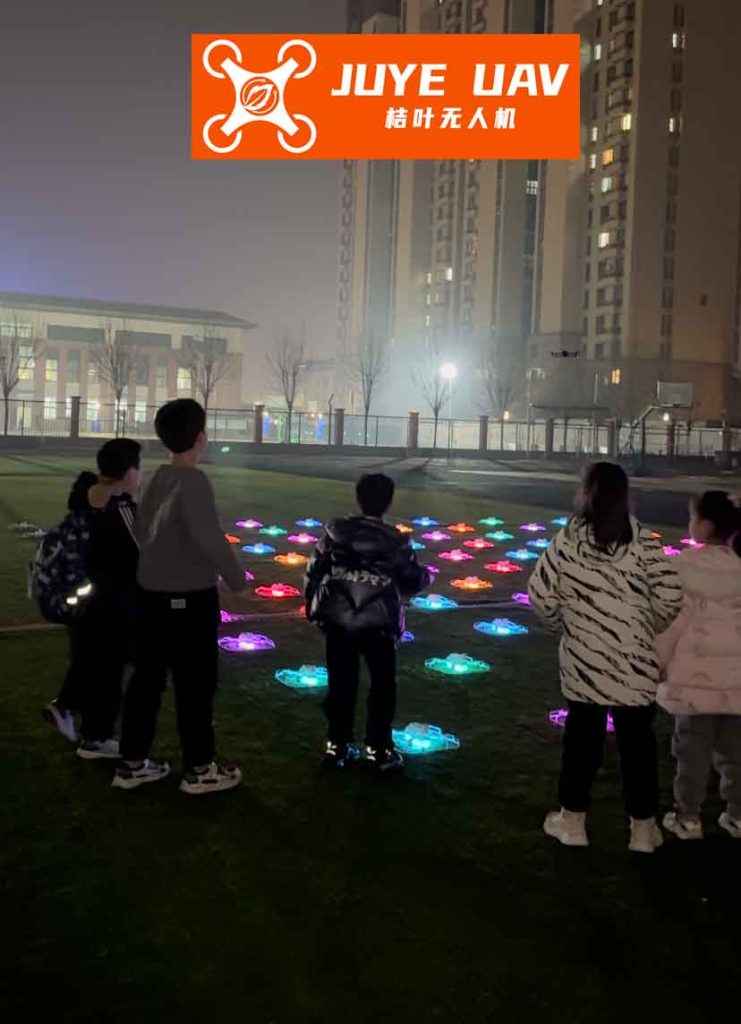
We conceptualize the formation drone light show as a mission executed by multiple coordinated fleets, or sub-formations. Consider a scenario with $N$ launch pads (or charging stations) and a total pool of $M$ drones. Drones from the same pad form a logical sub-formation $A_n$. The grand show comprises $K$ distinct keyframes or “scenes,” each requiring a specific global drone configuration. Let the sets be defined as $\mathcal{M} = \{1,2,\ldots,M\}$ (drones), $\mathcal{N} = \{1,2,\ldots,N\}$ (pads/sub-formations), and $\mathcal{K} = \{1,2,\ldots,K\}$ (keyframe scenes). Each keyframe $k$ has an associated artistic value $V_k$, a required data upload volume $C_k$ (e.g., for updating high-resolution LED color states), and a strict duration $T_k^{hold}$ for which the formation must be held stable.
A critical performance metric for a formation drone light show is visual fidelity, which can be compromised by individual drone failure or positional error. We model the probability of a single drone correctly achieving its target state in keyframe $k$ as $p_k$, influenced by local wind or GPS uncertainty. For a sub-formation $A_n$ assigned to a part of the keyframe, the probability that at least one drone fails, creating a visible “hole,” is mitigated by redundancy. The probability of the sub-formation $A_n$ successfully rendering its portion of keyframe $k$ is:
$$ P_{success}(A_n, k) = 1 – (1 – p_k)^{|A_n|} $$
where $|A_n|$ is the number of drones in the sub-formation. Therefore, the effective realized value of keyframe $k$ contributed by sub-formation $A_n$ becomes:
$$ V_{realized}(k, A_n) = P_{success}(A_n, k) \cdot V_k $$
This formalizes the trade-off: larger sub-formations improve robustness but increase resource consumption.
Drone energy consumption is the primary constraint on show duration. It consists of propulsion energy and communication energy. Propulsion power for a rotorcraft UAV at speed $v$ is well-modeled as:
$$ P(v) = P_0 \left(1 + \frac{3v^2}{u_{tip}^2}\right) + P_i \left(\sqrt{1 + \frac{v^4}{4v_0^4}} – \frac{v^2}{2v_0^2} \right)^{1/2} + \frac{1}{2} d_0 \rho s A v^3 $$
Here, $P_0$ and $P_i$ are blade profile and induced powers in hover, $u_{tip}$ is rotor tip speed, $v_0$ is mean rotor induced velocity, $d_0$ is fuselage drag ratio, $s$ is rotor solidity, $\rho$ is air density, and $A$ is rotor disc area. For inter-keyframe transit at constant cruise speed $V_{cr}$, the energy to travel distance $d_{k,k’}$ between keyframes $k$ and $k’$ is:
$$ E^f_{k,k’} = P(V_{cr}) \cdot T^f_{k,k’}, \quad \text{where} \quad T^f_{k,k’} = \frac{d_{k,k’}}{V_{cr}} $$
During the keyframe hold period, drones hover and upload data. The hover power is $P(0)$. The upload time, and thus additional hover time, depends on the communication link.
We assume sub-formations are allocated orthogonal frequency bands to avoid inter-formation interference, with intra-formation sharing using time-division multiple access (TDMA). The total system bandwidth is $W_{total}$. If sub-formation $A_n$ is allocated bandwidth $W_n$, the achievable rate for a drone at keyframe $k$ (at horizontal position $\mathbf{q}_k$) to its ground control station at pad $n$ (position $\mathbf{q}_n$) is based on a dominant LoS channel gain $h_{k,n} = \beta_0 ||\mathbf{q}_k – \mathbf{q}_n||^{-2}$, where $\beta_0$ is the channel gain at 1 m. The time for $|A_n|$ drones to each upload $C_k$ bits is:
$$ T^{comm}_k = \frac{|A_n| C_k}{W_n \log_2\left(1 + \frac{P_{tx} h_{k,n}}{W_n N_0}\right)} $$
where $P_{tx}$ is drone transmit power and $N_0$ is noise spectral density. Therefore, the total hover energy for sub-formation $A_n$ at keyframe $k$ is:
$$ E^h_k = P(0) \cdot \left( T_k^{hold} + T^{comm}_k \right) $$
The communication model explicitly links bandwidth allocation $W_n$ to energy consumption and timeline feasibility for the formation drone light show.
The planning problem is a multi-depot vehicle routing problem with resource constraints. Each sub-formation $A_n$ has a sequence of keyframes to visit, denoted by a permutation $\pi_n = (\pi_n(0), \pi_n(1), …, \pi_n(L_n+1))$, where $\pi_n(0)$ and $\pi_n(L_n+1)$ represent the home pad, and $L_n$ is the number of keyframes assigned to that sub-formation. The total travel distance $S_n$ for sub-formation $A_n$ is:
$$ S_n = \sum_{j=0}^{L_n} d_{\pi_n(j), \pi_n(j+1)} $$
with $d$ representing Euclidean distance. The total flight time is $T^f_n = S_n / V_{cr}$. The overall system utility $U$ to be maximized for the formation drone light show is a weighted sum of total artistic value realized minus total energy costs:
$$
U = \sum_{n \in \mathcal{N}} \sum_{k \in \mathcal{K}_n} \left[ V_{realized}(k, A_n) – \lambda E^h_k – \zeta \cdot |A_n| \cdot E^f_n \right]
$$
Here, $\mathcal{K}_n$ is the set of keyframes assigned to sub-formation $n$, $E^f_n$ is the average flight energy per drone in the sub-formation, and $\lambda, \zeta$ are weighting coefficients balancing artistic value against hover and cruise energy costs, respectively.
The complete Joint Formation Drone Light Show Optimization Problem can be formulated as a Mixed-Integer Nonlinear Program (MINLP):
$$
\begin{aligned}
& \underset{\{\mathbf{A}\}, \{\boldsymbol{\pi}\}, \{\mathbf{W}\}}{\text{maximize}}
& & U \\
& \text{subject to}
& & \text{(C1) } \sum_{n=1}^{N} x_{k,n} = 1, \quad \forall k \in \mathcal{K} \\
& & & \text{(C2) } \sum_{k=1}^{K} x_{k,n} \geq 1, \quad \forall n \in \mathcal{N} \\
& & & \text{(C3) } \sum_{n=1}^{N} |A_n| = M \\
& & & \text{(C4) } S_n \leq S_{max}, \quad \forall n \in \mathcal{N} \\
& & & \text{(C5) } |A_n| > 0, \quad \forall n \in \mathcal{N} \\
& & & \text{(C6) } \sum_{n=1}^{N} W_n = W_{total} \\
& & & \text{(C7) } W_n > 0, \quad \forall n \in \mathcal{N}
\end{aligned}
$$
The binary variable $x_{k,n}=1$ if keyframe $k$ is assigned to sub-formation $n$. (C1) ensures each keyframe is covered by one sub-formation. (C2) ensures each sub-formation has at least one keyframe. (C3) accounts for all drones. (C4) is a maximum travel distance constraint per sub-formation (battery limit). (C5)-(C7) handle formation size and bandwidth allocation. This MINLP is NP-hard and highly coupled.
| Parameter | Symbol | Value/Range |
|---|---|---|
| Number of Keyframes | $K$ | 15 – 40 |
| Number of Launch Pads | $N$ | 3 – 6 |
| Total Number of Drones | $M$ | 200 – 1000 |
| Keyframe Data Payload | $C_k$ | 10 – 50 MB |
| Keyframe Hold Time | $T_k^{hold}$ | 2.0 – 5.0 s |
| Single-Drone Reliability | $p_k$ | 0.95 – 0.99 |
| Artistic Value per Keyframe | $V_k$ | 10 – 20 (units) |
| Total System Bandwidth | $W_{total}$ | 20 MHz |
| Drone Transmit Power | $P_{tx}$ | 100 mW |
| Noise PSD | $N_0$ | -174 dBm/Hz |
| Reference Channel Gain | $\beta_0$ | -60 dB |
| UAV Cruise Speed | $V_{cr}$ | 15 m/s |
| Max Sub-formation Distance | $S_{max}$ | 3000 m |
| Energy Weight Coefficients | $\lambda, \zeta$ | $1 \times 10^{-5}$, $5 \times 10^{-5}$ |
To solve this complex MINLP for the formation drone light show, we propose a hybrid, multi-start algorithm that decomposes the problem and leverages the strengths of different optimization techniques. The core idea is to alternate between optimizing the discrete variables (keyframe assignment $\mathbf{x}$, sub-formation sequences $\boldsymbol{\pi}$, and sub-formation sizes $|\mathbf{A}|$) and the continuous variable (bandwidth allocation $\mathbf{W}$).
Step 1: Discrete Optimization via a Multi-Start Genetic Algorithm (GA). For a fixed bandwidth allocation $\mathbf{W}$, the problem reduces to a constrained multi-depot routing problem with team sizing. A GA is well-suited for this combinatorial search. A chromosome encodes three segments: (1) a permutation of keyframe IDs representing a global visitation order, (2) a segment of length $K$ assigning each keyframe in the global order to a sub-formation ID, and (3) a segment of length $N$ defining the number of drones $|A_n|$ in each sub-formation. Specialized crossover and mutation operators ensure valid solutions (e.g., all keyframes assigned, total drones sum to $M$). The fitness function is the utility $U$ with a penalty for violating the maximum travel distance $S_{max}$. A multi-start strategy runs multiple GA instances from different random seeds to avoid local optima, a critical feature for the vast solution space of a large formation drone light show.
Step 2: Continuous Optimization via Gradient Projection Method. Given fixed discrete variables from Step 1 (i.e., defined $\mathcal{K}_n$, $|A_n|$, and sequences), the utility maximization simplifies to minimizing the total communication-induced hover time via optimal bandwidth allocation:
$$
\begin{aligned}
& \underset{\{W_n\}}{\text{minimize}}
& & f(\mathbf{W}) = \sum_{n=1}^{N} \sum_{k \in \mathcal{K}_n} \frac{|A_n| C_k}{W_n \log_2\left(1 + \frac{\gamma_{k,n}}{W_n}\right)} \\
& \text{subject to}
& & \sum_{n=1}^{N} W_n = W_{total}, \quad W_n > 0
\end{aligned}
$$
where $\gamma_{k,n} = P_{tx} \beta_0 ||\mathbf{q}_k – \mathbf{q}_n||^{-2} / N_0$. One can prove that $f_n(W_n) = \frac{\alpha}{W_n \log_2(1 + \frac{\beta}{W_n})}$ is convex in $W_n$ for $W_n > 0$ (where $\alpha, \beta > 0$). Since the sum of convex functions is convex, $f(\mathbf{W})$ is convex over the simplex constraint. The Gradient Projection Method is highly efficient for this smooth convex problem. Starting from a feasible allocation, it iteratively moves in the negative gradient direction of $f(\mathbf{W})$ and projects back onto the constraint set $\\{\mathbf{W} | \sum W_n = W_{total}, W_n > 0\\}$, guaranteeing convergence to the optimal bandwidth split for the given formation drone light show plan.
Step 3: Joint Iterative Optimization. The complete algorithm, termed the Genetic-Gradient Projection Joint Optimization (GGPJO) for formation drone light show planning, alternates between the two steps until convergence.
| Step | Action |
|---|---|
| 1: Initialize | Set iteration $t=0$. Initialize bandwidth $\mathbf{W}^{(0)}$ equally. |
| 2: GA Optimization | Given $\mathbf{W}^{(t)}$, run multi-start GA to solve for discrete variables $\mathbf{x}^{(t+1)}, \boldsymbol{\pi}^{(t+1)}, |\mathbf{A}|^{(t+1)}$. Calculate utility $U^{(t+1/2)}$. |
| 3: Gradient Projection | Given discrete variables from step 2, run Gradient Projection to optimize bandwidth $\mathbf{W}^{(t+1)}$. |
| 4: Update & Check | Calculate new utility $U^{(t+1)}$ with $\mathbf{W}^{(t+1)}$. If $|U^{(t+1)} – U^{(t)}| < \epsilon$ or $t > t_{max}$, STOP. Else, $t = t+1$, go to Step 2. |
This bi-level approach decomposes the hard MINLP. The GA explores the combinatorial space of assignments and paths, while the Gradient Projection method optimally distributes communication resources for any given plan. The iteration ensures feedback; a better bandwidth allocation enables the GA to find plans with higher utility, and vice-versa. The multi-start GA enhances robustness, crucial for the high-stakes planning of a commercial formation drone light show.
We evaluate the proposed GGPJO framework through numerical simulations with parameters inspired by large-scale formation drone light show operations (see Table 1). We compare against two benchmark methods: (1) Benchmark 1 (Decoupled Sequential): First uses K-Means to assign keyframes to nearest pads and a nearest-neighbor TSP solver for per-sub-formation routing, with equal drone distribution and equal bandwidth allocation. (2) Benchmark 2 (ACO-PSO Hybrid): Uses Ant Colony Optimization (ACO) for discrete variable optimization and Particle Swarm Optimization (PSO) for continuous bandwidth optimization, representing another metaheuristic-based joint approach.
The performance is measured by the final system utility $U$. In a scenario with $K=25$ keyframes, $M=300$ drones, $N=4$ pads, and $W_{total}=20$ MHz, the GGPJO algorithm consistently achieves a 15-25% higher utility than Benchmark 1 and 8-12% higher than Benchmark 2. The key reasons are evident in the solution structure: GGPJO intelligently allocates more drones to sub-formations covering keyframes with higher artistic value $V_k$ and lower reliability $p_k$, and it assigns more bandwidth to sub-formations that are operating farther from their control pad or have larger data payloads $C_k$. This adaptive resource pooling is absent in the decoupled benchmark. The convergence of the GGPJO is also more stable and faster in later iterations compared to the ACO-PSO hybrid, as the Gradient Projection step provides a direct, efficient path to the optimal continuous solution.
The impact of the energy weight coefficients $\lambda$ and $\zeta$ on the optimal formation drone light show structure is profound. As these weights increase, placing more cost on energy consumption, the GGPJO algorithm automatically adjusts the plan: it creates more, smaller sub-formations to reduce the travel distance $S_n$ per drone (lowering $\zeta \cdot |A_n| \cdot E^f_n$), and it favors keyframe sequences that minimize total flight path length, even if it means slightly lower overall artistic value coverage. This dynamic trade-off, managed automatically by the joint optimization, is essential for tailoring a formation drone light show to specific operational constraints, such as very limited battery capacity or a requirement for an exceptionally long show duration.
Furthermore, the framework’s scalability is tested by increasing the problem size. For a massive formation drone light show with $K=40$ and $M=800$, the multi-start GA component effectively explores the vast assignment space, while the Gradient Projection method’s efficiency (with complexity roughly $O(T \cdot N \cdot \langle L_n \rangle)$ for $T$ iterations) ensures the bandwidth sub-problem does not become a bottleneck. The ability to handle multiple depots (launch pads) is a key advantage over single-depot models, as it naturally fits the distributed logistics of launching a large fleet from multiple perimeter locations, a common practice in major formation drone light show events to reduce setup density and improve safety.
In conclusion, the seamless execution of a breathtaking formation drone light show is a monumental optimization challenge that demands an integrated approach. By jointly optimizing the discrete assignment and routing variables with the continuous communication resource variable through our proposed hybrid Genetic-Gradient Projection Joint Optimization (GGPJO) algorithm, we establish a rigorous framework that maximizes overall show utility—balancing artistic impact against practical energy and synchronization limits. This methodology ensures that every aspect of the formation drone light show, from the grand choreographic sequence down to the kilobyte of bandwidth allocated to a single drone, is co-designed for harmony and efficiency. The framework is not merely an academic exercise; it provides a scalable, robust planning tool that can elevate the reliability, duration, and creative potential of real-world formation drone light show productions, pushing the boundaries of what is possible in synchronized aerial artistry.
| Method | Key Idea | Advantages | Disadvantages | Relative Utility Gain* |
|---|---|---|---|---|
| Decoupled Sequential (Benchmark 1) | Separate spatial clustering, routing, and fixed resource split. | Simple, fast computation. | Ignores coupling, leads to poor resource use and low robustness. | 0% (Baseline) |
| ACO-PSO Hybrid (Benchmark 2) | Uses swarm intelligence metaheuristics for both discrete and continuous parts. | Good global search ability; handles coupling. | Slower convergence; parameters sensitive; less efficient on convex sub-problem. | +10% to +15% |
| Proposed GGPJO | Hybrid: Multi-start GA for combinatorial part, Gradient Projection for convex resource part. | Efficient exploitation of problem structure; robust multi-start; stable convergence. | Higher computational cost per iteration than decoupled method. | +20% to +30% |
*Typical range compared to Decoupled Sequential baseline in simulated scenarios.