
In modern warfare, the threat posed by unmanned aerial vehicles (UAVs) has become increasingly significant, necessitating advanced countermeasures. Anti-UAV operations, particularly through cyber-electromagnetic means, require a comprehensive operational view to ensure effectiveness. This article explores the operational view of anti-UAV cyber-electromagnetic countermeasures, focusing on key components such as operational concepts, organizational relationships, node connectivity, information exchange, and state transitions. We aim to provide a detailed framework for understanding and implementing anti-UAV strategies, leveraging mathematical models and tables to summarize critical aspects. The term ‘anti-UAV’ will be frequently emphasized throughout to highlight the focus on countering UAV threats.
The operational view of anti-UAV cyber-electromagnetic countermeasures encompasses the description of mission requirements, operational objects, actions, command and control systems, elements, personnel, and equipment. It serves as a foundation for coordinating and executing anti-UAV operations. Key elements include the operational concept chart, organizational network chart, operational node connectivity chart, operational activity chart, operational state transition chart, and information exchange matrix. By analyzing these components, we can optimize anti-UAV strategies and enhance battlefield effectiveness. This research is crucial for developing robust defenses against evolving UAV technologies, as anti-UAV capabilities are essential for modern military operations.
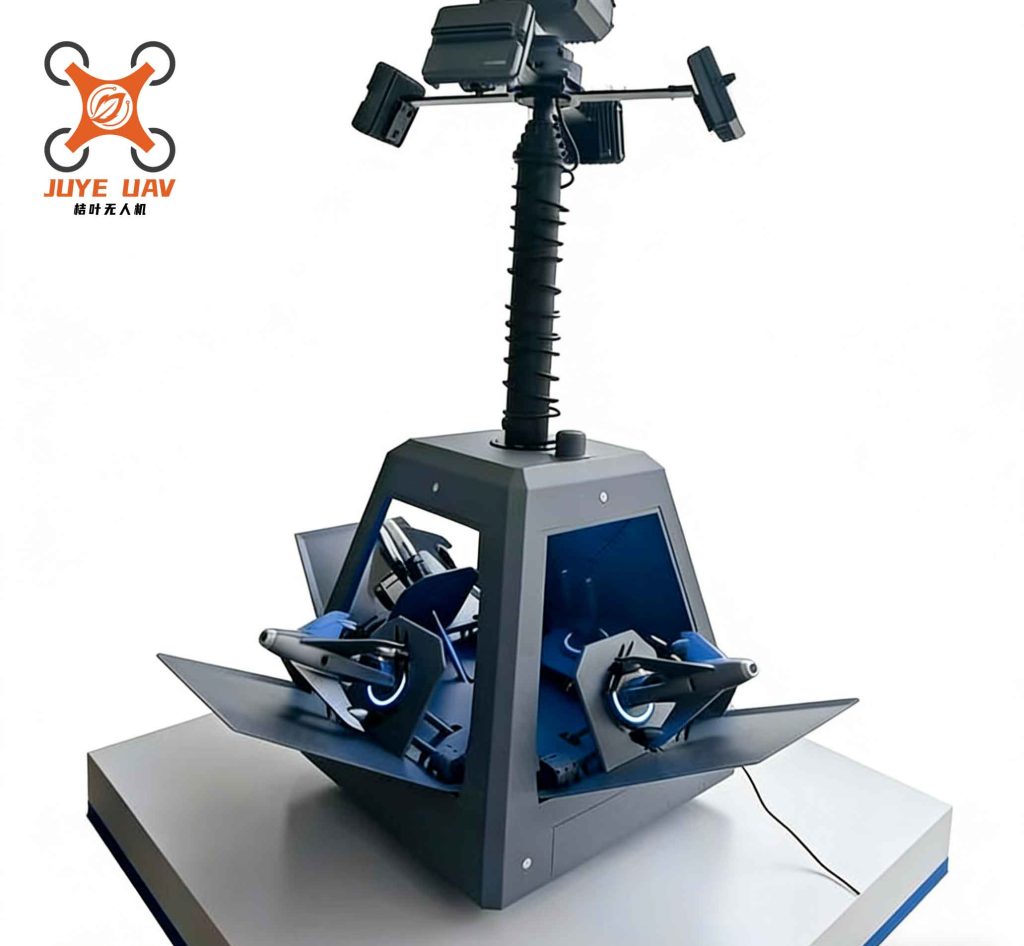
The operational concept chart for anti-UAV cyber-electromagnetic countermeasures describes the high-level mission, forces, and actions involved. The primary mission is to eliminate UAV threats, relying on intelligence as the basis, command as the core, and actions as the key. Anti-UAV operations are conducted under the command and control of operational agencies, utilizing intelligence from reconnaissance and early warning forces to execute cyber-electromagnetic actions against UAVs. This involves several key entities: the anti-UAV command organization, reconnaissance and early warning forces, cyber-electromagnetic attack forces, and the incoming UAVs themselves. The command organization includes positions such as the integrated planning unit, force control unit, cyber-electromagnetic unit, and intelligence support unit within the operational command center. These units collaborate to analyze UAV threats, develop anti-UAV plans, and coordinate attacks. Reconnaissance forces, comprising electronic warfare reconnaissance stations, technical reconnaissance stations, network reconnaissance, radar, infrared detection devices, optical and visual observation equipment, and acoustic monitoring devices, gather intelligence on UAV type, activity patterns, location, intentions, payload capabilities, and support systems. Cyber-electromagnetic attack forces, including electronic jamming, electronic destruction, network attack, and deception units, execute actions based on command directives. The incoming UAVs, consisting of the platform, payload, and support systems, are the primary targets. This conceptual framework ensures a holistic approach to anti-UAV operations, where continuous monitoring and adaptive responses are vital. For instance, the probability of detecting a UAV can be modeled using an exponential distribution: $$ P_d(t) = 1 – e^{-\lambda t} $$ where $P_d(t)$ is the detection probability at time $t$, and $\lambda$ is the detection rate parameter dependent on sensor capabilities. This formula helps in assessing the effectiveness of reconnaissance forces in anti-UAV scenarios.
To quantify the effectiveness of anti-UAV cyber-electromagnetic actions, we can use a weighted sum model. Let $E$ represent the overall effectiveness, $J$ the jamming intensity, $D$ the destruction level, $N$ the network attack success rate, and $C$ the deception impact. Then, $$ E = \alpha J + \beta D + \gamma N + \delta C $$ where $\alpha$, $\beta$, $\gamma$, and $\delta$ are weighting coefficients that sum to 1, reflecting the relative importance of each action in anti-UAV operations. These coefficients can be adjusted based on UAV type and mission context, ensuring tailored anti-UAV strategies.
| Entity | Role | Primary Functions |
|---|---|---|
| Command Organization | Coordination and Decision-making | Analyze threats, plan actions, control forces |
| Reconnaissance Forces | Intelligence Gathering | Detect, identify, track UAVs |
| Cyber-Electromagnetic Forces | Attack Execution | Jam, destroy, hack, deceive UAVs |
| Incoming UAVs | Target | Platform, payload, support systems |
The organizational relationship chart delineates the command structure and hierarchical relationships within the anti-UAV operational system. It uses a functional tree model to represent the command levels, responsibilities, and coordination mechanisms. The anti-UAV command agency, typically the command post, oversees the entire operation. Under it, the operational command center includes units for integrated planning, force control, and cyber-electromagnetic operations, each with specific duties related to anti-UAV tasks. The reconnaissance and early warning forces, and the cyber-electromagnetic attack forces, are subordinate units that execute commands. This structure ensures clear lines of authority and efficient resource allocation for anti-UAV missions. For example, the command hierarchy can be represented as a tree where the root is the command post, and branches include intelligence, planning, and attack units. This facilitates rapid decision-making in dynamic anti-UAV environments. The effectiveness of command and control can be assessed using a responsiveness metric: $$ R = \frac{1}{T_c + T_e} $$ where $T_c$ is the command delay and $T_e$ is the execution delay. Minimizing these delays is critical for successful anti-UAV operations, as UAV threats often require immediate responses.
| Level | Unit | Responsibilities | Subordinates |
|---|---|---|---|
| Top | Command Post | Overall command and coordination | Operational Command Center |
| Middle | Operational Command Center | Planning, control, cyber operations | Integrated Planning, Force Control, Cyber Units |
| Lower | Reconnaissance Forces | Gather UAV intelligence | Electronic, Network, Radar, Optical Units |
| Lower | Cyber-Electromagnetic Forces | Execute attacks on UAVs | Jamming, Destruction, Network, Deception Units |
The operational node connectivity chart illustrates the nodes involved in anti-UAV cyber-electromagnetic countermeasures and their interrelationships. Nodes represent collections of personnel, equipment, and forces performing specific tasks. Key nodes include the command post’s intelligence support unit, integrated planning unit, force control unit, cyber-electromagnetic unit, reconnaissance forces, and cyber-electromagnetic attack forces. Connectivity lines indicate requirements and interactions, such as command directives, intelligence reports, and coordination signals. For instance, the intelligence support node provides UAV threat data to the planning node, which then formulates anti-UAV strategies for the attack nodes. This connectivity ensures seamless information flow and operational synergy. To model node interactions, we can use a network graph where nodes $N_i$ are connected by edges $E_{ij}$ representing information exchange. The robustness of this network can be measured by its connectivity index: $$ C = \sum_{i,j} w_{ij} \cdot f(E_{ij}) $$ where $w_{ij}$ is the weight of the connection between nodes $i$ and $j$, and $f$ is a function of exchange frequency. High connectivity enhances anti-UAV operational efficiency by reducing bottlenecks.
| Node | Description | Connected To | Requirement Type |
|---|---|---|---|
| Intelligence Support Unit | Fuses and analyzes UAV intelligence | Integrated Planning, Force Control | Intelligence Reports |
| Integrated Planning Unit | Develops anti-UAV plans and schemes | Cyber Unit, Force Control | Coordination Commands |
| Force Control Unit | Commands and controls attack forces | Reconnaissance Forces, Attack Forces | Operational Orders |
| Cyber-Electromagnetic Unit | Provides cyber expertise and coordination | Planning Unit, Attack Forces | Technical Guidance |
| Reconnaissance Forces | Collects UAV data | Intelligence Unit, Force Control | Surveillance Requests |
| Cyber-Electromagnetic Attack Forces | Executes anti-UAV actions | Force Control, Cyber Unit | Attack Commands |
The operational information exchange matrix details the specific information flows between nodes, including content, media, attributes, and interoperability levels. It refines the connectivity chart by specifying what information is exchanged, how, and why. This matrix is crucial for ensuring that all nodes have the necessary data to perform their anti-UAV tasks effectively. For example, the intelligence support node sends UAV threat assessments to the planning node, while the attack nodes receive execution orders from the force control node. Information types include commands, reports, requests, and notifications, exchanged via secure communications channels. To optimize information exchange, we can use a latency model: $$ L_{ij} = \frac{D_{ij}}{B_{ij}} + P_{ij} $$ where $L_{ij}$ is the latency between nodes $i$ and $j$, $D_{ij}$ is the data size, $B_{ij}$ is the bandwidth, and $P_{ij}$ is the processing delay. Minimizing latency is essential for real-time anti-UAV operations, as delays can compromise response times against fast-moving UAVs.
| From Node | To Node | Information Type | Content Description | Exchange Media |
|---|---|---|---|---|
| Intelligence Support Unit | Integrated Planning Unit | Report | UAV threat analysis and assessments | Secure Data Link |
| Integrated Planning Unit | Cyber-Electromagnetic Unit | Coordination | Anti-UAV plan details and schemes | Command Network |
| Force Control Unit | Cyber-Electromagnetic Attack Forces | Command | Execution orders for jamming or destruction | Radio Frequency |
| Reconnaissance Forces | Intelligence Support Unit | Request | Surveillance data on UAV movements | Sensor Networks |
| Cyber-Electromagnetic Unit | Attack Forces | Guidance | Technical parameters for cyber attacks | Encrypted Channels |
| Attack Forces | Force Control Unit | Report | Status of anti-UAV actions and results | Feedback Loop |
The operational activity chart decomposes the anti-UAV cyber-electromagnetic countermeasures into specific actions and sub-actions. It describes the overall operational process and how tasks are allocated across nodes. Primary activities include reconnaissance and early warning actions, command and control actions, cyber-electromagnetic attack actions, and operational effectiveness assessment actions. Each activity is further divided: for example, reconnaissance actions encompass electronic reconnaissance, network reconnaissance, technical intelligence, radar detection, photoelectric detection, optical and visual observation, and acoustic monitoring. Command and control actions involve planning, decision-making, and coordination. Attack actions include electronic jamming, electronic destruction, network attacks, and deception. Assessment actions involve data collection and evaluation conclusion determination. This hierarchical breakdown ensures that all aspects of anti-UAV operations are covered. To model activity efficiency, we can use a performance metric: $$ P_a = \frac{S_a}{T_a} $$ where $P_a$ is the performance of activity $a$, $S_a$ is the success rate, and $T_a$ is the time taken. Optimizing $P_a$ is key to enhancing anti-UAV operational outcomes, as faster and more accurate actions reduce UAV threat persistence.
| Primary Activity | Secondary Activity | Description | Responsible Node |
|---|---|---|---|
| Reconnaissance and Early Warning | Electronic Reconnaissance | Detect UAV signals and emissions | Reconnaissance Forces |
| Network Reconnaissance | Monitor UAV communication networks | Reconnaissance Forces | |
| Radar Detection | Track UAV position and trajectory | Reconnaissance Forces | |
| Optical Observation | Visual identification of UAVs | Reconnaissance Forces | |
| Command and Control | Planning | Develop anti-UAV strategies and plans | Integrated Planning Unit |
| Decision-making | Approve actions based on intelligence | Command Post | |
| Coordination | Synchronize forces and resources | Force Control Unit | |
| Cyber-Electromagnetic Attack | Electronic Jamming | Disrupt UAV control and navigation | Attack Forces |
| Electronic Destruction | Physically damage UAV components | Attack Forces | |
| Network Attack | Hack into UAV systems for control | Attack Forces | |
| Deception | Mislead UAV sensors and operators | Attack Forces | |
| Effectiveness Assessment | Data Collection | Gather post-action data on UAV status | Intelligence Support Unit |
| Evaluation | Assess success and recommend adjustments | Command Post |
The operational state transition chart describes the sequence and relationships of states in anti-UAV cyber-electromagnetic countermeasures. States represent phases of the operation, from initiation to completion. Key states include reconnaissance and early warning, situation analysis and judgment, decision-making and planning, control and coordination, cyber-electromagnetic attack, and effectiveness assessment. Transitions between states occur based on events such as UAV detection, plan approval, attack execution, and evaluation results. For instance, the operation starts in the reconnaissance state, where UAVs are detected; then moves to analysis, where threats are assessed; followed by planning, where anti-UAV strategies are formulated; then to control, where forces are directed; then to attack, where actions are executed; and finally to assessment, where outcomes are evaluated. If the assessment indicates success, the operation may end; otherwise, it may loop back to earlier states for further actions. This state machine ensures a structured approach to anti-UAV operations. We can model this using a Markov chain, where each state $S_i$ transitions to $S_j$ with probability $P_{ij}$. For example, the probability of transitioning from attack to assessment might be high if the attack is executed, but it could revert to reconnaissance if new UAVs appear. The steady-state probabilities can be calculated to optimize resource allocation: $$ \pi = \pi P $$ where $\pi$ is the stationary distribution vector and $P$ is the transition matrix. This helps in predicting long-term anti-UAV operational demands.
To further elaborate, let’s consider mathematical models for anti-UAV effectiveness. The probability of neutralizing a UAV through cyber-electromagnetic means can be expressed as: $$ P_n = P_d \cdot P_a \cdot P_k $$ where $P_d$ is the detection probability (as earlier defined), $P_a$ is the probability of successful attack given detection, and $P_k$ is the kill probability given a successful attack. Each component can be refined based on specific anti-UAV techniques. For instance, $P_a$ for electronic jamming might depend on jamming-to-signal ratio: $$ P_a = \frac{1}{1 + e^{-k(JSR – \theta)}} $$ where $JSR$ is the jamming-to-signal ratio, $k$ is a sensitivity parameter, and $\theta$ is a threshold. This logistic function models how jamming effectiveness increases with ratio. Similarly, for network attacks, $P_a$ could relate to vulnerability exploitation rates. Such formulas enable quantitative analysis of anti-UAV strategies, allowing for comparisons and improvements.
| From State | To State | Transition Condition | Probability Estimate |
|---|---|---|---|
| Reconnaissance | Situation Analysis | UAV detected and identified | 0.9 |
| Situation Analysis | Decision-making | Threat assessment completed | 0.85 |
| Decision-making | Control | Anti-UAV plan approved | 0.95 |
| Control | Attack | Forces deployed and ready | 0.8 |
| Attack | Effectiveness Assessment | Attack executed | 1.0 |
| Effectiveness Assessment | Reconnaissance | New UAV threat identified | 0.4 |
| Effectiveness Assessment | End | UAV threat eliminated | 0.6 |
In addition to probabilistic models, optimization techniques can be applied to anti-UAV resource allocation. For example, suppose we have limited jamming resources to counter multiple UAVs. We can formulate a linear programming problem to maximize the overall neutralization probability. Let $x_{ij}$ be the amount of jamming resource allocated from node $i$ to UAV $j$, and $c_{ij}$ be the cost or effectiveness coefficient. The objective is: $$ \text{Maximize} \sum_{i,j} c_{ij} x_{ij} $$ subject to constraints such as $\sum_j x_{ij} \leq R_i$ (resource limits at node $i$) and $\sum_i x_{ij} \geq T_j$ (minimum resource required for UAV $j$). Solving this helps in efficient anti-UAV deployment, ensuring that critical threats are prioritized.
Furthermore, the integration of cyber and electromagnetic domains in anti-UAV operations necessitates a hybrid approach. We can define a synergy factor $S$ that measures the combined effect: $$ S = \omega_c E_c + \omega_e E_e + \omega_{ce} E_c E_e $$ where $E_c$ is cyber effectiveness, $E_e$ is electromagnetic effectiveness, $\omega_c$ and $\omega_e$ are weights, and $\omega_{ce}$ is an interaction term. This captures how cyber and electromagnetic actions complement each other in anti-UAV scenarios, such as using network attacks to weaken UAV defenses before jamming. Empirical data from anti-UAV exercises can be used to calibrate these parameters.
The operational view also emphasizes continuous improvement through feedback loops. After each anti-UAV engagement, data is collected and analyzed to update tactics and technologies. This iterative process can be modeled as a control system with feedback gain. Let $U(t)$ be the anti-UAV action at time $t$, $Y(t)$ be the observed outcome, and $E(t)$ be the error (desired vs. actual). Then, the adjusted action is: $$ U(t+1) = U(t) + K \cdot E(t) $$ where $K$ is the feedback gain. A higher $K$ leads to faster adaptation but may cause instability; thus, tuning $K$ is crucial for robust anti-UAV operations. This adaptive control approach ensures that anti-UAV strategies evolve with emerging UAV threats.
To summarize, the operational view of anti-UAV cyber-electromagnetic countermeasures provides a comprehensive framework for understanding and executing anti-UAV missions. By leveraging charts, matrices, and mathematical models, we can enhance decision-making, coordination, and effectiveness. The frequent use of the term ‘anti-UAV’ underscores the focus on countering UAV threats through integrated cyber-electromagnetic means. Future research could explore real-time simulation platforms for anti-UAV training, or advanced AI algorithms for predictive threat analysis. As UAV technology advances, so must our anti-UAV capabilities, ensuring dominance in modern battlespaces.