
As I consider the evolution of contemporary warfare, I am struck by the profound mediation brought about by the military drone. It is no longer merely a weapon or a surveillance tool; it has become a complex apparatus that fundamentally reshapes how action is executed, memory is formed, and reality is represented. The conflict in Ukraine has starkly illustrated this, often being described as the first full-scale drone war. This shift compels me, as someone analyzing media and perception, to look beyond the surface of the circulating images. I must look back to the very genesis of this communication, to the visual medium itself. The core question that occupies my thinking is this: how does the act of operation unify the functions of “seeing-remembering-acting” within the military drone apparatus? And crucially, how is the human operator’s consciousness and body positioned within this technical system? What kind of bodily experience underlies the image?
For too long, discourse surrounding the military drone has been dominated by an ocularcentric paradigm. This perspective, implicitly modeled on the cinematic apparatus, privileges the “gaze.” The drone is metaphorically cast as a Gorgon, whose destructive power emanates from its vision alone. This framework abstracts warfare into a binary relationship of seeing/being seen, of surveillance and control, epitomized by the panoptic model. While powerful for social critique, this visual reductionism, I argue, obscures a more fundamental dimension. It severs vision from the other senses and from the body’s capacity for action. In this discourse, the military drone operator is often rendered as a disembodied eye, and the act of killing is mystified as a magical consequence of a malevolent look. This overlooks a crucial fact: the drone is not just a seeing machine but an acting machine, and its interface demands an operational engagement from a situated, sensing body.
To understand this, I find it necessary to suspend the assumptions of visual-centrism and return to the phenomenon itself. I turn to a phenomenology of gestures. A gesture, understood here, is a movement of the body or of a tool attached to the body. It is a meaningful, intentional action that cannot be fully explained by causal mechanics but requires interpretation within its context. The classical “gaze” of the cinema spectator—fixed in a seat, passively receiving a pre-ordained visual narrative—is one such gesture. The military drone interface, however, elicits a different primary gesture: aiming. This shift from gazing to aiming signifies a fundamental reconstitution of the human-image-apparatus relationship. The theoretical object is no longer the image-as-text to be interpreted, but the operational image as an integral part of a feedback loop.
The military drone system is a synthesis of bodily prostheses. Historically, its development reveals a stitching together of distinct human faculties. Early “aerial torpedoes” were pure action, extensions of the arm’s capacity to strike. Later reconnaissance drones added the eye’s function of distant vision, but with a critical delay—images were captured on film, recovered, and analyzed. This process was hermeneutic; the world was translated into a text (the photograph, the map) to be read and interpreted. The operator’s position was external to the image, akin to a film editor or analyst.
The revolution came with real-time video transmission. This created a cybernetic feedback loop, a distributed perceptual system. The operator’s body, via the Ground Control Station (GCS) interface, the drone, and its sensors, forms a continuous circuit. My intention, expressed through a bodily gesture (moving a joystick), is translated into the drone’s movement in the battlefield environment. The visual feedback from that environment is streamed back to my screen, informing my next micro-decision and gesture. This is the “kill chain” as a lived, perceptual process, not just a schematic. The relationship can be modeled as a control loop:
$$
\text{Operator (O)} \xrightarrow[\text{Gesture}]{GCS} \text{Drone (D)} \xrightarrow[\text{Sensors}]{} \text{Environment (E)} \xrightarrow[\text{Video Feed}]{} \text{O}
$$
In this loop, my body is telepresent. It is distributed across multiple spaces: the physical space of the control station, the electronic space of the data stream, and the remote space of the drone’s operation. The GCS interface, especially the Heads-Up Display (HUD) overlay on the video feed, is designed for transparency and intuitive, embodied action. The joystick’s movements map intuitively to the drone’s flight dynamics and the camera’s pan/tilt/zoom. Through practice, the apparatus is incorporated into my body schema. The drone’s eye becomes “my” eye in that remote space; its trajectory feels like an extension of my own intentional movement. The interface, like a well-crafted hammer, becomes “ready-to-hand,” receding from my focal awareness.
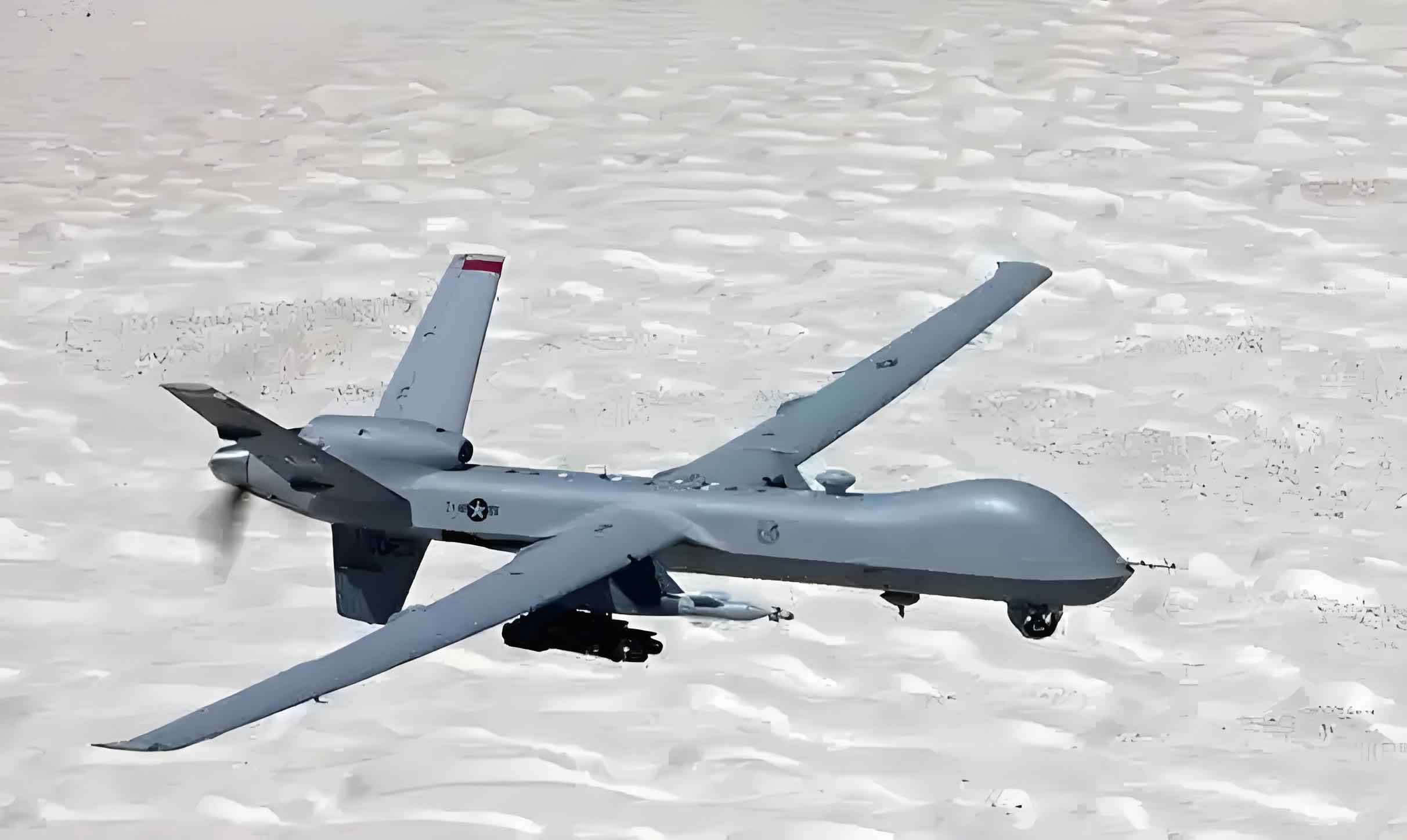
This embodied operation fundamentally reconfigures the sensory hierarchy established by visual media. In the operational mode, vision is subsumed under a broader, synesthetic tactile intentionality. When I look at the screen of a military drone, I am not merely “gazing” at representations. I am surveying a field of actionable objects. The crosshairs are not just a visual symbol; they are the focal point of a manual targeting gesture. The target on screen is perceived not first as a symbol to be decoded (a “soldier,” a “tank”), but as an object-to-be-touched, a point in space upon which my action will converge. Vision here is tactile and anticipatory. It is a vision that grips and manipulates, not just observes. This reunites the senses that film and photography had analytically separated. The following table contrasts the sensory configurations:
| Aspect | Cinematic/Photographic Gaze | Drone Operational Aiming |
|---|---|---|
| Primary Gesture | Passive Looking / Contemplation | Active Aiming / Manipulation |
| Body State | Immobile, Receptive | Mobile, Engaged (hands-on) |
| Sensory Mode | Vision Dominant & Isolated | Vision-Tactile-Action Synergy |
| Temporality | Past (recorded), Linear Narrative | Real-time, Continuous Feedback Loop |
| Image Status | Hermeneutic Text (to be read) | Operational Surface (to be acted upon) |
| Subject Position | Disembodied Spectator “outside” the image | Embodied Operator “inside” the operational field |
The operational image is thus a non-hermeneutic image. It resists being treated as a coded text. Its meaning is not unlocked through symbolic interpretation but through successful navigation and intervention in the feedback loop. The complex calculations of ballistics, telemetry, and object recognition are hidden within the “black box” of the apparatus’s software. For me, the operator, the world is rendered as an intuitive, quasi-direct perceptual field. I act through the image, not upon its symbolic meaning. This creates a powerful and dangerous form of transparency. The interface becomes a window I reach through, annihilating the mediating distance that the contemplative gaze maintained. The ethical violence of the military drone lies not simply in making killing easier, but in this radical tactile reduction of the other—who appears on screen not as a complex human signifier but as a targetable coordinate within my embodied motor intentionality.
This leads to the formation of what I can term a distributed subject. In the operational circuit, my subjectivity is not confined to my organic body in the control station. It is diffused across the network: my will is in the commands sent, my perception is in the drone’s sensors, and my agency is in the weapon’s release. The identification is not with a camera’s symbolic perspective (as in film theory), but with the functional unity of the entire apparatus. I become the drone-plane-weapon system. This can be expressed as a form of identification:
$$
\text{Operator Identity (O\_id)} \propto \int (\text{Bodily Gesture} + \text{Interface Transparency} + \text{Drone Response}) \, dt
$$
Where the integration over time (\(dt\)) signifies the continuous, real-time feedback that binds my consciousness to the machine’s actions. The military drone interface, therefore, materializes a new human-world relationship fostered by digital technology. The world is not just represented as a picture (\( \text{World} \rightarrow \text{Image} \)), as Heidegger described the modern age. It is rendered as an operational domain (\( \text{World} \rightarrow \text{Operational Field} \)). The image is the primary site of this rendering, but it is an image whose purpose is to disappear as a mediating layer, to become a perfectly responsive extension of my bodily senses into any point in physical or even virtual space.
In conclusion, analyzing the military drone through the lens of gesture phenomenology reveals a significant shift in the regime of perception and agency. Moving beyond the limitations of the visual-centric “gaze,” we uncover an embodied practice of “aiming” that is orchestrated through the interactive interface. This operation unifies the multiple functions of the apparatus and the human body, creating a telepresent, distributed subject. Within this framework, vision is dethroned from its solitary, transcendent status and reintegrated into a holistic sensory-motor engagement with the world. The operational image of the military drone acts as a transparent surface for action, simultaneously revealing a world rendered as an immediate field of intervention while concealing the complex, textual code that makes this transparency possible. The profound implication is that our very mode of being-in-the-world is being reconfigured by such interfaces, collapsing distances not through symbolic understanding, but through an electronic tactile grasp that promises total control while posing unprecedented ethical and existential challenges. The body of the operator is disciplined into the system’s logic, while the body of the target is reduced to an operand in a programmed field. This is the new condition of communication and conflict that the military drone so starkly embodies.