
In my analysis of recent developments in the nuclear sector, I have witnessed a transformative shift toward integrating advanced technologies to enhance safety and security. This evolution is particularly evident in emergency preparedness frameworks and the rising emphasis on countering unmanned aerial threats. As a observer of these trends, I aim to delve into the intricacies of these changes, emphasizing how they reshape nuclear facility operations globally. The increasing reliance on anti-drone systems, for instance, underscores a proactive approach to mitigating risks in an era where drone intrusions pose significant challenges. Throughout this discussion, I will incorporate technical insights, using formulas and tables to summarize key points, while repeatedly highlighting the critical role of anti-drone measures in modern nuclear security paradigms.
The nuclear industry has long grappled with balancing innovation with stringent safety protocols. From my perspective, the advent of modular small reactors and other advanced designs necessitates regulatory adaptations. In the United States, the recent approval of new emergency preparedness rules marks a pivotal moment. These rules, set for release by the end of 2023, are designed to be technology-inclusive and performance-based, moving away from one-size-fits-all mandates tailored for traditional large light-water reactors. This shift allows for tailored emergency planning zones based on reactor characteristics, potentially reducing deployment costs and expanding siting options. To illustrate, consider the relationship between reactor safety parameters and emergency zone sizing. One can model this using a simplified formula for risk assessment: $$ R_e = k \cdot \frac{P_f \cdot C}{S_i} $$ where \( R_e \) represents the emergency plan radius, \( k \) is a regulatory constant, \( P_f \) denotes the probability of failure, \( C \) is the consequence factor (e.g., population density), and \( S_i \) is the inherent safety level. For small modular reactors with passive safety features, \( S_i \) increases significantly, leading to a smaller \( R_e \), as shown in the table below.
| Reactor Type | Inherent Safety Level (S_i) | Typical Emergency Radius (miles) | Impact on Siting |
|---|---|---|---|
| Traditional Large LWR | Moderate | 10 | Restricted to remote areas |
| Advanced SMR | High | ≤ 5 (adjustable) | Feasible near urban centers |
| Experimental Reactors | Variable | Case-by-case basis | Flexible deployment |
This regulatory change, in my view, reduces uncertainty for developers who previously faced the burden of preparing dual licensing documents. By aligning rules with technological realities, it fosters innovation while maintaining safety—a balance I find crucial for the nuclear renaissance. However, this progress is just one facet of a broader security landscape, where threats from unauthorized drones necessitate robust anti-drone strategies. As I explore further, the integration of drone technology for monitoring and defense becomes paramount, with anti-drone systems emerging as a linchpin in safeguarding critical infrastructure.
Turning to the United Kingdom, I have noted pioneering efforts in leveraging drones for radiation monitoring at nuclear sites. The use of drones equipped with Light Detection and Ranging sensors and radiation detectors represents a leap in operational efficiency. From my examination, these unmanned systems enable rapid data collection for 3D modeling and radiation heat mapping, accelerating decommissioning processes and minimizing human exposure to hazardous environments. The technical specifications can be summarized in a table to highlight their capabilities.
| Drone Component | Function | Benefit in Nuclear Context |
|---|---|---|
| LiDAR Sensor | High-resolution spatial mapping | Enables precise 3D models of facilities |
| Radiation Detector | Real-time radiation measurement | Generates heat maps for contamination zones |
| Autonomous Flight System | Pre-programmed patrols | Reduces manpower needs and risks |
In my assessment, the efficiency gain from such drones can be quantified using a formula for data acquisition rate: $$ D_r = \frac{A_c \cdot N_s}{t_f} $$ where \( D_r \) is the data rate in square meters per hour, \( A_c \) is the coverage area per scan, \( N_s \) is the number of sensors, and \( t_f \) is the flight time. This approach not only enhances safety but also complements anti-drone initiatives by providing a surveillance backbone. However, as drones become tools for good, they also pose security risks if misused, making anti-drone measures indispensable. I believe this dual use underscores the need for comprehensive strategies that integrate monitoring drones with defensive anti-drone systems to create a resilient security envelope.
The focus on anti-drone technologies intensifies in South Korea, where multiple nuclear power plants have deployed systems to detect and intercept unauthorized drones. From my observations, these anti-drone frameworks utilize radio frequency scanners and handheld jammers to neutralize threats within a 3-kilometer perimeter. The effectiveness of such anti-drone systems can be analyzed through probabilistic models. For instance, the detection probability \( P_d \) for an intruding drone follows a Poisson distribution: $$ P_d = 1 – e^{-\lambda \cdot t} $$ where \( \lambda \) is the arrival rate of drone signals, and \( t \) is the scanning time. Similarly, the interception success rate \( P_i \) depends on jamming power and drone resilience: $$ P_i = \frac{J_p}{D_r + \epsilon} $$ with \( J_p \) as jamming power, \( D_r \) as drone resistance, and \( \epsilon \) as environmental factors. To contextualize, below is a table comparing anti-drone system components across applications.
| Anti-Drone Component | Detection Method | Interception Range | Use in Nuclear Plants |
|---|---|---|---|
| RF Scanner | Signal frequency analysis | Up to 5 km | Identifies unauthorized drones early |
| Handheld Jammer | Radio wave disruption | 1-3 km | Neutralizes drones in restricted zones |
| Integrated Radar | Motion tracking | 10 km+ | Enhanced monitoring for large facilities |
In my perspective, the deployment of these anti-drone systems reflects a proactive stance against evolving threats, with nuclear facilities prioritizing such defenses due to their criticality. The term anti-drone resonates throughout this discussion because, as I see it, these systems are not merely add-ons but essential layers of protection. For example, the synergy between drone-based monitoring and anti-drone interception creates a dynamic security matrix. Visualizing this, consider the following representation of an anti-drone setup in action.
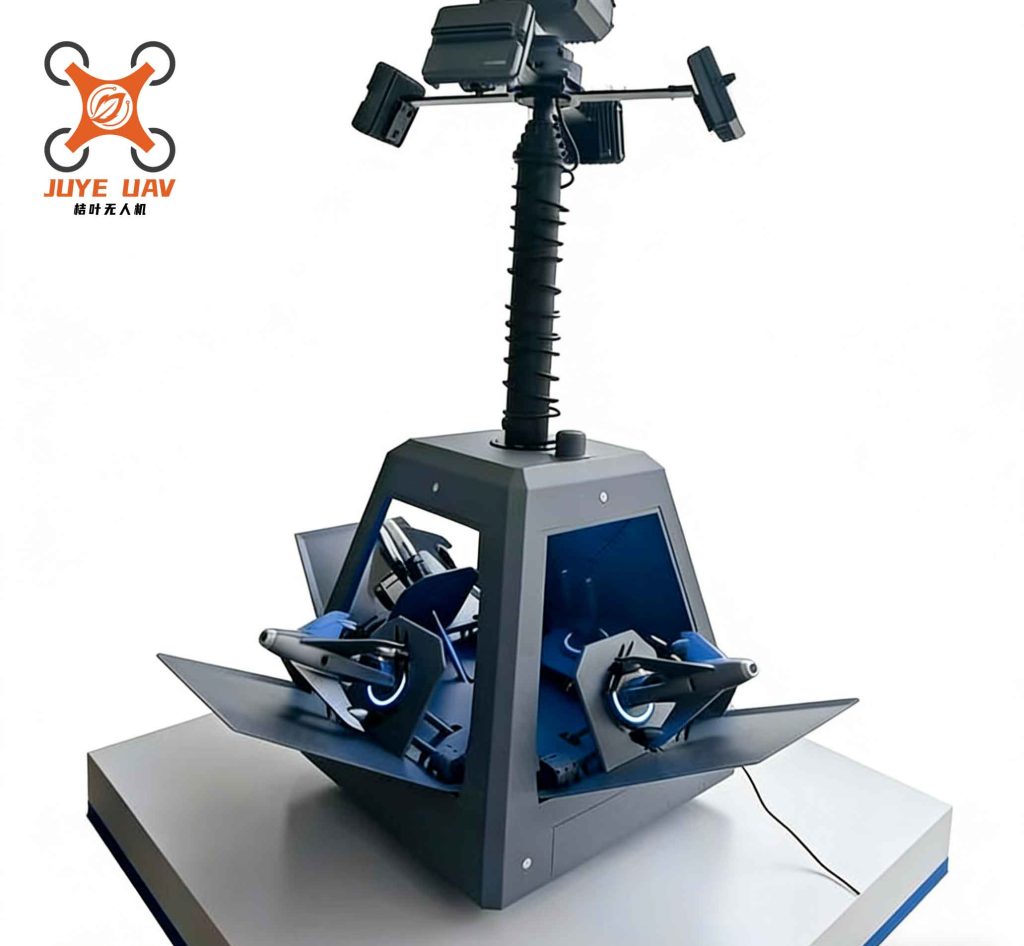
This image illustrates the sophistication of modern anti-drone technologies, which I find integral to hardening nuclear sites against intrusions. As I delve deeper, the global trend toward anti-drone adoption becomes apparent, with countries investing in research to counter drone threats. From my analysis, the effectiveness of anti-drone measures hinges on continuous innovation, as drones themselves evolve in capability. Thus, nuclear security must embrace a holistic approach, blending regulatory updates like those in the U.S., monitoring advancements from the U.K., and robust anti-drone frameworks from South Korea.
Expanding on the technical aspects, I consider the mathematical modeling of nuclear safety and anti-drone efficacy crucial for informed decision-making. For radiation safety, the dose rate \( D \) from a source can be expressed as: $$ D = \frac{S \cdot \Gamma}{r^2} $$ where \( S \) is the source strength, \( \Gamma \) is the specific gamma constant, and \( r \) is the distance. This formula underscores why drones with detectors are valuable for remote monitoring, reducing human exposure. Conversely, in anti-drone scenarios, the signal-to-noise ratio \( SNR \) for detection is: $$ SNR = \frac{P_t \cdot G_t}{N_0 \cdot B} $$ with \( P_t \) as transmitted power, \( G_t \) as antenna gain, \( N_0 \) as noise density, and \( B \) as bandwidth. High SNR enhances anti-drone system reliability, a point I emphasize given the stakes in nuclear security.
From a broader viewpoint, I observe that the integration of these technologies fosters a new era of nuclear facility management. The table below summarizes global initiatives and their alignment with anti-drone priorities.
| Country | Initiative | Key Technology | Anti-Drone Relevance |
|---|---|---|---|
| USA | Emergency preparedness rules for advanced reactors | Performance-based frameworks | Indirectly supports anti-drone planning via flexible siting |
| UK | Radiation monitoring drones | LiDAR and detectors | Enhances surveillance, complementing anti-drone efforts |
| South Korea | Anti-drone system deployment at plants | RF scanners and jammers | Direct anti-drone implementation for threat neutralization |
In my assessment, the repeated mention of anti-drone measures here is intentional, as they represent a critical thread in the security tapestry. As I reflect on these developments, the future of nuclear security seems increasingly intertwined with autonomous systems and real-time response capabilities. For instance, the concept of a networked anti-drone grid, where multiple sensors and interceptors collaborate, can be modeled using game theory: $$ U = \sum_{i=1}^{n} (B_i – C_i) $$ where \( U \) is the utility of the anti-drone network, \( B_i \) is the benefit from neutralizing threat \( i \), and \( C_i \) is the cost of deployment. Optimizing this utility requires continuous adaptation, a challenge I believe the industry is poised to meet.
To conclude, from my first-person perspective, the evolution of nuclear security is a multifaceted journey marked by regulatory innovation, technological adoption, and an unwavering focus on anti-drone capabilities. The stories from the U.S., U.K., and South Korea illustrate a global commitment to enhancing safety through tailored rules, drone-based monitoring, and proactive anti-drone defenses. As I emphasize throughout, anti-drone systems are not just optional extras but essential components in safeguarding against modern threats. By leveraging formulas for risk assessment and tables for comparative analysis, we can better understand these dynamics and drive progress toward a safer nuclear future. The integration of these elements, I am convinced, will define the next generation of nuclear facility security worldwide.