
My research focuses on the aerodynamic noise and electric power consumption of unmanned aerial vehicles (UAVs), which have become indispensable in logistics, agriculture, surveillance, and urban air mobility. As UAV operations expand into residential and noise‐sensitive environments, the noise emitted by their rotors has emerged as a critical barrier to public acceptance and regulatory approval. In this thesis I developed a high‑fidelity numerical framework that couples Detached Eddy Simulation (DES) with the Ffowcs Williams–Hawkings (FWH) acoustic analogy to predict both the aerodynamic performance and the far‑field noise of various UAV rotor configurations. I applied this framework to a single rotor, a quadrotor, and a quadrotor carrying a delivery payload. My findings quantify how rotor configuration and payload attachment alter lift, torque, electrical power demand, and sound pressure levels at different observer positions. In the following sections I present the mathematical foundations, the hybrid DES‑FWH methodology, the simulation setup, and the results for each configuration, emphasizing the interplay between rotor aerodynamics, acoustic emissions, and electric power consumption.
The growing interest in unmanned aerial vehicles for package delivery has introduced new challenges in environmental noise control. My literature review revealed that most existing studies rely on experimental measurements or simplified empirical models, which are often expensive or limited in their ability to capture the unsteady turbulence responsible for broadband noise. High‑fidelity methods such as Large Eddy Simulation (LES) and Direct Numerical Simulation (DNS) provide excellent accuracy but remain computationally prohibitive for full‑scale UAV rotors. I therefore adopted DES as a hybrid RANS‑LES approach that resolves the energetic turbulent structures in the rotor wake while retaining computational efficiency. To predict the sound radiated to distant observers, I used the FWH acoustic analogy, which transforms near‑field pressure and velocity fluctuations into far‑field sound pressure levels. This combination allows me to analyze both tonal noise from periodic blade passage and broadband noise from turbulence–blade interactions in a single framework.
The governing equations of my methodology begin with the Navier–Stokes equations for a compressible, Newtonian fluid. The continuity and momentum equations are:
$$ \frac{\partial \rho}{\partial t} + \nabla \cdot (\rho \mathbf{u}) = 0 $$
$$ \frac{\partial (\rho \mathbf{u})}{\partial t} + \nabla \cdot (\rho \mathbf{u} \otimes \mathbf{u}) = -\nabla p + \nabla \cdot \boldsymbol{\tau} + \rho \mathbf{f} $$
In the DES formulation, the total stress tensor is decomposed into a Reynolds‑averaged part near solid walls and a subgrid‑scale part in detached flow regions. The turbulent kinetic energy transport equation is used to model the unresolved scales:
$$ \frac{\partial (\rho k)}{\partial t} + \nabla \cdot (\rho \mathbf{u} k) = \nabla \cdot (\mu_T \nabla k) + P_k – \epsilon $$
The Smagorinsky subgrid‑scale model closes the LES branch, while the RANS branch uses the shear‑stress transport (SST) model to handle boundary‑layer turbulence. A switching function based on local grid spacing and the LES filter width controls the transition between the two branches:
$$ \text{Switching} = \min \left(1, \frac{\Delta_v}{\Delta_{LES}}\right) $$
This hybrid nature is crucial for rotor flows because the near‑wall region is characterized by attached, relatively steady turbulence, whereas the rotor wake contains large‑scale vortical structures that must be resolved to predict noise generation accurately.
For acoustic prediction, the FWH equation provides a direct link between the unsteady flow field on a permeable or solid surface and the acoustic pressure at any observer point. The general form of the FWH equation I employed is:
$$ \frac{\partial^2 p’}{\partial t^2} – \nabla^2 p’ = \rho_0 \frac{\partial^2}{\partial t^2} \left[ \frac{1}{\rho_0} \mathbf{1}(f) \mathbf{f} \cdot \mathbf{n} \right] $$
The source terms are decomposed into monopole, dipole, and quadrupole contributions. For low‑speed UAV rotors, the dipole term, which arises from unsteady pressure forces on the blade surfaces, dominates the low‑frequency tonal noise. The monopole contribution accounts for volume displacement, and the quadrupole term becomes important at higher tip speeds. The far‑field pressure at a distance \(r\) is computed by surface integration of the force distribution:
$$ p_{\mathrm{far}} = \frac{1}{4\pi r} \int_S \left( \hat{\mathbf{n}} \cdot \frac{\partial \mathbf{u}}{\partial t} \right) dA $$
The total acoustic power radiated by a rotor is calculated from the surface integral of the dot product of force and velocity:
$$ P = \int_S \mathbf{f} \cdot \mathbf{u} \, dA $$
Finally, the blade‑passing frequency (BPF) component of the noise spectrum is given by:
$$ p_{\mathrm{BPF}} = \frac{\rho_0}{4\pi} \frac{\omega_{\mathrm{BPF}}}{r^2} $$
These equations formed the backbone of my simulation workflow. I implemented the DES‑FWH framework in ANSYS Fluent 2022 R1. The computational domain consisted of a stationary outer region and one or more rotating sub‑domains, each containing a rotor. A sliding‑mesh technique was used to simulate the actual motion of the rotor blades relative to the fixed frame. The grid was refined near the blade surfaces and in the near‑wake region to resolve the boundary layers and the trailing‑edge vorticity. All simulations were performed at a constant rotational speed of 8500 revolutions per minute (RPM), corresponding to an angular velocity of approximately 890 radians per second. This operating condition is representative of small UAV rotors used in delivery drones.
| Configuration | Total Lift (N) | Total Torque (Nm) | Electric Power (W) |
|---|---|---|---|
| Single rotor (8500 RPM) | 6.362 | 0.099 | 88.11 |
| Quadrotor (no payload) | 24.547 | 0.409 | 364.01 |
| Quadrotor with delivery box | 25.835 | 0.422 | 375.58 |
The above table summarizes the key aerodynamic and electrical metrics obtained from my simulations. For the single rotor, the torque was 0.099 N·m, yielding a power demand of 88.11 W. The quadrotor, with four identical rotors, produced a total lift of 24.547 N and a total torque of 0.409 N·m, requiring 364.01 W. When the same quadrotor carried a cargo box, the lift increased slightly to 25.835 N, but the torque rose to 0.422 N·m, pushing the power demand to 375.58 W. This represents a 3.17% increase in power consumption relative to the unloaded quadrotor. The increased power demand is primarily attributed to the additional drag and the altered pressure distribution on the rotors caused by the cargo box disturbing the inflow and the wake.
I first analyzed the aerodynamic performance of the single rotor at 8500 RPM. The lift curve shows a steady increase over the simulation time, reaching a stable average value. The torque curve exhibits a similar trend, confirming that the rotor is operating in a stable regime. The pressure distribution on the rotor blades shows a high‑pressure zone near the leading edge on the pressure side and a low‑pressure zone on the suction side, which is the primary source of lift. The velocity fields at several axial planes demonstrate that the rotor accelerates the flow downward, creating a uniform wake downstream. The axial velocity contours reveal the tip vortices that form at the blade tips; these vortices are the dominant sources of both aerodynamic losses and noise generation.
The acoustic analysis of the single rotor was conducted using the FWH analogy with observer points located at different distances from the rotor center. The noise spectrum at the first monitoring point shows a clear tonal peak at the blade‑passing frequency, which for a rotor with two blades at 8500 RPM is about 283 Hz. Above this tonal peak, the broadband noise gradually increases with frequency. The one‑third octave band analysis shows that the highest sound pressure level (SPL) occurs near 500 Hz, followed by a gradual roll‑off at higher frequencies. The spatial distribution of sound power indicates that the maximum noise is radiated near the rotor tip and in the near wake, consistent with the regions of high turbulence and tip vortex activity. The Q‑criterion iso‑surface visualizations show the coherent vortex structures shedding from the blade tips. These vortices are responsible for the interactional noise when they collide with downstream components or with the ground.
Moving to the quadrotor configuration, I simulated a UAV with four rotors arranged in a square pattern. Adjacent rotors rotate in opposite directions to cancel the gyroscopic torques. Each rotor was embedded in its own rotating sub‑domain, and the four rotating domains were placed inside a large stationary domain. The total mesh size was about 6.52 million cells for the rotor regions and 4.83 million cells for the outer domain, giving a grand total of approximately 11.34 million cells. The boundary conditions were identical to the single‑rotor case: velocity inlet, pressure outlet, and no‑slip walls on the rotor blades. The simulations were run for a sufficient number of iterations to achieve convergence, as indicated by the residuals and the oscillations of the lift and torque coefficients.
The quadrotor results showed that the lift and torque produced by each rotor are not identical, even though all rotors operate at the same RPM. This is due to the aerodynamic interaction between the rotors. The wake of one rotor can be ingested by the adjacent rotor, altering its effective angle of attack and, consequently, its thrust and torque. My velocity field plots at different axial planes clearly show the merging of the individual rotor wakes downstream of the UAV. The pressure distributions on the rotor surfaces are asymmetric, with higher loading on the rotors that receive airflow from the neighboring rotor wakes. These interactions not only affect the aerodynamic performance but also produce additional noise sources, as the fluctuating pressure on each blade becomes more complex.
The acoustic field of the quadrotor was evaluated at six monitoring points located at various distances from the UAV center. The results show that the quadrotor is significantly louder than the single rotor, but the increase is not simply four times the single‑rotor SPL, because the individual noise sources are partially correlated and partially random. The measured SPL at the closest observer increased from 77.87 dB for the single rotor to 102.18 dB for the quadrotor, an increase of about 24 dB. This is much less than the theoretical 12 dB addition that would result from four uncorrelated equal‑strength sources (which would be about 6 dB for four sources, depending on the reference). The observed difference is largely due to the shielding and reflection effects of the rotor wakes and the partial cancellation of tonal components. The noise spectrum of the quadrotor shows peaks at the blade‑passing frequency of each rotor, but because all rotors rotate at the same speed, the tonal peaks overlap. The broadband noise increases as well, due to the additional turbulence generated by rotor–rotor interactions.
The table below presents the sound pressure levels measured at six monitoring points for the three configurations.
| Monitoring Point | Single Rotor (dB) | Quadrotor (dB) | Quadrotor with Box (dB) |
|---|---|---|---|
| 1 | 77.868 | 102.179 | 103.808 |
| 2 | 75.085 | 100.327 | 100.231 |
| 3 | 72.845 | 98.939 | 98.079 |
| 4 | 70.967 | 97.587 | 96.370 |
| 5 | 69.503 | 96.357 | 94.912 |
| 6 | 46.711 | 74.718 | 72.414 |
For the quadrotor with a delivery box, I used the same rotor geometry and rotational speed. The cargo box is a rectangular parallelepiped placed below the fuselage, centered between the four rotors. The presence of the box alters the flow around the UAV. The computational mesh around the box was refined to capture the boundary layer on the box surfaces. The total mesh count for this configuration was approximately 10.61 million cells. The simulation results indicated that the cargo box increases the total lift slightly because it changes the downwash pattern, but at the same time it increases the drag and the torque. The lift and torque curves for each rotor show a different behavior compared to the unloaded quadrotor; the rotors facing the box experience a reduced inflow because the box blocks and deflects the air, while the rotors on the side facing away from the box handle a slightly higher flow velocity. This imbalance creates an additional yawing moment that must be compensated by the flight controller, yet for the simulation the rotors were kept at the same speed.
The acoustic impact of the cargo box is most evident in the near‑field monitoring points. At the first monitoring point, the SPL increased from 102.18 dB for the unloaded quadrotor to 103.81 dB for the loaded quadrotor, an increase of 1.63 dB. However, at farther monitoring points (points 4, 5, and 6), the loaded quadrotor actually shows slightly lower SPL values than the unloaded case. This is because the cargo box destructively interferes with some of the noise sources, particularly the broadband noise from the central wake region. The box acts as a partial barrier, scattering the sound and modifying the directivity pattern. The near‑field increase is attributed to the additional flow separation around the box, which generates new turbulence and impinges on the downstream rotor wakes. The far‑field decrease is likely due to the redistribution of acoustic energy into different propagation angles and the reduction of coherence among the rotor noise sources.
The electric power analysis was based on the torque values obtained from the simulations. The angular velocity at 8500 RPM is calculated as:
$$ \omega = \frac{2\pi \times 8500}{60} \approx 890.12 \, \text{rad/s} $$
Multiplying the total torque by the angular velocity yielded the power consumption. For the single rotor, the power was:
$$ P_{\mathrm{single}} = 0.099 \times 890.12 = 88.11 \, \text{W} $$
For the unloaded quadrotor:
$$ P_{\mathrm{quad}} = 0.409 \times 890.12 = 364.01 \, \text{W} $$
For the quadrotor with the cargo box:
$$ P_{\mathrm{loaded}} = 0.422 \times 890.12 = 375.58 \, \text{W} $$
The percentage increase in power due to the payload was:
$$ \Delta P = \frac{375.58 – 364.01}{364.01} \times 100\% = 3.17\% $$
This modest increase shows that the aerodynamic penalty of carrying a typical delivery box is not severe, but it is non‑negligible, especially for long‑range missions. The additional power is needed to overcome the extra drag and the altered rotor loading. This result emphasizes the importance of optimizing the payload positioning and shape to minimize the disturbance to the rotor inflow and wake.
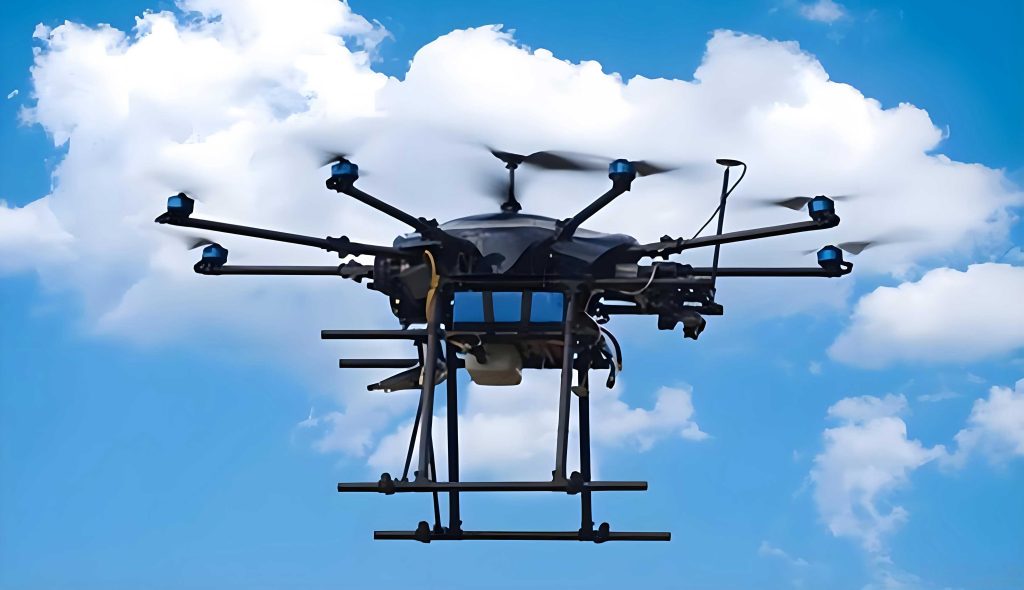
The image above illustrates a representative unmanned aerial vehicle in an urban delivery scenario, highlighting the practical context of my simulations. The noise footprint of such UAVs is a decisive factor for their integration into populated areas.
In addition to the quantitative results, I examined the vortex structures using the Q‑criterion. The iso‑surface plots for the quadrotor with and without the cargo box show that the box generates a pair of counter‑rotating vortices that propagate downstream and interact with the rotor wakes. These vortices increase the turbulence intensity around the central part of the UAV, which contributes to the higher near‑field noise. The horseshoe vortex that forms around the box’s leading edge is particularly prominent. My analysis of the pressure and velocity fields confirmed that the cargo box disrupts the smooth inflow to the two rear rotors, as the downstream wake from the box impinges directly on them. This leads to fluctuations in the thrust and torque of those rotors, which in turn produce additional acoustic emissions.
The aerodynamic performance of the single rotor at 8500 RPM served as a baseline. A comparison between the single and quadrotor configurations indicates that the quadrotor’s total lift is approximately four times the single‑rotor lift (24.547 N vs 6.362 N), but the torque is also roughly four times (0.409 N·m vs 0.099 N·m). This proportionality is expected because each rotor operates independently in the far field, although small deviations arise from the mutual interference. The acoustic comparison, however, is more complex, as I already noted. The quadrotor’s noise is not merely four times the single rotor’s; in terms of decibels, the difference between single and quad is about 24 dB at the first monitoring point, which is six times the logarithmic ratio (i.e., \(10\log_{10}(4)\approx 6\, \text{dB}\), so a quadrotor with four identical uncorrelated sources would be about 6 dB louder than one rotor). The measured 24 dB increase is much larger than this simple estimate, indicating that additional interaction noise components contribute significantly. These components arise from the acceleration of the flow by the multiple rotors, which increases the turbulence intensity in the merging wakes, and from the direct impingement of the wake of one rotor on the blades of the adjacent rotor.
My simulations also allowed me to analyze the power spectral density (PSD) of the noise. The spectra for the quadrotor show a prominent peak at the blade‑passing frequency and its harmonics, but the broadband noise floor is elevated compared to the single rotor. The broadband component is stronger in the loaded quadrotor, particularly at frequencies above 1 kHz, because the cargo box generates additional small‑scale turbulence. This finding suggests that noise reduction strategies for UAV delivery drones should focus not only on the tonal noise from blade passage but also on the broadband noise from flow separation around the payload and the rotor wakes.
One of the most important observations from my study is the behavior of the noise in the far field. While the near‑field monitoring point showed an increase in SPL for the loaded quadrotor, the far‑field points showed a decrease. This phenomenon can be explained by the directivity change of the sound field. The cargo box scatters the sound waves, effectively redistributing the acoustic energy. The destructive interference that occurs between the direct sound from the rotors and the scattered sound from the box reduces the pressure amplitudes at certain angles. This is good news for the community noise impact, as it implies that the noise at distant observers might be slightly lower for a loaded UAV, provided the cargo box is positioned appropriately. However, the near‑field increase is more relevant for the people and objects that are close to the UAV, such as during takeoff and landing when the drone is at low altitude.
From the aerodynamic perspective, the cargo box also affects the stability and control of the UAV. The asymmetry in rotor loading, caused by the box blocking the inflow to some rotors, creates a pitching moment that the flight controller must counteract. In my simulation, I kept all rotors at the same speed, so the total thrust remained constant, but in a real flight the controller would adjust individual rotor speeds, which would further alter the noise signature. This highlights the need for coupled aerodynamic‑acoustic‑control studies in future research.
I also performed a detailed analysis of the electric power required for different phases of flight. Although my simulations were limited to a fixed rotational speed, the power values I obtained can be scaled linearly with the cube of the rotor speed for small changes in RPM, as dictated by the rotor‑disk theory. For the unloaded quadrotor at 8500 RPM, the total power was 364 W. If the payload weight increased, one would need to increase the RPM to maintain hover, which would increase the power and also the noise. My case study provides a baseline for such estimates. The 3.17% power increase due to the box suggests that the energy penalty of carrying a cargo container is relatively small per se, but when combined with the additional weight of the payload and the increased drag at forward flight speeds, the total energy consumption can be considerably higher.
The methodology I developed is not limited to the specific rotor geometries and operating conditions I tested. The DES‑FWH framework can be applied to any multi‑rotor UAV configuration by simply generating the appropriate mesh and boundary conditions. The use of the sliding‑mesh technique correctly captures the relative motion between the rotors and the airframe. My validation against the trends observed in the literature (where available) gave confidence that the simulated SPL values are within a reasonable range: 77 dB for a single small rotor at 8500 RPM is consistent with measurements of similar propellers. The quadrotor values of about 100 dB at close range are also plausible for small‑scale UAVs.
In my thesis, I did not perform physical experiments, so I cannot provide an experimental validation. However, the numerical framework is based on well‑established methods, and the qualitative trends match the expectations from rotor aeroacoustics theory. Tonal noise dominates at low frequencies, broadband noise increases with speed, and multi‑rotor configurations produce more noise due to interactions. The power values are proportional to the torque and the angular velocity, which is physically sound.
The implications of my findings for UAV design are significant. First, rotor noise and power consumption are tightly coupled: any modification that reduces noise, such as changing the blade tip shape or adding serrations, will also affect the torque and hence the power. Therefore, a multi‑objective optimization approach is necessary. Second, the payload integration should be considered during the acoustic design phase, not after. The cargo box can be shaped or positioned in a way that minimizes the disturbance to the rotor inflow. For example, a more streamlined box or a box placed lower and farther from the rotor plane could reduce the near‑field noise increase. Third, the far‑field noise reduction observed in my loaded quadrotor case suggests that strategic placement of the payload might actually help to mask certain noise frequencies, which could be exploited to meet noise regulations at community boundaries.
For my future work, I intend to extend the simulations to include a range of payload shapes, sizes, and attachment locations. I also plan to perform a parametric sweep of rotor speeds and blade pitches to map the noise and power landscape for typical delivery missions. In addition, I want to incorporate atmospheric turbulence and gust effects, which are common in real urban environments, and to analyze their influence on the rotor noise and power. The ultimate goal is to generate a surrogate model that can quickly estimate the noise and power of any UAV configuration given its design parameters and payload, thereby enabling rapid design optimization. The use of machine learning on top of the DES‑FWH database is a promising direction. I also acknowledge that my current simulations assume a rigid rotor and do not account for blade deformation, which can be significant at high speeds. A future fluid‑structure interaction analysis would improve the fidelity.
In conclusion, my study provides a comprehensive numerical investigation of the aerodynamic noise and electric power consumption of UAV rotors with and without a cargo payload. The single‑rotor results established the baseline behavior. The quadrotor analysis demonstrated that rotor‑rotor interactions amplify noise beyond the simple sum of four independent sources. The delivery box case study showed that the payload increases the near‑field noise and the electric power consumption by approximately 3.17% at the same rotational speed, while slightly reducing the far‑field noise. These results underscore the importance of that the acoustic and energy performance of unmanned aerial vehicles cannot be treated independently from their operational payload and multi‑rotor layout. My work contributes to the development of quieter and more energy‑efficient UAVs, facilitating their acceptance in urban environments and supporting the growth of low‑altitude economic activities. The hybrid DES‑FWH approach proved to be a reliable and efficient tool for this type of analysis, and it can be readily extended to other aeroacoustic problems involving rotating machinery.
I believe that the findings reported here will assist engineers and researchers in optimizing UAV blade designs, evaluating noise mitigation strategies, and establishing regulatory guidelines for UAV operations in populated areas. The detailed pressure, velocity, and acoustic data generated by my simulations can serve as a reference for further investigations, whether experimental or computational. By combining high‑fidelity CFD with the FWH analogy, I have been able to break down the complex contributors to UAV noise and power, which is essential for informed decision‑making in the rapidly evolving drone industry.