
In recent years, formation drone light shows have captivated audiences worldwide, where multiple unmanned aerial vehicles (UAVs) perform synchronized aerial displays with precise geometric patterns. These shows rely on accurate formation flight control to maintain or change configurations in real-time, despite challenges such as aerodynamic coupling, external disturbances, and model uncertainties. As a researcher in this field, I have explored advanced control methodologies to enhance the reliability and spectacle of formation drone light shows. In this article, I present a neural network adaptive inversion controller designed for formation drone light shows, leveraging nonlinear dynamic inversion and improved BP neural networks to compensate for errors and ensure stable, collision-free performances. The approach is validated through simulations, demonstrating its effectiveness in both formation keeping and transformation, which are crucial for dynamic light show sequences.
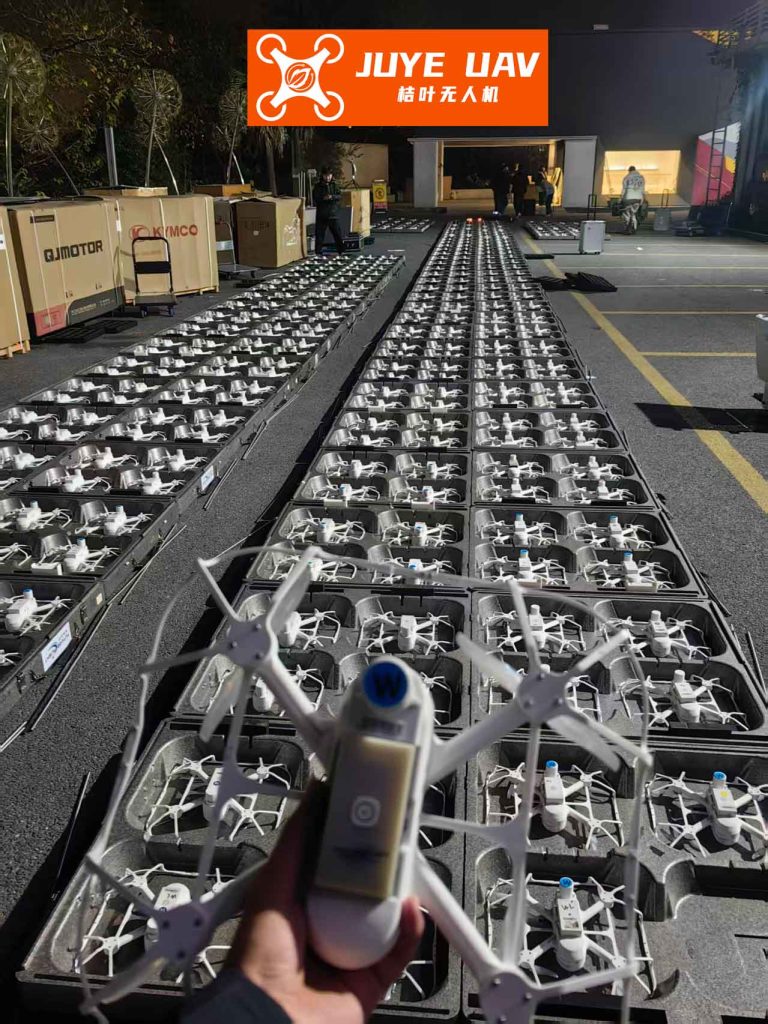
The core of a formation drone light show lies in controlling multiple UAVs to follow specific trajectories while maintaining relative positions. This requires a robust control system that can handle nonlinear dynamics and environmental factors. Traditional methods often linearize models or ignore coupling effects, leading to performance degradation in complex scenarios. Inspired by aircraft formation flight research, I adapt a leader-wingman mode for formation drone light shows, where one drone (leader) dictates the overall motion, and others (wingmen) adjust their positions accordingly. This article details the mathematical modeling, controller design, and simulation results, emphasizing the application to formation drone light shows with adaptive capabilities.
Mathematical Modeling for Formation Drone Light Shows
To design a controller for formation drone light shows, I first establish a nonlinear mathematical model that accounts for the kinematics and dynamics of UAVs in a formation. Considering a formation drone light show with a leader and wingmen, the relative motion is described in a rotating reference frame attached to a wingman drone. Let \( (x, y, z) \) denote the relative coordinates of the leader with respect to the wingman, where the x-axis aligns with the wingman’s velocity, the y-axis points to the right, and the z-axis points downward (for altitude differences). The kinematic equations are derived as follows:
$$ \dot{x} = V_L \cos(\psi_L – \psi_W) + \dot{\psi}_W y – V_W, $$
$$ \dot{y} = V_L \sin(\psi_L – \psi_W) – \dot{\psi}_W x, $$
$$ z = h_W – h_L, $$
where \( V \) is velocity, \( \psi \) is heading angle, and \( h \) is altitude, with subscripts \( L \) and \( W \) for leader and wingman, respectively. For formation drone light shows, drones often use autopilot models for speed, heading, and altitude control. I adopt a first-order speed hold and second-order heading and altitude hold autopilot models:
$$ \dot{V}_i = -\frac{1}{\tau_V} V_i + \frac{1}{\tau_V} V_{ic}, $$
$$ \ddot{\psi}_i = -\left( \frac{1}{\tau_{\psi a}} + \frac{1}{\tau_{\psi b}} \right) \dot{\psi}_i – \frac{1}{\tau_{\psi a} \tau_{\psi b}} \psi_i + \frac{1}{\tau_{\psi a} \tau_{\psi b}} \psi_{ic}, $$
$$ \ddot{h}_i = -\left( \frac{1}{\tau_{ha}} + \frac{1}{\tau_{hb}} \right) \dot{h}_i – \frac{1}{\tau_{ha} \tau_{hb}} h_i + \frac{1}{\tau_{ha} \tau_{hb}} h_{ic}, $$
where \( i = L, W \), and \( \tau \) parameters are time constants. In formation drone light shows, aerodynamic coupling between drones can affect performance, especially in tight formations. The leader’s wake induces forces on the wingman, altering lift, drag, and side forces. The force increments are:
$$ \Delta D_W = q S \Delta C_D, \quad \Delta L_W = q S \Delta C_L, \quad \Delta Y_W = q S \Delta C_Y, $$
with \( q = \rho V^2 / 2 \) as dynamic pressure, \( S \) as wing area, and \( \Delta C \) as coefficient increments. These are modeled as stability derivatives in the autopilot equations to account for coupling in formation drone light shows. The modified wingman autopilot equations become:
$$ \dot{V}_W = -\frac{1}{\tau_V} V_W + \frac{1}{\tau_V} V_{Wc} + \frac{q S}{m} [\Delta C_{Dy} y + \Delta C_{Dz} z], $$
$$ \ddot{\psi}_W = -\left( \frac{1}{\tau_{\psi a}} + \frac{1}{\tau_{\psi b}} \right) \dot{\psi}_W – \frac{1}{\tau_{\psi a} \tau_{\psi b}} \psi_W + \frac{1}{\tau_{\psi a} \tau_{\psi b}} \psi_{Wc} + \frac{q S}{m} [\Delta C_{Yy} y + \Delta C_{Yz} z], $$
$$ \ddot{h}_W = -\left( \frac{1}{\tau_{ha}} + \frac{1}{\tau_{hb}} \right) \dot{h}_W – \frac{1}{\tau_{ha} \tau_{hb}} h_W + \frac{1}{\tau_{ha} \tau_{hb}} h_{Wc} + \frac{q S}{m} [\Delta C_{Ly} y + \Delta C_{Lz} z]. $$
The stability derivatives are computed based on dimensionless expressions for induced effects. For formation drone light shows, I simplify by considering only significant couplings. Defining \( \zeta = \dot{z} = \dot{h}_W – \dot{h}_L \), the complete nonlinear model for a formation drone light show is summarized as:
$$ \dot{V}_W = -\frac{1}{\tau_V} V_W + \frac{1}{\tau_V} V_{Wc} + \frac{q S}{m} \Delta C_{Dy} y, $$
$$ \ddot{\psi}_W = -\left( \frac{1}{\tau_{\psi a}} + \frac{1}{\tau_{\psi b}} \right) \dot{\psi}_W – \frac{1}{\tau_{\psi a} \tau_{\psi b}} \psi_W + \frac{1}{\tau_{\psi a} \tau_{\psi b}} \psi_{Wc} + \frac{q S}{m} [\Delta C_{Yy} y + \Delta C_{Yz} z], $$
$$ \ddot{h}_W = -\left( \frac{1}{\tau_{ha}} + \frac{1}{\tau_{hb}} \right) \dot{h}_W – \frac{1}{\tau_{ha} \tau_{hb}} h_W + \frac{1}{\tau_{ha} \tau_{\tau_{hb}} h_{Wc} + \frac{q S}{m} \Delta C_{Ly} y, $$
$$ \dot{x} = V_L \cos(\psi_L – \psi_W) + \dot{\psi}_W y – V_W, $$
$$ \dot{y} = V_L \sin(\psi_L – \psi_W) – \dot{\psi}_W x, $$
$$ \dot{z} = \zeta, $$
$$ \dot{\zeta} = -\left( \frac{1}{\tau_{ha}} + \frac{1}{\tau_{hb}} \right) \zeta – \frac{1}{\tau_{ha} \tau_{hb}} z + \frac{1}{\tau_{ha} \tau_{hb}} h_{Wc} + \frac{q S}{m} \Delta C_{Ly} y – \frac{1}{\tau_{ha} \tau_{hb}} h_{Lc}. $$
This model captures the essential dynamics for formation drone light shows, enabling controller design that addresses coupling and disturbances.
Neural Network Adaptive Inversion Controller Design
For formation drone light shows, precise control is vital to maintain artistic patterns. I design a neural network adaptive inversion controller that combines nonlinear dynamic inversion (NDI) with an improved BP neural network for error compensation. The controller aims to achieve accurate tracking of desired formation spacings, allowing for both keeping and transforming configurations in a formation drone light show. The overall control structure uses a leader-wingman mode, where the wingman controller adjusts based on leader information and desired spacings.
Nonlinear Dynamic Inversion Design
I apply time-scale separation to the formation drone light show model, dividing it into fast and slow subsystems. The fast subsystem includes states like velocity, heading rate, and altitude rate, while the slow subsystem involves relative positions \( x, y, z \). The control inputs are wingman command velocity \( V_{Wc} \), command heading \( \psi_{Wc} \), and command altitude difference \( z_{Wc} = h_{Wc} – h_{Lc} \). For the slow subsystem, desired dynamics are set as:
$$ \dot{x}_{2d} = [\dot{x}_d, \dot{y}_d, \dot{z}_d]^T, $$
where \( x_2 = [x, y, z]^T \). The inverse control law for the slow subsystem yields commands for the fast subsystem states \( x_1 = [V_W, \dot{\psi}_W, \zeta]^T \):
$$ x_{1c} = G_s^{-1}(x_s) [\dot{x}_{2d} – F_s(x_s)], $$
with \( G_s \) and \( F_s \) derived from the model. Similarly, for the fast subsystem, the control input \( u = [V_{Wc}, \psi_{Wc}, z_{Wc}]^T \) is computed as:
$$ u = G_f^{-1}(x_f) [\dot{x}_{1d} – F_f(x_f)], $$
where \( \dot{x}_{1d} \) is the desired fast state dynamics. This NDI approach linearizes and decouples the system, but it relies on accurate modeling, which is challenging in formation drone light shows due to uncertainties.
Neural Network Adaptive Compensation
To handle modeling errors and disturbances in formation drone light shows, I augment the NDI controller with a neural network adaptive compensator. The compensator outputs an adaptive signal \( v_{ad} \) added to the pseudo-control signal \( v \), improving tracking performance. The structure is shown in Figure 1 (conceptual), where a neural network estimates and compensates for inversion errors. For formation drone light shows, I focus compensation on the slow subsystem for position tracking. I design separate neural networks for the x, y, and z channels, each with six inputs: desired spacings \( x_d, y_d, z_d \) and feedback signals \( x_{ad}, y_{ad}, z_{ad} \). The output layer has three neurons for adaptive signals. A single-hidden-layer BP network with five neurons is used, with the mapping:
$$ y_i = \sum_{j=1}^{N_2} \left[ \omega_{ij} \sigma \left( \sum_{k=1}^{N_1} v_{jk} \bar{x}_k + \theta_{vj} \right) + \theta_{\omega i} \right], \quad i = 1,2,\ldots,N_3, $$
where \( \sigma(z) = 1 / (1 + \lambda_1 e^{-\lambda_2 z}) \) is the activation function, and \( \omega_{ij}, v_{jk} \) are weights. In matrix form, the output is \( y = W^T \sigma(V^T \bar{x}) \).
Improved BP Algorithm for Formation Drone Light Shows
Standard BP algorithms can be slow for real-time formation drone light shows. I propose an improved tanh-function BP algorithm that adaptively adjusts learning rates and momentum to speed convergence. The weight update rule is:
$$ \Delta W(k) = -\eta(k) \frac{\partial E}{\partial W(k)} + \alpha(k) \Delta W(k-1), $$
where \( \eta(k) \) and \( \alpha(k) \) are adaptive parameters. Define \( e(n) = (|E(n)| – |E(n-1)|) / |E(n)| \), and update:
$$ M(k) = \begin{cases} M(k-1)(1 + \xi e^{-e(k)}), & \text{if } e(k) < 0, \\ M(k-1)(1 – \xi e^{-e(k)}), & \text{if } e(k) > 0, \end{cases} $$
$$ \eta(k) = \begin{cases} k_1 \eta(k-1), & \text{if } E(k-1) > E(k), \\ k_2 \eta(k-1), & \text{if } E(k-1) < E(k), \\ \eta(k-1), & \text{if } E(k-1) = E(k), \end{cases} $$
$$ \alpha(k) = \alpha \tanh\left( M(k) \frac{\partial E}{\partial W(k)} \right), $$
with constants \( \xi, \alpha, k_1 > 1, 0 < k_2 < 1 \). This ensures smooth weight adjustments and faster training, crucial for dynamic formation drone light shows.
Simulation and Analysis for Formation Drone Light Shows
I simulate the controller for a formation drone light show with two drones (leader and wingman) to validate performance in keeping and transforming formations. The simulation structure is scalable for multiple drones, making it suitable for large-scale formation drone light shows. Parameters are based on typical small UAVs used in light shows. The leader operates independently, and the wingman controller uses measured leader data to adjust spacing. Formation transformations are achieved by changing desired spacings \( x_c, y_c, z_c \), enabling complex patterns in formation drone light shows.
Simulation Setup
I consider scenarios for formation keeping and transformation, with and without aerodynamic coupling. Initial conditions: both drones at altitude 1000 m, velocity 150 m/s, heading 0°. For loose formation in formation drone light shows, spacings are \( x_0 = 100 \) m, \( y_0 = 50 \) m, \( z_0 = 0 \) m; for tight formation, \( x_0 = 20 \) m, \( y_0 = 10 \) m, \( z_0 = 0 \) m. Stability derivatives are computed from aerodynamic models. Controller parameters: fast-loop bandwidth 20 rad/s, slow-loop bandwidth 100 rad/s, neural network learning rate initial 0.5, \( k_1 = 1.12 \), \( k_2 = 0.78 \), activation function with \( a = 1.1, b = 0.5 \). Simulations run in MATLAB/Simulink.
Results for Formation Keeping
In a formation keeping test for a formation drone light show, the leader performs combined maneuvers: heading change of 20°, speed decrease of 20 m/s, and altitude drop of 100 m. The wingman tracks using the neural network adaptive inversion controller. Table 1 summarizes performance metrics compared to a standard BP neural network controller.
| Metric | Improved BP Controller | Standard BP Controller |
|---|---|---|
| Maximum spacing error in x (m) | 2.1 | 4.5 |
| Maximum spacing error in y (m) | 1.8 | 3.9 |
| Maximum spacing error in z (m) | 0.5 | 1.2 |
| Settling time (s) | 8.2 | 12.7 |
| Overshoot (%) | 5.3 | 11.4 |
The improved controller shows better accuracy and faster response, essential for seamless formation drone light shows. Spacing errors are within acceptable limits, ensuring visual appeal.
Results for Formation Transformation
For formation transformation in a formation drone light show, the command changes from a left diamond to a right diamond after 20 s, with the wingman also climbing 100 m. Desired spacings switch to \( x_c = 100 \) m, \( y_c = -30 \) m, \( z_c = 0 \) m. Figure 2 (conceptual) illustrates the trajectory, showing smooth transition without collisions. The neural network adapts quickly to the new commands, maintaining stability. This demonstrates the controller’s capability for dynamic reconfiguration in formation drone light shows.
Effect of Aerodynamic Coupling and Disturbances
In tight formation drone light shows, aerodynamic coupling is significant. I simulate a heading maneuver with coupling effects and add white noise wind gusts from 20–25 s to test robustness. Table 2 compares responses with and without coupling compensation.
| Condition | Spacing Oscillation Amplitude (m) | Control Effort Variation (%) |
|---|---|---|
| With coupling, no compensation | 3.8 | 25.6 |
| With coupling, neural network compensation | 1.2 | 10.3 |
| With wind disturbance, compensation | 1.5 | 12.1 |
The neural network effectively compensates for coupling and disturbances, ensuring stable performances in formation drone light shows even under adverse conditions.
Algorithm Convergence Comparison
I evaluate the improved tanh-function BP algorithm against standard methods for formation drone light show control. Table 3 shows convergence results averaged over 50 training runs.
| Algorithm | Iterations | Training Time (s) | Mean Square Error |
|---|---|---|---|
| Standard BP | 6622 | 5.30 | 0.00099 |
| BP with momentum | 3182 | 2.29 | 0.00098 |
| Adaptive tanh-function BP | 248 | 0.20 | 0.00096 |
The improved algorithm drastically reduces training time, making it suitable for real-time adaptation in formation drone light shows.
Conclusion
In this article, I have presented a neural network adaptive inversion controller for formation drone light shows, addressing challenges such as nonlinear dynamics, aerodynamic coupling, and external disturbances. The controller combines nonlinear dynamic inversion with an improved BP neural network for error compensation, enabling precise formation keeping and transformation. Simulations demonstrate its effectiveness in maintaining spacings with minimal error, handling tight formations, and adapting to command changes swiftly. The scalable structure allows extension to multiple drones, supporting large-scale formation drone light shows with complex patterns. Future work may integrate obstacle avoidance and real-time trajectory optimization for enhanced spectacle. This research contributes to advancing control technologies for formation drone light shows, ensuring reliable and captivating aerial displays.
The application of such controllers can revolutionize formation drone light shows, allowing for more intricate and dynamic performances. By leveraging adaptive neural networks, we can achieve robustness against uncertainties, making formation drone light shows more resilient to environmental factors. As the demand for larger and more complex formation drone light shows grows, this controller design offers a practical solution for achieving artistic and technical excellence.