
The field of bio-inspired robotics has witnessed tremendous growth, with a significant focus on replicating the efficient and agile flight of insects. Among these, the butterfly presents a fascinating model of complex aerodynamics and precise control. In this article, I explore the motion control mechanisms and optimization strategies for a flying butterfly drone from a multidisciplinary perspective, integrating principles from biology, mechanics, materials science, control theory, and aerodynamics. The ultimate goal is to systematically analyze its flight kinematics and dynamics, propose a composite wing motion control mechanism, and establish a comprehensive framework for enhancing its performance and practical utility.
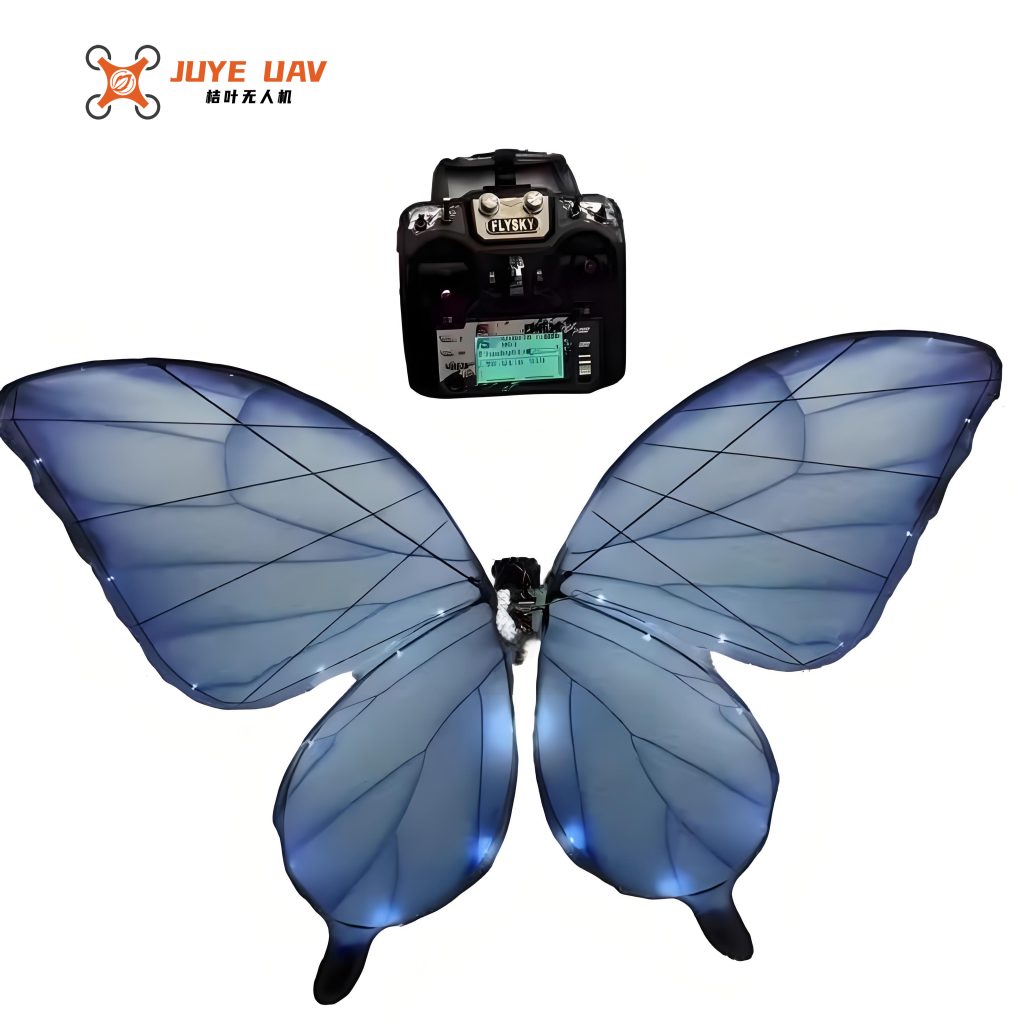
Insect flight, particularly that of butterflies, is not a simple flapping motion but a sophisticated symphony of coordinated movements. The primary mechanics can be understood through a “drag-based” or “clap-and-fling” principle adapted for continuous motion. The flying butterfly drone leverages this by generating both lift and thrust from aerodynamic drag forces on the wings. During the downstroke, the wing moves downward and forward, creating a drag force with a significant upward component to balance weight. Conversely, during the upstroke, the body is pitched upward, and the wing moves backward and upward, providing thrust to overcome body drag. This fundamental process is governed by three core wing motions:
- Flapping: The periodic up-and-down oscillation, primarily responsible for generating lift and bulk propulsion.
- Twisting (or Feathering): The rotation of the wing along its spanwise axis, dynamically changing the angle of attack (AoA) throughout the stroke to optimize vortex generation and force production.
- Swinging/Pitching: The fore-aft or dorso-ventral tilting of the wing’s stroke plane, fine-tuning the effective sweep angle and AoA for stability and maneuverability control.
The seamless integration of these multi-degree-of-freedom (DoF) motions enables the remarkable agility observed in natural butterflies, a key target for the flying butterfly drone.
Flight Mechanics and Foundational Design Principles
The design of an effective flying butterfly drone must be rooted in a deep understanding of its biological counterpart’s mechanics, leading to specific engineering principles.
Bio-inspired Design Philosophy
The wings are the most critical component. Their design must replicate the lightweight, flexible, yet durable structure of butterfly wings. This necessitates moving beyond rigid materials. Modern flying butterfly drones employ flexible composites like Carbon Fiber Reinforced Polymers (CFRP) or polymer membranes integrated with super-elastic alloys. These materials offer high strength-to-weight ratios and the necessary compliance for passive, aerodynamically beneficial deformations. Furthermore, mimicking micro-scale features such as wing venation patterns and surface nanostructures (simulating scales) can enhance airflow attachment and reduce drag.
Reproducing the complex wing motion patterns requires a meticulous actuation and transmission system. Each wing must be independently controllable in flapping frequency ($f$), stroke amplitude ($\phi$), twisting angle ($\theta_{twist}$), and swing angle ($\psi$). This multi-DoF actuation is fundamental to achieving the desired flight envelope for the flying butterfly drone.
A relentless focus on lightweight design is paramount to achieve a favorable lift-to-drag ratio. Every component, from the airframe to the actuators, must be minimized in mass without compromising structural integrity to withstand aerodynamic loads and vibrations. For instance, a well-designed flying butterfly drone can have a wingspan of 70cm, a weight comparable to a standard egg, yet possess the robustness for sustained flight.
| Design Aspect | Biological Inspiration | Engineering Implementation | Key Objective |
|---|---|---|---|
| Wing Structure | Lightweight, flexible membrane with veins. | CFRP frames with elastic polymer membranes; textured surfaces. | High lift, efficient deformation, durability. |
| Actuation & Motion | Muscle-driven multi-DoF wing kinematics. | Precision micro-servos/DC motors with linkage mechanisms for flapping, twisting, swinging. | Independent control of flapping ($f$, $\phi$), twisting ($\theta_{twist}$), swinging ($\psi$). |
| Mass & Strength | Extreme lightweight with adequate strength. | Topology-optimized structures; advanced composites (e.g., CFRP, lightweight alloys). | Maximize lift-to-weight ratio; ensure structural integrity. |
Motion Control Mechanisms: Kinematics, Dynamics, and Stabilization
Kinematic and Dynamic Modeling
Accurate control begins with precise modeling. The kinematic model describes the geometric motion of the wings without considering forces. For a wing segment, its position and orientation in a body-fixed frame can be described using transformation matrices. The flapping angle $\phi(t)$, twisting angle $\theta_{twist}(t)$, and swing angle $\psi(t)$ are typically harmonic functions:
$$\phi(t) = \phi_0 \sin(2\pi f t)$$
$$\theta_{twist}(t) = \theta_0 + \theta_A \sin(2\pi f t + \delta_{\theta})$$
$$\psi(t) = \psi_0 + \psi_A \sin(2\pi f t + \delta_{\psi})$$
Here, $\phi_0$, $\theta_A$, $\psi_A$ are amplitudes, $\theta_0$, $\psi_0$ are mean offsets, and $\delta_{\theta}$, $\delta_{\psi}$ are phase shifts relative to the flapping motion. The overall transformation from a wing-fixed coordinate to the body frame involves sequential rotation matrices $R_{flap}$, $R_{twist}$, and $R_{swing}$.
The dynamics model accounts for the forces and torques generated. The net aerodynamic force $F_{aero}$ and torque $\tau_{aero}$ on a wing are complex due to unsteady effects like the Leading Edge Vortex (LEV). A simplified quasi-steady model often approximates the force on a wing element as proportional to the square of its velocity relative to the air ($v^2$), its area ($dA$), and a coefficient dependent on the instantaneous angle of attack $\alpha(t)$:
$$dF = \frac{1}{2} \rho C_F(\alpha(t)) v(t)^2 dA$$
where $\rho$ is air density and $C_F$ is a force coefficient. The total force and torque are obtained by integrating over the entire wing surface throughout the stroke cycle. These dynamics form the basis for predicting the flying butterfly drone’s trajectory and designing its controller.
Control of Wing Motion Patterns
The flight of the flying butterfly drone is governed by the deliberate modulation of its composite wing motions. The flapping motion is the primary driver. Adjusting the flapping frequency ($f$) directly influences lift and thrust magnitude. Modifying the stroke amplitude ($\phi_0$) and the stroke plane angle (via $\psi_0$) allows for vectoring the resultant force, enabling climb, descent, forward, and backward motion.
Twisting and swinging motions are crucial for efficiency and refined control. Active twisting optimizes the angle of attack throughout the stroke, promoting strong LEV attachment during downstroke for high lift and minimizing negative lift during upstroke. Swinging adjusts the effective frontal area and the direction of force application, crucial for generating control moments for roll and yaw. The control system dynamically adjusts these parameters in real-time based on sensor feedback and the desired maneuver, forming the core intelligence of the flying butterfly drone.
Flight Attitude and Stability Control
Attitude control—pitch, roll, and yaw—is achieved by creating differential forces between the left and right wings or by modulating the symmetry of the stroke.
- Pitch (nose up/down): Achieved by differentially changing the mean stroke plane angle ($\psi_0$) or the flapping amplitude ($\phi_0$) of both wings simultaneously.
- Roll (banking): Generated by creating a differential lift force, typically by introducing a slight difference in the flapping frequency ($\Delta f$) or amplitude ($\Delta \phi_0$) between the left and right wings.
- Yaw (turning): Controlled by creating an asymmetric drag profile, often by differentially adjusting the wing twist timing ($\delta_{\theta}$) between strokes, or by employing a non-symmetric flapping pattern where one wing’s downstroke is emphasized.
Stability in the face of disturbances (e.g., wind gusts) is maintained through a fast feedback loop. Sensors like Inertial Measurement Units (IMUs) detect unintended changes in orientation (roll, pitch angles $(\Theta, \Phi)$ and rates $(p, q)$). The controller then computes corrective actions, such as modifying differential flapping parameters, to generate restoring moments, ensuring the flying butterfly drone maintains its intended flight path.
| Attitude Axis | Control Objective | Typical Wing Motion Modulation | Resultant Aerodynamic Effect |
|---|---|---|---|
| Pitch | Nose-up / Nose-down | Symmetric change in stroke plane angle ($\psi_0$) or amplitude ($\phi_0$). | Shifts the net thrust vector forward or backward relative to the center of gravity. |
| Roll | Bank left / Bank right | Differential flapping frequency ($f_L \neq f_R$) or amplitude ($\phi_{0L} \neq \phi_{0R}$). | Creates a differential lift force, producing a rolling moment. |
| Yaw | Turn left / Turn right | Differential twist phasing ($\delta_{\theta L} \neq \delta_{\theta R}$) or non-symmetric flapping. | Creates a differential drag force, producing a yawing moment. |
Multidisciplinary Optimization Strategies for Enhanced Performance
Material and Structural Optimization
The pursuit of an optimal flying butterfly drone demands continuous refinement of its physical form. Material selection focuses on composites that offer tailored flexural stiffness, allowing wings to passively camber under aerodynamic load, enhancing lift. Structural optimization employs techniques like topology optimization to create ultra-lightweight yet stiff airframe components. Furthermore, biomimetic surface patterning, inspired by butterfly wing scales, can be applied via micro-fabrication to actively manage boundary layer flow, potentially reducing skin-friction drag.
Energy Management Optimization
Endurance is a critical metric. Optimization occurs at multiple levels: using high-efficiency, low-power drive units like coreless DC motors or piezoelectric actuators; implementing dynamic power management algorithms that scale actuator effort with flight mode (e.g., low power for glide, high power for rapid ascent); and exploring energy harvesting. The latter could involve integrating piezoelectric materials into the wing spars to convert vibration energy into stored electrical power, supplementing the primary battery—a high-energy-density lithium-polymer cell—thereby extending the operational duration of the flying butterfly drone.
Control Algorithm Optimization
Intelligent control is paramount for autonomy. A hierarchical architecture is effective. The low-level loop uses robust or adaptive PID controllers to precisely track desired wing kinematics ($\phi_{desired}, \theta_{twist_{desired}}$). The high-level loop employs advanced algorithms for navigation and decision-making:
- Model Predictive Control (MPC): Optimizes a sequence of control inputs over a future horizon, accounting for system dynamics and constraints, ideal for smooth trajectory following.
- Reinforcement Learning (RL): Allows the flying butterfly drone to learn optimal flight policies (e.g., for gust rejection) through interaction with a simulated or real environment, maximizing a reward function related to stability and energy efficiency.
- Deep Learning Models: Recurrent Neural Networks (RNNs) or Transformers can be used to predict complex aerodynamic effects or identify flight regimes from sensor data, enabling proactive control adjustments.
Aerodynamic Efficiency Optimization
Maximizing the lift-to-drag ratio ($L/D$) is a primary goal. Computational Fluid Dynamics (CFD) simulations are indispensable for virtual prototyping, allowing for the exhaustive testing of countless wing shapes, flexural properties, and kinematic parameters ($f$, $\phi_0$, $\theta_{twist}(t)$). The objective is to find configurations that maximize force production while minimizing power consumption, $P_{mech}$.
$$ \text{Optimize: } \eta_{aero} = \frac{\text{Useful Aerodynamic Power}}{\text{Mechanical Power Input}} \propto \frac{L \cdot V_{flight}}{P_{mech}} $$
where $V_{flight}$ is the forward flight speed. Furthermore, implementing the observed biological strategy of active wing flexion and pronounced non-symmetric flapping during sharp turns can dramatically improve the maneuverability and agility of the flying butterfly drone beyond what symmetric flapping can achieve.
Multimodal Sensing and Adaptive Regulation
Robust perception enables adaptability. A sophisticated flying butterfly drone integrates a suite of miniaturized sensors: IMU (accelerometers, gyroscopes), vision sensors (for optic flow and obstacle detection), barometers, and even micro-airflow sensors. Sensor fusion algorithms, like an Extended Kalman Filter (EKF), combine these noisy data streams to produce accurate, real-time estimates of the drone’s state (position $(x,y,z)$, velocity $(u,v,w)$, attitude $(\Theta, \Phi, \Psi)$).
$$ \hat{\mathbf{x}}_k = \text{EKF}(\hat{\mathbf{x}}_{k-1}, \mathbf{u}_k, \mathbf{z}_k) $$
where $\hat{\mathbf{x}}_k$ is the state estimate at time $k$, $\mathbf{u}_k$ is the control input, and $\mathbf{z}_k$ is the sensor measurement vector. This estimated state feeds into an adaptive controller that can, for example, detect a lateral wind disturbance (via IMU and optic flow) and automatically command a differential wing twist adjustment to counteract the resulting yaw, maintaining the flying butterfly drone’s heading and position.
| Optimization Dimension | Key Technologies/Methods | Primary Performance Impact |
|---|---|---|
| Materials & Structure | Flexible composites, topology optimization, biomimetic surface engineering. | Increased lift, reduced weight, enhanced durability, lower drag. |
| Energy Management | High-density batteries, efficient drives, dynamic power allocation, piezoelectric harvesting. | Extended flight endurance and operational range. |
| Control Algorithms | Hierarchical control, MPC, RL, Deep Learning (RNN/Transformer). | Improved autonomy, robustness to disturbances, optimal trajectory tracking. |
| Aerodynamic Efficiency | High-fidelity CFD simulation, parameter sweep optimization, bio-inspired asymmetric kinematics. | Higher lift-to-drag ratio, greater maneuverability, lower energy consumption per distance traveled. |
| Sensing & Adaptation | Multi-sensor fusion (IMU, vision, flow), Kalman filtering, adaptive control laws. | Enhanced situational awareness, stability in dynamic environments, precise state estimation. |
Conclusion
In this exploration, I have systematically constructed a multidisciplinary framework for the development and enhancement of a flying butterfly drone. By delving into the composite wing kinematics of flapping, twisting, and swinging, and establishing corresponding kinematic and dynamic models, a solid theoretical foundation for motion control is laid. The proposed multi-layered optimization strategy—spanning materials, energy systems, intelligent algorithms, and aerodynamics—provides a concrete technological pathway toward achieving efficient, stable, and agile flight. The flying butterfly drone serves as a compelling exemplar of bio-inspired engineering. Looking forward, convergence in smart materials, artificial intelligence, micro-electromechanical systems (MEMS), and advanced manufacturing will propel these systems toward greater miniaturization, intelligence, endurance, and collaborative swarm capabilities. The potential applications in precision agriculture, environmental monitoring, and search-and-rescue operations are vast. This multidisciplinary integration not only advances the specific domain of the flying butterfly drone but also offers novel insights and methodologies for the broader field of bio-inspired robotics and intelligent autonomous systems.