
In modern warfare, efficient intelligence acquisition is crucial for gaining battlefield initiative. Traditional military reconnaissance methods, such as foot or vehicle-based close reconnaissance, are high-risk and inefficient, struggling to meet the demands of contemporary combat scenarios. Unmanned Aerial Vehicles (UAVs), or drones, have emerged as vital tools in modern military reconnaissance due to their low cost, flexibility, and mobility. Among these, UAV imaging reconnaissance—where drones equipped with imaging sensors collaborate with other reconnaissance resources to cover and search given targets for intelligence collection—has become a key technology for enhancing battlefield reconnaissance efficiency. In China, the rapid advancement in UAV drone technology has positioned it as a leader in developing sophisticated multi-UAV systems for diverse reconnaissance missions.
In actual battlefield environments, reconnaissance needs for both point targets and area targets are extensive. Point target reconnaissance includes locating command posts, tracking high-value weapon platforms, and assessing damage to critical infrastructure like power stations and bridges. Area reconnaissance needs encompass damage assessment, scanning forward battle zones, and monitoring large regions. While existing research has explored UAV reconnaissance for either point or area targets separately, few studies address the joint imaging reconnaissance planning problem involving both types. This integration is essential for comprehensive battlefield coverage. Moreover, single UAVs are often limited by endurance and payload constraints, making them inadequate for modern operational needs. In contrast, multiple UAVs can collaborate to overcome individual limitations, expand reconnaissance scope, and improve efficiency. Utilizing a multi-UAV system to simultaneously execute joint point and area target reconnaissance can shorten mission time and maximize the advantages of UAVs in imaging tasks, representing a significant means to enhance battlefield reconnaissance effectiveness.
This paper studies the Multi-UAV Cooperative Point-and-Area Target Joint Imaging Reconnaissance Task Planning Problem (MUSPPAIR). In this scenario, multiple heterogeneous UAVs depart simultaneously from a base, sequentially visit pre-defined point and area targets, and return after completing all reconnaissance tasks. Considering the timeliness of battlefield intelligence, each target must be visited within a specified time window. Due to limited UAV capabilities and numbers, it is challenging to meet all task demands. Thus, we formulate a mixed-integer linear programming model aiming to minimize total reconnaissance time and the number of failed reconnaissance tasks, incorporating complex constraints such as UAV battery capacity, task imaging quality requirements, and onboard imaging sensor capabilities. Each point target can only be covered by one UAV, while each area target can be decomposed and jointly covered by multiple UAVs in a coalition, reducing search time and maximizing adherence to time windows. We design a knowledge-driven task planning algorithm for collaborative heterogeneous multi-UAV reconnaissance (HMUR-KTPA) to solve this problem. The algorithm decomposes the original problem into two phases: multi-UAV task allocation and single-UAV task sequencing, and iteratively optimizes solutions using domain knowledge-driven operators.
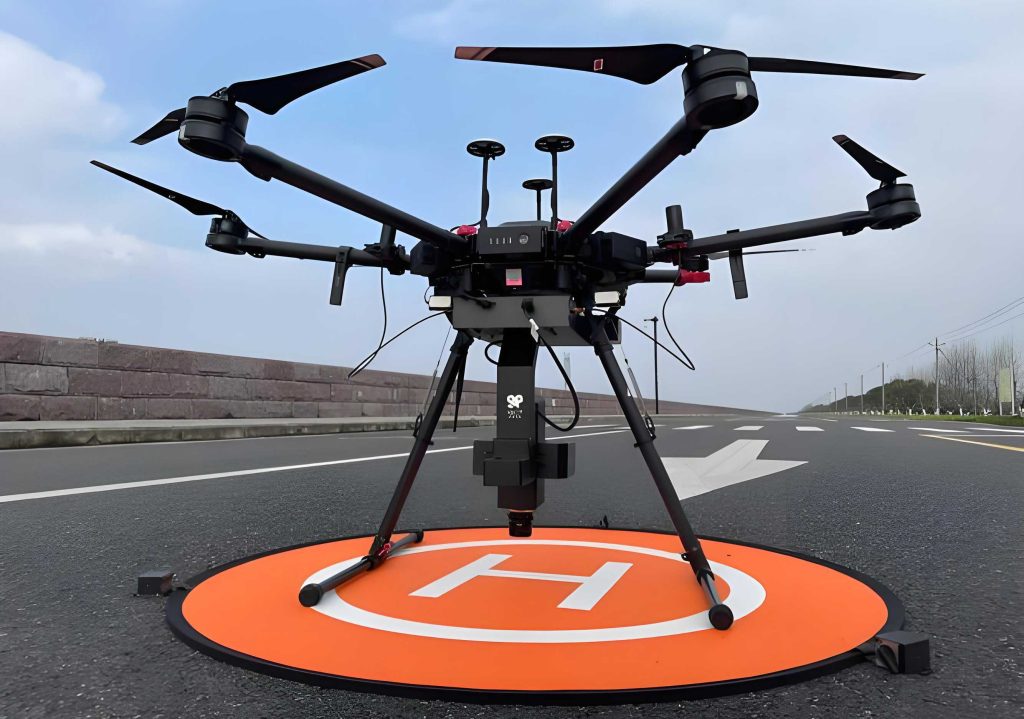
The contributions of this work are threefold. First, we address point, line, and area reconnaissance tasks by studying the multi-UAV cooperative joint imaging reconnaissance problem and establishing a planning model that considers onboard sensor constraints and area target decomposition. Second, we propose HMUR-KTPA, which decomposes the problem into two stages: multi-UAV task allocation and single-UAV task planning. In the allocation stage, we design an optimal coalition-based task allocation algorithm and four planning factors to assign tasks to all UAVs. In the planning stage, we develop a coalition-first-assigned algorithm and an improved variable neighborhood descent search algorithm to generate task schedules for each UAV. The two stages interact iteratively to produce high-quality scheduling solutions. Third, extensive simulation experiments demonstrate that our approach effectively improves resource utilization and mission success rates. Sensitivity analyses are conducted from three aspects: point/area reconnaissance task ratio, number of UAVs, and onboard imaging sensor capability.
Problem Description and Modeling
In the multi-UAV cooperative imaging reconnaissance task planning problem, we need to plan tasks for multiple UAVs to complete reconnaissance of various targets. Assume the reconnaissance task set $T$ contains a set of point reconnaissance tasks $P = \{1, 2, \ldots, r\}$ and a set of area reconnaissance tasks $A = \{r+1, r+2, \ldots, n\}$. A set of heterogeneous UAVs $K = \{1, 2, \ldots, m\}$ depart from a base to execute reconnaissance tasks and return after completing all assigned tasks. To ensure timeliness, each target must be covered within a time window $(st_i, et_i)$.
As illustrated, each UAV can cover multiple heterogeneous reconnaissance tasks within its range. Each point reconnaissance task can only be covered by one UAV. Since a single UAV may struggle to complete area target reconnaissance within the time window, area targets can be split and collaboratively covered by multiple UAVs. Furthermore, different reconnaissance tasks have varying imaging quality requirements, so the planning must match UAV onboard imaging sensors to these requirements. The goal is to have limited UAVs cover more reconnaissance tasks in as short a time as possible. A coalition is defined as multiple UAVs collaborating to cover an area task, where each UAV’s onboard imaging equipment must meet the area task’s imaging quality requirements.
The multi-UAV cooperative imaging reconnaissance problem is constrained by UAV platform performance, task time windows, task imaging quality requirements, and platform endurance. To find high-quality reconnaissance task schedules, we build a mixed-integer programming model with objectives to maximize the number of completed tasks and minimize total reconnaissance execution time. The mathematical model for the multi-UAV cooperative point-and-area target joint imaging reconnaissance task planning problem is as follows. Table 1 lists the symbol descriptions.
| Symbol | Description |
|---|---|
| $K$ | UAV set, $K = \{1, 2, \ldots, m\}$ |
| $P$ | Point reconnaissance task set, $P = \{1, 2, \ldots, r\}$ |
| $A$ | Area reconnaissance task set, $A = \{r+1, r+2, \ldots, n\}$ |
| $T$ | Task set, $T = P \cup A$ |
| $0, k, i$ | Indices for base, UAV, and task |
| $d_{i,j}$ | Distance from task $i$ to task $j$ (m) |
| $(st_i, et_i)$ | Earliest start time and latest end time for task $i$ |
| $D_i^k$ | Reconnaissance distance of UAV $k$ for area task $i$ |
| $t_i^k$ | Time for UAV $k$ to reconnoiter task $i$ |
| $v_k, L_k, dy_k$ | Speed, maximum range (m), and field-of-view width (m) of UAV $k$ |
| $GSD_i^k$ | Imaging capability (Ground Sample Distance) of UAV $k$ at task $i$ |
| $(Px_k, Py_k), PE_k$ | Pixel dimensions and pixel size (µm) of UAV $k$’s imaging payload |
| $E_k, f_k$ | Endurance time and focal length (mm) of UAV $k$’s imaging payload |
| $S_i, h_i$ | Area (m²) and minimum flight height (m) for task $i$ |
| $dt_i, PR_i$ | Required reconnaissance duration and imaging demand for task $i$ |
| $at_i^k$ | Arrival time of UAV $k$ at task $i$ |
| $x_{i,j}^k$ | If UAV $k$ flies from task $i$ to task $j$, $x_{i,j}^k = 1$; otherwise $0$ |
| $y_i^k$ | If task $i$ is completed by UAV $k$, $y_i^k = 1$; otherwise $0$ |
The objective function is:
$$ \min f = c_1 \cdot \max_{k \in K} \left\{ \sum_{i \in T \cup \{0\}} \sum_{j \in T \cup \{0\}, j \neq i} x_{i,j}^k \cdot \frac{d_{i,j}}{v_k} + \sum_{i \in T \cup \{0\}} y_i^k \cdot t_i^k \right\} + c_2 \cdot \sum_{i \in T \cup \{0\}} \sum_{k \in K} (1 – y_i^k) $$
where $c_1$ and $c_2$ are weights (both set to 0.5). The reconnaissance execution time includes flight time and reconnaissance time, determined by the UAV with the longest mission time. The constraints are as follows:
1. All UAVs must depart from and return to the base:
$$ \sum_{i \in T \cup \{0\}} x_{0,i}^k = \sum_{i \in T \cup \{0\}} x_{i,0}^k = 1, \quad \forall k \in K $$
2. Flow conservation for task points, ensuring each UAV visits a task at most once:
$$ \sum_{j \in T} x_{i,j}^k = \sum_{j \in T} x_{j,i}^k \leq 1, \quad \forall k \in K, i \in T $$
3. Each task has at most one predecessor and one successor for a UAV:
$$ \sum_{j \in T \cup \{0\}} x_{i,j}^k = y_i^k, \quad \forall k \in K, i \in T $$
$$ \sum_{i \in T \cup \{0\}} x_{i,j}^k = y_j^k, \quad \forall k \in K, j \in T $$
4. Each point task is covered by at most one UAV:
$$ \sum_{k \in K} y_i^k \leq 1, \quad \forall i \in P $$
5. Imaging quality constraint: UAV’s imaging capability must meet the task’s demand:
$$ y_i^k (GSD_i^k – PR_i) \geq 0, \quad \forall i \in T, k \in K $$
$$ GSD_i^k = \frac{PE_k \cdot h_i}{f_k \cdot 10^3}, \quad \forall i \in T, k \in K $$
6. UAV range constraint, including travel between tasks and coverage distance for area tasks:
$$ \sum_{i \in T \cup \{0\}} \sum_{j \in T \cup \{0\}, j \neq i} d_{i,j} \cdot x_{i,j}^k + \sum_{i \in A} D_i^k \cdot y_i^k \leq L_k, \quad \forall k \in K $$
$$ D_i^k = S_i \cdot \frac{v_k}{\sum_{k1=1}^g v_{k1} \cdot dy_{k1}}, \quad \forall i \in A $$
where $g$ is the number of UAVs in the coalition for area task $i$.
7. Endurance constraint of UAV imaging payload:
$$ \sum_{i \in T} t_i^k \cdot y_i^k \leq E_k, \quad \forall k \in K $$
8. Time consumption between tasks:
$$ at_i^k + \left( dt_i + \frac{d_{i,j}}{v_k} \right) – M(1 – x_{i,j}^k) \leq at_j^k, \quad \forall i, j \in T \cup \{0\}, k \in K $$
where $M$ is a large constant.
9. Time window constraints:
$$ at_i^k \geq st_i, \quad \forall i \in T, k \in K $$
$$ at_i^k + t_i^k \leq et_i, \quad \forall i \in T, k \in K $$
$$ \sum_{k \in K} t_i^k \cdot y_i^k \geq dt_i, \quad \forall i \in A $$
10. Decision variable domains:
$$ x_{i,j}^k \in \{0, 1\}, \quad \forall i, j \in T \cup \{0\}, k \in K $$
$$ y_i^k \in \{0, 1\}, \quad \forall i \in T \cup \{0\}, k \in K $$
These constraints ensure path connectivity, avoid duplicate coverage, enforce resolution requirements, manage battery limits, and adhere to time windows, making the model suitable for real-world scenarios like traffic monitoring or time-sensitive battlefield targets. The development of such models is crucial for advancing China UAV drone capabilities in complex environments.
Knowledge-Driven Multi-UAV Cooperative Reconnaissance Task Planning Method
The multi-UAV cooperative task planning problem is NP-Hard, with solution space growing exponentially with problem scale and UAV numbers. Incorporating heterogeneous task types and constraints like imaging quality and payload endurance further complicates solving. To obtain high-quality multi-UAV task schedules quickly, we design a knowledge-driven multi-UAV cooperative reconnaissance task planning method (HMUR-KTPA). Leveraging problem characteristics, HMUR-KTPA decomposes the original problem into two stages: multi-UAV task allocation and single-UAV task scheduling. Since decomposition may affect global optimality, the two stages alternate iteratively, exchanging information to enhance solution quality. The pseudocode is shown in Algorithm 1.
| Step | Description |
|---|---|
| 1 | Input: UAV information $U$, task information $M$, initial temperature $T_0$, termination temperature $T_f$, max iterations $l_{\max}$, decay factor $\sigma$. |
| 2 | Output: Task scheduling solution $S$. |
| 3 | Initialize multi-UAV task allocation scheme $A \leftarrow \text{OCA}(U, M)$. |
| 4 | Initialize single-UAV schedules $s_k \leftarrow \text{CFA}(a_k)$ for each $a_k \in A$. |
| 5 | Merge all $s_k$ to obtain initial task schedule $S$. |
| 6 | Set best solution $S_b \leftarrow S$, current temperature $T \leftarrow T_0$, iteration $l \leftarrow 1$. |
| 7 | While $T > T_f$ or $l < l_{\max}$: |
| 8 | For $i \leftarrow 1$ to $s$ (number of iterations per temperature): |
| 9 | Generate new multi-UAV allocation $A’$ using four task adjustment operators. |
| 10 | Generate new single-UAV schedules $s_k’ \leftarrow \text{IVND}(a_k’)$ for each $a_k’ \in A’$. |
| 11 | Merge $s_k’$ to form new schedule $S’$, decode using constraints (2)-(5). |
| 12 | Compute objective difference $\Delta f = f(S’) – f(S)$. |
| 13 | If $\Delta f < 0$, accept $S \leftarrow S’$. If $f(S’) < f(S_b)$, update $S_b \leftarrow S’$. |
| 14 | Else if $\exp(-\Delta f / T) > \text{rand}(0,1)$, accept $S \leftarrow S’$. |
| 15 | Increment $l$. |
| 16 | End for, update temperature $T \leftarrow \sigma \cdot T$. |
| 17 | End while, output $S_b$. |
In the initialization phase, considering imaging sensor characteristics and area coverage time constraints, we design an Optimal Coalition-based Allocation algorithm (OCA) to generate initial multi-UAV task assignments. To obtain execution paths for each UAV, we develop a Coalition-First-Assigned algorithm (CFA) that produces feasible schedules based on the allocation. CFA prioritizes scheduling area reconnaissance tasks assigned to UAV coalitions, as these have stricter time window constraints due to multiple UAV involvement. Only tasks satisfying all constraints are successfully scheduled. When computing the objective function, infeasible solutions incur a large penalty cost, so feasible solutions are preferred in optimization.
In the iterative optimization phase, we design four domain knowledge-driven multi-UAV task adjustment operators to modify task allocation: UAV Task Transfer, UAV Task Exchange, Coalition UAV Addition, and Coalition UAV Deletion. Simultaneously, based on global optimality conditions, we design an Improved Variable Neighborhood Descent algorithm (IVND) to adjust single-UAV schedules toward optimal solutions. IVND includes four scheduling operators: Scheduled Task Swap, Scheduled Task Inversion, Unscheduled Task Insertion, and Unscheduled Task Replacement. To avoid local optima, the Metropolis criterion accepts suboptimal solutions with a probability. Multi-UAV allocation and single-UAV scheduling alternate until stopping conditions are met—when temperature falls below a threshold or no improvement is found over consecutive iterations.
Multi-UAV Task Allocation Method
Optimal Coalition-Based Allocation Algorithm (OCA)
Due to varying task imaging quality requirements and UAV imaging capabilities, randomly assigning tasks may lead to mismatches, producing infeasible solutions or wasting UAV resources. To accelerate search for high-quality solutions, we propose OCA based on problem characteristics. The pseudocode is in Algorithm 2.
| Step | Description |
|---|---|
| 1 | Input: UAV info $U$, task info $M$. |
| 2 | Output: Optimal coalition $C$, initial allocation $A$. |
| 3 | Initialize coalition $C_i \leftarrow \emptyset$ for each task $i$, unscheduled task set $T \leftarrow \{1,\ldots,n\}$, UAV task sets $A_k \leftarrow \emptyset$. |
| 4 | For each task $i$, compute imaging capability $GSD_i^k$ for all UAVs using Eq. (8). |
| 5 | Compute imaging capability overflow $H_i^k = GSD_i^k – PR_i$. |
| 6 | Count UAVs satisfying imaging constraint: $N_i = \text{count}(H_i^k \geq 0)$. |
| 7 | While $T \neq \emptyset$: |
| 8 | Find task $i^* = \arg\min_{i \in T} N_i$ (task with fewest available UAVs). |
| 9 | Sort available UAVs for $i^*$ by score (considering assigned tasks and overflow). |
| 10 | While sorted list not empty: |
| 11 | Select top UAV $k$, add to coalition $C_{i^*}$, remove from list. |
| 12 | Add task $i^*$ to $A_k$. |
| 13 | Compute coalition reconnaissance duration $rt_{i^*}$ using Eq. (19). |
| 14 | If $rt_{i^*} \leq et_{i^*} – at_{i^*}$, break; else continue. |
| 15 | End while, update coalition $C$, remove $i^*$ from $T$. |
| 16 | End while, sort tasks in each $A_k$ by time window, merge into $A$. |
To ensure assigned UAVs meet imaging quality demands, we first filter available UAVs for each task. To minimize resource waste, compute the imaging capability overflow $H_i^k$ for task $i$ and UAV $k$:
$$ H_i^k = GSD_i^k – PR_i, \quad \forall i \in T, k \in K $$
OCA prioritizes tasks with fewer available UAVs to maximize task allocation. For point tasks with short duration, assign to the highest-ranked UAV. For area tasks requiring longer coverage, single UAVs may not suffice. Thus, form an optimal coalition of multiple UAVs that minimize reconnaissance time while meeting duration constraints and minimizing imaging overflow. To minimize coalition reconnaissance time, all UAVs in the coalition start and end simultaneously. For area task $i$ with area $S_i$, covered by $g$ heterogeneous UAVs, the reconnaissance duration for UAV $k$ is:
$$ rt_i = \frac{S_i}{\sum_{k1=1}^g v_{k1} \cdot dy_{k1}}, \quad \forall i \in A $$
where UAV field-of-view width $dy_k$ is:
$$ dy_k = \frac{Py_k \cdot PE_k \cdot h}{f_k \cdot 10^3}, \quad \forall k \in K $$
with $h$ as flight height.
Domain Knowledge-Driven Multi-UAV Task Adjustment
Initial allocation may overload some UAVs or involve suboptimal UAVs in coalitions, prolonging coverage time and risking time window violations. Overemphasis on overflow may underutilize high-performance UAVs. Thus, in reallocation, we design four adjustment operators based on optimality conditions.
1. UAV Task Transfer: Randomly transfer one task from one UAV to another.
2. UAV Task Exchange: Randomly exchange one task between two UAVs.
3. Coalition UAV Addition: Randomly add one UAV to a coalition for an area task.
4. Coalition UAV Deletion: Randomly remove one UAV from a coalition.
These operators adjust task sets and coalition compositions, balancing loads and improving feasibility. In China UAV drone applications, such dynamic adjustments are vital for adapting to evolving battlefield conditions.
Single-UAV Task Scheduling Method
Coalition-First-Assigned Algorithm (CFA)
Unlike traditional multi-UAV planning, we consider heterogeneous UAV coalitions for area targets, requiring all coalition UAVs to satisfy the same time window. This makes time constraints for coalition-visited area tasks more complex. To generate ordered execution paths and reduce complexity, we design CFA, which prioritizes scheduling area tasks accessed by coalitions before point tasks accessed singly. CFA checks constraint satisfaction when inserting new tasks to enhance initial solution feasibility. Pseudocode is in Algorithm 3.
| Step | Description |
|---|---|
| 1 | Input: UAV $k$’s task assignment $a_k$. |
| 2 | Output: UAV $k$’s schedule $s_k$. |
| 3 | Initialize scheduled task set $z_k \leftarrow \emptyset$, unscheduled set $u_k \leftarrow \emptyset$. |
| 4 | Count number of UAVs visiting each task: $nu = \text{Count}(a_k)$. |
| 5 | While $nu \neq \emptyset$: |
| 6 | Select task $i$ with maximum UAV visits from $nu$. |
| 7 | If task $i$ satisfies all constraints, add to $z_k$; else add to $u_k$. |
| 8 | Remove $i$ from $nu$. |
| 9 | End while, merge $z_k$ and $u_k$ into $s_k$. |
Improved Variable Neighborhood Descent Algorithm (IVND)
After initialization, tasks are divided into scheduled (feasible) and unscheduled (failed). Adjusting scheduled task order can optimize success count, while inserting or replacing unscheduled tasks can utilize UAV potential. Thus, for both types, we design IVND with four neighborhood structures:
1. Scheduled Task Swap ($N_1$): Randomly swap two scheduled tasks in a UAV’s sequence.
2. Scheduled Task Inversion ($N_2$): Randomly shuffle a contiguous subsequence of scheduled tasks.
3. Unscheduled Task Insertion ($N_3$): Randomly insert an unscheduled task into the scheduled sequence.
4. Unscheduled Task Replacement ($N_4$): Swap a scheduled task with an unscheduled task.
These operators explore solution space effectively, crucial for optimizing China UAV drone missions where efficiency is paramount.
Simulation and Analysis
To validate HMUR-KTPA performance in multi-UAV cooperative imaging reconnaissance task scheduling, we conduct comparative experiments with six algorithms and sensitivity analyses. Environment: Windows 10, Core i5-10400F 2.90GHz CPU, 8GB RAM, MATLAB R2021b. Since no standard test set exists for this problem, we generate eight instances (C1-C8) with varying point/area target counts and UAV numbers. Each includes task coordinates, time windows, min flight height, imaging requirements, area, UAV speed, max range, sensor pixels, pixel size, focal length, and battery. We use three UAV types with parameters in Table 2.
| UAV | Speed (m/s) | Range (km) | Pixel (Px, Py) | Pixel Size (µm) | Focal Length (mm) | Battery (min) |
|---|---|---|---|---|---|---|
| UAV-1 | 50 | 70 | (5472, 2648) | 2.3 | 24 | 80 |
| UAV-2 | 50 | 60 | (5280, 3956) | 3.4 | 30 | 70 |
| UAV-3 | 50 | 50 | (8192, 5460) | 4.4 | 35 | 60 |
HMUR-KTPA parameters: initial temperature $T_0=100$, minimum $T_f=0.1$, decay $\sigma=0.05$, max iterations $l_{\max}=100$. We modify ADPSO, VNS, ALNS algorithms for comparison by adding unscheduled task insertion and replacement operators to handle coalition adjustments. Also, include a multi-UAV energy-saving path planning algorithm based on genetic algorithm and gradient descent (HGA/GD). To assess module contributions, we test HMUR-KTPA without OCA (no-OCA) and without CFA (no-CFA). Each algorithm runs 20 times, averaging results.
Algorithm Performance Analysis
Results in Table 3 and Figure 1 show HMUR-KTPA achieves the best objective values across all instances, outperforming others. Table 4 and Figure 2 indicate HMUR-KTPA schedules the most tasks successfully, demonstrating superior constraint handling and resource utilization. As task count increases, success rates drop due to limited UAVs, but HMUR-KTPA maintains higher rates. Figure 3 shows runtimes: ALNS and VNS are fastest, HMUR-KTPA, no-OCA, no-CFA moderate (~10 seconds), ADPSO and HGA/GD slowest. HMUR-KTPA balances speed and solution quality. Table 5 and Figure 4 reveal path lengths: with fixed total tasks, increasing area tasks lengthens paths due to coalition coverage; HMUR-KTPA yields shortest paths except in C1, while scheduling more tasks, confirming efficacy.
| Instance | Point/Area Tasks | UAVs | ADPSO | VNS | ALNS | HGA/GD | no_CFA | no_OCA | HMUR-KTPA |
|---|---|---|---|---|---|---|---|---|---|
| C1 | 7/3 | 3 | 4.11 | 3.22 | 5.07 | 3.54 | 3.27 | 3.19 | 3.19 |
| C2 | 5/5 | 3 | 5.12 | 4.95 | 6.36 | 4.95 | 4.50 | 4.36 | 4.30 |
| C3 | 14/6 | 4 | 11.35 | 12.63 | 14.49 | 12.86 | 11.42 | 12.02 | 11.13 |
| C4 | 10/10 | 4 | 18.21 | 16.54 | 19.05 | 14.75 | 13.35 | 13.06 | 12.33 |
| C5 | 21/9 | 6 | 30.49 | 30.87 | 30.50 | 29.74 | 28.40 | 29.33 | 28.06 |
| C6 | 15/15 | 6 | 32.92 | 29.19 | 30.61 | 33.33 | 28.04 | 27.78 | 27.12 |
| C7 | 28/12 | 8 | 129.53 | 135.01 | 139.84 | 132.28 | 132.03 | 131.54 | 124.12 |
| C8 | 20/20 | 8 | 148.24 | 138.85 | 147.88 | 148.48 | 137.59 | 141.03 | 135.91 |
| Instance | Point/Area Tasks | UAVs | ADPSO | VNS | ALNS | HGA/GD | no_CFA | no_OCA | HMUR-KTPA |
|---|---|---|---|---|---|---|---|---|---|
| C1 | 7/3 | 3 | 6 | 8 | 6 | 8 | 4 | 5 | 8 |
| C2 | 5/5 | 3 | 6 | 6 | 5 | 3 | 4 | 4 | 7 |
| C3 | 14/6 | 4 | 12 | 9 | 8 | 9 | 11 | 12 | 14 |
| C4 | 10/10 | 4 | 11 | 9 | 9 | 11 | 10 | 10 | 13 |
| C5 | 21/9 | 6 | 18 | 20 | 18 | 18 | 19 | 18 | 21 |
| C6 | 15/15 | 6 | 20 | 18 | 21 | 19 | 17 | 18 | 21 |
| C7 | 28/12 | 8 | 30 | 25 | 28 | 27 | 26 | 28 | 30 |
| C8 | 20/20 | 8 | 32 | 30 | 29 | 26 | 28 | 30 | 33 |
Table 6 shows coalitions for each task in C8, and Table 7 presents the HMUR-KTPA schedule for C8. Point tasks numbered 1-5,11-15,21-25,31-35; area tasks as #6-#10,#16-#20,#26-#30,#36-#40. Some area tasks need only one UAV, but most require coalitions, validating the multi-UAV cooperative area reconnaissance model. This approach is particularly beneficial for China UAV drone operations, where collaborative strategies enhance coverage and efficiency.
| Task | Coalition | Task | Coalition | Task | Coalition | Task | Coalition |
|---|---|---|---|---|---|---|---|
| 1 | ③ | 11 | ⑧ | 21 | ④ | 31 | ③ |
| 2 | ⑤ | 12 | ② | 22 | ② | 32 | ③ |
| 3 | ② | 13 | ① | 23 | ④ | 33 | ④ |
| 4 | ⑤ | 14 | ③ | 24 | ① | 34 | ⑦ |
| 5 | ④ | 15 | ④ | 25 | ⑦ | 35 | ⑦ |
| #6 | ⑥ | #16 | ⑧ | #26 | ②④ | #36 | ⑥ |
| #7 | ③ | #17 | ⑤⑧ | #27 | ②⑤⑦⑧ | #37 | ② |
| #8 | ⑧ | #18 | ③ | #28 | ①⑤ | #38 | ⑧ |
| #9 | ③ | #19 | ⑥ | #29 | ①②⑤⑧ | #39 | ① |
| #10 | ⑥⑦ | #20 | ①⑥ | #30 | ⑧ | #40 | ①④ |
| UAV | Schedule |
|---|---|
| ① | 13 → 24 → #39 → #40 → #29 → #28 → #20 |
| ② | #27 → 22 → #37 → 12 → 3 → #29 → #26 |
| ③ | 1 → 14 → #7 → #9 → 32 → 31 → #18 |
| ④ | 33 → 23 → #40 → 26 → 15 → 5 → 21 |
| ⑤ | 2 → #27 → 4 → #29 → #28 → #17 |
| ⑥ | #36 → #6 → #10 → #19 → #20 |
| ⑦ | 25 → #10 → 34 → 35 → #27 |
| ⑧ | #27 → #38 → #16 → #17 → #29 → #30 → 11 → #8 |
Sensitivity Analysis
To analyze key factors influencing HMUR-KTPA, we examine point/area target ratio, UAV count, and UAV imaging capability, with total tasks fixed at 40.
Area-to-Point Target Ratio
We set instances C9-C13 with ratios 1:9, 2:8, 3:7, 4:6, 5:5, and 8 UAVs. Results in Figure 5 show as area target proportion increases, path length grows due to additional coverage distance. Task completion rate declines and objective value rises, indicating area tasks involve more complex constraints (coalition coordination), reducing successful execution probability. Thus, higher area task ratios challenge multi-UAV systems, emphasizing the need for efficient coalition management in China UAV drone missions.
Number of UAVs
Instances C14-C19 with UAV counts 3,4,5,6,7,8 and fixed ratio 3:7. Figure 6 shows as UAVs increase, path length shortens (since longest path per UAV decreases), task completion rate rises, and objective value drops. More UAVs provide more resources for point tasks and coalition options for area tasks, improving feasibility. This underscores the value of scalable UAV fleets in reconnaissance operations.
Imaging Sensor Capability
Imaging sensor parameters affect problem in two ways: (1) UAV ability to meet task imaging demand depends on pixel size $PE$ and focal length $f$; (2) area coverage time depends on pixel component $Py$, pixel size $PE$, speed $v$, and focal length $f$. Define capability metric $\varepsilon = \frac{Py \cdot PE \cdot v}{1000 \cdot f}$; higher $\varepsilon$ means better capability. Instances C20-C22 with 8 UAVs of same capability, parameters in Table 8.
| Instance | UAV | Speed $v$ (m/s) | Pixel $Py$ | Pixel Size $PE$ (µm) | Focal Length $f$ (mm) | Capability $\varepsilon$ |
|---|---|---|---|---|---|---|
| C20 | UAV-1 | 50 | 2648 | 2.3 | 24 | 12.69 |
| C21 | UAV-2 | 50 | 3956 | 3.4 | 30 | 22.42 |
| C22 | UAV-3 | 50 | 5460 | 4.4 | 35 | 34.32 |
Figure 7 shows as capability increases, task completion rate improves due to easier satisfaction of imaging and time constraints. Path length first rises then falls: low capability limits feasible tasks, keeping paths short; medium capability enables more tasks, increasing path length; high capability relaxes constraints, allowing shorter paths through better scheduling. This highlights the importance of advanced imaging sensors in China UAV drone designs for reconnaissance efficacy.
Conclusion
This paper addresses the multi-UAV cooperative point-and-area target joint imaging reconnaissance task planning problem by proposing a knowledge-driven multi-UAV cooperative reconnaissance task planning method (HMUR-KTPA). Key conclusions are:
First, we establish a mixed-integer programming model considering multiple constraints such as onboard imaging equipment capabilities, task imaging quality requirements, and time windows, where area reconnaissance tasks can be collaboratively covered by coalitions of heterogeneous UAVs. This research can be extended to disaster assessment, emergency rescue, and other fields where UAV cooperation is valuable.
Second, we propose HMUR-KTPA, which decomposes the problem into multi-UAV task allocation and single-UAV task planning stages. In initialization, an optimal coalition-based allocation algorithm and a coalition-first-assigned scheduling algorithm generate high-quality initial solutions. In iterative optimization, four domain knowledge-driven multi-UAV adjustment operators and an improved variable neighborhood descent algorithm with four scheduling operators search for optimal task allocation and scheduling solutions. The stages interact iteratively to produce high-quality schedules.
Third, comparative experiments show HMUR-KTPA outperforms other algorithms in solution quality across eight instances, scheduling the most tasks successfully, proving its ability to maximize resource utilization. Sensitivity analyses indicate that with equal task counts, area reconnaissance tasks have lower success probability due to more complex constraints; increasing UAV numbers or enhancing onboard imaging sensor capabilities can improve task completion rates.
In this work, we integrate two optimization objectives into a single-objective problem via linear weighting. Future work will introduce more efficient multi-objective optimization algorithms to generate Pareto optimal solution sets, providing diverse, trade-off alternatives for decision-makers. The advancements presented here contribute significantly to the development of intelligent multi-UAV systems, particularly in the context of China UAV drone technology, where such collaborative reconnaissance capabilities are essential for modern defense and civilian applications.