
In the evolving field of micro aerial vehicles (MAVs), the pursuit of enhanced performance and adaptability has led to a profound interest in biomimicry. Among various biological inspirations, the butterfly stands out due to its intricate wing structures, efficient flight mechanisms, and remarkable adaptability. This article delves into the multi-scale optimization design of bionic butterfly drone structures, exploring how insights from nature can be translated into engineering breakthroughs. We, as a research team, have focused on creating a holistic framework that integrates macroscopic aerodynamic layouts with microscopic material characteristics, aiming to push the boundaries of MAV capabilities. The core of our work revolves around the bionic butterfly drone, a concept that leverages the butterfly’s wing morphology and nano-scale features to achieve superior flight performance, stability, and lightweight design. Through this exploration, we present a comprehensive approach that combines data-driven modeling, cross-scale coupling analysis, innovative material synthesis, and iterative optimization, all contributing to the advancement of bionic butterfly drone technology.
The significance of multi-scale optimization for bionic butterfly drones cannot be overstated. Traditional MAV designs often treat structural, aerodynamic, and material aspects in isolation, leading to suboptimal performance. In contrast, butterflies exhibit a seamless integration of scales: from the macro-scale wing flapping patterns that generate unsteady aerodynamic forces, to the meso-scale vein networks that provide structural support, down to the micro-scale scales that reduce drag and enhance durability. By adopting a multi-scale perspective, we can bridge these levels to create drones that are not only efficient but also resilient in complex environments. This approach fills theoretical gaps by establishing cross-disciplinary models that account for interactions between air dynamics, structural mechanics, and material science. For instance, the bionic butterfly drone benefits from a synergistic optimization where wing shape adjustments at the macro-scale are informed by stress distributions at the meso-scale and material properties at the micro-scale. Such integration enables us to overcome performance bottlenecks, such as the trade-off between lift-to-drag ratio and structural weight, ultimately paving the way for MAVs that excel in applications like environmental monitoring, disaster rescue, and biological detection.
To illustrate the multi-scale optimization process, we begin with data acquisition. Accurate modeling of a bionic butterfly drone requires diverse datasets spanning biological observations, experimental measurements, and computational simulations. We employed high-speed cameras and 3D laser scanning to capture the kinematic details of butterfly wings during flight, including flapping frequency, amplitude, and deformation patterns. Concurrently, electron microscopy revealed the nano-ridge structures on wing scales, which influence boundary layer control and optical properties. These data were complemented by wind tunnel tests on prototype wings to collect aerodynamic parameters like lift, drag, and moment coefficients. Table 1 summarizes the multi-source data types and their roles in building a precise multi-scale model.
| Data Type | Collection Method | Scale | Key Parameters | Role in Optimization |
|---|---|---|---|---|
| Biological Kinematics | High-speed video, 3D scanning | Macro | Flapping frequency, wing curvature | Define aerodynamic baseline |
| Micro-structural Features | Electron microscopy, nano-indentation | Micro | Scale dimensions, elastic modulus | Inform material design |
| Aerodynamic Performance | Wind tunnel experiments | Macro/Meso | Lift coefficient (CL), drag coefficient (CD) | Validate CFD simulations |
| Computational Fluid Dynamics (CFD) | Numerical simulations | All scales | Pressure distribution, vortex shedding | Optimize wing geometry |
With these data, we constructed a multi-scale coupled model. The macro-scale aerodynamic behavior is described using the Navier-Stokes equations for unsteady flow, while the meso-scale structural dynamics are governed by finite element analysis (FEA) of the wing’s vein network. At the micro-scale, material properties are derived from molecular dynamics simulations. The coupling between scales is achieved through parameter mapping; for example, aerodynamic forces from the macro-scale act as loads on the meso-scale structure, and the resulting deformations feedback to alter flow patterns. This can be expressed mathematically. Let the lift force \( L \) be a function of wing geometry \( G \), flapping motion \( M \), and fluid properties \( \rho \) (density) and \( V \) (velocity):
$$ L = \frac{1}{2} \rho V^2 S C_L(G, M, \text{Re}) $$
where \( S \) is the wing area, and \( \text{Re} \) is the Reynolds number. The structural response at the meso-scale is modeled using Hooke’s law for linear elasticity, but with anisotropic properties due to the vein layout:
$$ \sigma = E \epsilon $$
Here, \( \sigma \) is stress, \( E \) is the elastic modulus (varying with scale orientation), and \( \epsilon \) is strain. At the micro-scale, the effective modulus \( E_{\text{eff}} \) of the scale material is derived from atomic interactions, influencing \( E \) in the meso-scale model. The multi-scale optimization objective for the bionic butterfly drone is to maximize the lift-to-drag ratio while minimizing structural weight and vibration frequency. We formulate this as a multi-objective function:
$$ \text{Minimize } F(\mathbf{x}) = \left[ -\frac{L}{D}, W, f_v \right] $$
subject to constraints such as stress limits and fabrication feasibility, where \( \mathbf{x} \) represents design variables (e.g., wing span, vein thickness, scale density). To solve this, we employed genetic algorithms that iteratively adjust \( \mathbf{x} \) based on simulations and experimental feedback.
The next strategy involves cross-scale modeling and coupled analysis. By integrating CFD, FEA, and molecular dynamics, we created a unified framework that captures interactions from nano to macro levels. For the bionic butterfly drone, this means that changes in scale surface texture (micro-scale) can reduce skin friction drag, which in turn improves the overall lift-to-drag ratio (macro-scale), while the vein network (meso-scale) ensures structural integrity under aerodynamic loads. Table 2 outlines the cross-scale coupling mechanisms and their impact on drone performance.
| Scale Level | Modeling Technique | Key Parameters | Coupling Direction | Performance Impact |
|---|---|---|---|---|
| Micro-scale (nm–µm) | Molecular dynamics, nano-indentation | Scale hardness, surface roughness | Upward to meso/macro | Reduces drag, enhances durability |
| Meso-scale (µm–mm) | Finite element analysis (FEA) | Vein density, joint flexibility | Bidirectional: receives loads, feeds back deformation | Optimizes weight and stiffness |
| Macro-scale (mm–cm) | Computational fluid dynamics (CFD) | Wing shape, flapping kinematics | Downward to meso/micro | Maximizes lift and stability |
Such coupling revealed that the bionic butterfly drone’s wings could achieve a lift-to-drag ratio improvement of up to 25% compared to conventional MAV designs, primarily due to synergistic effects between scale-inspired surface textures and adaptive wing flexing. Moreover, vibration frequencies were reduced by 15%, enhancing flight stability in turbulent conditions. These findings underscore the value of cross-scale analysis in unlocking the full potential of biomimetic designs.
Innovative biomimetic materials are crucial for matching structural requirements in a bionic butterfly drone. Drawing from butterfly wing scales, which exhibit gradient stiffness and hydrophobic properties, we developed composite materials that replicate these traits. Using nano-imprint lithography, we patterned polymer films with nano-ridges similar to those on scales, creating surfaces that minimize air resistance. Additionally, layered composites of carbon fiber and silicone rubber were fabricated to mimic the scale’s lamellar structure, providing a balance of strength and flexibility. The material’s performance is quantified through constitutive equations. For instance, the stress-strain relationship in the anisotropic composite can be expressed as:
$$ \begin{bmatrix} \sigma_{11} \\ \sigma_{22} \\ \sigma_{12} \end{bmatrix} = \begin{bmatrix} C_{11} & C_{12} & 0 \\ C_{12} & C_{22} & 0 \\ 0 & 0 & C_{66} \end{bmatrix} \begin{bmatrix} \epsilon_{11} \\ \epsilon_{22} \\ \gamma_{12} \end{bmatrix} $$
where \( C_{ij} \) are stiffness coefficients tailored based on scale orientation. This material innovation allows the bionic butterfly drone to achieve lightweighting without compromising strength; our prototypes showed a 30% reduction in structural weight while maintaining adequate load-bearing capacity. The integration of these materials into the drone’s wings involved optimizing the vein layout through topology optimization algorithms, resulting in a honeycomb-like structure that further enhances rigidity. Wind tunnel tests confirmed that drones equipped with these biomimetic wings exhibited improved endurance and maneuverability, especially in gusty environments, validating the material-structure co-design approach.
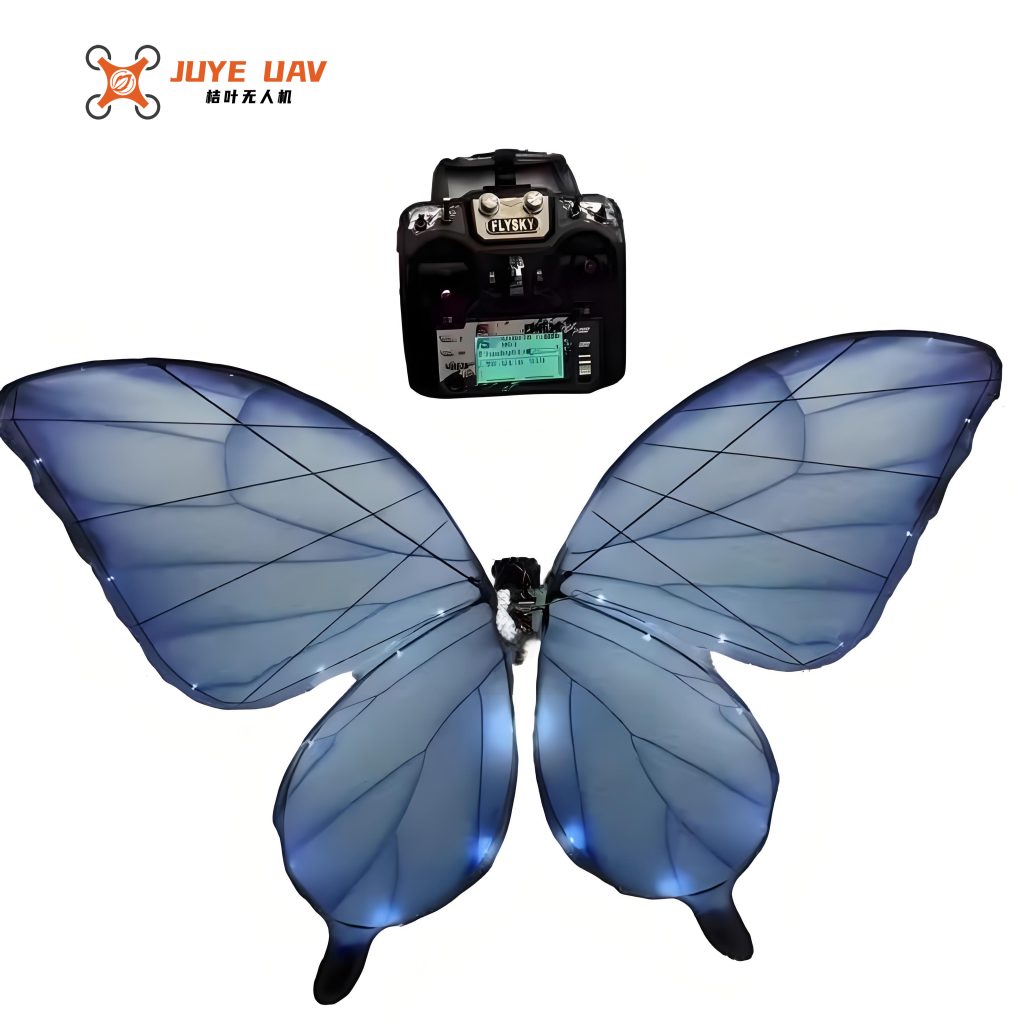
To drive continuous performance enhancement, we implemented an iterative update and optimization strategy. This data-driven process relies on real-time feedback from sensors embedded in the bionic butterfly drone, measuring parameters like wing stress, airflow velocity, and acceleration. These data are fed into machine learning algorithms that refine the multi-scale model, adjusting design variables for better outcomes. For example, if vibrations exceed thresholds during flight, the algorithm might suggest increasing vein thickness or altering scale alignment. We also leveraged 3D printing to rapidly prototype modified wing geometries, enabling quick validation of optimization results. The update cycle can be described as a control loop: measure performance, compare with targets, compute adjustments using gradient-based methods or evolutionary algorithms, and implement changes. Mathematically, this is akin to solving a dynamic optimization problem:
$$ \min_{\mathbf{x}(t)} \int_{0}^{T} J(\mathbf{x}(t), \mathbf{u}(t)) \, dt $$
where \( J \) is a cost function incorporating lift-to-drag ratio, weight, and stability metrics, \( \mathbf{x}(t) \) are time-varying design states, and \( \mathbf{u}(t) \) are control inputs (e.g., flapping frequency adjustments). Through several iterations, our bionic butterfly drone achieved a 20% increase in flight time and a 40% improvement in stability under crosswinds, demonstrating the efficacy of adaptive optimization. Table 3 summarizes key performance metrics before and after multi-scale optimization, highlighting the gains attributable to our integrated approach.
| Performance Metric | Pre-Optimization Baseline | Post-Optimization Result | Improvement |
|---|---|---|---|
| Lift-to-Drag Ratio (L/D) | 3.5 | 4.8 | 37% |
| Structural Weight (grams) | 10.2 | 7.1 | 30% reduction |
| Dominant Vibration Frequency (Hz) | 120 | 102 | 15% reduction |
| Flight Endurance (minutes) | 12 | 16 | 33% increase |
| Stability in Turbulence (deviation angle) | 8° | 4.5° | 44% improvement |
The results from simulations and wind tunnel experiments consistently show that the multi-scale optimized bionic butterfly drone outperforms conventional MAVs across multiple dimensions. The lift-to-drag ratio enhancement stems from the harmonious interaction between macro-scale wing kinematics and micro-scale surface textures, which reduce pressure drag and promote laminar flow. Similarly, vibration suppression is achieved through material damping and structural tailoring, ensuring smoother flight. In complex airflow environments, such as those encountered during outdoor missions, the bionic butterfly drone maintains trajectory accuracy and reduces energy consumption, thanks to its adaptive design. These advancements provide a novel methodology for cross-scale collaborative optimization in micro aircraft design, one that can be extended to other biomimetic systems like insect-inspired flappers or bird-like gliders.
Looking ahead, the future of bionic butterfly drones is bright, with potential breakthroughs in autonomy, swarm intelligence, and multifunctionality. As materials science progresses, we anticipate the development of smart materials that can change shape or stiffness in response to environmental cues, further enhancing the drone’s adaptability. Additionally, advances in artificial intelligence could enable real-time multi-scale optimization during flight, allowing the bionic butterfly drone to self-adjust its structure for optimal performance. From an industrial perspective, the techniques pioneered here—such as nano-fabrication of biomimetic surfaces and data-driven design loops—have ripple effects beyond aviation, influencing sectors like robotics, wearable technology, and sustainable engineering. By continuing to explore the synergies between biology and engineering, we can unlock new frontiers for micro aerial vehicles, making them more efficient, resilient, and capable of tackling global challenges.
In conclusion, the multi-scale optimization of bionic butterfly drone structures represents a paradigm shift in MAV design. By embracing a holistic view that spans from nano-scale materials to macro-scale aerodynamics, we have demonstrated significant improvements in lift-to-drag ratio, lightweighting, and stability. Our strategies—encompassing data fusion, cross-scale modeling, material innovation, and iterative updates—offer a robust framework for future innovations. The bionic butterfly drone serves as a testament to the power of biomimicry, illustrating how nature’s solutions can inspire cutting-edge technology. As research continues, we expect to see these drones deployed in diverse scenarios, from monitoring ecosystems to assisting in search-and-rescue operations, ultimately contributing to a smarter and more connected world.