
In modern precision agriculture, the use of crop spraying drones, or spraying UAVs, has become increasingly prevalent due to their efficiency, flexibility, and ability to reduce chemical drift. However, path planning for multiple spraying UAVs involves complex multi-objective optimization, where goals such as minimizing total flight distance and energy consumption must be balanced. A significant challenge arises when the relative importance (weights) of these objectives is uncertain or unknown, making traditional multi-objective methods inadequate. This paper addresses the multi-objective path planning problem for crop spraying drone swarms by developing a mathematical model that minimizes both operational distance and energy consumption. We employ the Stochastic Multi-Attribute Acceptability Analysis (SMAA) method to handle uncertain weight scenarios and design a heuristic solution algorithm based on artificial immune systems to efficiently compute satisfactory paths. Through simulation experiments, we demonstrate the effectiveness of our approach in achieving optimized paths under both completely unknown and partially known weight conditions, highlighting the robustness of the proposed method for real-world applications in agriculture.
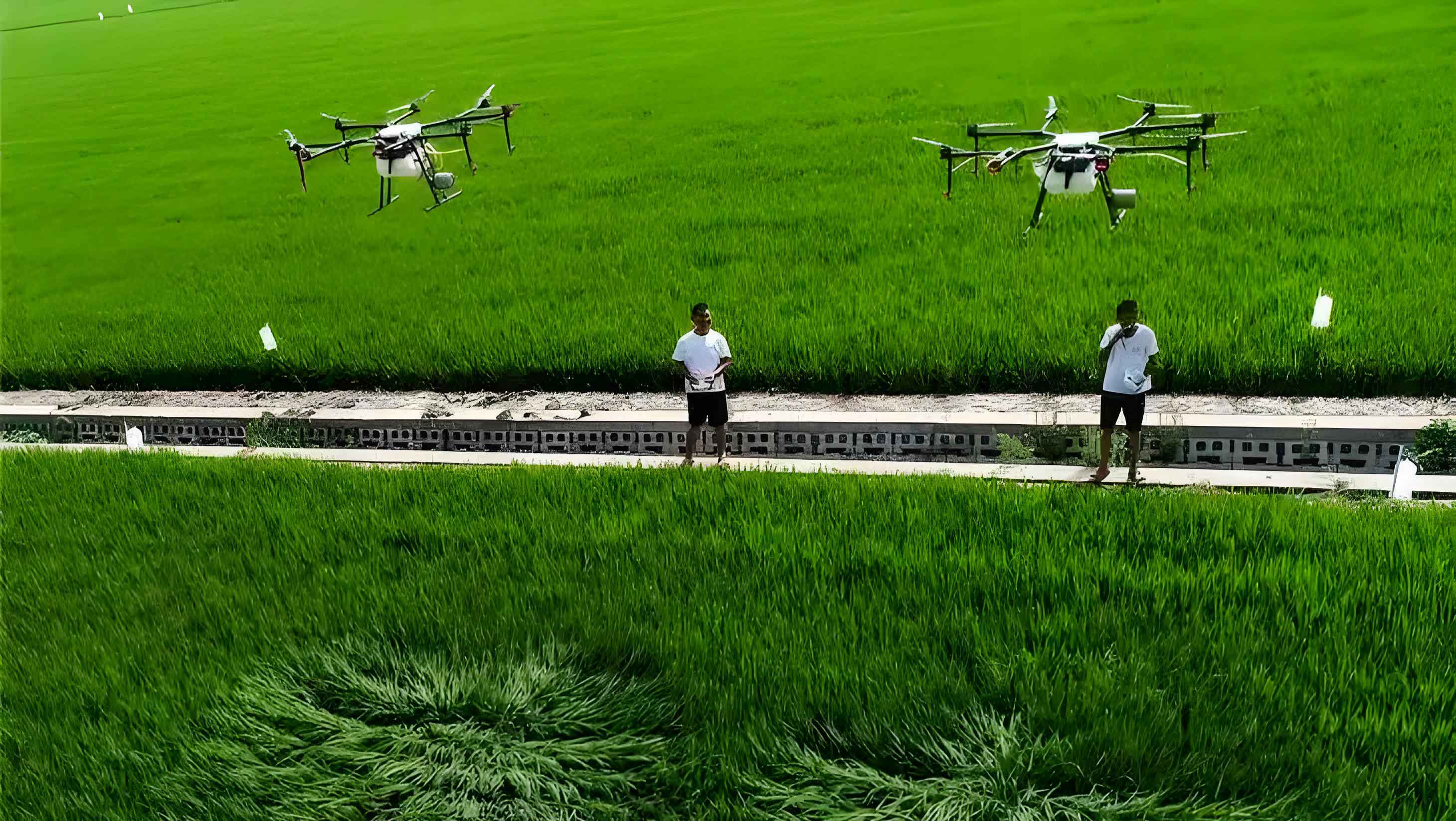
The path planning for crop spraying drones typically involves determining optimal routes that cover all target fields while adhering to constraints such as payload capacity and operational logic. For a swarm of spraying UAVs, the problem becomes more intricate, as it requires coordinating multiple drones to work collaboratively. In this study, we consider a scenario where a fleet of identical crop spraying drones departs from a central base, services various fields with known pesticide demands, and returns to the base. The primary objectives are to minimize the total flight distance, which directly impacts operational time and cost, and to minimize the total energy consumption, which is crucial for extending battery life and reducing operational expenses. The mathematical formulation accounts for factors such as drone speed, payload-dependent energy consumption rates, and field-specific internal travel distances computed using methods like the boustrophedon path planning. The multi-objective nature of this problem necessitates a framework that can handle uncertainties in decision-making preferences, particularly when the weights assigned to distance and energy objectives are not precisely defined.
To model the path planning problem, we define the following parameters and variables. Let \( m \) represent the number of spraying UAVs, and \( n \) denote the number of fields to be serviced, with the base indexed as 0. The decision variable \( x_{ijk} \) is a binary indicator that equals 1 if drone \( k \) travels from field \( i \) to field \( j \), and 0 otherwise. Similarly, \( y_{ik} \) is a binary variable that equals 1 if field \( i \) is serviced by drone \( k \). The distance between fields \( i \) and \( j \) is given by \( d_{ij} \), and the internal operating distance within field \( i \), calculated based on the boustrophedon method, is denoted as \( d_i \). The first objective function, aimed at minimizing the total flight distance \( f_1 \), is expressed as:
$$ f_1 = \sum_{k=1}^{m} \sum_{i=0}^{n} \sum_{j=0}^{n} x_{ijk} d_{ij} + \sum_{k=1}^{m} \sum_{i=1}^{n} y_{ik} d_i $$
The second objective function focuses on minimizing the total energy consumption \( f_2 \). Energy usage for a crop spraying drone depends on factors like travel distance, payload weight, and drone speed. Assuming constant speed, the energy consumption is modeled as a linear function of the drone’s weight (including its own weight and the payload) and the distance traveled. Let \( \alpha_0 \) be the energy consumption rate per meter when the drone is empty, \( w \) be the drone’s自重, and \( \alpha^* \) be the energy consumption rate per meter when fully loaded. The real-time payload of drone \( k \) when traveling from field \( i \) to \( j \) is \( z_{ijk} \), and when operating in field \( i \), it is \( z_{ik} \), which we approximate as the average payload during the operation. Thus, the energy objective is:
$$ f_2 = \sum_{k=1}^{m} \sum_{i=1}^{n} \sum_{j=1}^{n} x_{ijk} \left( \alpha_0 + \frac{\alpha^* – \alpha_0}{w} z_{ijk} \right) d_{ij} + \sum_{k=1}^{m} \sum_{i=1}^{n} y_{ik} \left( \alpha_0 + \frac{\alpha^* – \alpha_0}{w} z_{ik} \right) d_i $$
The optimization problem is then formulated as minimizing both objectives subject to constraints. The capacity constraint ensures that the total pesticide demand of fields serviced by each drone does not exceed its maximum payload \( f \):
$$ \sum_{i=1}^{n} s_i y_{ik} \leq f \quad \text{for } k = 1, 2, \ldots, m $$
where \( s_i \) is the pesticide demand of field \( i \). Logical constraints include that each field is serviced exactly once:
$$ \sum_{k=1}^{m} y_{ik} = 1 \quad \text{for } i = 1, 2, \ldots, n $$
and flow conservation constraints for the drones:
$$ \sum_{j=1}^{n} x_{ijk} = y_{ik} \quad \text{for } i = 0, 1, \ldots, n; \, k = 1, 2, \ldots, m $$
$$ \sum_{i=1}^{n} x_{ijk} = y_{jk} \quad \text{for } j = 0, 1, \ldots, n; \, k = 1, 2, \ldots, m $$
$$ \sum_{j=1}^{n} x_{0jk} = \sum_{i=1}^{n} x_{i0k} \quad \text{for all } k $$
These constraints ensure that each spraying UAV starts and ends at the base, and that the routes are feasible. The multi-objective nature of this model means that we seek Pareto-optimal solutions where neither objective can be improved without worsening the other. However, in practice, decision-makers may have preferences that are not precisely quantifiable, leading to uncertain weights for the objectives. This is where the SMAA method becomes invaluable, as it allows for the evaluation of solutions across a range of possible weights without requiring explicit weight specifications.
The SMAA method handles uncertain weights by defining a feasible weight space \( W \) that encompasses all possible weight combinations. For two objectives, such as flight distance and energy consumption, the weight space when weights are completely unknown is:
$$ W = \left\{ (w_1, w_2) \in \mathbb{R}^2 \mid w_1 + w_2 = 1, \, w_1 \geq 0, \, w_2 \geq 0 \right\} $$
Here, \( w_1 \) and \( w_2 \) represent the weights for the distance and energy objectives, respectively. If partial information is available, such as \( w_1 > w_2 \), the weight space is restricted accordingly. SMAA uses a utility function to combine the objectives; for each solution \( x \), the overall utility \( U(x) \) is computed as a weighted sum of the normalized objective values. For instance, using linear normalization, the utility for objective values \( f_1(x) \) and \( f_2(x) \) is:
$$ U(x) = w_1 u_1(f_1(x)) + w_2 u_2(f_2(x)) $$
where \( u_1 \) and \( u_2 \) are normalization functions, such as \( u_j(f_j) = \frac{\max f_j – f_j}{\max f_j – \min f_j} \) for minimization objectives. The rank of each solution is determined based on its utility across the weight space. The set of weights that make solution \( x \) achieve rank \( r \) is:
$$ W_x^r = \left\{ w \in W \mid \text{rank}(x, w) = r \right\} $$
The acceptability of a solution is then calculated as the probability that it achieves a certain rank, integrated over the weight space. The rank acceptability \( RA_r \) for rank \( r \) is:
$$ RA_r = \int_{x} f(x) \int_{w \in W_x^r} f(w) \, dw \, dx $$
where \( f(w) \) is the probability density function of the weights, often assumed uniform for completely unknown weights. The overall acceptability \( a_h \) of a solution is computed using ranking weights \( \alpha_r \), such as the inverse rank weight \( \alpha_r = 1/r \):
$$ a_h = \sum_{r} \alpha_r RA_r $$
This acceptability measure serves as the fitness function in our heuristic algorithm, guiding the search for high-quality solutions under weight uncertainty.
To solve the multi-objective path planning model for crop spraying drones, we employ an artificial immune algorithm, which is a heuristic inspired by the biological immune system. This algorithm is well-suited for handling complex optimization problems with multiple constraints and objectives. The process begins with initialization, where a population of candidate solutions is generated. Each solution is encoded as a permutation of field indices, with randomly inserted breakpoints to divide the sequence into routes for multiple spraying UAVs. For example, with 3 drones and 8 fields, a random permutation like [2, 4, 6, 3, 5, 1, 7, 8] might be split into three routes: base→2→4→6→base, base→3→5→1→base, and base→7→8→base. The initial population is generated repeatedly until it contains a sufficient number of feasible solutions that satisfy the capacity and logical constraints.
The fitness of each solution is evaluated using the SMAA-based acceptability measure. For each candidate solution, we compute the objective values \( f_1 \) and \( f_2 \), then determine its rank acceptability across the feasible weight space. Solutions that violate constraints, such as payload limits, are assigned a fitness of zero. Elite solutions with the highest acceptability are preserved in each generation to prevent the loss of good candidates. Selection of parent solutions for reproduction is performed using a roulette wheel method, where solutions with higher acceptability have a greater chance of being selected.
Crossover and mutation operators are applied to generate offspring solutions. For crossover, we use a two-point crossover method: two random points are selected in the parent sequences, and the segments between these points are exchanged to produce new offspring. This may result in invalid solutions with duplicate or missing fields, which are repaired by replacing duplicates with missing fields while preserving the order of non-duplicate elements. Mutation involves randomly swapping two fields in a solution to introduce diversity. The algorithm iterates through generations, combining the new population with elite solutions from the previous generation, and recalculates fitness until convergence criteria are met, such as a maximum number of iterations or stability in the solution quality.
We conducted simulation experiments to validate our approach for crop spraying drone path planning. The scenario involved a base at coordinates (150, 0) and 7 fields with known boundaries and pesticide demands. The spraying UAVs had a maximum payload of 40 kg, a self-weight of 25 kg, an operating width of 4 m, and energy consumption rates of 7 mAh/m when fully loaded and 3 mAh/m when empty. Pesticide consumption was set at 0.015 kg per square meter. Internal field distances were precomputed using the boustrophedon method. The algorithm parameters included a population size of 20, crossover rate of 0.7, mutation rate of 0.2, and 20 generations, with 3 elite solutions retained per generation.
We explored two weight scenarios: completely unknown weights and partially known weights where the distance objective was more important than energy. The following table summarizes the average objective values of elite solutions over generations for the completely unknown weight case:
| Iteration | Average Distance (m) | Average Energy (mAh) |
|---|---|---|
| 1 | 3131.8 | 19114.5 |
| 2 | 3002.6 | 18224.9 |
| 3 | 2888.7 | 19324.9 |
| 4 | 2844.8 | 18785.2 |
| 5 | 2819.7 | 18425.6 |
| 6 | 2821.9 | 17954.9 |
| 7 | 2758.9 | 18673.1 |
| 8 | 2763.4 | 17587.5 |
| 9 | 2754.3 | 16830.3 |
| 10 | 2672.7 | 15906.5 |
| 11 | 2672.7 | 15823.7 |
| 12 | 2670.1 | 16002.1 |
| 13 | 2670.1 | 16002.1 |
| 14 | 2670.1 | 16002.1 |
| 15 | 2672.8 | 15794.1 |
| 16 | 2672.8 | 15794.1 |
| 17 | 2672.8 | 15794.1 |
| 18 | 2672.8 | 15794.1 |
| 19 | 2672.8 | 15794.1 |
| 20 | 2672.8 | 15794.1 |
The algorithm converged after 15 generations, with the best solution achieving a flight distance of 2674.1 m and energy consumption of 15731.3 mAh. The acceptability analysis for the final elite solutions is shown below:
| Solution ID | Routes | Distance (m) | Energy (mAh) | Rank Acceptability (r1, r2, r3) | Overall Acceptability |
|---|---|---|---|---|---|
| 1 | 0-3-2-1-0; 0-4-0; 0-5-6-7-0 | 2674.1 | 15731.3 | (0.522, 0.478, 0) | 0.761 |
| 2 | 0-4-0; 0-2-1-3-0; 0-5-6-7-0 | 2674.1 | 15820.1 | (0, 0.058, 0.942) | 0.343 |
| 3 | 0-3-2-1-0; 0-4-0; 0-5-7-6-0 | 2670.1 | 15831.1 | (0.478, 0.464, 0.058) | 0.730 |
Solution 1 had the highest overall acceptability of 0.761, making it the preferred choice under completely unknown weights. For the partially known weight scenario (distance weight > energy weight), the algorithm converged faster, in 12 generations, and the best solution had a distance of 2670.1 m and energy of 15831.1 mAh, with an improved acceptability of 0.987. This demonstrates the adaptability of our method to different weight conditions, ensuring that the path planning for spraying UAVs remains effective even with limited preference information.
In conclusion, this paper presents a comprehensive framework for multi-objective path planning of crop spraying drone swarms, addressing the challenges of uncertain objective weights. By integrating a mathematical model with SMAA and an artificial immune algorithm, we can efficiently generate paths that balance flight distance and energy consumption. The simulations confirm that our approach converges to high-quality solutions and adapts to varying weight scenarios, making it suitable for practical applications in agriculture. Future work could incorporate additional factors such as wind conditions, dynamic obstacles, and more detailed energy models to further enhance the realism and applicability of the path planning for spraying UAVs. The use of crop spraying drones in precision agriculture is poised to grow, and robust path planning methods like ours will play a crucial role in optimizing their performance and sustainability.