
As a researcher deeply immersed in the field of advanced military systems, I have witnessed firsthand the rapid evolution of unmanned technologies, which are reshaping the landscape of modern warfare. In this article, I will explore the development, core technologies, and extensive applications of military unmanned systems, with a particular emphasis on military drones. The integration of artificial intelligence, robotics, and networked systems has propelled these platforms from mere reconnaissance tools to pivotal combat assets, fundamentally altering strategic and tactical operations. My analysis draws from historical contexts and recent conflicts, highlighting how military drones have become indispensable in achieving information dominance, precision strikes, and force protection. Throughout this discussion, I will employ tables and mathematical formulas to succinctly summarize key concepts, ensuring a comprehensive understanding of this transformative domain.
The concept of military unmanned technology encompasses a broad spectrum of systems designed to operate without direct human intervention, leveraging automation and intelligent algorithms. At its core, this technology aims to reduce human risk in hostile environments while enhancing operational efficiency and effectiveness. Military drones, as a prime example, exemplify this shift toward unmanned platforms. The foundational technologies driving this revolution include microelectronics, nanotechnology, computer science, communication networks, stealth materials, and aerospace engineering. These advancements have converged to create sophisticated systems capable of autonomous decision-making, real-time data processing, and seamless integration into larger military architectures. I believe that the proliferation of military drones is not merely a trend but a paradigm shift, as evidenced by their escalating deployment in conflicts worldwide.
To understand the technical underpinnings, let’s delve into the构成 of military intelligent unmanned technology. This field is interdisciplinary, drawing from artificial intelligence (AI), robotics, neuroscience, and computational biology. The following table summarizes the key technological components and their roles in enhancing military drone capabilities:
| Technology | Description | Application in Military Drones |
|---|---|---|
| High-Performance Computing | Involves supercomputers and parallel processing systems for rapid data analysis and simulation. | Enables real-time image processing, target recognition, and autonomous navigation for military drones. |
| Neural Network Technology | Machine learning models inspired by biological neurons, used for pattern recognition and adaptive control. | Improves sensor data interpretation, threat assessment, and evasive maneuvers in military drones. |
| Robotics Technology | Focuses on creating machines that mimic human cognitive functions, including expert systems and autonomous agents. | Forms the basis for unmanned ground vehicles and aerial military drones, allowing complex mission execution. |
| Human-Machine Interface | Technologies like virtual reality and natural language processing that enhance interaction between operators and systems. | Facilitates remote piloting and situational awareness for military drone operators. |
| Distributed Network Computing | Decentralized computing architectures that support seamless communication and data sharing across platforms. | Integrates military drones into networked battlefields, enabling coordinated swarms and data fusion. |
| Biological Computer Technology | Emerging field using DNA or biological components for computation, offering high-density data storage. | Potential for miniaturized processors in future military drones, enhancing stealth and efficiency. |
| Smart Structure Technology | Materials with embedded sensors and actuators that adapt to environmental changes. | Improves durability and stealth of military drone airframes, reducing detectability. |
Each of these technologies contributes to the autonomy and intelligence of military drones. For instance, neural networks can be mathematically represented using formulas that model decision-making processes. A basic neural network unit, or neuron, computes an output based on weighted inputs, often expressed as:
$$ y = f\left(\sum_{i=1}^{n} w_i x_i + b\right) $$
Here, \( y \) is the output, \( x_i \) are input signals (e.g., sensor data from a military drone), \( w_i \) are weights adjusted through learning, \( b \) is a bias term, and \( f \) is an activation function such as the sigmoid:
$$ f(z) = \frac{1}{1 + e^{-z}} $$
This formalism allows military drones to classify targets or navigate obstacles autonomously. Similarly, high-performance computing enables complex simulations for drone swarm coordination, modeled by equations like:
$$ \frac{d\mathbf{p}_j}{dt} = \sum_{k=1}^{N} \mathbf{F}(\mathbf{p}_j, \mathbf{p}_k) + \mathbf{G}(\mathbf{p}_j, \mathbf{t}) $$
where \( \mathbf{p}_j \) represents the position of the j-th military drone in a swarm, \( \mathbf{F} \) denotes inter-drone forces for collision avoidance, and \( \mathbf{G} \) accounts for external targets or threats. Such mathematical frameworks underpin the operational efficacy of military drones, making them more than mere remote-controlled vehicles.
The historical application of unmanned weapons, particularly military drones, in warfare underscores their transformative impact. From early reconnaissance roles to contemporary strike missions, military drones have evolved into versatile tools that dominate battlespaces. I will now summarize their usage across key conflicts, emphasizing how each war accelerated technological advancements. The table below provides a chronological overview:
| Conflict | Time Period | Military Drone Models Used | Primary Roles | Impact and Outcomes |
|---|---|---|---|---|
| Vietnam War | 1960s-1970s | BQM-34 “Firebee” | Strategic reconnaissance | Reduced pilot casualties; demonstrated drone survivability in high-threat environments. |
| Middle East Wars (e.g., Lebanon) | 1970s-1980s | “Firebee”, “Scout”, “Mastiff” | Electronic warfare and decoy operations | Enabled suppression of enemy air defenses; showcased drone utility in deception tactics. |
| Gulf War | 1991 | “Pioneer”, TALD, BQM-74 | Reconnaissance, target acquisition, battle damage assessment | Provided real-time intelligence; facilitated precise artillery and airstrikes. |
| Kosovo War | 1999 | “Predator”, “Hunter”, “Phoenix” | Surveillance and reconnaissance | Served as key intelligence assets; enhanced NATO targeting accuracy. |
| Afghanistan War | 2001 onward | “Predator”, “Global Hawk”, “Micro Star” | Reconnaissance-strike missions, targeted killings | Pioneered armed military drones; eliminated high-value targets with minimal risk. |
| Iraq War | 2003 | “Predator”, “Global Hawk”, “Shadow” | Precision strikes, biochemical detection, tactical reconnaissance | Decimated enemy divisions; demonstrated multi-role capabilities of military drones. |
This progression highlights how military drones have transitioned from passive observers to active combatants. In the Vietnam War, for example, the BQM-34 military drone conducted over 3,000 sorties with a low loss rate, proving the value of unmanned platforms in high-risk scenarios. The mathematical efficiency of such operations can be expressed in terms of cost-benefit ratios. Let \( C_h \) represent the cost of a human-piloted mission, including potential loss of life, and \( C_d \) the cost of a military drone mission. The advantage ratio \( R \) is:
$$ R = \frac{C_h}{C_d} \cdot \frac{S_d}{S_h} $$
where \( S_d \) and \( S_h \) denote success rates of drone and human missions, respectively. Historical data often shows \( R > 1 \), justifying increased investment in military drone technology.
The visual representation of a modern military drone underscores its sophisticated design, which integrates stealth features, advanced sensors, and weapon systems. Below is an image that encapsulates the technological essence of these platforms:
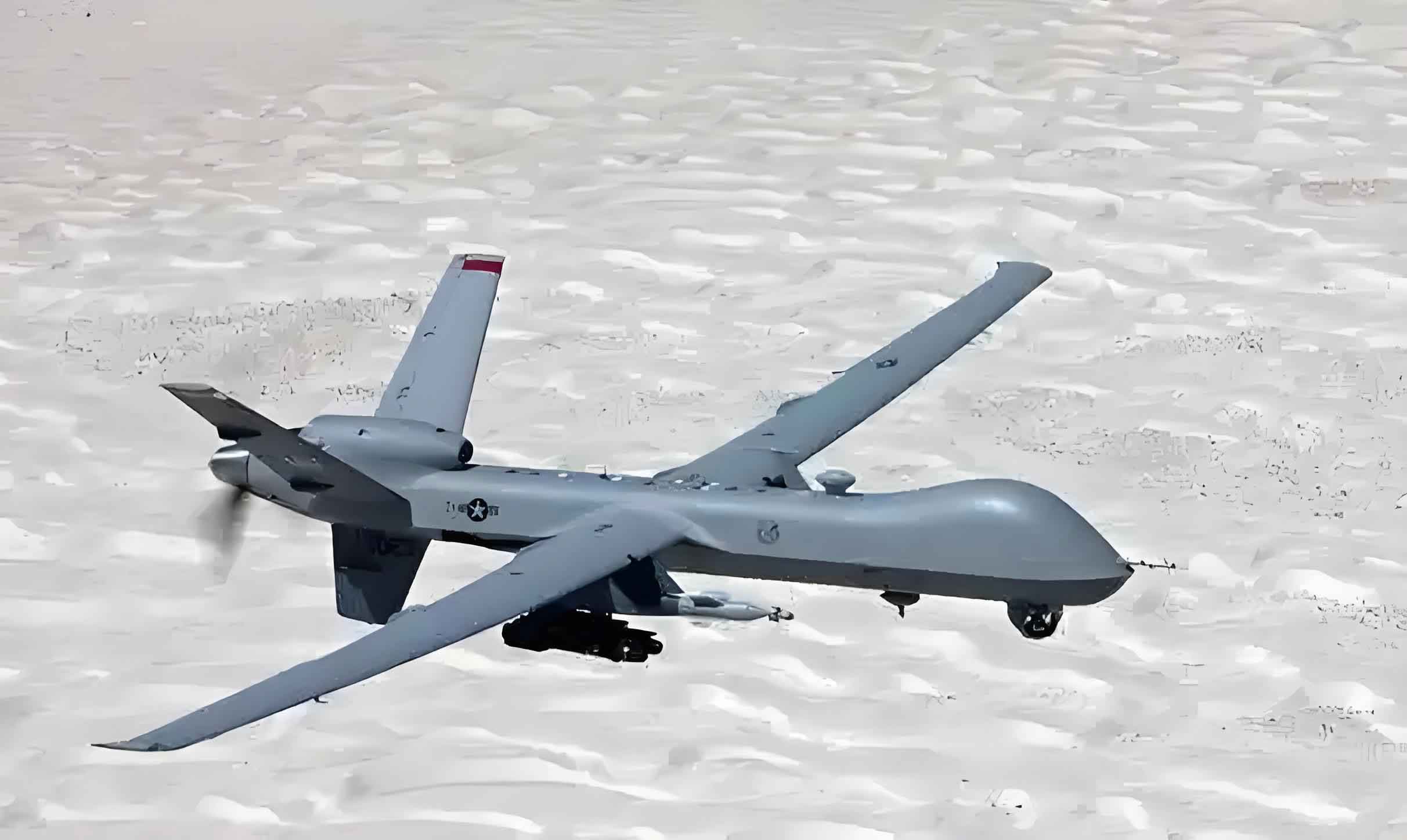
As seen in the image, military drones are engineered for durability and versatility, capable of operating in diverse environments. Their design principles often involve aerodynamic optimization, modeled by equations such as the lift force equation:
$$ L = \frac{1}{2} \rho v^2 S C_L $$
where \( L \) is lift, \( \rho \) is air density, \( v \) is velocity, \( S \) is wing area, and \( C_L \) is the lift coefficient. This ensures that military drones can maintain stable flight during long-endurance missions, which is critical for surveillance and strike roles.
In recent conflicts, military drones have demonstrated unprecedented capabilities. During the Afghanistan War, the armed “Predator” military drone marked a milestone by conducting targeted strikes with AGM-114 Hellfire missiles. This evolution can be analyzed through a decision-making model for autonomous engagement. Suppose a military drone identifies a target with confidence level \( P_t \) based on sensor fusion. The decision to engage follows a threshold rule:
$$ \text{Engage if } P_t \geq \Theta \text{, where } \Theta = f(I, R_o, E) $$
Here, \( \Theta \) is a threshold dependent on intelligence \( I \), rules of engagement \( R_o \), and environmental factors \( E \). This algorithmic approach minimizes human error and accelerates response times, a key advantage of military drones in dynamic battlespaces.
Moreover, the proliferation of miniaturized military drones, such as the “Micro Star” deployed in Afghanistan, has expanded tactical options for ground forces. These micro-drones leverage advancements in micro-electromechanical systems (MEMS), with dynamics described by scaled-down versions of Newton’s laws. For instance, the motion of a micro military drone under thrust \( T \) and drag \( D \) is:
$$ m \frac{d^2 \mathbf{x}}{dt^2} = \mathbf{T} – \mathbf{D} + \mathbf{W} $$
where \( m \) is mass, \( \mathbf{x} \) is position, and \( \mathbf{W} \) represents wind disturbances. Their small size allows covert operations in urban terrains, further emphasizing the versatility of military drones.
Looking ahead, the future of military unmanned technology is poised for further innovation. I anticipate that next-generation military drones will incorporate quantum computing for unbreakable encryption, advanced AI for fully autonomous missions, and bio-hybrid systems for enhanced resilience. The convergence of these technologies can be modeled using network theory, where the effectiveness \( E \) of a drone swarm is:
$$ E = \alpha \log(N) + \beta \sum_{i=1}^{N} C_i + \gamma H $$
with \( N \) as the number of military drones, \( C_i \) as individual computational power, \( H \) as information entropy, and \( \alpha, \beta, \gamma \) as coefficients. This equation suggests that as military drones become more interconnected and intelligent, their collective impact on warfare will grow exponentially.
In conclusion, military unmanned technology, spearheaded by military drones, represents a cornerstone of modern defense strategies. From their humble beginnings as reconnaissance tools to their current status as multi-role combat platforms, military drones have revolutionized how wars are fought and won. The continuous integration of AI, networking, and advanced materials ensures that military drones will remain at the forefront of military innovation. As I reflect on this journey, it is clear that the evolution of military drones is not just about technology but about redefining the very nature of conflict, making it more precise, less risky for personnel, and increasingly dependent on unmanned systems. The formulas and tables presented here encapsulate the technical rigor behind these advancements, underscoring the critical role of military drones in shaping the future battlefield.