
As a researcher focused on military equipment design, I have been deeply involved in the development of support systems for modern warfare. In today’s rapidly evolving battlefield landscapes, military UAVs have become indispensable assets for reconnaissance, target acquisition, and combat operations. However, the sustainability and operational readiness of these military UAVs are heavily dependent on effective maintenance and rapid repair capabilities, especially in harsh and complex environments. This article presents my comprehensive approach to designing an emergency repair shelter for military UAVs, tailored to withstand extreme natural conditions while ensuring quick turnaround for damaged units. The goal is to enhance the in-service equipment readiness rate and support continuous military UAV operations in new-era conflicts.
The concept of complex environments in military contexts refers to the natural factors that significantly impact operational effectiveness. From my analysis, these environments include high-altitude mountainous regions, tropical jungles, desert and戈壁 areas, and frigid border zones. Each presents unique challenges: for instance, high-altitude environments feature low pressure, hypoxia, and freezing temperatures, while deserts exhibit extreme heat, dryness, and sandstorms. These conditions directly influence the design parameters of any support infrastructure, including repair shelters for military UAVs. To systematize these influences, I have categorized key environmental factors and their effects on military activities, as shown in Table 1.
| Environmental Type | Primary Characteristics | Design Implications for Military UAV Shelters |
|---|---|---|
| High-Altitude Mountain | Low pressure, low oxygen, cold, strong winds, UV radiation | Requires pressure resistance, thermal insulation, wind-resistant structures |
| Tropical Region | High temperature, high humidity, heavy rainfall | Needs heat dissipation, moisture-proofing, corrosion-resistant materials |
| Desert and戈壁 | Extreme heat, dryness, sandstorms, large diurnal temperature swings | Demands dust sealing, solar radiation protection, thermal regulation |
| Northern Border Zones | Sub-zero temperatures, strong winds, snow and ice | Calls for anti-freeze features, structural stability against wind loads |
Understanding these factors is crucial because they dictate the shelter’s exterior form, material selection, and internal climate control. For example, in desert environments, the shelter must minimize heat absorption and withstand sand abrasion, while in tropical areas, it should prevent mold growth and ensure ventilation. My design process always begins with a thorough environmental assessment to ensure that the military UAV repair shelter can operate reliably across diverse terrains. This involves modeling environmental stresses using parameters like temperature ($T$), humidity ($H$), wind speed ($W$), and solar radiation ($S$). A simplified performance metric can be expressed as:
$$ P_e = \alpha T + \beta H + \gamma W + \delta S $$
where $P_e$ represents the environmental performance score, and $\alpha, \beta, \gamma, \delta$ are weighting coefficients based on the specific theater of operation. This formula helps in prioritizing design features; for instance, in windy regions, $\gamma$ would be high, emphasizing structural robustness.
The core function of a military UAV repair shelter is to provide a mobile platform for maintenance, regular checks, and emergency repairs of military UAVs. Based on my experience, such shelters integrate multiple subsystems: external enclosures, internal equipment, power supply systems, and tooling. The internal layout must accommodate everything from diagnostic instruments to spare parts, all while facilitating efficient workflow. I have outlined the typical physical-internal equipment attributes in Table 2, which serves as a foundation for the shelter’s spatial planning.
| Attribute Category | Description |
|---|---|
| Technical Function | Supports daily maintenance, periodic inspections, emergency repairs, and training for military UAVs |
| Key Internal Equipment | Silent diesel generator, exhaust fans, split air conditioning units, aluminum racking, workbenches, cable reels, storage cabinets, hoisting mechanisms |
| Auxiliary Components | Electrical outlets, signal ports, ventilation apertures, lighting systems |
| Power System | Integrated distribution box with overload, leakage, and surge protection |
To translate these attributes into an effective design, I follow a methodical approach centered on the repair workflow and environmental adaptability. The repair process for damaged military UAVs is time-sensitive; any delay can compromise mission success. I have streamlined this into a two-tiered system: for lightly damaged military UAVs, they are transported to the shelter, while for severe cases, the shelter deploys to the site. This logistics model reduces downtime and is encapsulated in the repair time equation:
$$ T_r = T_s + \frac{D}{R_m} $$
where $T_r$ is the total repair time, $T_s$ is the setup and transportation time, $D$ is the damage severity index (ranging from 0 to 1), and $R_m$ is the repair rate dependent on shelter capabilities. Minimizing $T_r$ is a key objective, driving decisions in shelter mobility and internal layout efficiency.
Environmental adaptation requirements are non-negotiable in my designs. The shelter must perform under specified technical indicators, which I summarize in Table 3. These criteria ensure that the military UAV repair shelter remains operational in extreme conditions, thereby guaranteeing that military UAV assets can be quickly restored to service.
| Requirement Type | Specifications | Design Response |
|---|---|---|
| Temperature Range | -10°C to 70°C operational | Use of insulated panels with polyurethane foam; integrated heating and cooling systems |
| Humidity Tolerance | 25% to 85% relative humidity at 25°C | Moisture-resistant materials; dehumidification features in air conditioning |
| Rain and Wind Resistance | Withstands 8 mm/min rain at 45° angle for 2.5 hours; stable in 6-level winds (13.8 m/s); intact in 8-level winds (20.7 m/s) | Sealed joints; reinforced aluminum alloy structure; aerodynamic shaping |
| Camouflage and Concealment | Blend into forest, desert, or urban settings | Application of adaptive camouflage patterns (e.g., desert迷彩); low-profile silhouette |
| Transportability | Compatible with road transport via trucks and maritime shipping | Standardized container dimensions; built-in self-loading mechanisms |
| Safety and Longevity | Compliance with military safety standards (e.g., GJB900-90); service life of 15 years | Fire-retardant materials; rounded edges; robust electrical protections |
In terms of造型设计, I prioritize a holistic integration of form and function. The exterior shape must not only meet environmental demands but also facilitate quick access and repair operations. For instance, large automated doors on the front allow damaged military UAVs to be driven or carried in directly, while side doors provide entry for personnel. The choice of materials is critical: I typically use rust-resistant aluminum sheets for the outer shell, with steel square tube skeletons for strength. The insulation core is polyurethane foam, selected for its thermal properties and light weight, which is vital for mobility. The overall aesthetic should reflect military robustness and technological advancement, avoiding unnecessary protrusions that could snag in vegetation or increase wind drag.
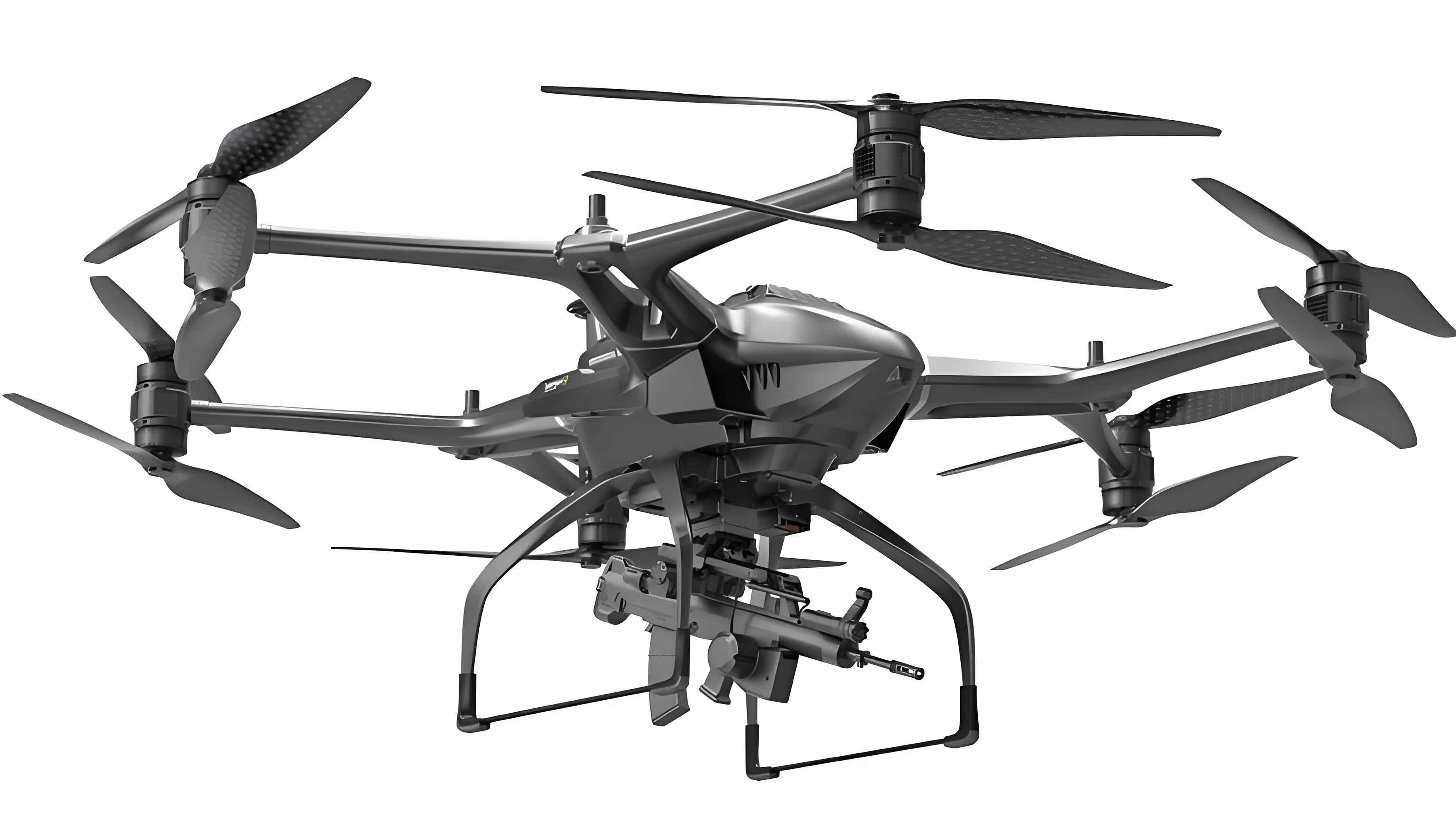
Now, let me delve into a specific design实例 that I developed. This military UAV repair shelter measures 800 cm in length, 260 cm in width, and 260 cm in height. The整体造型 features a rectangular form with chamfered edges to reduce wind resistance. The left side has double doors with louvers for generator ventilation, the right side incorporates transparent glass doors for internal monitoring, and the front hosts a large roll-up door for military UAV ingress. The rear includes flip-up hatches for equipment access and windows for natural light. To visualize this configuration, consider the following representation of a military UAV in a repair context:
The internal布局 is meticulously planned to support the repair workflow. As shown in Table 4, the shelter is divided into two main zones: the power source area and the repair作业区. This segregation minimizes interference and optimizes space utilization, ensuring that technicians can work efficiently on military UAVs without congestion.
| Zone | Key Equipment | Function |
|---|---|---|
| Power Source Area | Silent diesel generator, exhaust fans, external AC units | Provides independent power supply and climate control; isolated to reduce noise and heat |
| Repair作业区 | Workbenches, tool cabinets, hoisting systems, parts racks, diagnostic stations | Facilitates disassembly, repair, and reassembly of military UAVs; includes storage for components |
The spatial arrangement follows a linear flow: damaged military UAVs enter from the front, are positioned centrally under hoists, and are serviced using tools from surrounding stations. I use aluminum profile racking with adjustable trays to accommodate various military UAV parts, and all storage is secured with tie-downs to prevent movement during transport. The floor is anti-slip aluminum plate, and walls are covered with sound-absorbing finishes to create a controlled environment. Climate control is achieved through split air conditioners, with calculations for heat load based on equipment and occupancy:
$$ Q_c = U \cdot A \cdot \Delta T + \sum P_i $$
where $Q_c$ is the cooling capacity required, $U$ is the overall heat transfer coefficient of the shelter walls, $A$ is the surface area, $\Delta T$ is the temperature difference between inside and outside, and $\sum P_i$ is the total heat generated by internal equipment like generators and lights. This ensures that even in extreme heat, the interior remains conducive for repairing sensitive military UAV electronics.
Transportation and装卸方式 are integral to the shelter’s design. Military UAV repair shelters must be rapidly deployable, so I incorporated a self-loading system using extendable wheels and chain-driven pallet conveyors. The shelter can be loaded onto a standard military truck via a built-in mechanism: the wheels extend to lift the shelter onto a pallet, which then moves on rollers driven by a motorized chain. This reduces reliance on external cranes and speeds up deployment in remote areas. The transportability equation considers weight ($W_t$) and volume ($V$):
$$ C_t = \frac{W_t}{V} \cdot \frac{1}{M_s} $$
where $C_t$ is the transport efficiency index, and $M_s$ is the setup time. By optimizing this, the shelter can be airlifted or shipped as needed, supporting military UAV operations globally.
In conclusion, designing a military UAV repair shelter for complex environments requires a multidisciplinary approach that balances environmental resilience, operational efficiency, and logistical practicality. My methodology, grounded in environmental analysis and repair流程 optimization, has yielded a shelter that enhances the readiness of military UAV fleets. Future advancements may involve smart technologies for predictive maintenance of military UAVs, but the core principles of adaptability and rapid response will remain paramount. This work underscores the critical role of tailored support systems in sustaining military UAV dominance on modern battlefields.