
As a researcher in the field of aerospace and human-computer interaction, I have witnessed the rapid transformation of command and control systems for military UAVs. The efficacy of these systems hinges on the seamless interaction between human operators and machines, a domain that has evolved significantly over the years. In this article, I will delve into the developmental stages of human-machine interaction within military UAV command and control systems, explore future trends, and emphasize the pivotal role of proactive multimodal interfaces. The integration of advanced technologies is reshaping how we command military UAVs, making operations more intuitive and efficient. Throughout this discussion, the term ‘military UAV’ will be frequently referenced to underscore its centrality in modern warfare and defense strategies.
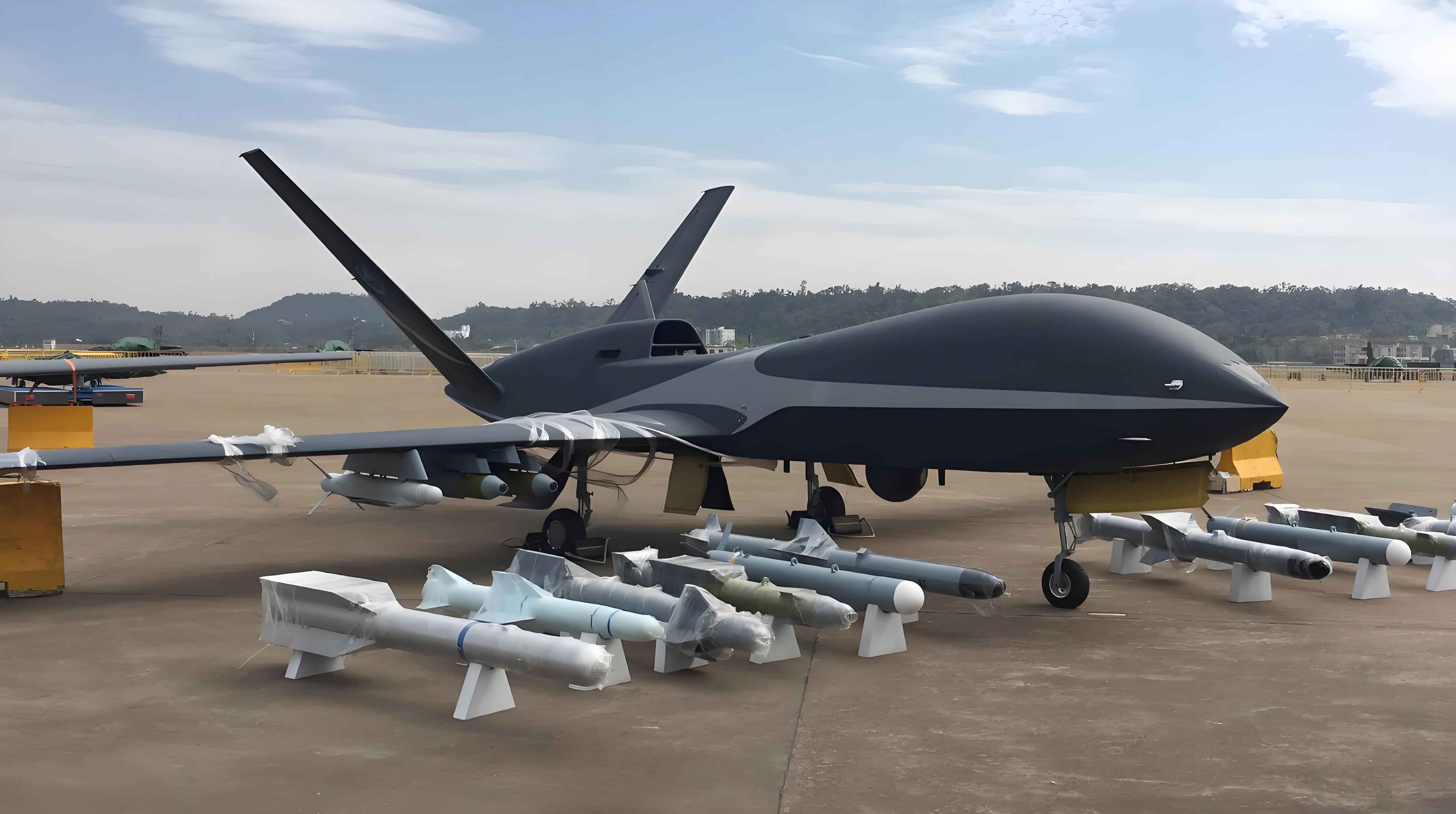
The evolution of human-machine interaction for military UAV command and control systems can be broadly categorized into three distinct phases. Each phase represents a leap in technology and user experience, driven by the need for enhanced situational awareness and operational efficiency in complex environments. Military UAV operations demand high precision and rapid decision-making, which directly correlates with the quality of interaction between the operator and the system. In the following sections, I will outline these stages, supported by comparative analyses and mathematical models that quantify interaction improvements.
The first phase is the Graphical User Interface (GUI) Interaction Stage. During this period, military UAV command and control systems predominantly relied on multiple large-screen displays, with input methods centered around keyboards, mice, and supplemented by physical buttons, knobs, and control sticks. This stage is characterized by abundant display output resources but relatively limited input modalities. For instance, operators would manually click through menus to issue commands, which, while functional, introduced latency and cognitive load. The information flow in such systems can be modeled using basic human-in-the-loop control theory. Consider a simple feedback loop where the operator’s input $u(t)$ affects the military UAV’s state $x(t)$, and the system output $y(t)$ is displayed back. The interaction efficiency $E$ can be approximated as:
$$E = \frac{1}{T} \int_0^T \frac{I(u(t), y(t))}{H(u(t)) + H(y(t))} dt$$
where $I$ denotes mutual information between input and output, $H$ represents entropy, and $T$ is the operation time. This formula highlights the trade-offs in information transfer during GUI-based interactions. A key limitation was the passive nature of the system—it only responded to explicit commands, often leading to operator fatigue in prolonged missions involving multiple military UAVs.
The second phase, the Multi-Channel Fusion Interaction Stage, marked a significant advancement. Building upon graphical interfaces, this stage incorporated emerging technologies such as virtual displays, voice interaction, and gesture recognition. This enriched both output and input capabilities, allowing for more natural and efficient control. For example, operators could use voice commands to direct a military UAV’s flight path while using hand gestures to manipulate sensor feeds. The fusion of multiple input channels reduces error rates and enhances robustness. Mathematically, the fusion process can be described using a Bayesian framework. Let $s$ be the system state, and $o_1, o_2, \dots, o_n$ be observations from $n$ different channels (e.g., voice, gesture). The posterior probability of the state given observations is:
$$P(s | o_1, o_2, \dots, o_n) = \frac{P(s) \prod_{i=1}^n P(o_i | s)}{\sum_{s’} P(s’) \prod_{i=1}^n P(o_i | s’)}$$
This approach improves decision accuracy by combining multimodal data. In military UAV applications, this meant faster response times and reduced cognitive strain, as operators could leverage intuitive modalities akin to human communication. However, the interaction remained largely passive, requiring the operator to initiate actions.
The third and current phase is the Intelligent Interaction Stage. This represents a paradigm shift toward systems that emulate human-like cognitive abilities, enabling proactive and context-aware interactions. Powered by artificial intelligence, these systems can perceive, reason, and act autonomously to support military UAV operations. Key drivers include advances in machine learning, natural language processing, and neural interfaces. The transition from passive to active interaction is fundamental here. Instead of waiting for commands, the system anticipates needs based on environmental data and operator behavior. This can be quantified through predictive analytics models. For instance, using a time-series forecasting approach, the system predicts the operator’s next action $a_{t+1}$ given historical actions $a_1, a_2, \dots, a_t$ and context $c_t$:
$$a_{t+1} = f(a_1, \dots, a_t, c_t; \theta)$$
where $f$ is a deep learning model with parameters $\theta$. Such capabilities are revolutionizing how military UAV fleets are managed, allowing for seamless coordination in dynamic battlespaces.
To summarize these stages, the following table contrasts their key features, emphasizing the evolution in military UAV command and control contexts:
| Stage | Primary Input Methods | Primary Output Methods | Interaction Paradigm | Typical Military UAV Applications |
|---|---|---|---|---|
| GUI Interaction | Mouse, Keyboard, Buttons | Large-screen Displays | Passive, Command-based | Basic reconnaissance and strike missions |
| Multi-Channel Fusion | Voice, Gesture, Touch | Virtual Displays, Haptic Feedback | Reactive, Multimodal | Enhanced surveillance and coordinated operations |
| Intelligent Interaction | AI-driven Proactive Suggestions | Immersive Environments, Adaptive Interfaces | Proactive, Context-aware | Autonomous swarms and real-time tactical decision support |
Looking ahead, the future of human-machine interaction for military UAV command and control systems will be shaped by four pivotal directions: intelligent perception and cognition, virtual-reality integration, brain-computer interaction, and natural language understanding. These areas promise to further blur the line between human and machine, creating symbiotic relationships that enhance operational efficacy. Military UAV systems will increasingly rely on these technologies to maintain superiority in contested environments.
Intelligent perception and cognition enable systems to transition from passive to active interaction. By equipping military UAV command centers with sensor arrays—such as cameras, microphones, and environmental sensors—the system can perceive its surroundings much like a human operator. Coupled with AI algorithms for scene understanding and behavior analysis, it can proactively offer solutions. For example, if a military UAV detects an unexpected obstacle, the system might automatically suggest alternative routes without waiting for operator input. This reduces the need for constant manual oversight. The cognitive process can be modeled using reinforcement learning, where the system learns optimal policies through interaction. The reward function $R(s, a)$ might incorporate mission success metrics for military UAV operations:
$$Q(s, a) = \mathbb{E} \left[ \sum_{k=0}^\infty \gamma^k R(s_{t+k}, a_{t+k}) \mid s_t = s, a_t = a \right]$$
where $Q(s, a)$ is the action-value function, and $\gamma$ is a discount factor. This allows the system to make informed decisions autonomously, significantly improving response times in critical scenarios involving military UAVs.
Virtual-reality integration merges physical and digital interfaces, enhancing user experience through tactile and spatial interactions. In military UAV command and control, this could manifest as mixed reality displays where operators manipulate holographic projections of drone feeds overlaid on real-world maps. Such interfaces provide intuitive spatial awareness, crucial for navigating complex terrains. The technology leverages advancements in augmented reality (AR) and computer vision. A mathematical representation involves spatial mapping functions. Let $P_w$ be a point in the physical world, and $P_v$ be its corresponding point in the virtual environment. The transformation can be expressed as:
$$P_v = M \cdot P_w + t$$
where $M$ is a rotation matrix and $t$ a translation vector. This seamless blend allows operators to interact with military UAV data as if it were tangible, reducing cognitive load and improving decision accuracy. For instance, an operator might use hand gestures to reposition a virtual representation of a military UAV’s camera view, with changes reflected in real-time on the actual drone.
Brain-computer interaction (BCI) represents a revolutionary input modality, where neural signals are decoded to control systems directly. For military UAV applications, this could enable operators to command drones through thought alone, bypassing traditional physical interfaces. Recent projects, such as DARPA’s non-invasive neural technologies, aim to develop high-bandwidth brain-machine interfaces. The core of BCI involves signal processing and classification. Electroencephalography (EEG) signals can be analyzed to extract features related to intent. A common approach uses the Fourier transform to decompose signals into frequency bands. The power spectral density $S(f)$ of an EEG signal $x(t)$ is:
$$S(f) = \left| \int_{-\infty}^\infty x(t) e^{-i 2\pi f t} dt \right|^2$$
Machine learning classifiers then map these features to control commands for military UAVs. While still emerging, BCI promises unprecedented speed and naturalness in interaction, potentially allowing a single operator to manage multiple military UAVs simultaneously with minimal physical effort.
Natural language understanding (NLU) is key to achieving truly natural communication between operators and military UAV systems. Advances in deep learning, particularly models like BERT and GPT, have dramatically improved machines’ ability to comprehend and generate human language. In command and control contexts, this enables operators to issue complex instructions in conversational language, such as “Have the military UAV scout the northern ridge and report any movements.” The system parses the intent and executes accordingly. The underlying models often rely on attention mechanisms. For a sequence of words $w_1, w_2, \dots, w_n$, the attention weight $\alpha_{ij}$ between words $i$ and $j$ is computed as:
$$\alpha_{ij} = \frac{\exp(e_{ij})}{\sum_{k=1}^n \exp(e_{ik})}, \quad e_{ij} = \frac{Q_i \cdot K_j^\top}{\sqrt{d_k}}$$
where $Q_i$ and $K_j$ are query and key vectors, and $d_k$ is the dimensionality. This allows the system to focus on relevant parts of the input, enabling accurate understanding of nuanced commands for military UAV operations. As NLU matures, it will reduce training overhead and make systems accessible to a broader range of personnel.
The convergence of these four directions points toward active multimodal interaction as the future norm for military UAV command and control systems. This paradigm integrates multiple input and output channels—such as voice, gesture, brain signals, and AI suggestions—into a cohesive interface that adapts dynamically to context. The system not only responds to explicit inputs but also anticipates needs based on real-time data from military UAV sensors and external sources. This proactive approach minimizes operator workload and maximizes mission effectiveness. To illustrate the benefits, consider the following table comparing traditional versus active multimodal interaction in a military UAV scenario:
| Aspect | Traditional Interaction | Active Multimodal Interaction |
|---|---|---|
| Initiative | Operator-driven | System-driven with operator oversight |
| Input Modalities | Single or limited channels | Multiple fused channels (e.g., voice, gaze, thought) |
| Response Time | Slower due to manual inputs | Faster due to predictive assistance |
| Cognitive Load | High, requiring constant attention | Reduced, as system handles routine tasks |
| Scalability | Limited to few military UAVs per operator | Potential to control swarms of military UAVs efficiently |
Mathematically, the efficiency of such systems can be evaluated using information theory metrics. The overall system performance $P$ might be a function of multiple factors, including bandwidth $B$, signal-to-noise ratio $\text{SNR}$, and user satisfaction $U$:
$$P = \alpha \cdot B \log_2(1 + \text{SNR}) + \beta \cdot U$$
where $\alpha$ and $\beta$ are weighting coefficients. This holistic view underscores the importance of both technical and human-centric measures in designing next-generation interfaces for military UAVs.
In conclusion, the evolution of human-machine interaction for military UAV command and control systems is progressing toward intelligent, proactive, and multimodal frameworks. From basic graphical interfaces to brain-computer symbiosis, each advancement has enhanced our ability to deploy and manage military UAVs effectively. The integration of intelligent perception, virtual-reality fusion, neural interfaces, and natural language understanding will redefine operator roles, making interactions more intuitive and efficient. As these technologies mature, they will empower military forces to leverage military UAVs in increasingly complex missions, ensuring dominance in future battlefields. The journey toward seamless human-machine collaboration is ongoing, and its success will hinge on continuous innovation and user-centered design principles tailored specifically for military UAV ecosystems.