
As an observer of modern military technology, I have witnessed the rapid evolution of unmanned aerial systems, particularly the rise of military micro drones. These compact devices are reshaping warfare, offering unparalleled advantages in surveillance, reconnaissance, and tactical operations. In this article, I will delve into the current state and future trends of military micro drones, drawing from global developments and my own insights. The term ‘military drone’ will be frequently emphasized to underscore its centrality in contemporary defense strategies.
The concept of unmanned flight dates back over a century, but it is in recent decades that military micro drones have emerged as a critical asset. Defined broadly as unmanned aerial vehicles with dimensions and weights minimized for portability and stealth, these military drones are instrumental in asymmetric warfare and counter-terrorism. The European UAV system association once categorized micro drones as those with a range under 10 km, altitude below 250 meters, endurance up to 1 hour, and takeoff weight less than 5 kg. However, advancements have pushed these boundaries, making military micro drones more capable and versatile.
In my assessment, the key characteristics of military micro drones can be summarized to highlight their operational value. These traits not only define their utility but also drive ongoing research and deployment. Below is a table that encapsulates the primary features:
| Characteristic | Description | Impact on Military Operations |
|---|---|---|
| Flexible Launch and Recovery | Military micro drones employ various launch methods: hand-thrown, vertical takeoff, or catapult-assisted. They require minimal space, allowing deployment in confined urban or rugged terrains. | Enables rapid deployment by infantry units, enhancing tactical agility without relying on runways. |
| High Mobility and Stealth | With low acoustic signatures and small cross-sections, these military drones can navigate complex environments like alleys or forests, avoiding detection while gathering intelligence. | Improves reconnaissance effectiveness, providing real-time data for decision-making in high-risk zones. |
| Low Cost and Reduced Risk | Compared to larger UAVs, military micro drones are affordable, with costs ranging from thousands to tens of thousands of dollars per unit. They minimize human exposure in dangerous missions. | Lowers budgetary burdens and casualty rates, making sustained operations feasible even for resource-limited forces. |
| Ease of Transport and Operation | Their lightweight design allows single soldiers to carry multiple units, with user-friendly controls often integrated into portable ground stations. | Increases accessibility for special forces and frontline troops, democratizing aerial surveillance capabilities. |
From my perspective, these characteristics underscore why military micro drones are becoming indispensable. For instance, the flexibility in launch modes can be modeled mathematically to optimize deployment strategies. Consider the probability of successful launch in urban settings, which depends on environmental factors. A simple formula for launch success rate (LSR) might be:
$$ LSR = \alpha \cdot e^{-\beta \cdot D} $$
Here, $\alpha$ represents the base success coefficient (often near 1 for hand-thrown military drones), $\beta$ is a terrain complexity factor, and $D$ is the distance to the target area. This illustrates how engineering and operational parameters interplay in military drone applications.
Turning to the global landscape, the development of military micro drones has been led by a few key nations. I have analyzed the progress in the United States, Israel, and China, as they represent the forefront of innovation. Each country has pursued unique pathways, reflecting diverse strategic priorities. To provide a clear comparison, I have compiled a table of representative military micro drones from these regions:
| Country | Representative Military Drone Model | Key Specifications | Operational Use |
|---|---|---|---|
| United States | Micro Star (a conceptualized variant) | Weight: <100g, Range: 5 km, Endurance: 30 min, Speed: 56 km/h | Close-range surveillance, urban reconnaissance |
| United States | Dragon Eye | Weight: 2.3 kg, Wingspan: 1.143 m, Range: 10 km, Endurance: 1 hour | Marine corps operations, tactical intelligence in conflicts |
| Israel | Skylark Series | Endurance: up to 3 hours, Altitude: 4700 m, Night-capable with thermal imaging | Special forces missions, exported to multiple nations |
| Israel | Meteor Series | Launch: tube-based, Altitude: 10,000 m, Endurance: 4 hours | High-altitude reconnaissance, artillery spotting |
| China | Domestically developed models (unnamed for proprietary reasons) | Focused on tactical and operational levels, with ongoing R&D for micro variants | Counter-terrorism, disaster response, and military-civil fusion initiatives |
In my view, the U.S. has invested heavily in military micro drones, with programs dating back to the late 1990s. The ‘micro drone’ concept, as pioneered by American research, emphasizes miniaturization and autonomy. Israel, learning from early imports, now excels in exporting military drones, leveraging实战 experience from regional conflicts. China, while a later starter, is rapidly advancing through indigenous innovation and international collaborations. The proliferation of these military drones underscores their strategic value in modern warfare.
To visualize the operational context of such military micro drones, consider the following image that captures a typical deployment scenario. This illustrates how compact and integrated these systems can be in field operations.
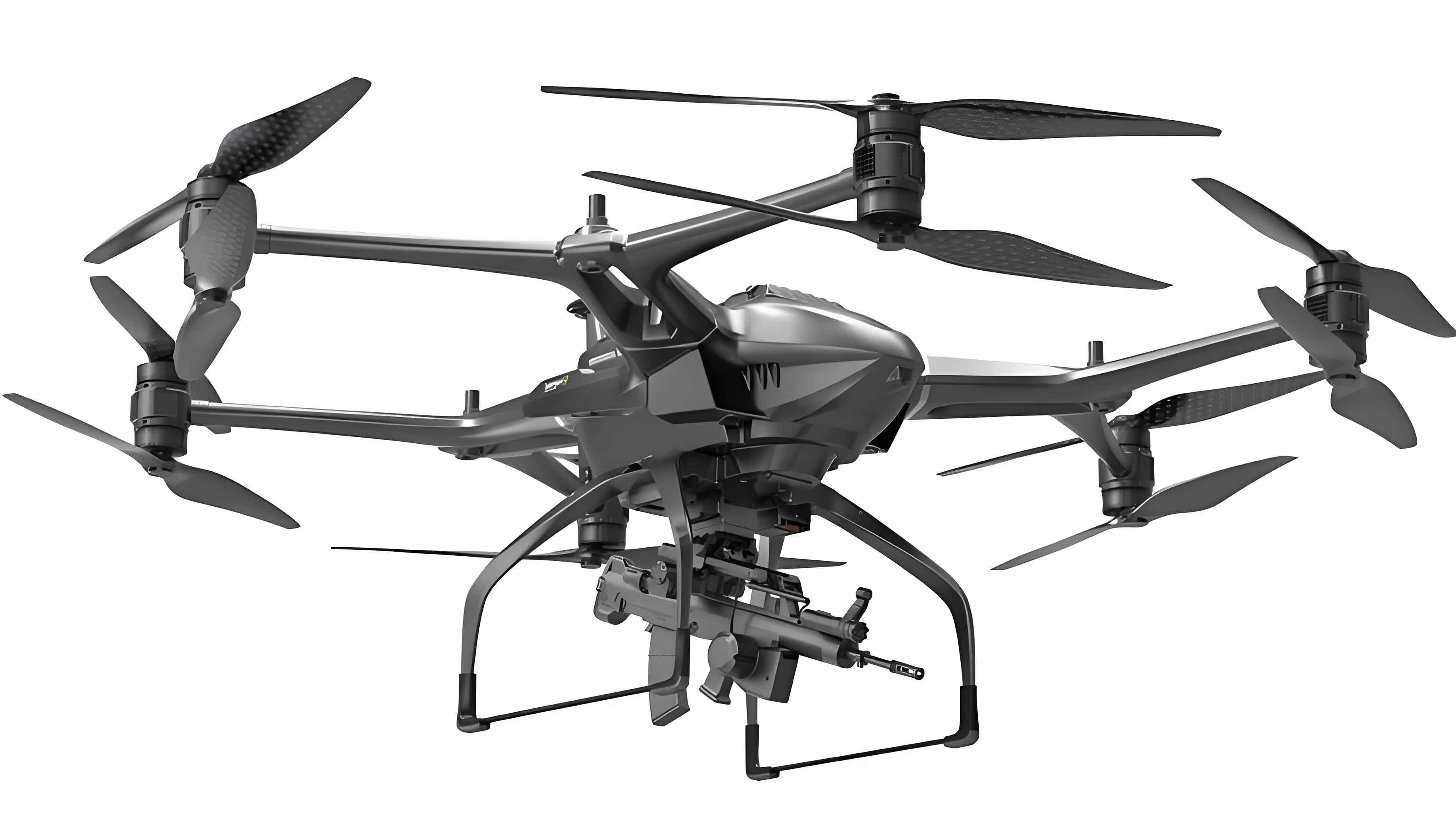
Looking ahead, I believe the future trends of military micro drones will revolve around overcoming current limitations and expanding capabilities. Based on my analysis, three major directions will dominate research and development. First, enhancing endurance and range is critical. Current military drones often suffer from short flight times due to battery constraints. The endurance $T$ can be expressed as:
$$ T = \frac{C \cdot V}{P_{avg}} $$
where $C$ is battery capacity in ampere-hours, $V$ is voltage, and $P_{avg}$ is the average power consumption. To improve $T$, researchers are exploring high-energy-density batteries, solar cells, and aerodynamic optimizations. For instance, reducing drag coefficient $C_d$ can extend range $R$ according to:
$$ R = \frac{L}{D} \cdot \frac{\eta \cdot E}{W} $$
Here, $L/D$ is lift-to-drag ratio, $\eta$ is propulsion efficiency, $E$ is energy available, and $W$ is weight. Advancements in materials science are key to boosting these parameters for military micro drones.
Second, miniaturization and noise reduction are paramount. The ideal military micro drone would be nearly invisible and inaudible, but physical laws pose challenges. Noise level $N$ in decibels can be modeled for rotary-wing drones as:
$$ N = 10 \log_{10}\left(\frac{\rho \cdot A \cdot v^6}{c^5}\right) + K $$
where $\rho$ is air density, $A$ is rotor area, $v$ is tip speed, $c$ is speed of sound, and $K$ is a constant. Reducing $A$ and $v$ through design innovations can lower $N$, enhancing stealth. Similarly, size reduction involves integrating nano-electronics, with Moore’s Law-like scaling applied to sensor suites. I anticipate that future military drones will approach sub-10 cm dimensions without sacrificing functionality.
Third, functional diversification and increased autonomy are inevitable. Current military micro drones primarily carry optical or thermal sensors, but future versions could incorporate electronic warfare modules, communication relays, or even micro-weapons. The payload capacity $P_{max}$ limits this, given by:
$$ P_{max} = W_{total} – (W_{airframe} + W_{battery} + W_{avionics}) $$
As components shrink, $W_{avionics}$ decreases, allowing more $P_{max}$ for versatile payloads. Moreover, artificial intelligence will enable autonomous swarming, where multiple military drones collaborate. A swarm’s effectiveness $E_s$ can be quantified as:
$$ E_s = N \cdot \left(1 + \gamma \cdot \ln(M)\right) $$
where $N$ is the number of drones, $\gamma$ is a coordination factor, and $M$ is the communication bandwidth. This highlights the shift toward smarter, networked military drone systems.
To further elaborate on these trends, I have compiled a table projecting the evolution of military micro drones over the next decade:
| Aspect | Current State (Approx. 2020s) | Future Projection (2030s) | Technological Enablers |
|---|---|---|---|
| Endurance | 1-3 hours typical | 5-10 hours through hybrid power systems | Solid-state batteries, energy harvesting |
| Size | Wingspans of 0.5-1 m common | Sub-20 cm in all dimensions for most models | MEMS sensors, 3D-printed structures |
| Noise Level | 50-70 dB at close range | Below 40 dB for covert operations | Blade design optimizations, noise-canceling materials |
| Autonomy | Pre-programmed or remote-controlled | Fully autonomous with AI-driven decision-making | Machine learning algorithms, edge computing |
| Payload Variety | Cameras and basic sensors dominate | Multi-spectral imagers, SIGINT packages, micro-ordinance | Nanotechnology, modular design frameworks |
In my opinion, the integration of military micro drones into combined arms operations will accelerate. These military drones are not just tools but force multipliers, enabling distributed sensing and precision engagement. The cost-effectiveness ratio $CER$ for military drone deployments can be expressed as:
$$ CER = \frac{B_{benefits}}{C_{cost}} = \frac{\sum (I_{intel} + M_{mission success})}{U_{unit cost} \cdot D_{deployment risk}} $$
where $I_{intel}$ represents intelligence value, $M_{mission success}$ is operational outcome, $U_{unit cost}$ is per-drone expense, and $D_{deployment risk}$ accounts for loss probabilities. As technology advances, $CER$ increases, justifying broader adoption of military micro drones.
Furthermore, I foresee ethical and regulatory challenges arising from the proliferation of military drones. Issues like airspace congestion, privacy infringements, and autonomous lethality will require international norms. However, the strategic imperative to maintain technological edge ensures that investment in military micro drones will continue unabated. Nations are already experimenting with swarms of military drones for overwhelming defenses, a tactic modeled by Lanchester’s laws of combat:
$$ \frac{dA}{dt} = -\beta B, \quad \frac{dB}{dt} = -\alpha A $$
where $A$ and $B$ represent forces, and $\alpha$, $\beta$ are attrition coefficients. With military drones, $\alpha$ can be enhanced through superior numbers and coordination, shifting the balance in modern battlespaces.
In conclusion, based on my extensive analysis, military micro drones are poised to redefine warfare in the 21st century. Their evolution from simple surveillance tools to autonomous, multifunctional systems reflects broader trends in digitization and miniaturization. As I reflect on the rapid progress, it is clear that military drones will remain at the forefront of defense innovation, influencing everything from tactical infantry units to grand strategy. The ongoing research into endurance, stealth, and intelligence will ensure that these military drones become even more integral to national security, ultimately shaping the future of conflict in profound ways. The journey of the military drone is far from over, and I am confident that its next chapters will be as transformative as its past.