
From my perspective as a researcher in aerospace technology, the evolution of unmanned aerial vehicles (UAVs), commonly referred to as military drones, has revolutionized modern warfare. A typical military drone system comprises at least the aircraft, one or more ground control stations, payloads, data links, launch and recovery subsystems, and ground support equipment. Having studied conflicts from Vietnam to Iraq, I observe that military drones have progressed from simple target drones to pre-programmed reconnaissance platforms, remotely piloted systems, composite-control multi-role UAVs, and now toward fully autonomous unmanned combat aerial systems. This article delves into the usage characteristics of military drones, focusing on classification, operational principles, and missions, with an emphasis on how these aspects shape contemporary and future military strategies. I will employ tables and mathematical formulations to encapsulate key concepts, ensuring a comprehensive analysis that underscores the critical role of military drones in defense ecosystems.
The utilization of military drones is intrinsically linked to their design, which is often mission-centric. To understand their application, I first categorize military drones based on their primary用途. While classifications exist by weight, range, altitude, or purpose, I adopt a用途-based approach for clarity in usage analysis. Military drones can be broadly divided into non-lethal and lethal categories, each with specialized sub-types. The following table summarizes this classification, highlighting the diverse applications of military drones across operational domains.
| Category | Sub-Type | Primary Role | Example Missions |
|---|---|---|---|
| Non-Lethal | Reconnaissance Drones | Surveillance and intelligence gathering | Battlefield monitoring, target acquisition |
| Communications Drones | C4I relay and data transmission | Enhancing battlefield communication networks | |
| Electronic Warfare Drones | Signal jamming and cyber operations | Disrupting enemy communications and radar | |
| Logistics Drones | Supply delivery and medical evacuation | Transporting cargo to remote or hostile areas | |
| Lethal | Combat Drones | Direct strike and air-to-ground attacks | Eliminating high-value targets, close air support |
| Anti-Radiation Drones | Suppression of enemy air defenses (SEAD) | Destroying radar installations and missile sites | |
| Loitering Munitions | Kamikaze-style attacks on time-sensitive targets | Engaging mobile assets like armored vehicles |
This categorization reveals the expansive use-cases for military drones, from intelligence, surveillance, and reconnaissance (ISR) to direct combat roles. In my analysis, I note that advancements in autonomy and sensor fusion are blurring these boundaries, enabling multi-role capabilities. For instance, a single military drone might perform reconnaissance before executing a strike, embodying the concept of “sensor-to-shooter” integration. The efficiency of such systems can be modeled using cost-effectiveness ratios. Let me propose a simple formula to evaluate the operational value of a military drone:
$$ V = \frac{\alpha \cdot I + \beta \cdot S + \gamma \cdot D}{C} $$
Here, \( V \) represents the overall value of the military drone, \( I \) denotes intelligence gain, \( S \) is survivability, \( D \) is destructive capability, and \( C \) is the total cost (including procurement, operation, and maintenance). The coefficients \( \alpha \), \( \beta \), and \( \gamma \) are weighting factors that reflect mission priorities, such as emphasis on stealth or firepower. This equation underscores how military drones optimize resource allocation in modern theaters.
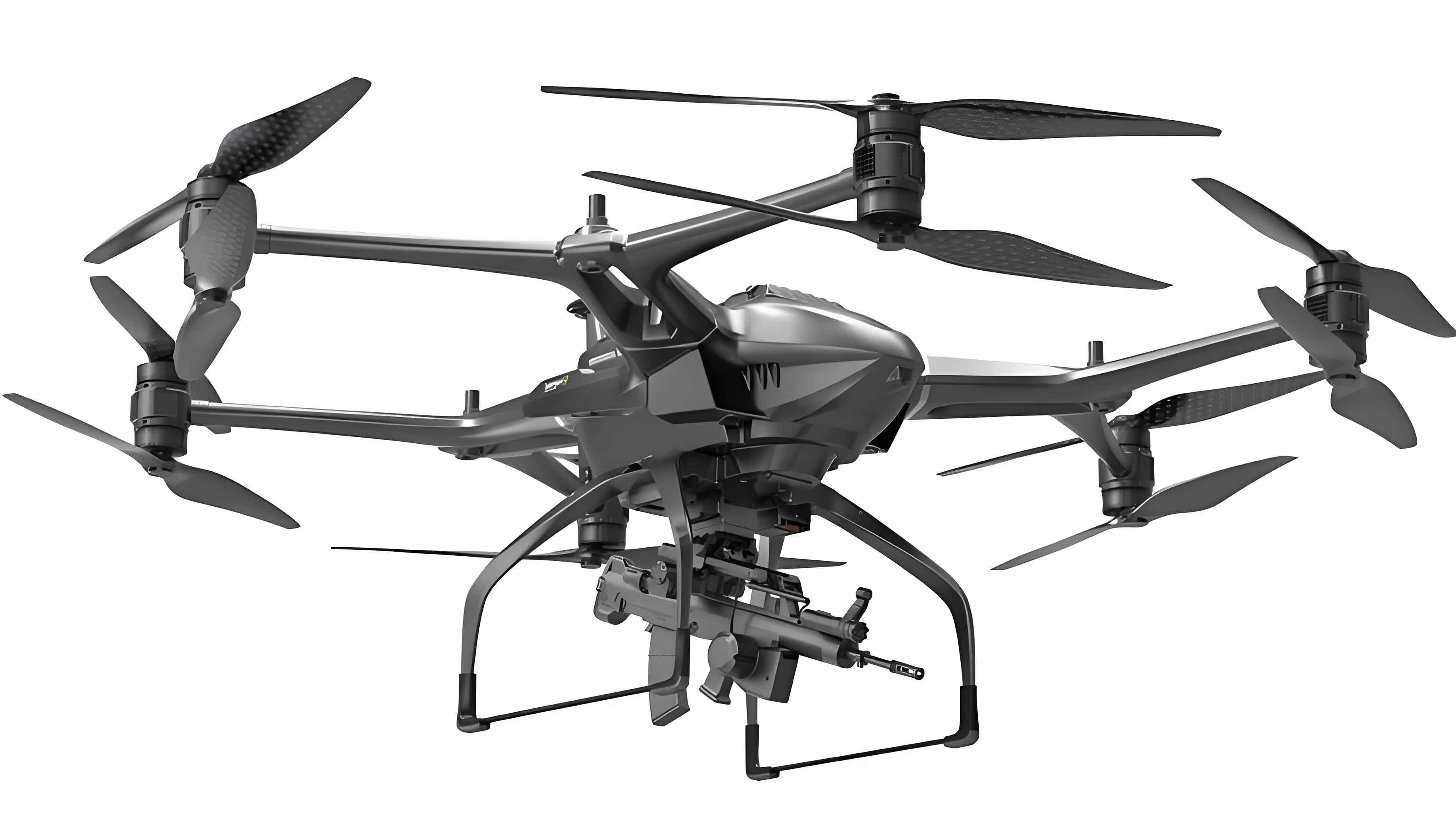
Moving to operational principles, I examine the doctrinal guidelines that govern the deployment of military drones. Based on historical engagements and future projections, I distill several core principles that enhance effectiveness. These principles, often exemplified by U.S. military practices, include massed, concentrated, and prioritized use; task-based, functional, and creative employment; and planned, adaptive, and coordinated operations. I elaborate on each below, integrating mathematical insights where applicable.
First, the principle of massed, concentrated, and prioritized use emphasizes deploying military drones in large numbers to saturate key areas. In conflicts like Kosovo, hundreds of military drones were集中 used to monitor high-value zones. This approach maximizes coverage and redundancy. From a logistical standpoint, the required number of military drones \( N \) for a given area \( A \) can be estimated using:
$$ N = \frac{A}{r^2 \cdot \pi \cdot \eta} $$
where \( r \) is the effective sensor range of the military drone, and \( \eta \) is an overlap factor to ensure continuous surveillance. This formula highlights how scaling drone fleets impacts operational dominance.
Second, task-based, functional, and creative use involves leveraging military drones for assigned missions while exploiting ancillary capabilities. For example, in the Gulf War, drones like the Pioneer performed diverse roles beyond core reconnaissance. Creativity is key; during Kosovo, Hunter drones were repurposed for target定位 and air strike guidance. This flexibility can be quantified through a versatility index \( \zeta \), defined as:
$$ \zeta = \sum_{i=1}^{n} w_i \cdot f_i $$
where \( f_i \) represents the performance score of the military drone in function \( i \) (e.g., surveillance, strike, communication), and \( w_i \) is the mission-specific weight. Higher \( \zeta \) values indicate broader utility of the military drone platform.
Third, planned, adaptive, and coordinated use ensures that military drones are integrated into broader command and control (C2) architectures. Given their operation across altitudes from 10 to 10,000 meters, coordination with air traffic management is critical. I model this using a network theory approach, where the effectiveness \( E \) of a drone swarm is:
$$ E = \log\left(1 + \frac{B \cdot L}{\sigma^2}\right) $$
Here, \( B \) is bandwidth for data links, \( L \) represents the number of secure connections among military drones and control nodes, and \( \sigma^2 \) denotes interference or jamming power. This underscores the importance of robust C2 for military drone operations.
To synthesize these principles, I present a table comparing their application in recent conflicts, illustrating how military drones have been employed under different doctrinal frameworks.
| Conflict | Massed/Concentrated Use | Task-Based/Creative Use | Planned/Coordinated Use | Key Military Drone Types |
|---|---|---|---|---|
| Gulf War (1990-1991) | Limited numbers, focused on strategic sites | Multi-role missions like naval gunfire support | Basic integration with coalition air forces | Pioneer, Pointer |
| Kosovo War (1999) | ~300 drones集中 for key regions | Creative targeting and battle damage assessment | Enhanced coordination with NATO air campaigns | Predator, Hunter |
| Afghanistan (2001-present) | Prolific use for persistent surveillance | Strike missions via armed Reaper drones | Real-time data fusion with ground units | Reaper, Global Hawk |
| Iraq War (2003-2011) | Saturation of urban and rural areas | Improvised explosive device (IED) detection | Joint operations with infantry and aviation | Shadow, ScanEagle |
Next, I explore the作战任务 of military drones, which form the core of their usage. These tasks span combat support, combat assistance, and direct combat strikes. Drawing from U.S. doctrine and adapting it to broader contexts, I categorize missions into 13 areas, as outlined in the following table. This comprehensive list demonstrates how military drones permeate every facet of modern warfare.
| Mission Category | Specific Task | Description | Relevance to Military Drone Types |
|---|---|---|---|
| Combat Support | Strategic/Tactical Communications | Serving as C4I relays to enhance battlefield data flow | Communications drones, high-altitude platforms |
| Precision Guidance | Tracking mobile targets for real-time strike coordination | Reconnaissance drones with targeting pods | |
| Real-Time Combat Assessment | Providing immediate feedback for operational adjustments | Multi-sensor ISR drones | |
| Enemy Order of Battle Intelligence | Gathering data on force dispositions in data-scarce zones | Long-endurance surveillance drones | |
| Combat Assistance | Battle Damage Assessment (BDA) | High-resolution evaluation of target destruction post-strike | Imaging drones, sometimes armed variants |
| Battlefield Intelligence Collection | Supporting ground and amphibious operations with terrain insights | Tactical short-range drones | |
| Special Operations Support | Tracking high-value units or individuals for特种 forces | Stealthy, low-observable military drones | |
| Battlefield Interdiction and Isolation | Blockading areas using anti-radiation or anti-tank drones | Loitering munitions, combat drones | |
| Sensitive Reconnaissance Operations | Monitoring politically or militarily critical events discreetly | Covert surveillance drones | |
| Direct Combat & Other Roles | Humanitarian Assistance | Assessing refugee movements or natural disaster impacts | Endurance drones with wide-area sensors |
| UN Treaty Monitoring | Verifying compliance with international agreements | Neutral-flagged observation drones | |
| Counter-Narcotics Operations | Patrolling borders to identify and track illicit activities | Maritime or land-based patrol drones | |
| Combat Strike Missions | Executing air-to-ground attacks, including软杀伤 and hard kill | Armed drones like Reaper, future unmanned combat air vehicles |
In my assessment, these missions highlight the versatility of military drones. For instance, the combat strike role is increasingly pivotal, with armed military drones delivering precision fires while minimizing pilot risk. The effectiveness of such strikes can be modeled using probability of kill \( P_k \) calculations:
$$ P_k = 1 – e^{-\lambda \cdot A \cdot \sigma} $$
where \( \lambda \) is the arrival rate of military drones to the target area, \( A \) is the lethal area of the weapon, and \( \sigma \) is the target susceptibility. This equation helps optimize strike packages involving multiple military drones.
Furthermore, the integration of military drones into networked systems enhances mission success. Consider a swarm of \( m \) military drones performing cooperative surveillance. The total information gain \( G \) over time \( t \) can be expressed as:
$$ G(t) = \int_0^t \sum_{j=1}^{m} s_j(\tau) \cdot c_j(\tau) \, d\tau $$
Here, \( s_j(\tau) \) is the sensor output of the \( j \)-th military drone, and \( c_j(\tau) \) is a connectivity factor to the central node. This integral emphasizes the cumulative advantage of using military drones in distributed arrays.
Looking ahead, I anticipate that military drone technology will advance rapidly, driven by investments in artificial intelligence, stealth materials, and energy propulsion. Future military drones may operate in swarms with collaborative autonomy, executing complex missions like electronic warfare or suppressive fire. The trend toward miniaturization will also expand roles, from nano-drones for indoor reconnaissance to hypersonic platforms for rapid global reach. In my view, the continued evolution of military drones will redefine aerial warfare, making them indispensable for national defense.
To conclude, through this first-person analysis, I have explored the classification, operational principles, and missions of military drones. The tables and formulas provided offer a structured way to understand their usage characteristics. As military drones become more pervasive, their ability to perform diverse tasks—from reconnaissance to direct combat—will only grow, underscoring the importance of ongoing research and development. Ultimately, mastering the deployment of military drones is crucial for maintaining tactical and strategic superiority in the 21st century.