
From my vantage point within the military, the evolution of flight control technology for military drones represents a cornerstone of modern defense strategy. The transition of technologies from pure military application to dual-use, or “military-to-civilian” transfer, has accelerated innovation, particularly in unmanned systems. In this discourse, I will outline the current landscape and future trajectories of flight control systems for military drones, emphasizing the imperative to maintain technological superiority. The development of military drone guidance and control can be conceptualized across three interconnected domains: the Physical Domain, the Information Domain, and the Cognitive Domain. These domains are fused through the classic OODA (Observe, Orient, Decide, Act) loop, which is fundamental to decision-making in combat. The Physical Domain provides sensor data, the Information Domain processes and judges this data, and the Cognitive Domain makes decisions and issues commands back to the Physical Domain. This framework underpins the advancement of military drone capabilities, driving the need for more sophisticated, autonomous, and resilient systems.
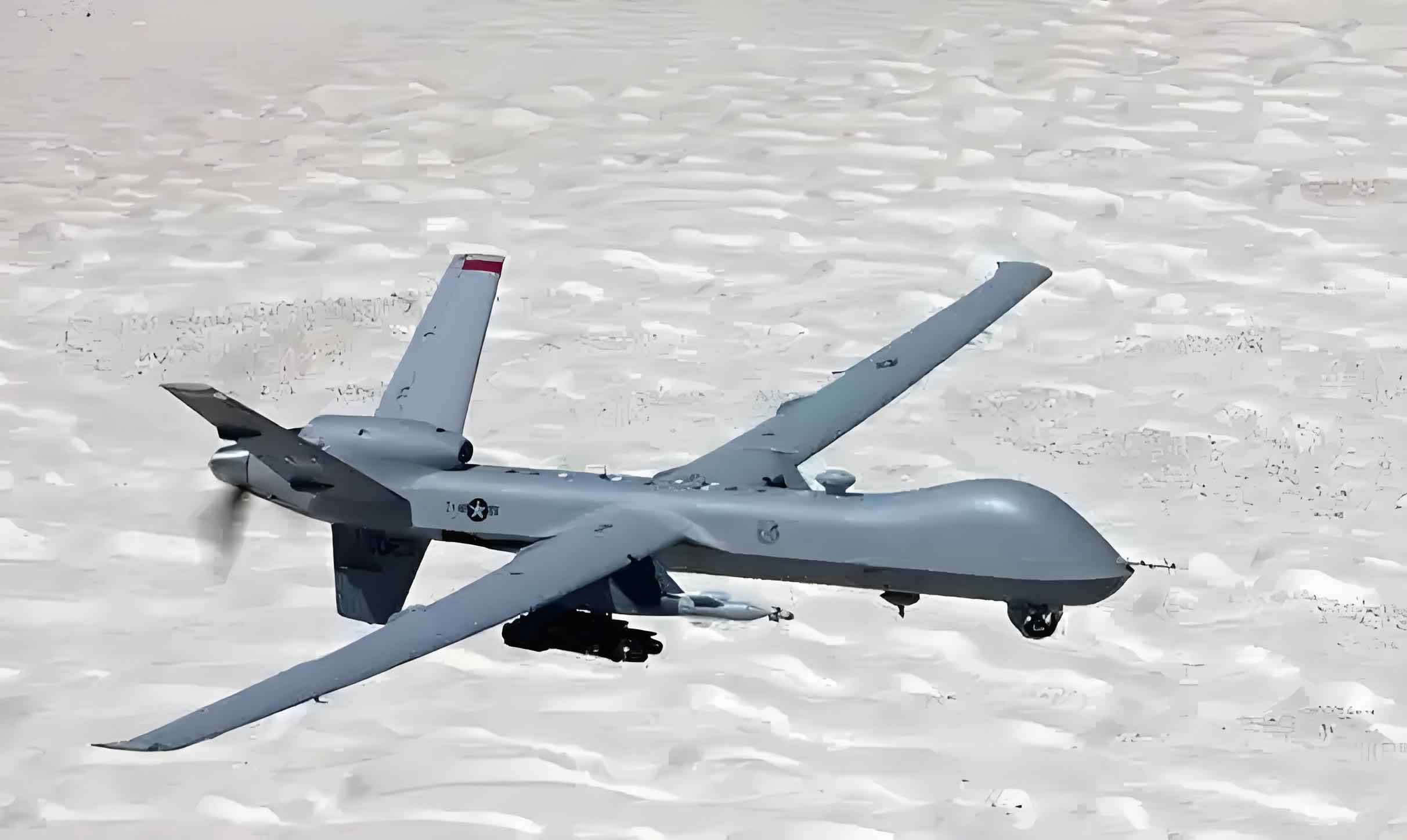
Modern warfare is characterized by information dominance and precision strikes, creating an insatiable demand for real-time intelligence, surveillance, and reconnaissance (ISR). Military drones offer unparalleled advantages in this arena. Compared to manned aircraft, military drones provide superior stealth, extended endurance, and eliminate the risk of pilot casualties. Against satellites, military drones offer greater timeliness, flexibility, higher resolution, shorter warning times, and lower operational costs. Consequently, ISR remains the most mature and widespread application for military drones. However, evolving technological landscapes and shifting global security paradigms are imposing new, rigorous demands on military drone development, especially concerning their core flight control technologies.
Analysis of Military Drone Development Trends
Based on our operational assessments and research, the trajectory of military drone development is shaped by three dominant trends: platform polarization, mission diversification, and the push toward autonomous, intelligent control.
Polarization of Military Drone Platforms
The platform development for military drones is diverging into two distinct extremes: high-altitude long-endurance (HALE) large-scale systems and miniaturized, highly agile micro-drones. This polarization is a direct response to multifaceted battlefield requirements.
To achieve expansive area coverage and persistent, gap-free surveillance, military drones must operate at higher altitudes and for longer durations. This drives the global pursuit of next-generation HALE military drones. Their flight control systems must manage complex, high-altitude aerodynamics and ensure reliable operation over missions lasting days or even weeks. The key performance parameters can be summarized in the following table:
| Platform Type | Key Characteristics | Flight Control Challenges |
|---|---|---|
| HALE/Large Military Drone | Altitude > 15km, Endurance > 24h, Large payload capacity | High-altitude stability, fuel-efficient trajectory management, autonomous navigation over vast distances. |
| Micro/Mini Military Drone | Weight < 2kg, Portable, Low acoustic/visual signature | Agile maneuvering in complex urban/canyoned environments, robust control under strong disturbances, swarm coordination. |
Concurrently, the utility of micro and mini military drones has become undeniable. Their small size, low cost, and excellent concealment allow them to access denied areas and provide tactical intelligence for small units operating in complex terrains like cities, forests, and mountains. The control laws for such military drones must be extremely robust and adaptive. For instance, the dynamics of a micro military drone can be simplified for control design as:
$$ \begin{aligned} m\dot{\mathbf{v}} &= \mathbf{R}\mathbf{F}_b – m\mathbf{g} + \mathbf{d}_a \\ J\dot{\boldsymbol{\omega}} &= \boldsymbol{\tau}_b – \boldsymbol{\omega} \times J\boldsymbol{\omega} + \mathbf{d}_r \end{aligned} $$
where \( m \) is mass, \( \mathbf{v} \) is velocity, \( \mathbf{R} \) is rotation matrix, \( \mathbf{F}_b \) is body-frame thrust, \( \mathbf{g} \) is gravity, \( \mathbf{d}_a \) and \( \mathbf{d}_r \) are aerodynamic and rotational disturbances, \( J \) is inertia, \( \boldsymbol{\omega} \) is angular velocity, and \( \boldsymbol{\tau}_b \) is control torque. Compensating for \( \mathbf{d}_a \) and \( \mathbf{d}_r \) in real-time is a critical challenge for micro military drone control.
Diversification of Military Drone Mission Sets
The mission scope for military drones is expanding dramatically, propelled by technological advancement and the complex, multi-domain nature of modern conflicts. Military drones are no longer just ISR platforms; they are becoming key players in strike, air combat, maritime warfare, and missile defense. This diversification necessitates highly specialized and adaptable flight control systems.
| Mission Domain | Typical Tasks | Flight Control Implications |
|---|---|---|
| Ground Attack | Suppression of Enemy Air Defenses (SEAD), Close Air Support (CAS), Deep Strike | Terrain-following/avoidance, dynamic weapon release coordination, evasive maneuvering. |
| Maritime Warfare | Anti-Surface Warfare, Anti-Submarine Warfare | Ship-relative navigation, wave disturbance rejection, coordinated search patterns. |
| Air Combat | Air-to-Air Engagement, Interception, Point Defense | High-G maneuvering control, target tracking/prediction, cooperative combat algorithms. |
| Missile Defense | Ballistic Missile Interception | Extreme high-speed guidance, terminal homing precision, hit-to-kill trajectory shaping. |
Each mission imposes unique constraints on the flight control logic. For example, an air combat military drone requires control algorithms that can execute aggressive maneuvers at the limits of the flight envelope, often formulated as an optimal control problem:
$$ \min_{u(t)} J = \Phi(\mathbf{x}(t_f), t_f) + \int_{t_0}^{t_f} L(\mathbf{x}(t), \mathbf{u}(t), t) dt $$
subject to dynamics \( \dot{\mathbf{x}} = f(\mathbf{x}, \mathbf{u}, t) \) and constraints \( \mathbf{x} \in \mathcal{X}, \mathbf{u} \in \mathcal{U} \), where \( \mathbf{x} \) is the state (position, velocity, attitude), \( \mathbf{u} \) is the control input, and \( \mathcal{X}, \mathcal{U} \) define performance limits.
Advancement toward Autonomous and Intelligent Control
The level of autonomy is what truly defines a military drone’s capability. Current control paradigms often rely on remote piloting or pre-programmed waypoints. However, the future lies in human-machine teaming and fully autonomous operation. Advances in computing power, software, pattern recognition, and adaptive reasoning are paving the way for military drones that can understand, decide, and act with minimal human intervention. This shift is critical for operating in contested electromagnetic environments where communications may be degraded or denied. The intelligence of a military drone can be modeled as a hierarchical decision-making process within the OODA framework, where the control system must close the loop from observation to action autonomously.
Key Flight Control Technologies and Capability Requirements
To meet the trends outlined above, our focus for military drone flight control development centers on three overarching capability pillars: High-Performance Computation & Control, High-Bandwidth Interconnection & Interoperability, and High Fault-Tolerance & Environmental Adaptation.
High-Performance Computation and Control Capability
This pillar concerns the onboard ability to process complex data and execute advanced control algorithms in real-time. It is foundational for autonomy.
1. Autonomous Flight Path Planning Technology: This enables a military drone to dynamically replan its route or mission objectives with minimal human input. The core challenge is achieving real-time performance under computational constraints. It involves modeling the planning space, analyzing constraints (e.g., threat zones, terrain, fuel), defining objective functions (e.g., minimize risk, maximize coverage), and selecting efficient algorithms (e.g., A*, Rapidly-exploring Random Trees (RRT), Mixed-Integer Linear Programming (MILP)). The planning problem can be expressed as:
$$ \mathcal{P}: \text{Find } \mathbf{p}(t) \text{ s.t. } \mathbf{p}(t) \in \mathcal{P}_{free}, \quad \mathbf{p}(t_0)=\mathbf{p}_0, \quad \mathbf{p}(t_f) \in \mathcal{P}_{goal}, \quad \text{and } J(\mathbf{p}) \text{ is minimized.} $$
Here, \( \mathbf{p}(t) \) is the planned path, \( \mathcal{P}_{free} \) is collision-free space, and \( \mathcal{P}_{goal} \) is the goal region.
2. Intelligent Pilot Assistance (Digital Pilot) Technology: This system acts as an onboard copilot, aiding in takeoff, cruise, obstacle avoidance, landing, and emergency handling. It utilizes a formalized flight knowledge base. Key technologies include knowledge representation (e.g., ontologies), human-machine optimal collaboration modeling, and reliable machine hand-eye coordination. A simplified decision logic might use a rule-based system: IF (sensor_indicates_engine_failure) AND (altitude > threshold) THEN (execute_glide_path_procedure).
3. Air Combat Decision Technology: For military drones engaged in aerial warfare, this technology enables autonomous tactical decision-making. It integrates with the OODA loop: Observe (track enemy), Orient (assess relative geometry, energy), Decide (select maneuver), Act (execute via flight control). Decision-making can be modeled using game theory or reinforcement learning. A classic differential game formulation for two-aircraft combat is:
$$ \min_{u_1} \max_{u_2} J = \int_{0}^{t_f} [\mathbf{x}^T Q \mathbf{x} + \mathbf{u}_1^T R_1 \mathbf{u}_1 – \mathbf{u}_2^T R_2 \mathbf{u}_2] dt $$
where \( \mathbf{x} \) is the relative state, and \( u_1, u_2 \) are the control inputs of the friendly and enemy military drone respectively.
4. Morphing Control Technology: Morphing military drones can change wing geometry (sweep, span, fold) to optimize performance across different flight phases (e.g., loiter vs. dash). Control must manage the transition dynamics and maintain stability. The equations of motion become time-varying during morphing:
$$ M(\eta(t))\dot{\mathbf{V}} + C(\eta(t), \mathbf{V})\mathbf{V} = \mathbf{F}_{aero} + \mathbf{F}_{control} $$
where \( \eta(t) \) represents the morphing parameters (e.g., sweep angle), and \( M, C \) are the inertia and Coriolis matrices which now depend explicitly on time.
5. Hypersonic Aeroelastic Suppression Technology: For hypersonic military drones, significant mass change from fuel burn and intense aerodynamic heating alter aeroelastic properties like flutter speed. Control systems must actively suppress these instabilities. This involves solving coupled fluid-thermal-structure-control equations. A simplified linear model for control design might be:
$$ \begin{bmatrix} M_{ss} & 0 \\ \rho Q_{as} & M_{aa} \end{bmatrix} \begin{bmatrix} \ddot{q}_s \\ \ddot{q}_a \end{bmatrix} + \begin{bmatrix} B_{ss} & 0 \\ 0 & B_{aa} \end{bmatrix} \begin{bmatrix} \dot{q}_s \\ \dot{q}_a \end{bmatrix} + \begin{bmatrix} K_{ss} & 0 \\ \rho Q_{as} U^2 & K_{aa} \end{bmatrix} \begin{bmatrix} q_s \\ q_a \end{bmatrix} = \begin{bmatrix} F_s \\ F_a \end{bmatrix} $$
where \( q_s \) are structural modes, \( q_a \) are aerodynamic states, \( \rho \) is density, \( U \) is velocity, and \( F \) includes control forces. The controller must stabilize this system across varying \( U \) and \( \rho \).
| Sub-Technology | Core Objective | Key Mathematical/Control Methods |
|---|---|---|
| Autonomous Path Planning | Real-time, optimal route generation | Graph search (A*), Sampling-based (RRT), Optimization (MILP, NLP) |
| Digital Pilot | Human-machine collaborative control | Knowledge graphs, Rule-based systems, Supervised learning |
| Air Combat Decision | Autonomous tactical maneuver selection | Differential games, Reinforcement Learning, State machine logic |
| Morphing Control | Stable control during geometry change | Gain-scheduling, Adaptive control, Linear Parameter Varying (LPV) systems |
| Hypersonic Aeroelastic Suppression | Active flutter suppression in varying conditions | Robust control (H∞), Linear Quadratic Gaussian (LQG), Model Predictive Control (MPC) |
High-Bandwidth Interconnection and Interoperability Capability
This pillar addresses the ability of military drones to communicate and cooperate seamlessly with other platforms (manned or unmanned), constituting a networked force multiplier.
1. Carrier-Based Autonomous Landing Guidance and Control: Enabling military drones to land on moving aircraft carriers autonomously is a pinnacle of precision control. It involves integrating guidance laws (e.g., precision relative navigation using ship’s datum) with robust control to reject deck motion and air wake turbulence. The guidance law often follows a pre-defined glideslope, while the control system tracks it under disturbances.
2. Autonomous Aerial Refueling (AAR) Guidance and Control: This extends the range and endurance of military drones. The core problem is precise station-keeping and docking in the turbulent wake of the tanker. Relative position control is critical. A common approach uses a proportional-navigation style law for the receiver military drone:
$$ \mathbf{a}_c = N \mathbf{V}_c \times \boldsymbol{\Omega} $$
where \( \mathbf{a}_c \) is acceleration command, \( N \) is a navigation constant, \( \mathbf{V}_c \) is closing velocity, and \( \boldsymbol{\Omega} \) is the line-of-sight rate to the drogue/basket. This must be integrated with formation flight control.
3> Manned-Unmanned Teaming (MUM-T) Guidance and Control: Here, a manned aircraft commands one or more military drones. The flight control system of the military drone must interpret high-level commands (e.g., “scout that ridge”) and translate them into detailed trajectories, while maintaining situational awareness and deconfliction. This involves offline/online trajectory planning and secure, low-latency data links.
4. Multi-Military Drone Autonomous Mission Planning: This technology allows a group of military drones to dynamically allocate tasks and replan paths collectively. It enhances robustness. The problem can be framed as a combined task assignment and path planning optimization:
$$ \min_{\mathbf{A}, \mathbf{P}} \sum_{i=1}^{N} \sum_{j=1}^{M} a_{ij} C_{ij}(\mathbf{p}_i) \quad \text{s.t.} \quad \sum_i a_{ij} = 1, \quad \mathbf{p}_i \in \mathcal{P}_{free}, \quad \|\mathbf{p}_i(t) – \mathbf{p}_k(t)\| > d_{safe} $$
where \( \mathbf{A} = [a_{ij}] \) is the assignment matrix (1 if military drone i is assigned to task j), \( C_{ij} \) is the cost for military drone i to perform task j along path \( \mathbf{p}_i \), and \( d_{safe} \) is a safe separation distance.
5. Swarm Control: Inspired by biological systems, swarm control enables large numbers of simple, low-cost military drones to achieve complex emergent behaviors. Key sub-technologies include consensus algorithms for coordination:
$$ \dot{x}_i = \sum_{j \in \mathcal{N}_i} (x_j – x_i) $$
where \( x_i \) is the state (e.g., position, heading) of the i-th military drone, and \( \mathcal{N}_i \) is its set of neighbors. This simple rule can lead to cohesive flocking. More advanced swarming for military drones incorporates objective-driven dynamics and resilient communications.
| Technology | Primary Function | Key Coordination Metrics/Formulas |
|---|---|---|
| Autonomous Carrier Landing | Precision landing on moving ship deck | Tracking error < 1m, Glideslope deviation < 0.1°, Disturbance rejection bandwidth |
| Autonomous Aerial Refueling | Docking with tanker in turbulent wake | Relative position error < 0.3m, Docking success rate, \( \mathbf{a}_c = N \mathbf{V}_c \times \boldsymbol{\Omega} \) |
| MUM-T Control | Execution of high-level commands from manned platform | Command interpretation latency, Mission success rate under comms degradation |
| Multi-Military Drone Mission Planning | Dynamic task allocation & path planning for group | Overall mission time, Resource utilization, \( \min \sum a_{ij} C_{ij} \) |
| Swarm Control | Emergent group behavior from local rules | Swarm coherence, Scalability, Resilience to unit loss, \( \dot{x}_i = \sum_{j \in N_i} (x_j – x_i) \) |
High Fault-Tolerance and Environmental Adaptation Capability
Military drones must operate reliably in harsh, uncertain environments and survive system failures. This pillar ensures mission continuity and safety.
1. Health Management and Prognostics Technology: This involves using sensor data and models to predict impending failures (prognostics) and assess system health. Techniques range from model-based approaches (e.g., Kalman filters for residual generation) to data-driven methods (e.g., machine learning for anomaly detection). A model-based residual \( r(t) \) is generated:
$$ r(t) = y(t) – \hat{y}(t) $$
where \( y(t) \) is the measured output and \( \hat{y}(t) \) is the output estimated by a nominal model. Statistical analysis of \( r(t) \) can indicate faults.
2. Collision Detection and Avoidance (CD&A) Technology: Essential for integrating military drones into shared airspace. It involves sensing (e.g., radar, electro-optical, ADS-B), threat assessment, and evasion maneuver generation. A common criterion is time to collision (TTC) or the calculation of a “protected zone.” An avoidance maneuver can be derived from potential field methods:
$$ \mathbf{F}_{rep} = \begin{cases} k_{rep} (\frac{1}{d} – \frac{1}{d_0}) \frac{1}{d^2} \hat{\mathbf{d}} & \text{if } d \le d_0 \\ 0 & \text{if } d > d_0 \end{cases} $$
where \( d \) is distance to obstacle, \( d_0 \) is the threshold distance, \( k_{rep} \) is a gain, and \( \hat{\mathbf{d}} \) is the unit vector from obstacle to military drone. The total control command then includes this repulsive force.
3. Fault-Tolerant Control (FTC) and Environmental Adaptation: FTC enables a military drone to maintain stability and performance after a failure (e.g., actuator jam, sensor loss). Methods include control reallocation and adaptive control. For actuator failures, control allocation redistributes the desired virtual control \( \mathbf{v}_d \) among healthy actuators:
$$ \mathbf{v}_d = B(\sigma) \mathbf{u} $$
where \( B(\sigma) \) is the control effectiveness matrix which may change due to failure mode \( \sigma \). The allocator solves for \( \mathbf{u} \) to achieve \( \mathbf{v}_d \) despite \( B(\sigma) \). Robust control techniques like H∞ loop shaping ensure performance under environmental uncertainties (e.g., wind gusts, icing):
$$ \| T_{zw} \|_\infty < \gamma $$
where \( T_{zw} \) is the closed-loop transfer function from disturbances \( w \) to performance outputs \( z \), and \( \gamma \) is a performance bound.
| Technology | Purpose | Representative Methods and Formulas |
|---|---|---|
| Health Management & Prognostics | Predict failures, schedule maintenance | Residual generation \( r=y-\hat{y} \), Statistical Process Control (SPC), Machine Learning classifiers |
| Collision Detection & Avoidance | Sense and evade static/dynamic obstacles | Time to Collision (TTC), Potential Field \( \mathbf{F}_{rep} \), Optimal evasion trajectories |
| Fault-Tolerant Control | Maintain operation post-failure | Control Reallocation \( \min \| W_u (u – u_0) \| \text{ s.t. } B(\sigma)u = v_d \), Adaptive control, Sliding mode control |
| Environmental Adaptation | Compensate for atmospheric/weather effects | Robust control (H∞, μ-synthesis), Gain scheduling, Model Reference Adaptive Control (MRAC) |
The pursuit of these technologies ensures that a military drone remains a viable and potent asset even when facing system degradation or operating in unpredictable battlefields. The integration of health management, robust avoidance, and fault-tolerant control creates a resilient autonomous system capable of completing its mission.
Conclusion
In my assessment, the future of military drone supremacy hinges on the maturation and integration of flight control technologies across three core capability vectors: High-Performance Computation and Control, High-Bandwidth Interconnection and Interoperability, and High Fault-Tolerance and Environmental Adaptation. The military drone platform is evolving rapidly—polarizing in size, diversifying in mission, and growing in intelligence. Each trend imposes specific demands on the underlying flight control system, necessitating advances in algorithms, processing hardware, communication protocols, and resilient design. From autonomous path planning and air combat AI to swarm coordination and carrier landings, the technological challenges are profound. The mathematical frameworks—from optimal control and game theory to consensus algorithms and robust control—provide the foundation for solving these challenges. As we continue to develop and field next-generation military drones, a relentless focus on these flight control capabilities will ensure they remain decisive instruments in the defense arsenal, capable of operating effectively in the complex, contested, and unpredictable environments of future conflicts. The continuous feedback from operational deployment will further refine these requirements, ensuring that flight control technology for military drones remains at the cutting edge, embodying the principles of speed, autonomy, and resilience central to modern warfare.