
From my perspective as an analyst observing technological advancements, the rapid progression of aerospace and modern high-tech applications has catapulted unmanned military equipment into a pivotal role across all domains of contemporary warfare. Among these, the military drone stands out as an emerging aerial force, demonstrating exceptional performance in various battlefields. Currently, the application of military drones is gradually diversifying into both military and civilian spheres, with nations worldwide continuously exploring, developing, and deploying them. However, issues such as uneven technical expertise, imbalanced development levels, and varying market demands persist across different professional fields, research directions, functional uses, and operational requirements. Aligning with technological trends, enhancing existing technologies, fostering innovation, and solving prominent technical challenges are key to advancing military drone capabilities in the coming period.
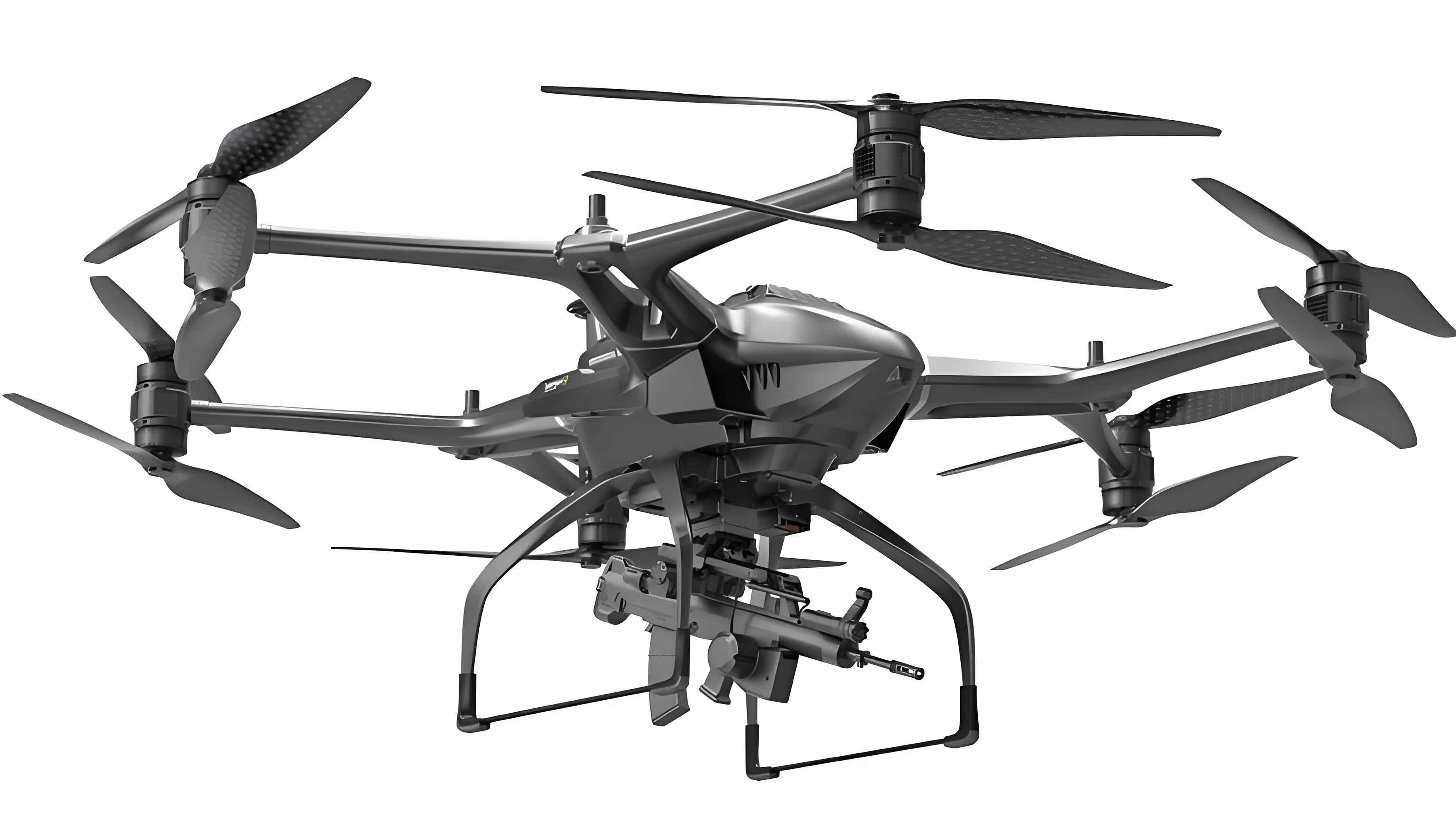
Reflecting on the historical trajectory, the development of military drones abroad began as early as 1914 during World War I, when British military forces secretly researched unmanned aircraft. By 1927, successes in testing bomb-carrying drones, aerial target drones, torpedo-dropping drones, and unmanned attack aircraft marked the dawn of drone application technology. During World War II, participating nations primarily utilized drones for combat support missions, including target reconnaissance and battlefield damage assessment, though they were mainly employed as target drones. Post-World War II, the Cold War arms race between the United States and the Soviet Union, coupled with the rapid growth of the aerospace industry, spurred飞速发展 in drone technology globally. The functions and varieties of military drones became increasingly diverse, ushering in a golden age for their practical application. After the Cold War, while military applications of drones expanded, their foray into civilian domains began to take shape. Since the 1990s, the frequent use of U.S. military drones in global conflicts has reignited intense interest among military establishments worldwide. Military drones have showcased their potential in local wars, pioneering successful cases in information warfare,科技战, electronic warfare, and special joint operations, thus翻开 a new chapter in drone history.
To summarize key milestones in foreign military drone development, I present the following table:
| Period | Key Developments | Primary Applications |
|---|---|---|
| 1914-1920s | Secret research by UK; experimental成功 of载弹 drones, target drones | Early military testing, target practice |
| 1930s-1945 | Widespread use in WWII for reconnaissance and damage assessment | Combat support, target drones |
| 1946-1990 | Cold War-driven diversification; advancement in technologies | Military surveillance, electronic warfare |
| 1990s-Present | Frequent deployment in conflicts; rise of长航时 drones, stealth drones | Information warfare, precision strikes, civilian applications |
Currently, the United States leads in military drone technology, with a focus on long-endurance drones, unmanned combat aerial vehicles (UCAVs), micro-drones, and specialized drones. Israel, while technically reliant on the U.S., ranks among the top in drone technology and production, being a major exporter with high international market share for both military and civilian drone products. In Europe, countries like Russia, the UK, France, and Germany have seen rapid development, each with distinct technical requirements and突出领域. However, their overall processing capabilities and technical levels generally lag behind world leaders. Neighboring nations such as Japan, South Korea, India, Singapore, and Iran have developed various military and civilian drones based on different applications, but their independent R&D remains weak, relying heavily on foreign imports.
Turning to domestic developments, China’s aviation industry was formally established in 1951 with the decision on航空工业. Over six decades of坎坷发展, it has grown from scratch into a robust industrial system with strong R&D and mass production capabilities, becoming a支柱产业 in the economy. After改革开放, while advancing military drones, exploration in civilian applications has progressed steadily. The frequent appearances of China’s self-developed military and civilian drones at domestic air shows like Zhuhai and Beijing, as well as international exhibitions such as Paris,范保罗,迪拜, and Singapore, have showcased the nation’s growing prowess in military drone technology.
I believe the significance of developing military drones in China cannot be overstated. Modern military drones are extensively used for electronic reconnaissance, electronic countermeasures, early warning, long-range attacks, battle assessment, military terrain aerial photography, mapping, and counter-terrorism. They reduce casualties, lower equipment costs, enhance capabilities in complex作战环境, and improve overall作战效率. These突出特点 are increasingly valued by military departments globally. The presence of military drones is no longer confined to sci-fi films; in future battlefields, multifunctional drones will play神入化 roles, potentially determining the outcome of conflicts. To adapt to new military革命潮流, safeguard national sovereignty and territorial integrity, and promote world peace, possessing and advancing military航空力量 is urgent. Given China’s vast territory, long border and coastal lines, and complex周边国际环境, developing advanced military drones to consolidate国防航空作战力量 is imperative.
In terms of development实力, China’s military drone R&D started relatively late. In the 1970s, independent development of unmanned reconnaissance drones began, with the无侦5 entering service in the early 1980s. In 1995, the Central Military Commission’s科技强军 strategy accelerated国防工业建设, leading to breakthroughs in尖端技术武器. Since then, military drone technology has advanced rapidly. Today, with the successful首飞 and deployment of next-generation drones like “翼龙,” “翔龙” for reconnaissance, and “利剑” stealth attack drones, China’s military drone technology has跻身 world前列.
However,从 my analysis, current technical weaknesses and problems persist. China’s military drone technology primarily relies on independent R&D and借鉴外国现有技术, remaining relatively落后 compared to world leaders and not fully meeting high-tech war demands. For large-scale军事任务, applications in electronic countermeasures, early warning, reconnaissance, and attack lack明显效果. Key areas such as high stealth capabilities, high机动能力, information transmission, autonomous control, precision navigation, endurance, and material structure applications are薄弱. To quantify some of these parameters, I consider公式 for performance metrics. For instance, endurance can be modeled as: $$E = \frac{C \cdot \eta}{P}$$ where \(E\) is endurance in hours, \(C\) is battery or fuel capacity, \(\eta\) is efficiency, and \(P\) is power consumption. Stealth performance often involves雷达截面 (RCS) calculations: $$RCS = \frac{4\pi \sigma}{\lambda^2}$$ where \(\sigma\) is the scattering cross-section and \(\lambda\) is the radar wavelength. These公式 highlight areas requiring improvement.
A comparative table of technical capabilities across major nations illustrates the gaps:
| Country/Region | Stealth Technology | Endurance (Hours) | Autonomy Level | Key Military Drone Models |
|---|---|---|---|---|
| United States | Advanced (e.g., RCS < 0.01 m²) | >40 (e.g., Global Hawk) | High (fully autonomous missions) | MQ-9 Reaper, RQ-4 Global Hawk |
| Israel | Moderate to High | 20-30 | Medium-High | Heron, Harop |
| Europe | Moderate | 15-25 | Medium | 神经元, Barracuda |
| China | Developing (e.g., RCS ~0.1 m²) | 20-30 (improving) | Medium | Wing Loong, Sharp Sword |
Looking ahead, future动向 and research规划 must build on recent successes in China’s military drone domain. Observing current trends and future directions, adapting to海陆空天电体系 requirements, and embracing科技变革 are crucial. By relying on科技进步, emphasizing科技创新, learning from国外先进 technologies, actively exploring research, applying高端科技,攻克高精尖端 challenges, securing自主知识产权, mastering核心技术, and结合实战 needs, we can develop new equipment and achieve跨越发展. It is essential to mobilize军事科研机构,地方科研院所,高等院校, and生产制造单位 to leverage their strengths. Targeted R&D and production of specialized military drone models for complex作战环境 and various战术实战任务 will accelerate the modernization of unmanned military武器装备, meeting future作战要求 and forming a distinctive military drone system.
From a strategic perspective, the evolution of military drone technology can be modeled using growth equations. For instance, the rate of technological advancement \(T\) over time \(t\) might follow: $$\frac{dT}{dt} = k \cdot I \cdot R$$ where \(k\) is a constant, \(I\) represents investment in R&D, and \(R\) is the innovation rate. This underscores the importance of sustained efforts. Additionally, the effectiveness \(E_f\) of a military drone in missions can be expressed as: $$E_f = \alpha S + \beta M + \gamma C$$ where \(\alpha, \beta, \gamma\) are weights, and \(S, M, C\) represent stealth, maneuverability, and communication capabilities, respectively. Optimizing these factors is key to dominance.
In conclusion, the military drone has transformed from a niche tool to a cornerstone of modern warfare and civilian applications. Its development reflects broader technological and strategic shifts. For China, advancing military drone capabilities is not just a technical endeavor but a national imperative for security and progress. By addressing weaknesses, fostering innovation, and collaborating across sectors, the future of military drones promises to be even more integral to global dynamics. As I see it, the continuous iteration and deployment of military drones will shape the battlefields and skies of tomorrow, making them indispensable assets in the pursuit of peace and sovereignty.