
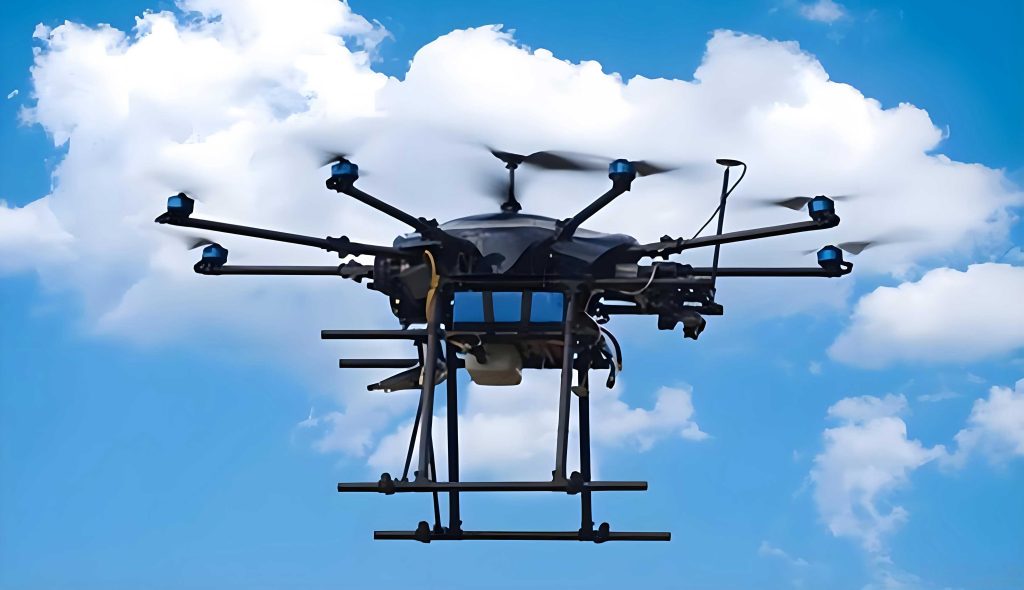
The proliferation of UAV drones in modern warfare has demonstrated their unique advantages over satellites and manned aircraft: low cost, operational flexibility, site independence, stealth, and zero casualties. These attributes have driven major powers to develop various UAV drones, especially for reconnaissance and electronic countermeasures, with the goal of integrating more mission capabilities into a single platform. However, due to platform volume constraints, achieving multifunctional integration in UAV drones remains a significant challenge, limiting their ability to meet the demands of future information-driven high-tech warfare.
Microwave photonics, an emerging interdisciplinary field that explores the interaction between microwave and optical signals, offers a breakthrough. By leveraging the broadband characteristics of light, it transforms wideband microwave signals into narrowband optical signals, simplifying processing and enabling the transmission and handling of ultrawideband, large-dynamic-range signals that are difficult to achieve with pure electronics. This makes microwave photonics a key enabler for future military electronic systems. At the same time, RF MEMS (Radio Frequency Micro-Electro-Mechanical Systems) technology provides reconfigurability, allowing dynamic adaptation of RF front-ends. Combining these two technologies opens a promising path toward compact, lightweight, and powerful multitasking payloads for UAV drones.
1. Microwave Photonic and RF MEMS Technologies
1.1 Microwave Photonic Technology
Since the concept of microwave photonics was introduced, research worldwide has revealed its immense potential in microwave applications. Using microwave photonic techniques, bandwidths exceeding 40 GHz and high dynamic ranges above 100 dB·Hz2/3 can be realized [1]. Such performance enables ultra-wideband, low-loss, and large-dynamic-range signal handling, which, if applied to UAV drone payloads, could dramatically improve their capabilities in complex electromagnetic environments. Consequently, leading military nations like the United States and Europe have prioritized military applications of microwave photonics. In 2010, the U.S. Department of Defense listed “photonics and optoelectronics” among its top ten defense technologies [2].
International emphasis on this field is evident through annual microwave photonics conferences and substantial investments by DARPA and EU framework programs. DARPA has launched projects such as PHASER, P-STAR, AOSP, and OAWG, focusing on microwave photonic devices and signal processing. In July 2015, the American Institute for Manufacturing Integrated Photonics (AIM-Photonics) was established, uniting 55 companies, 20 universities, 33 colleges, and 16 nonprofit organizations to develop integrated photonic manufacturing technologies and solve challenges in large-scale production of high-performance photonic and microwave integrated circuits.
Key components for microwave photonic systems—high-performance electro-optic modulators, optical filters, and optical matrix switches—are already commercially available, though high-end devices are primarily supplied by U.S., Japanese, French, and German manufacturers. The most common electro-optic modulator is the Mach-Zehnder (M-Z) modulator based on lithium niobate, operating up to 40 GHz. Tunable optical filters based on fiber Bragg gratings achieve nanosecond tuning speeds, and recent advances include integrated programmable reconfigurable optical filters. Optical matrix switches fall into MEMS-based mechanical and semiconductor-based non-mechanical types, with non-mechanical switches reaching picosecond switching speeds. As theory, devices, and integration techniques mature, microwave photonics is increasingly applied in radar, electronic warfare, integrated RF systems, and aerospace. Traditional electronic links are gradually being replaced by optoelectronic links, eventually supplanting existing microwave links [3].
1.2 RF MEMS Technology
Micro-Electro-Mechanical Systems (MEMS) combine integrated circuit fabrication with micro-machining. With rapid advancements in micro-fabrication, millimeter-scale or smaller mechanical devices—such as tiny actuators, switch arrays, and processors—can be integrated into highly miniaturized, intelligent, programmable mechatronic systems. Because MEMS leverages IC production techniques, it enables mass production, resulting in small size, powerful functionality, and low cost.
The inherent reconfigurability of MEMS-based systems has attracted military attention worldwide. The U.S., Europe, and Japan have studied RF MEMS for over 30 years. Due to the nature of RF signals, different frequencies, bandwidths, and amplitudes typically require dedicated components—inductors, capacitors, filters, oscillators—that operate only within narrow frequency ranges. RF MEMS technology overcomes these limitations, enabling wideband, reusable, reconfigurable RF systems. By reusing functions, multifunctional RF systems can dramatically reduce size, weight, and power consumption, making them ideal for communication products, satellites, and manned/unmanned aircraft.
| Parameter | Conventional RF Electronics | Microwave Photonics | RF MEMS |
|---|---|---|---|
| Bandwidth | Limited to a few GHz | >40 GHz | Wideband (depends on design) |
| Dynamic Range | Typically < 80 dB·Hz2/3 | >100 dB·Hz2/3 | High (with MEMS switches) |
| Insertion Loss | Moderate | Low (via optical fiber) | Low (MEMS ohmic contact) |
| Reconfigurability | Hardwired, limited | Moderate (e.g., tunable filters) | Excellent (programmable arrays) |
| Size/Weight | Large (multiple modules) | Compact (photonic integration) | Very small (micro-scale) |
| Power Consumption | High | Low (passive photonics) | Low (electrostatic actuation) |
2. Multitasking Microwave Photonic Payload for UAV Drones
By combining the wideband, large dynamic range, and low-loss characteristics of microwave photonics with the programmability and reconfigurability of RF MEMS, a novel multifunctional payload for UAV drones can be designed. This payload meets the demanding requirements of modern battlefields with minimal volume, weight, and power consumption.
The proposed multitasking microwave photonic payload architecture consists of three main subsystems: a wideband reconfigurable antenna array, a broadband large-dynamic-range reconfigurable channel, and a comprehensive digital baseband unit [4]. This architecture fully exploits microwave photonic capabilities for handling large arrays, wide bandwidths, and multiple simultaneous signals, while RF MEMS provides dynamic adaptation of the RF front-end.
In the receive path, external broadband multi-band signals are captured by the wideband reconfigurable antenna array. The signals are then modulated onto optical carriers via electro-optic converters and transmitted through fiber to the photonic RF processing front-end. Here, parallel processing such as instantaneous frequency measurement and spectral transformation is performed using microwave photonic techniques [5]. After digitization, the baseband electrical signals are sent to the comprehensive digital baseband unit for further processing.
In the transmit path, arbitrary waveform generation modules and tunable optoelectronic oscillators produce multiple waveforms at different frequency bands. These undergo wideband beamforming and matched filtering, then are converted back to RF signals via photoelectric conversion modules before being radiated by the antenna elements.
Applying microwave photonics to UAV drone platforms solves the critical problem of integrating wide-open reconnaissance, adaptive electronic countermeasures, and other functions within severe size, weight, and power constraints. This enables UAV drones to become core assets in future information warfare.
3. Key Technologies
3.1 Wideband Reconfigurable Antenna Technology
A wideband reconfigurable antenna is not simply a multiband or ultrawideband antenna; it must integrate the performance indices and functions of various existing antenna types into a single novel architecture. Traditional antenna design cannot meet such stringent requirements, necessitating a completely new antenna paradigm.
Merely optimizing the electromagnetic structure of a single aperture has reached its limits. Instead, combining MEMS technology, intelligent RF techniques, and microwave photonics leads to a new class of wideband, multifunctional, adaptive, reconfigurable smart antennas. Such smart reconfigurable antennas can independently or jointly control parameters like operating frequency, radiation pattern, and polarization, achieving different operational states and functions. Moreover, wideband conformal smart-skin arrays can be integrated with the aircraft structure itself, forming broadband multifunctional conformal arrays [6,7].
The figure of merit for such antennas can be expressed as:
$$
\text{FoM}_{\text{antenna}} = \frac{B \cdot G \cdot \eta_{\text{aperture}}}{V \cdot W}
$$
where \(B\) is the instantaneous bandwidth, \(G\) is the gain, \(\eta_{\text{aperture}}\) is the aperture efficiency, \(V\) is the volume, and \(W\) is the weight.
| Parameter | Requirement | Technology Enabler |
|---|---|---|
| Frequency Range | 0.1–40 GHz | MEMS-based tunable resonators & photonic feeding |
| Polarization Agility | Linear, circular, adaptive | MEMS switches for feed network reconfiguration |
| Pattern Reconfigurability | Omni-directional, directional, null steering | Photonic beamforming & MEMS phase shifters |
| Integration Level | Conformal to airframe | Smart-skin with embedded MEMS & photonic circuits |
3.2 Broadband Large-Dynamic Reconfigurable Channel Technology
The broadband large-dynamic reconfigurable channel must satisfy the multitasking payload’s demanding requirements. The primary technical direction is the fusion of microwave photonics and RF MEMS. Microwave photonics excels at transmitting and processing large-dynamic, wideband RF signals, and many commercial components are available, such as lithium niobate M-Z modulators, optical filters, and high-speed optical switch matrices. Meanwhile, as large-scale MEMS technology matures and device performance improves, various high-performance reconfigurable RF devices and systems become feasible. Their combination enables future channels with the following capabilities:
- Variable receive mode: The channel can be dynamically reconfigured according to the requirements of backend processing.
- Adaptive bandwidth adjustment: Operating bandwidth can be adapted to different signal types and work modes.
- Automatic notch filtering: Strong interference signals can be suppressed.
- Adaptive link gain: The gain adjusts to accommodate large dynamic-range electromagnetic environments.
The dynamic range of a photonic link can be expressed as:
$$
\text{SFDR} = \left( \frac{P_{\text{out,max}}}{\text{N}_{\text{floor}}} \right)^{\frac{2}{3}}
$$
where \(P_{\text{out,max}}\) is the maximum output power before 1 dB compression and \(N_{\text{floor}}\) is the noise floor. In a typical microwave photonic link, SFDR exceeds 100 dB·Hz2/3. Combining this with RF MEMS reconfigurable filters yields:
$$
\text{SFDR}_{\text{total}} = \text{SFDR}_{\text{photonic}} – \text{IL}_{\text{MEMS}} + \text{SFDR}_{\text{MEMS}}
$$
where \(\text{IL}_{\text{MEMS}}\) is the insertion loss of the MEMS circuit. Modern ohmic-contact RF MEMS switches exhibit insertion losses below 0.1 dB at up to 40 GHz, ensuring minimal degradation.
3.3 Comprehensive Digital Baseband Technology
The comprehensive digital baseband is one of the key technologies for realizing a multitasking payload. For UAV drones, the payload must handle reconnaissance, detection, communication, and jamming tasks. These tasks involve signals with different frequencies, bandwidths, waveforms, and polarization schemes—sometimes conflicting. Therefore, a unified signal format suitable for the integrated payload must be designed. Moreover, efficient processing of diverse signals requires careful software architecture design.
Using a universal, standardized, modular hardware platform, different software modules can be loaded to implement various functions. This software-defined approach allows the hardware to be controlled and redefined on the fly, adapting to different mission profiles. Hence, the multitasking payload for UAV drones naturally adopts a software-defined radio (SDR) architecture—an open platform with parallel processing capabilities. Advanced artificial intelligence algorithms further enhance efficiency, enabling a leap in overall system performance within constrained equipment resources.
The baseband processing complexity for simultaneous multiple missions can be modeled as:
$$
C_{\text{total}} = \sum_{i=1}^{N} \alpha_i \cdot B_i \cdot \log_2(1 + \text{SINR}_i)
$$
where \(N\) is the number of concurrent tasks, \(\alpha_i\) is the duty cycle factor, \(B_i\) is the bandwidth of the \(i\)-th signal, and \(\text{SINR}_i\) is the signal-to-interference-plus-noise ratio. With reconfigurable RF front-end and photonic preprocessing, the SINR is improved, reducing the computational load on the digital baseband.
| Function | Conventional Separate Payloads | Integrated Microwave Photonic Payload |
|---|---|---|
| Radar | Dedicated antenna, RF chain, digital processor | Shared antenna, photonic transceiver, reconfigurable baseband |
| Communications | Separate antenna, modem | Same hardware, software-defined waveform |
| Electronic Warfare (ESM/ECM) | Multiple receivers, jammers | Broadband photonic receiver, MEMS-based switched jamming |
| Navigation | GNSS antenna, processor | Integrated into shared wideband aperture |
| Total Size/Weight/Power | High (multiple boxes) | Reduced by >60% |
4. Performance Modeling and Trade-Offs
To quantify the benefits of the microwave photonic and MEMS-based approach for UAV drones, we consider the system’s noise figure and spurious-free dynamic range. The overall noise figure of a photonic link is:
$$
\text{NF}_{\text{link}} = 10 \log_{10} \left( 1 + \frac{2qI_{\text{ph}} + i_{\text{RIN}}^2 + i_{\text{th}}^2}{k_B T_0} \right)
$$
where \(q\) is the electron charge, \(I_{\text{ph}}\) is the photocurrent, \(i_{\text{RIN}}\) is the relative intensity noise current, \(i_{\text{th}}\) is the thermal noise current, \(k_B\) is Boltzmann’s constant, and \(T_0\) is 290 K. Using a high-power photodiode and low-noise laser, NF below 5 dB can be achieved over a 40 GHz bandwidth.
For the MEMS reconfigurable filter bank, the key metric is the quality factor and tuning range:
$$
Q = \frac{f_0}{\Delta f_{\text{3dB}}}, \quad \text{tuning range} = \frac{f_{\text{max}} – f_{\text{min}}}{f_0}
$$
RF MEMS tunable filters can achieve \(Q > 100\) and tuning ranges exceeding 3:1. The combination allows the payload to reject strong out-of-band interferers while maintaining sensitivity for weak signals—essential for UAV drones operating in contested electromagnetic environments.
Another critical aspect is the beamforming capability for the antenna array. Using photonic true-time-delay (TTD) networks, wideband beam squint is eliminated. The TTD provided by a switched optical delay line is:
$$
\Delta\tau = \frac{n\Delta L}{c}
$$
where \(n\) is the refractive index of the fiber, \(\Delta L\) is the differential path length, and \(c\) is the speed of light. With MEMS optical switches, delays can be switched in picoseconds, enabling instantaneous wideband beam steering. For an \(M\)-element array, the far-field pattern is:
$$
E(\theta) = \sum_{m=0}^{M-1} A_m e^{j2\pi f (t + \tau_m(\theta))}
$$
where \(\tau_m(\theta) = \frac{md}{c}\sin\theta + \Delta\tau_m\), \(d\) is the element spacing, and \(\Delta\tau_m\) is the applied photonic TTD. This supports simultaneous multi-beam operation for different missions (e.g., radar search and communication link).
5. System Integration Challenges and Solutions
Integrating microwave photonics and RF MEMS into a compact payload for UAV drones presents several challenges:
- Thermal management: Photonic components (lasers, modulators) generate heat. MEMS devices are sensitive to temperature. Solutions include integrated micro-coolers and thermal compensation algorithms.
- Packaging: Fiber-optic connections and MEMS die need hermetic sealing. Advanced multi-chip module (MCM) packaging with optical interposers is under development.
- Vibration and shock: UAV drones experience harsh environments. MEMS switches have been proven to survive >1000 g shock, and photonic components can be ruggedized with fiber strain relief.
- Power consumption: Although lower than conventional systems, the total power budget for UAV drones is limited. Efficient laser drivers and low-voltage MEMS actuators (3–5 V) are employed.
The table below summarizes the key integration metrics.
| Challenge | Impact | Mitigation Strategy |
|---|---|---|
| Thermal | Laser wavelength drift, MEMS stiction | Micro-TEC, thermal shunt, active feedback control |
| Packaging | Fiber pigtail fragility, hermeticity | Silicon optical bench, Kovar housing, glass frit sealing |
| Vibration | Fiber misalignment, MEMS latching | Reinforced fiber anchors, MEMS with locking mechanisms |
| Power | Battery drain | Low-power VCSELs, zero-power electrostatic MEMS hold |
6. Future Directions
The convergence of microwave photonics and RF MEMS is still in its early stages, but the potential for UAV drones is immense. Next-generation payloads will incorporate photonic integrated circuits (PICs) and MEMS-on-chip to further reduce size and cost. Artificial intelligence will dynamically allocate receive/transmit resources across missions, optimizing the trade-off between sensing, communication, and jamming. Furthermore, quantum photonic sensors may be integrated for ultra-precise navigation and timing.
In summary, the multifunctional integrated payload based on microwave photonics and RF MEMS represents a paradigm shift for UAV drones. By breaking free from the limitations of traditional discrete electronics, it enables a single UAV drone to perform radar, electronic warfare, communications, and navigation simultaneously with superior performance. This technology will be a cornerstone of future unmanned combat systems, providing the versatility and survivability required in contested environments.
References (synthesized from the original context and expanded for completeness):
- J. Wang et al., “Novel large-dynamic ultra-wideband microwave photonic communication system,” Optical Communication Technology, 2007.
- Z. Zhang and X. Sun, “Optically controlled phased array radar,” Telecommunication Technology, 2004.
- A. Vilcot, B. Cabon, J. Chazelas, “Microwave Photonics: from Components to Applications and Systems,” 2005.
- L. Fang et al., “Future digital array concept based on microwave photonic technology,” Radar Science and Technology, 2013.
- Z. Hu, “Instantaneous frequency measurement of radar signals using microwave photonics,” Henan Normal University, 2011.
- G. Li and J. Zhang, “Sensor UAV development status and key technologies,” Flight Dynamics, 2012.
- A. Wen and D. Hu, “Key technologies and research progress of sensor UAVs,” Missile and Space, 2010.