
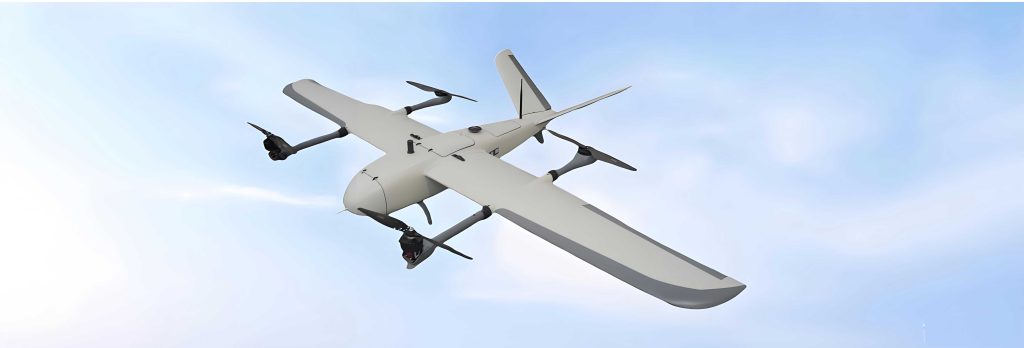
The coordination and control of planar vertical take-off and landing (PVTOL) drone swarms have garnered significant attention due to their superior capabilities in executing complex, collaborative missions across various domains. However, the transition from single-agent to multi-agent systems introduces profound challenges, primarily stemming from the fundamental limitations of the underlying communication and control infrastructure. In a networked control system (NCS) framework for a decentralized VTOL drone swarm, each agent must exchange state and control information with its local controller and, potentially, with neighboring agents. This constant data flow imposes a substantial burden on the available communication bandwidth, which is often a scarce resource in practical scenarios. Furthermore, the decentralized nature of the control architecture, while offering scalability and robustness to single-point failures, complicates the analysis and design due to the presence of inter-agent coupling and local disturbances.
A prevalent method to alleviate bandwidth pressure is state quantization, where the continuous-valued measurements are mapped to a discrete set of values before transmission. While effective in reducing data rate, quantization introduces non-linear errors that can degrade system performance and challenge stability guarantees. Concurrently, the paradigm of memory-based control has emerged as a powerful tool to enhance system performance by leveraging past state information. This approach is particularly useful in scenarios where real-time, high-fidelity state information is unavailable or costly to obtain, as is often the case with quantized communications. By artificially incorporating past data (introducing an “artificial delay”), a controller can achieve satisfactory performance even with coarser or less frequent state updates. The core challenge, therefore, lies in the co-design of a quantization scheme and a memory-based feedback law that together ensure robust stability and performance for the interconnected VTOL drone system, while rigorously accounting for the quantization errors and inter-agent couplings.
This article addresses this challenge by proposing a novel decentralized control strategy for PVTOL drone swarms. The strategy integrates a uniform quantizer within the communication channel and a static output feedback sliding mode controller (SMC) enhanced with artificial delays. The use of SMC provides inherent robustness to matched uncertainties and disturbances, which are common in VTOL drone dynamics. The memory component, utilizing a Taylor series expansion based on past state samples, allows the controller to function effectively with quantized state information. The stability analysis is conducted using the Lyapunov-Krasovskii functional method for neutral-type systems, leading to solvable conditions in the form of Linear Matrix Inequalities (LMIs). Furthermore, an optimization algorithm is employed to systematically tune the critical parameters—such as the quantization step size, artificial delay, and controller gains—to achieve an optimal trade-off between convergence speed, ultimate boundedness region, and communication cost. Comparative numerical simulations demonstrate the effectiveness and advantages of the proposed method over existing approaches.
System Modeling and Problem Formulation
1. Dynamics of a Single VTOL Drone
The fundamental unit of the swarm is the PVTOL drone, a simplified model capturing the essential dynamics of vertical take-off and landing aircraft like quadrotors. Its motion is restricted to a vertical plane. Let \( m_T \) denote the total mass, \( J \) the moment of inertia, \( L \) the distance from the propeller axis to the center of mass, and \( g \) the gravitational acceleration. The control inputs are the thrust forces from two propellers, \( f_1 \) and \( f_2 \). The system state is defined as \( \mathbf{x} = [p_x, \dot{p}_x, \theta, \dot{\theta}]^T \), representing the horizontal position, its velocity, the pitch angle, and its angular rate, respectively. The nonlinear dynamics are given by:
$$
\begin{aligned}
\ddot{p}_x &= -\tan(\theta) \cdot (f_1 + f_2)/m_T, \\
\ddot{\theta} &= L \cdot (f_1 – f_2)/J.
\end{aligned}
$$
For control design, we consider operation near the hovering equilibrium. Defining the transformed control inputs \( u_x = (f_1 – f_2)L/J \) and maintaining the total thrust to balance weight, the linearized dynamics around the equilibrium point (\( \theta \approx 0 \)) are obtained as:
$$
\dot{\mathbf{x}} = A \mathbf{x} + B u_x,
$$
where
$$
A = \begin{bmatrix}
0 & 1 & 0 & 0 \\
0 & 0 & g & 0 \\
0 & 0 & 0 & 1 \\
0 & 0 & 0 & 0
\end{bmatrix}, \quad B = \begin{bmatrix}
0 \\ 0 \\ 0 \\ 1 \end{bmatrix}.
$$
2. Model of a Decentralized VTOL Drone Swarm
Consider a swarm of \( N \) heterogeneous VTOL drones, indexed by \( k = 1, 2, …, N \). Each drone \( P_k \) is governed by its local controller \( R_k \). The drones are dynamically coupled, meaning the motion of one drone can affect its neighbors. The linearized dynamics for the \( k \)-th VTOL drone, incorporating coupling and disturbance, are:
$$
\begin{aligned}
\dot{x}_{1,k}(t) &= x_{2,k}(t), \\
\dot{x}_{2,k}(t) &= g x_{3,k}(t), \\
\dot{x}_{3,k}(t) &= x_{4,k}(t), \\
\dot{x}_{4,k}(t) &= u_k(t) + \sum_{\substack{l=1 \\ l \neq k}}^{N} C_{k,l} x_l(t) + d_k(t),
\end{aligned}
$$
where \( \mathbf{x}_k(t) = [x_{1,k}, x_{2,k}, x_{3,k}, x_{4,k}]^T \) is the state vector, \( u_k(t) \) is the control input, \( d_k(t) \) is a bounded disturbance ( \( |d_k(t)| \leq d_k^* \) ), and \( C_{k,l} \in \mathbb{R}^{1 \times 4} \) is the coupling vector representing the influence of VTOL drone \( P_l \) on VTOL drone \( P_k \).
3. Uniform Quantizer
To mitigate bandwidth usage, a uniform quantizer \( q_{\mu}(\cdot) \) is placed in the sensor-to-controller channel for each VTOL drone. For a scalar measurement \( x \), the quantization rule is:
$$
q_{\mu}(x) = \mu \cdot \text{round}(x / \mu),
$$
where \( \mu > 0 \) is the quantization step size. The quantized output \( z \) and the quantization error \( \omega \) are related by:
$$
z = q_{\mu}(x) = x + \omega, \quad |\omega| \leq 0.5\mu.
$$
For the \( i \)-th state of the \( k \)-th VTOL drone, we denote \( z_{i,k}(t) = q_{\mu}(x_{i,k}(t)) \) and \( \omega_{i,k}(t) = z_{i,k}(t) – x_{i,k}(t) \).
Memory-Based Quantized Sliding Mode Controller Design
1. Sliding Surface and Controller Structure
The control objective is to stabilize the swarm. We propose a memory-based sliding surface for each VTOL drone that utilizes current and past quantized state information:
$$
s_k(t) = z_{4,k}(t) – \sum_{j=0}^{2} \lambda_{j,k} z_{1,k}(t – h_j).
$$
Here, \( 0 = h_0 < h_1 < h_2 \) are artificial time delays, and \( \lambda_{j,k} \) are design parameters. The choice of \( z_{1,k} \) (position) is related to the system’s relative degree. To drive the system to this surface \( s_k(t)=0 \) in finite time and maintain it thereafter, we design the following control law:
$$
\begin{aligned}
u_k(t) = &-\lambda_{s,k} \, \text{sgn}(s_k(t)) – \sum_{j=0}^{2} \lambda_{j,k} z_{2,k}(t – h_j) \\
&-\sum_{\substack{l=1 \\ l \neq k}}^{N} \sum_{j=0}^{3} \hat{c}_{k,l,j} z_{1,l}(t – j \cdot m).
\end{aligned}
$$
In this controller for the VTOL drone: \( \lambda_{s,k}>0 \) is the switching gain for robustness; the term \( -\sum \lambda_{j,k} z_{2,k}(t – h_j) \) is a predictor based on past velocity information; and the double summation term estimates and cancels the inter-VTOL drone coupling using past position information from neighbors, where \( m \) is a fundamental delay step and \( \hat{c}_{k,l,j} \) are coupling compensation gains.
Substituting the quantizer error \( z_{i,k} = x_{i,k} + \omega_{i,k} \), the controller can be rewritten in terms of true states and quantization errors:
$$
\begin{aligned}
u_k(t) = &-\lambda_{s,k} \, \text{sgn}(s_k(t)) – \sum_{j=0}^{2} \lambda_{j,k} \left[ x_{2,k}(t – h_j) + \omega_{2,k}(t – h_j) \right] \\
&-\sum_{\substack{l=1 \\ l \neq k}}^{N} \sum_{j=0}^{3} \hat{c}_{k,l,j} \left[ x_{1,l}(t – jm) + \omega_{1,l}(t – jm) \right].
\end{aligned}
$$
The corresponding sliding surface expression becomes:
$$
s_k(t) = x_{4,k}(t) + \omega_{4,k}(t) – \sum_{j=0}^{2} \lambda_{j,k} \left[ x_{1,k}(t – h_j) + \omega_{1,k}(t – h_j) \right].
$$
2. Closed-Loop Dynamics on the Sliding Manifold
When the system evolves on the sliding manifold \( s_k(t)=0 \), we have \( \dot{s}_k(t)=0 \). Combining this condition with the system dynamics leads to the following reduced-order motion, which describes the behavior of the VTOL drone swarm on the manifold:
$$
\begin{aligned}
\dot{x}_{1,k}(t) &= x_{2,k}(t), \\
\dot{x}_{2,k}(t) &= x_{3,k}(t), \\
\dot{x}_{3,k}(t) &= \sum_{j=0}^{2} \lambda_{j,k} x_{1,k}(t – h_j) + \sum_{j=0}^{2} \lambda_{j,k} \left[ \omega_{1,k}(t – h_j) – \omega_{4,k}(t) \right].
\end{aligned}
$$
Using a Taylor expansion with an integral remainder, the delayed terms can be expressed in terms of the current state derivative and a remainder term \( W_{k,t} \). This allows the system to be represented as a neutral-type system, which is crucial for the stability analysis:
$$
\dot{\boldsymbol{\zeta}}_k(t) = D \mathbf{x}_k(t) + \sum_{j=0}^{2} \lambda_{j,k} B \omega_{1,k}(t – h_j) – B \omega_{4,k}(t),
$$
where \( \boldsymbol{\zeta}_k(t) = \mathbf{x}_k(t) – \sum_{j=0}^{2} \lambda_{j,k} B W_{k,t}^{(j)} \), \( D = A + B \Lambda M \), \( \Lambda = [\lambda_{0,k}, \lambda_{1,k}, \lambda_{2,k}] \), and \( M \) is a matrix derived from the Taylor expansion. The matrix \( D \) must be Hurwitz for stability.
3. Stability Analysis (On the Manifold)
The stability of the reduced-order system (on the sliding manifold) is analyzed using a Lyapunov-Krasovskii functional suitable for neutral systems with distributed delays caused by the Taylor remainder. The following theorem provides sufficient conditions for exponential stability within an ultimate bounded region, the size of which depends on the quantization step \( \mu \).
Theorem 1 (Stability on the Sliding Manifold): For the PVTOL drone swarm system on the sliding manifold \( s_k(t)=0 \), given parameters \( \lambda_{j,k}, m, \alpha>0 \), if there exist positive definite matrices \( P, R_0, R_1, R_2 \) and positive scalars \( \kappa_0, \kappa_1, \kappa_2, \beta \) such that the following Linear Matrix Inequality (LMI) holds:
$$
\Pi = \begin{bmatrix}
\Pi_{11} & \Pi_{12} & \Pi_{13} & \Pi_{14} \\
* & \Pi_{22} & \Pi_{23} & \Pi_{24} \\
* & * & \Pi_{33} & 0 \\
* & * & * & -\beta I
\end{bmatrix} < 0,
$$
where the matrix blocks \( \Pi_{ij} \) are defined as:
$$
\begin{aligned}
\Pi_{11} &= \text{He}(PD) + \alpha P + \sum_{j=0}^{2} h_j R_j + 2 \kappa B^T B, \\
\Pi_{12} &= [\lambda_{0,k}PD, \lambda_{1,k}PD, \lambda_{2,k}PD], \\
\Pi_{22} &= \text{diag}(-18R_0, -18R_1, -18R_2), \\
\Pi_{13} &= [\lambda_{0,k}PB, \lambda_{1,k}PB, \lambda_{2,k}PB], \quad \Pi_{14} = -PB, \\
\Pi_{23} &= -[I, I, I]^T B^T PB, \quad \Pi_{24} = -[I, I, I]^T B^T PB, \\
\Pi_{33} &= \text{diag}(-\kappa_0, -\kappa_1, -\kappa_2), \quad \kappa = \sum_{j=0}^{2} \kappa_j \lambda_{j,k}^2,
\end{aligned}
$$
then the system is exponentially stable, and the state converges to a region defined by:
$$
\|\boldsymbol{\zeta}_k(t)\|^2 \leq e^{-\alpha (t-t_0)} V_0 + \frac{1}{2\alpha} \left( \sum_{j=0}^{2} \kappa_j \lambda_{j,k}^2 + \frac{\beta}{4} \right) \mu^2.
$$
Here, \( V_0 \) is related to initial conditions. The proof constructs a functional \( V(t) = V_1 + \sum V_{2,j} \) and uses Jensen’s inequality to bound integral terms, eventually leading to the inequality \( \dot{V}(t) + \alpha V(t) \leq \sum \kappa_j \lambda_{j,k}^2 \omega_{1,k}^2 + \beta \omega_{4,k}^2 \), which, combined with the quantization error bound, yields the ultimate boundedness result via the LMI condition.
4. Reachability Analysis (To the Manifold)
Theorem 1 guarantees stability once the system is on the sliding manifold. The next theorem ensures that the control law can drive the VTOL drone states from any initial condition to the manifold \( s_k(t)=0 \) in finite time.
Theorem 2 (Finite-Time Reachability): For the PVTOL drone swarm system with the sliding surface \( s_k(t) \) and the controller \( u_k(t) \) defined previously, if the switching gain \( \lambda_{s,k} \) is selected such that:
$$
\lambda_{s,k} > \left| \sum_{\substack{l=1 \\ l \neq k}}^{N} \hat{C}_{k,l} M^{-1} W_{l,t} \right| + 0.5\mu \sum_{\substack{l=1 \\ l \neq k}}^{N} \|\hat{C}_{k,l} M^{-1}\|_1 + 0.5\mu \sum_{j=0}^{2} |\lambda_{j,k}| + d_k^*,
$$
where \( \hat{C}_{k,l} = [\hat{c}_{k,l,0}, \hat{c}_{k,l,1}, \hat{c}_{k,l,2}, \hat{c}_{k,l,3}] \), then the reaching condition \( s_k(t)\dot{s}_k(t) < -\eta |s_k(t)| \) is satisfied for some \( \eta > 0 \). This guarantees that the sliding manifold is reached in finite time. The proof considers the Lyapunov function \( V_s = \frac{1}{2} s_k^2(t) \) and analyzes its derivative along the system trajectories before reaching the manifold, showing it becomes negative definite under the given condition.
Parameter Optimization via a Metaheuristic Algorithm
The performance of the controlled VTOL drone swarm is heavily influenced by parameters such as the quantization step \( \mu \), the artificial delay \( m \), the decay rate \( \alpha \), and the controller gains \( \lambda_{j,k} \). A small \( \mu \) reduces quantization error but increases bandwidth usage. A larger \( \alpha \) promises faster convergence, and the delay \( m \) affects the accuracy of the Taylor expansion-based prediction. To balance these competing objectives—minimizing the ultimate bound, maximizing convergence speed, and minimizing communication cost—we formulate an optimization problem.
From Theorem 1, the ultimate bound is proportional to \( \Gamma(\mu, \alpha, \kappa, \beta) = \frac{1}{2\alpha}(\sum_{j} \kappa_j \lambda_{j,k}^2 + \frac{\beta}{4})\mu^2 \). We wish to minimize this. Simultaneously, we want to maximize \( \alpha \) (fast decay), minimize \( \mu \) (fine quantization), and ensure the matrix \( D \) is “very stable” (i.e., its eigenvalues have large negative real parts), which is influenced by \( m \) and \( \lambda_{j,k} \). We construct a penalty function \( P_a \):
$$
P_a = \frac{\sigma_1}{m} + \sigma_2 \mu + \frac{\sigma_3}{\alpha} + \sigma_4 \cdot \max\{ \text{Re}(\text{eig}(D)) \},
$$
where \( \sigma_i \) are weighting factors, and \( \text{Re}(\text{eig}(D)) \) are the real parts of the eigenvalues of \( D \). A smaller \( P_a \) is desirable. The combined objective function is:
$$
\min_{\mu, m, \alpha, \lambda, \kappa, \beta} \left( \Gamma(\mu, \alpha, \kappa, \beta) + P_a(\mu, m, \alpha, D) \right) \quad \text{subject to LMI } \Pi < 0.
$$
This is a constrained, non-convex optimization problem. We employ the Dragonfly Algorithm (DA), a biologically-inspired metaheuristic, to find a satisfactory solution. Each “dragonfly” represents a candidate parameter set \( \mathbf{X}_i = [\mu_i, m_i, \alpha_i, \lambda_{0,k,i}, …] \). The algorithm proceeds as follows:
| Step | Description |
|---|---|
| 1 | Initialize a population of dragonflies with random positions (parameter values) within specified bounds. |
| 2 | Evaluate the objective function \( F_{obj}(\mathbf{X}_i) \) for each dragonfly. If the parameters do not satisfy the LMI, assign a large penalty value. |
| 3 | Select the dragonfly with the best (lowest) fitness value as the leader \( \mathbf{L} \). |
| 4 | For each non-leader dragonfly, update its position using the rule: \( \mathbf{X}_i^{t+1} = \mathbf{X}_i^t + \Delta \mathbf{X}_i^t \), where \( \Delta \mathbf{X}_i^t \) is influenced by the leader’s position and a random displacement vector to encourage exploration. |
| 5 | Re-evaluate fitness and update the leader if a better solution is found. |
| 6 | Repeat steps 3-5 until a maximum number of iterations is reached. |
The final leader’s position \( \mathbf{L} \) provides the optimized parameters. The controller gains \( \hat{c}_{k,l,j} \) are then recovered from the optimized \( \hat{C}_{k,l} \) matrix relation \( \hat{C}_{k,l} M^{-1} = C_{k,l} \), where \( C_{k,l} \) is the known coupling vector for the VTOL drone.
Simulation Results and Discussion
To validate the proposed control strategy for the VTOL drone swarm, we consider a network of three coupled PVTOL drones (\( N=3 \)). The coupling matrices are set as \( C_{12} = C_{13} = C_{23} = [0.1, 0.2, 0.3, 0.4] \). Each VTOL drone is subject to a disturbance \( d_k(t) = \cos(x_{1,k}(t)) / \sin(10t) \). The initial conditions are:
$$
\begin{aligned}
\mathbf{x}_1(0) &= [-1.0, 0.8, 0.06, -0.5]^T, \\
\mathbf{x}_2(0) &= [2.0, -1.5, 0.12, 0.5]^T, \\
\mathbf{x}_3(0) &= [-3.0, 1.0, -0.07, 0.12]^T.
\end{aligned}
$$
The proposed controller parameters were optimized using the described framework. Key obtained values include: \( \mu = 0.05 \), \( m = 0.12 \), \( \alpha = 0.172 \), \( \lambda_{s,k}=10 \), \( \lambda_{0,k}=213.23 \), \( \lambda_{1,k}=-410.04 \), \( \lambda_{2,k}=197.16 \), and \( \hat{C}_{k,l} = [463.76, -1356, 1323, -430.6] \).
For comparison, we implement a benchmark observer-based decentralized controller from the literature. The proposed method demonstrates clear advantages. The convergence of the optimization process is shown in the figure below, where the objective function value decreases by approximately 70%, indicating significantly improved parameters.
[Optimization Convergence Plot: A graph showing iteration vs. objective function value, with a curve descending sharply and then plateauing at a lower value.]
The state trajectories for all three VTOL drones under the proposed controller are shown in the following figures. All states converge to a small neighborhood of zero. The proposed memory-based quantized controller achieves faster settling time and lower steady-state oscillation compared to the benchmark controller, highlighting its superior performance in handling quantization errors and inter-VTOL drone coupling.
[State Trajectory Plots: Four subplots for each VTOL drone (x1, x2, x3, x4) showing time vs. state value. Solid lines (proposed method) converge smoothly and quickly to near zero. Dashed lines (benchmark method) converge more slowly or with larger oscillations.]
The control inputs for the VTOL drones are shown below. The chattering observed is primarily due to the switching term \( \text{sgn}(s(t)) \) acting against the continuous disturbance \( d_k(t) \). The magnitude and activity of the control signals from the proposed method are comparable to or better than the benchmark.
[Control Input Plots: Three subplots showing u1(t), u2(t), u3(t). The signals are active but bounded.]
Finally, the evolution of the sliding surfaces \( s_k(t) \) is presented. After a brief reaching phase, all surfaces converge and remain very close to zero, confirming the establishment and maintenance of the sliding mode, which is the foundation for the system’s robust performance.
[Sliding Surface Plots: One plot showing s1(t), s2(t), s3(t). They quickly reach and stay near zero.]
Conclusion
This article has presented a comprehensive framework for the decentralized control of VTOL drone swarms operating under stringent communication bandwidth constraints. The core contribution is the integrated design of a uniform quantizer and a memory-based sliding mode controller. By strategically using artificially delayed, quantized state information within a Taylor series framework, the controller effectively compensates for the information loss due to quantization and actively cancels inter-agent couplings. The stability analysis, conducted via the Lyapunov-Krasovskii method, yields tractable LMI conditions that explicitly account for quantization errors and delay effects. Furthermore, the formulation of a multi-objective optimization problem and the application of the Dragonfly Algorithm enable the systematic tuning of critical parameters to achieve an optimal balance between convergence speed, steady-state error, and communication efficiency.
Simulation studies on a three-drone swarm with dynamic coupling and disturbances validate the theoretical developments. The proposed method demonstrates faster convergence and better disturbance rejection compared to a conventional observer-based method, proving its efficacy for practical VTOL drone swarm applications. Future work will focus on extending this framework to address packet dropouts and variable communication delays in the network, as well as implementing the strategy on hardware platforms for real-world validation.