
We are witnessing a paradigm shift in logistics infrastructure, driven by national low-altitude economy strategies and next-generation aviation technologies. Delivery drones and unmanned aerial vehicles (UAVs) now form the backbone of integrated “sky-ground” networks, overcoming geographical barriers in mountainous and urban-rural areas. These systems enhance last-mile efficiency by 40–60% while reducing carbon emissions by up to 84% compared to traditional diesel transport. The convergence of AI navigation, hydrogen propulsion, and dynamic airspace management enables unprecedented operational flexibility for delivery UAV fleets.
Performance Spectrum of Unmanned Logistics Platforms
Delivery drone configurations vary significantly in payload-range capabilities, creating complementary operational niches. Multi-rotor delivery UAVs dominate urban micro-logistics with vertical takeoff/landing (VTOL) agility, while fixed-wing platforms enable 1,200+ km regional distribution. Hydrogen-powered variants now achieve 4-hour endurance, critical for remote medical supply chains. The technical progression of these systems follows distinct optimization pathways:
Multi-rotor propulsion systems employ adaptive PID controllers with fault tolerance algorithms. For a hexacopter delivery drone, thrust distribution during motor failure is governed by:
$$ \tau = K_p e + K_i \int e \, dt + K_d \frac{de}{dt} $$
where $\tau$ represents motor torque and $e$ denotes attitude error. Redundant control architectures maintain stability even with 33% rotor failure. Meanwhile, fixed-wing delivery UAVs leverage aerodynamic optimization for fuel efficiency. The Breguet range equation highlights key parameters:
$$ R = \frac{\eta}{c} \frac{L}{D} \ln \left( \frac{W_{\text{initial}}}{W_{\text{final}}} \right) $$
where $\eta$ = propulsion efficiency, $c$ = specific fuel consumption, and $L/D$ = lift-drag ratio. Modern designs achieve $L/D$ ratios exceeding 18 through laminar flow airfoils.
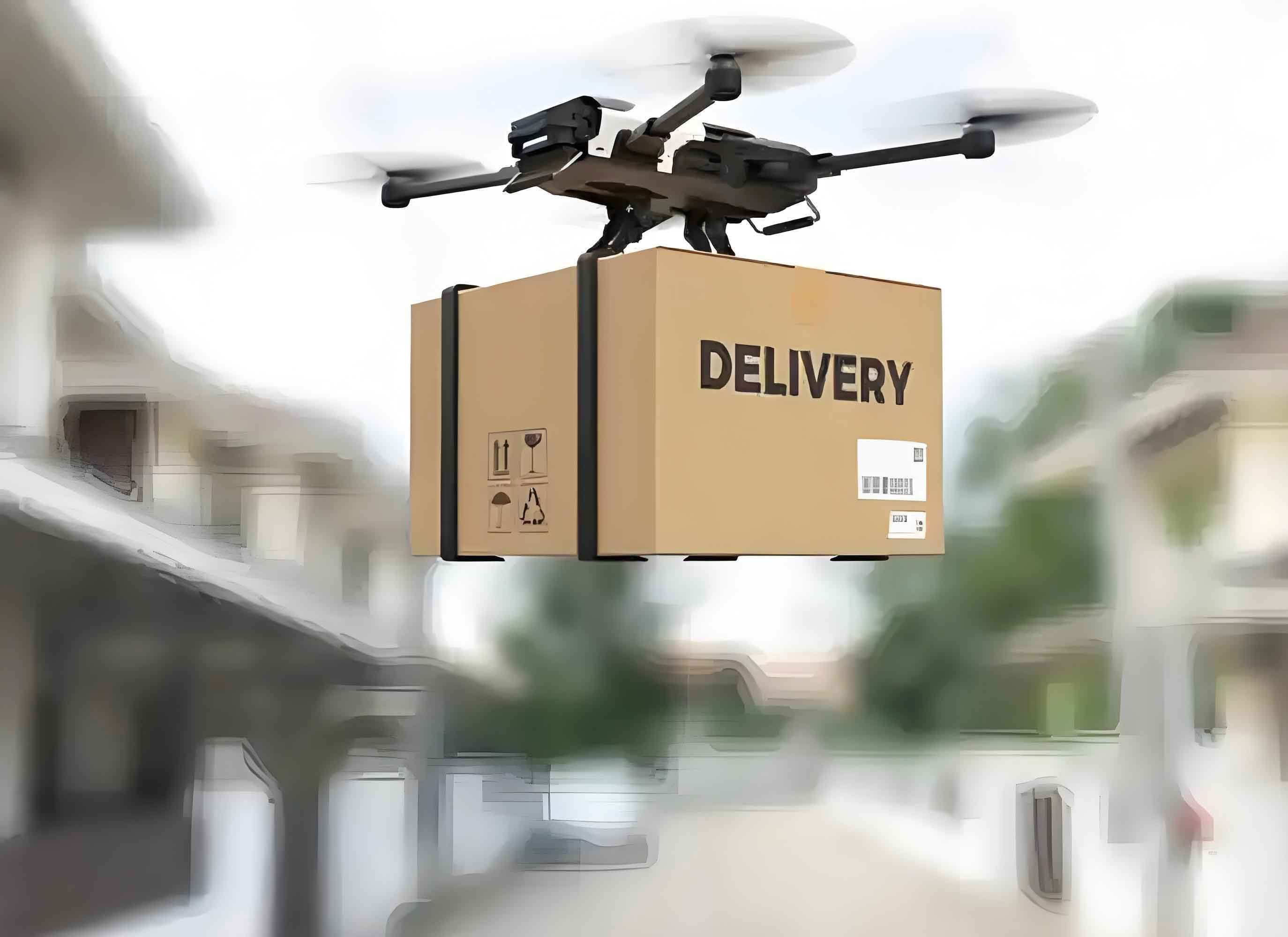
Technical Comparison of Delivery UAV Classes
| Platform Type | Max Payload (kg) | Range (km) | Endurance (hr) | Energy Density (Wh/kg) |
|---|---|---|---|---|
| Multi-rotor Delivery Drone | 80 | 70 | 0.65 | 300 |
| Fixed-wing Delivery UAV | 1,500 | 1,800 | 7 | 12,000 (H₂) |
| eVTOL Logistics Craft | 450 | 160 | 0.5 | 450 |
| Powered Parafoil UAV | 365 | 400 | 10 | 4,500 (fuel) |
Energy systems define operational viability. Lithium polymer batteries dominate light delivery drones with 300 Wh/kg density, while hydrogen fuel cells enable 1,000 Wh/kg for extended missions. Wireless charging infrastructure now achieves 92% efficiency through magnetic resonance coupling:
$$ \eta = \frac{k^2 Q_1 Q_2}{1 + k^2 Q_1 Q_2} \times 100\% $$
where $k$ = coupling coefficient and $Q$ = quality factors of transmitter/receiver coils. This enables 120-second battery swaps for delivery UAV fleets.
Airspace Architecture and Path Optimization
Low-altitude traffic management requires hierarchical airspace segmentation. China’s classification system designates layers below 300m for delivery drone operations, while U-Space frameworks in Europe implement dynamic geofencing. Critical to this infrastructure is 4D trajectory planning using hybrid algorithms:
Multi-objective path optimization for delivery UAVs minimizes both time and risk:
$$ \min \left( w_1 \sum_{i=1}^{n} t_i + w_2 \int_{path} \rho(x,y,z) \, ds \right) $$
where $t_i$ = segment transit time, $\rho$ = risk density function, and $w$ = weighting factors. Quantum genetic algorithms improve solution convergence by 68% over conventional methods.
Ground-air coordination models enhance delivery drone efficiency through synchronized routing. The vehicle-drone tandem problem (VDTP) formulation demonstrates 27% cost reduction:
| Coordination Model | Delivery Time Reduction | Energy Savings | Complexity Class |
|---|---|---|---|
| Single Truck-Single Drone | 32% | 41% | NP-Hard |
| Multi-Truck-Multi-Drone | 51% | 63% | Strongly NP-Hard |
| Drone Swarm Routing | 67% | 58% | MAX-SNP |
Ant colony optimization enables efficient delivery UAV routing in urban canyons. The transition probability between nodes follows:
$$ P_{ij}^k = \frac{[\tau_{ij}]^\alpha [\eta_{ij}]^\beta}{\sum_{l \in N_i^k} [\tau_{il}]^\alpha [\eta_{il}]^\beta} $$
where $\tau_{ij}$ = pheromone intensity, $\eta_{ij}$ = heuristic desirability, and $\alpha/\beta$ = influence parameters. This reduces urban delivery drone conflict points by 96% through 3D corridor stacking.
Operational Infrastructure Framework
Logistics networks require integrated hardware-software ecosystems. Four-tier delivery UAV infrastructure demonstrates scalability:
Energy replenishment systems use solar-hybrid charging stations with peak shaving algorithms. The power allocation model maximizes throughput:
$$ \max \sum_{i=1}^{m} \sum_{j=1}^{n} x_{ij} \cdot \mu_{ij} – \lambda \sum_{k=1}^{p} (P_k – \hat{P}_k)^2 $$
subject to $\sum x_{ij} \leq C_i$ (station capacity) and $\mu_{ij} \geq \mu_{\min}$ (service level). Neural network controllers adjust charging rates based on delivery UAV queue predictions, reducing wait times by 43%.
Safety and Certification Challenges
Delivery drone operations face triple redundancy requirements: navigation (GPS+INS+LiDAR), communication (5G-A+satellite), and propulsion. The safety integrity level (SIL) for urban delivery UAVs mandates failure probabilities below $10^{-9}$/hour. Cyberphysical protection employs homomorphic encryption for command integrity:
$$ \text{Enc}(m_1 \oplus m_2) = \text{Enc}(m_1) \otimes \text{Enc}(m_2) $$
ensuring secure data processing in delivery drone control systems.
Commercialization Economics
Cost structures reveal operational thresholds for delivery UAV profitability. The critical payload-distance product (PD) determines viability:
| Operation Type | Cost per kg-km ($) | Break-even PD (kg·km) | ROI Period (years) |
|---|---|---|---|
| Urban Delivery Drone | 0.18 | 3.5 | 2.7 |
| Rural UAV Logistics | 0.09 | 28 | 4.1 |
| Intercity Cargo UAV | 0.05 | 450 | 5.3 |
Hydrogen delivery drones achieve cost parity at 800+ km ranges due to superior $W_{\text{final}}/W_{\text{initial}}$ ratios in the Breguet equation. Regulatory harmonization remains critical—current certification timelines span 14-28 months across FAA, EASA, and CAAC frameworks, delaying delivery UAV deployment.
Future Development Vectors
Three convergence domains will define next-generation delivery UAV ecosystems:
1. Airspace-Digital Twin Integration: Real-time urban wind field modeling using computational fluid dynamics (CFD):
$$ \frac{\partial \mathbf{u}}{\partial t} + \mathbf{u} \cdot \nabla \mathbf{u} = -\frac{1}{\rho} \nabla p + \nu \nabla^2 \mathbf{u} + \mathbf{f} $$
enables delivery drone turbulence anticipation with 94% accuracy.
2. Autonomous Swarm Intelligence: Distributed ledger technology coordinates delivery UAV fleets through Byzantine fault-tolerant consensus, enabling 300+ vehicle coordination without ground control intervention.
3. Regulatory-Physical Network Synergy: Dynamic airspace cells (DACs) automatically reconfigure based on delivery UAV density, weather, and priority missions, increasing throughput by 170% compared to static sectors.
These advancements position delivery drones as the nucleus of sustainable logistics, potentially servicing 30% of global parcel volume by 2035 through continuous 3D mobility networks.