
As I explore the evolving landscape of economic development, I find that the low altitude economy represents a transformative force in advancing common prosperity among farmers and rural communities. This emerging economic形态, characterized by the use of manned and unmanned aircraft in low-altitude airspace, is not merely a technological advancement but a catalyst for reshaping agricultural practices, rural lifestyles, and income generation. In this analysis, I delve into the intrinsic logic, challenges, and innovative pathways through which the low altitude economy can drive sustainable growth and equity in rural areas. By integrating theoretical insights with practical applications, I aim to highlight how this sector, as a manifestation of new quality productivity, can bridge developmental gaps and foster inclusive progress.
The low altitude economy encompasses a wide array of activities, from agricultural drones for precision farming to low-altitude logistics and tourism, all of which contribute to multidimensional rural development. I observe that its core lies in leveraging aerial technologies to overcome spatial constraints, thereby enhancing productivity, cultural preservation, public service delivery, and environmental sustainability. For instance, in agriculture, drones equipped with advanced sensors enable real-time monitoring and targeted interventions, leading to efficiency gains. This aligns with broader goals of common prosperity, which emphasize not only material wealth but also spiritual fulfillment and ecological well-being. As I proceed, I will use tables and formulas to summarize key relationships and data, ensuring a comprehensive understanding of how the low altitude economy interacts with rural dynamics.
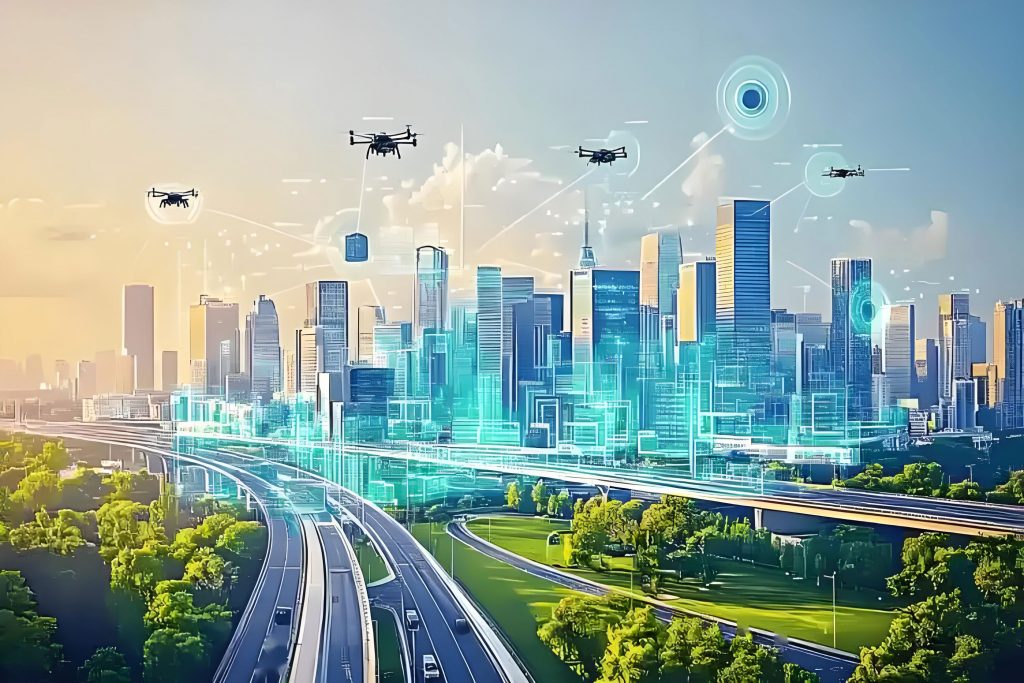
In examining the internal logic of the low altitude economy, I identify several mechanisms through which it promotes rural common prosperity. Firstly, technological empowerment via drones and other low-altitude vehicles facilitates precision agriculture, reducing resource waste and increasing yields. This can be modeled using a production function that incorporates low-altitude inputs: $$ Y = A \cdot F(K, L, LAE) $$ where \( Y \) represents agricultural output, \( A \) is total factor productivity, \( K \) and \( L \) denote capital and labor, and \( LAE \) signifies low-altitude economy inputs such as drone services. The integration of \( LAE \) enhances \( A \) by improving resource allocation and reducing environmental impact. Secondly, scene innovation in areas like low-altitude tourism and logistics creates new income streams, diversifying rural economies. For example, the development of “low-altitude + agritourism” projects combines aerial experiences with cultural elements, boosting local employment and revenues. Thirdly, industrial fusion breaks down traditional sector boundaries, leading to synergistic effects that amplify benefits for farmers. To illustrate, I present a table summarizing key application scenarios of the low altitude economy in rural settings:
| Scenario | Description | Impact on Common Prosperity |
|---|---|---|
| Precision Agriculture | Use of drones for planting, fertilizing, and pest control with sensors and AI. | Increases crop yields and reduces costs, raising farmers’ operational income. |
| Low-Altitude Logistics | Drones for transporting agricultural products and supplies in remote areas. | Enhances market access and reduces spoilage, expanding sales channels. |
| Cultural Heritage Preservation | Aerial imaging for documenting and monitoring historical sites. | Strengthens cultural identity and tourism, enriching spiritual life. |
| Public Service Delivery | Drones for medical supply drops and emergency response in underserved regions. | Improves healthcare access and safety, enhancing quality of life. |
| Eco-Monitoring | Low-altitude sensors for environmental surveillance and pollution control. | Promotes sustainable practices, safeguarding ecological foundations. |
Moreover, the low altitude economy fosters cultural revitalization by digitizing rural heritage through aerial photography and drones, which I see as crucial for spiritual common prosperity. The process can be expressed as a cultural capital accumulation function: $$ C_{t+1} = C_t + \delta \cdot LAE_c $$ where \( C_t \) represents cultural capital at time \( t \), \( \delta \) is the efficiency parameter, and \( LAE_c \) denotes low-altitude economy inputs in cultural activities. This equation highlights how continuous investment in low-altitude technologies enriches intangible cultural assets, fostering a sense of community and shared identity among rural residents.
However, I recognize that the low altitude economy faces significant challenges in rural contexts. Institutional barriers, such as fragmented airspace management and complex approval processes, hinder its scalability. Technologically, limitations in battery life and core components like sensors restrict the efficiency of low-altitude applications. For instance, the endurance of agricultural drones can be modeled as: $$ E = \frac{B}{P} $$ where \( E \) is endurance in hours, \( B \) is battery capacity, and \( P \) is power consumption. Current values often result in \( E < 0.5 \) hours, insufficient for large-scale operations. Additionally, talent shortages and inadequate infrastructure exacerbate these issues, creating a gap between potential and reality. The following table outlines these challenges in detail:
| Challenge Category | Specific Issues | Impact on Low Altitude Economy Development |
|---|---|---|
| Institutional Mechanisms | Lack of integrated airspace policies and multi-department coordination. | Slows down adoption and increases operational costs. |
| Technological Bottlenecks | Short battery life, dependency on imported components, and limited data analytics. | Reduces reliability and scalability of low-altitude solutions. |
| Human Resource Gaps | Insufficient trained professionals like drone operators and data analysts. | Limits innovation and effective implementation in rural areas. |
| Infrastructure Deficiencies | Poor network coverage, few landing sites, and inadequate charging stations. | Hampers real-time data transmission and continuous operations. |
| Application Scene Limitations | Underdeveloped business models in logistics and tourism, leading to homogeneity. | Restricts economic diversification and income growth. |
To address these challenges, I propose innovative pathways that leverage the low altitude economy’s potential. Strengthening institutional frameworks through coordinated policies and incentives can create an enabling environment. For example, establishing a “one-stop” approval platform for low-altitude flights can reduce bureaucratic delays, modeled as an optimization problem: $$ \min T = f(N, C) $$ where \( T \) is approval time, \( N \) is the number of departments involved, and \( C \) represents coordination efficiency. By minimizing \( T \), we accelerate the deployment of low-altitude technologies. Furthermore, enhancing technological innovation via产学研用 (industry-academia-research-application) collaborations can drive advancements in key areas. A formula for technological progress could be: $$ \Delta Tech = \alpha I + \beta R + \gamma LAE_{rd} $$ where \( \Delta Tech \) is the rate of technological improvement, \( I \) is investment, \( R \) is R&D input, and \( LAE_{rd} \) represents low-altitude economy-specific research efforts. This underscores the need for targeted investments to overcome existing bottlenecks.
In terms of talent development, I advocate for educational reforms and incentive schemes to build a skilled workforce. This includes integrating low-altitude economy curricula in vocational training and offering subsidies for rural returnees. The impact can be quantified using a human capital model: $$ HC = \sum (E_i \cdot S_i) $$ where \( HC \) is human capital, \( E_i \) represents education levels, and \( S_i \) denotes skills specific to the low altitude economy. By boosting \( HC \), we enhance the capacity for innovation and implementation. Additionally, infrastructure upgrades, such as deploying 5G networks and charging stations, are essential. The relationship between infrastructure and low-altitude economy performance can be expressed as: $$ P_{LAE} = \theta \cdot Infra + \epsilon $$ where \( P_{LAE} \) is the performance metric, \( Infra \) is infrastructure quality, and \( \theta \) is the elasticity coefficient. Improving \( Infra \) directly amplifies the benefits of the low altitude economy.
Expanding application scenes is another critical pathway. I suggest fostering “low-altitude +” models in production, governance, and commerce to create diverse revenue streams. For instance, in logistics, drones can revolutionize supply chains, with economic impact modeled as: $$ \Delta Revenue = \rho \cdot LAE_{logistics} \cdot D $$ where \( \Delta Revenue \) is the change in farmer income, \( \rho \) is a proportionality constant, \( LAE_{logistics} \) represents low-altitude logistics inputs, and \( D \) is demand factor. This highlights how scaling up scenes can directly contribute to common prosperity. The table below summarizes these innovative paths:
| Pathway | Key Actions | Expected Outcomes |
|---|---|---|
| Institutional Reform | Develop integrated policies, simplify approvals, and establish cross-department mechanisms. | Faster adoption and reduced costs, enhancing low altitude economy accessibility. |
| Technological Innovation | Boost R&D in drones and sensors, promote产学研用 collaborations, and support localization. | Improved efficiency and reliability of low-altitude applications. |
| Talent Cultivation | Revise education programs, offer incentives, and facilitate urban-rural knowledge exchange. | Larger skilled workforce driving low altitude economy growth. |
| Infrastructure Development | Build landing sites, enhance communication networks, and deploy energy solutions. | Seamless operations and broader coverage of low-altitude services. |
| Scene Expansion | Pilot new models in logistics, tourism, and public services, and encourage customization. | Diversified income sources and strengthened rural economies. |
In conclusion, I believe that the low altitude economy holds immense promise for advancing rural common prosperity by integrating technological advancements with holistic development goals. Through systematic addressing of challenges and strategic implementation of innovative pathways, we can unlock its full potential. The low altitude economy not only enhances material well-being but also enriches cultural and environmental dimensions, aligning with the essence of common prosperity. As I reflect on this, I am optimistic that continued focus on the low altitude economy will yield tangible benefits for farmers and rural communities, paving the way for a more equitable and sustainable future.