
The emergence of low-altitude economies has catalyzed transformative logistics paradigms, with delivery drones at the forefront of this revolution. These unmanned aerial vehicles (UAVs) enable three-dimensional cargo transport, bypassing terrestrial congestion and geographical barriers. The core system architecture of low-altitude delivery UAVs comprises six integrated modules: energy/power systems, flight control systems, environmental perception systems, avionics systems, logistics scheduling systems, and security management systems. Each module addresses critical operational challenges, from energy optimization to real-time obstacle detection.
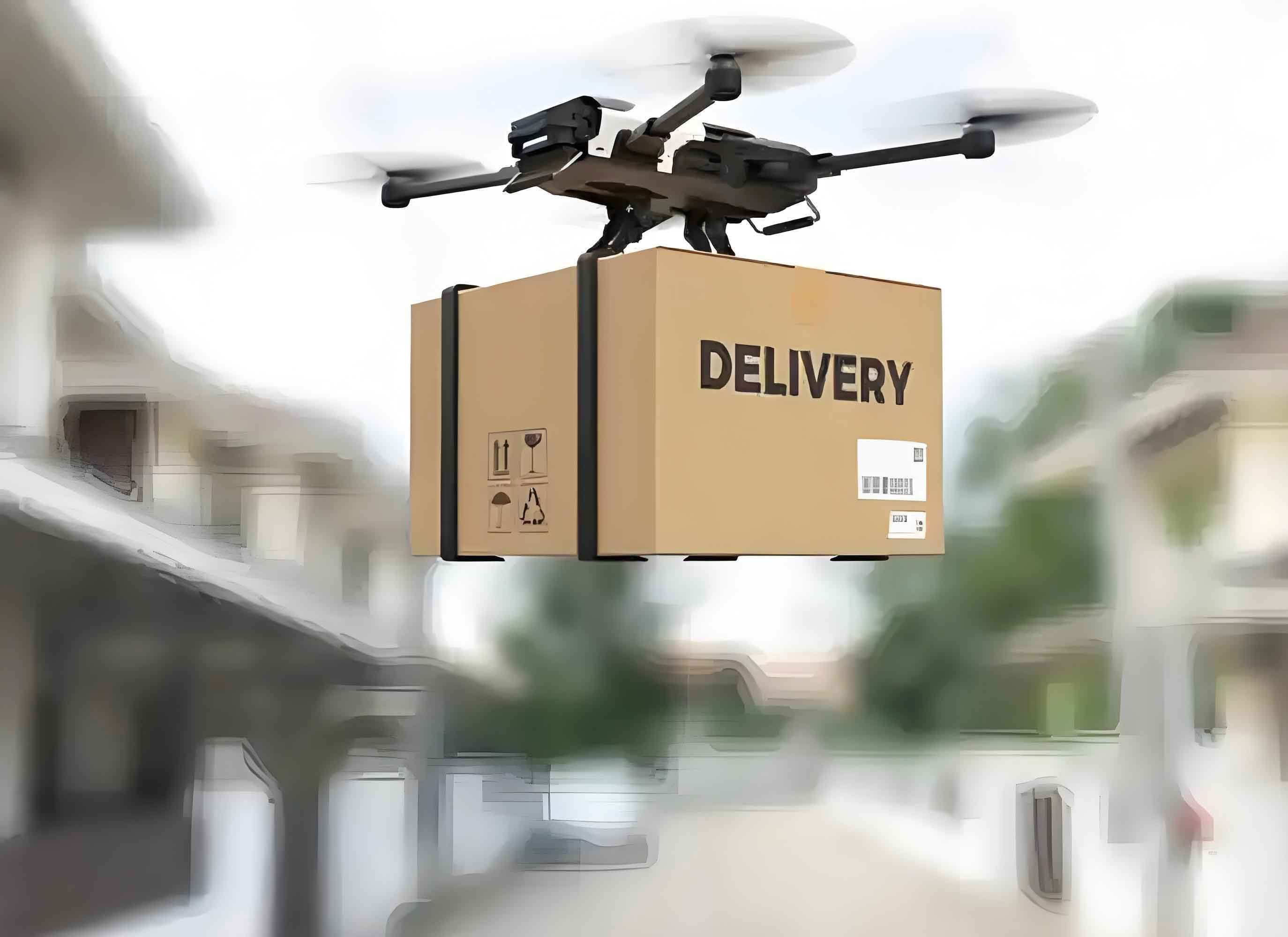
Global adoption showcases diverse applications: Amazon Prime Air achieves 30-minute deliveries within 24km radii, while Zipline’s medical delivery UAVs service remote African communities. Chinese platforms like JD.com deploy delivery drone fleets for rural logistics, demonstrating 40% cost reduction in mountainous regions. These implementations validate the operational feasibility of delivery drones across varied topographies and use cases.
Motion and Environmental Perception
Delivery drones require multimodal sensor fusion for operational safety. Key perception technologies include:
- LiDAR for 3D obstacle mapping: $$d_{obstacle} = \frac{c \cdot \Delta t}{2}$$ where \(c\) = light velocity, \(\Delta t\) = time-of-flight
- GPS-INS integration for geolocation: $$\dot{\mathbf{p}}^n = \mathbf{R}_b^n \mathbf{v}^b$$
- Payload sensors monitoring cargo integrity
- Vision systems for precision landing
Delivery Drone Motion Control
Precision control of delivery UAVs involves governing attitude \(\boldsymbol{\theta}\), position \(\mathbf{p}\), and velocity \(\mathbf{v}\) states. Control strategies bifurcate into linear and nonlinear approaches:
| Control Method | Key Equations | Application Context | Limitations |
|---|---|---|---|
| PID Control | $$u(t) = K_p e(t) + K_i \int_0^t e(\tau)d\tau + K_d \frac{de(t)}{dt}$$ | Stable flight regimes | Overshoot in dynamic environments |
| Sliding Mode | $$\sigma = \dot{e} + \lambda e, \quad \dot{\sigma} = -\eta \cdot \text{sgn}(\sigma)$$ | Obstacle avoidance | Control chattering |
| Adaptive Control | $$\dot{\hat{\Theta}} = -\Gamma \phi(\mathbf{x}) \sigma$$ | Payload variations | Computational load |
| MPC | $$\min_u \sum_{k=0}^{N} \|\mathbf{x}_{k|t} – \mathbf{r}_k\|^2_Q + \|u_k\|^2_R$$ | Energy-optimal routing | Real-time feasibility |
Delivery UAV Route Planning
Route optimization for delivery drones minimizes energy consumption \(E\), time \(T\), and risk \(R\):
$$\min_{\mathbf{P}} \alpha_1 E(\mathbf{P}) + \alpha_2 T(\mathbf{P}) + \alpha_3 R(\mathbf{P})$$
subject to:
$$\begin{cases}
\|\mathbf{p}_{k+1} – \mathbf{p}_k\| \leq d_{\max} \\
z_k \in [z_{\min}, z_{\max}] \\
\mathbf{p}_k \notin \mathcal{O} \quad \forall k
\end{cases}$$
where \(\mathbf{P} = \{\mathbf{p}_0, \mathbf{p}_1, …, \mathbf{p}_N\}\) denotes the path waypoints.
| Optimization Approach | Problem Type | Objectives | Constraints |
|---|---|---|---|
| Pareto Optimization | Multi-drone coordination | Coverage, energy balance | Communication range |
| Robust MILP | Uncertain demand | Cost minimization | Service time windows |
| Hybrid Metaheuristics | Urban delivery | Time, risk, energy | No-fly zones |
| Dynamic Programming | Energy-aware routing | Battery conservation | Payload-weight ratio |
Collaborative Optimization of Delivery Drones and Vehicles
Delivery drone-truck coordination manifests in four operational modes:
- Truck-as-Mothership: $$\min \sum_{i \in \mathcal{T}} t_i^{\text{launch}} + \sum_{j \in \mathcal{D}} t_j^{\text{flight}}$$
- Synchronous Delivery: $$\text{s.t.} \quad |t_k^{\text{return}} – t_{\text{truck}}(k)| \leq \Delta t_{\max}$$
- Electric Vehicle Coordination: $$E_{\text{drone}} + E_{\text{truck}} \leq \eta_{\text{charge}} \cdot t_{\text{charge}}$$
- Pickup-Delivery Integration: $$\max \sum_{i \in \mathcal{C}} \left[ w_i^+ \mathbb{I}_{\text{delivered}}(i) – w_i^- \mathbb{I}_{\text{delayed}}(i) \right]$$
| Collaboration Mode | Key Variables | Optimization Focus | Computational Methods |
|---|---|---|---|
| Truck-as-Mothership | Launch locations, flight paths | Total completion time | Two-stage heuristics |
| Synchronous Delivery | Rendezvous timing | Resource utilization | Branch-and-price |
| EV-Drone Systems | Charging schedules | Energy cooperation | Variable neighborhood search |
| Pickup-Delivery | Cargo capacity balance | Service completeness | Simulated annealing |
Profit Allocation in Delivery Drone-Vehicle Collaboration
Cooperative game theory governs fair revenue distribution between delivery drone and truck operators. The Shapley value \(\phi_i\) quantifies marginal contributions:
$$\phi_i(v) = \sum_{S \subseteq N \setminus \{i\}} \frac{|S|! (|N| – |S| – 1)!}{|N|!} [v(S \cup \{i\}) – v(S)]$$
where \(v(S)\) denotes coalition value. Core stability requires:
$$\sum_{i \in N} x_i = v(N), \quad \sum_{i \in S} x_i \geq v(S) \quad \forall S \subset N$$
Transportation and Privacy Security
Delivery drone security frameworks address:
- Sensor hardening: $$\mathcal{H}_{\text{sensor}} = \text{Enc}_{K}( \text{IMU} \oplus \text{LiDAR} )$$
- Cyber-physical protocols: $$\min_{P_t} \frac{\| \mathbf{h}_e^H \mathbf{w} \|^2 P_t}{\| \mathbf{h}_u^H \mathbf{w} \|^2 P_t + \sigma^2} \leq \gamma_{\text{eavesdrop}}$$
- Anti-spoofing: $$\text{Verify}_{\text{signature}}( \text{GPS}_{\text{enc}} ) = \text{True}$$
Sustainable Development of the Industry
Delivery drone adoption faces economic and regulatory challenges:
$$\Pi_{\text{drone}} = \underbrace{\beta \cdot Q_{\text{deliv}}}_{\text{Revenue}} – \underbrace{C_{\text{infra}} – C_{\text{energy}} – C_{\text{regul}}}_{\text{Cost}}$$
Key sustainability dimensions:
- Rural Accessibility: \(\lim_{d_{\text{road}} \to \infty} \text{Cost}_{\text{drone}} < \text{Cost}_{\text{ground}}}\)
- Employment Transition: \(\nabla_{\text{tech}} \text{Jobs}_{\text{logistics}} > 0\)
- Regulatory Evolution: \(\frac{\partial \text{Airspace}_{\text{accessible}}}{\partial t} > 0\)
Conclusion and Research Frontiers
Delivery drones represent a paradigm shift in logistics, yet require advances in five domains:
- Reliability Engineering: Robust grasping mechanisms satisfying $$\left\| \frac{\partial \tau_{\text{grip}}}{\partial m} \right\| \leq \epsilon_{\text{safe}}$$
- Heterogeneous Coordination: Multi-agent systems obeying $$\min_{\mathbf{u}} \| \mathbf{\dot{x}} – f(\mathbf{x}, \mathbf{u}) \|^2_{\mathcal{L}_2}$$
- Regulatory Sandboxes: Dynamic airspace allocation algorithms maximizing $$\rho_{\text{utilize}} = \frac{\mathcal{V}_{\text{operational}}}{\mathcal{V}_{\text{allocated}}}$$
- Behavioral Economics: Adoption models incorporating $$\frac{dA}{dt} = k \cdot (\beta P^{-\alpha} – \gamma C_{\text{perceived}})$$
- Green Logistics: Lifecycle analysis minimizing $$\int_0^{T_{\text{life}}} \text{CO}_2(t) dt$$
These advancements will position delivery UAVs as sustainable pillars of next-generation logistics networks.