
The evolution of unmanned aerial vehicles (UAVs) has led to the development of hybrid platforms that combine the advantageous features of different configurations. A prime example is the quadrotor drone with tiltable rotors, often termed a quad tilt-rotor UAV. This innovative design merges the vertical take-off and landing (VTOL) and hovering capabilities of a standard quadrotor drone with the high-speed forward flight and extended range of a fixed-wing aircraft. Compared to tilt-rotor designs with two rotors, this quadrotor drone configuration offers enhanced payload capacity and potentially greater cruise speeds, making it suitable for a wider range of missions. However, this increased capability introduces significant control challenges. The system possesses inherent control redundancy due to the co-existence of rotor-based and aerodynamic surface-based actuators. Furthermore, its dynamic model is highly time-varying and uncertain, particularly during the transitional flight phase where the rotors tilt, and aerodynamic effects change dramatically. This paper focuses on addressing these challenges through the modeling and simulation of a longitudinal attitude control system for such a quadrotor drone.
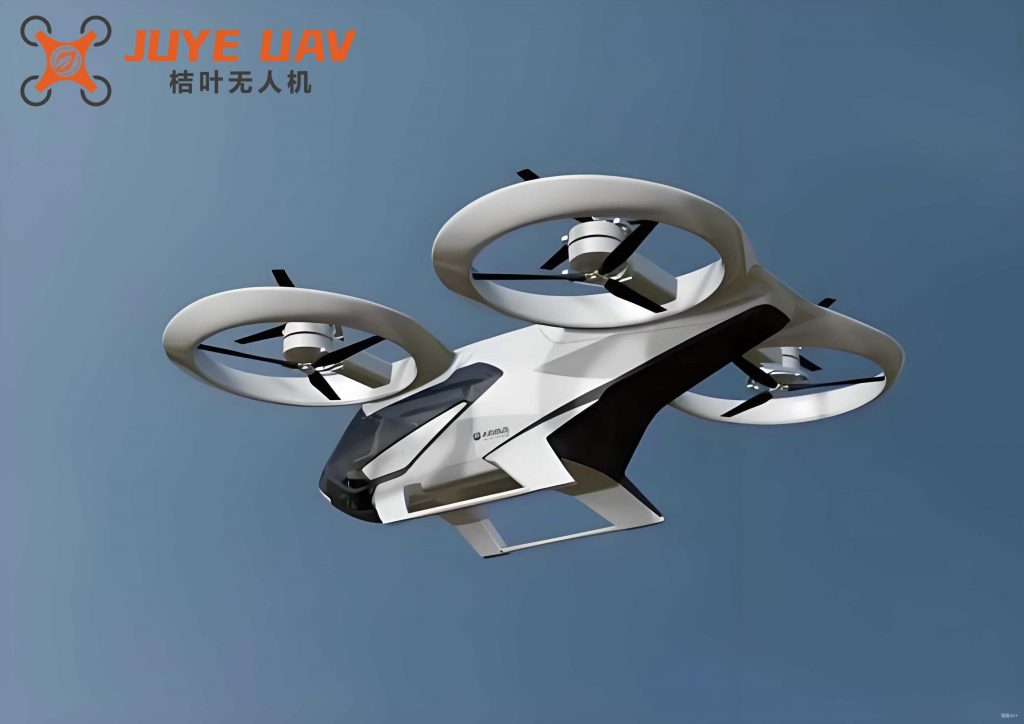
The core problem lies in the quadrotor drone’s dual control mechanisms. Attitude can be manipulated either by differential thrust from the four rotors or by deflecting aerodynamic control surfaces like elevators. This redundancy must be managed intelligently. Moreover, the model parameters, especially aerodynamic coefficients, vary with airspeed and rotor tilt angle, and are susceptible to disturbances like wind gusts. Therefore, a robust control strategy that does not rely heavily on a precise, fixed mathematical model is highly desirable. In this work, we employ a control allocation strategy based on the tilt angle to manage redundancy and design a novel attitude controller based on Fuzzy Linear Active Disturbance Rejection Control (Fuzzy LADRC) to handle model uncertainties and disturbances effectively.
1. System Description and Flight Modes
The subject of this study is a tandem-wing quadrotor drone. Its four rotors are arranged in an “X” configuration. The actuators consist of four brushless motors with propellers, servos for tilting the rotor nacelles, and a pair of elevon servos. The fundamental characteristic of this quadrotor drone is its ability to transition between distinct flight modes by rotating the nacelles of its four rotors. The nature of the forces acting on the vehicle changes significantly across these modes:
Vertical Mode: The rotor nacelles are oriented vertically (0° tilt). Lift is generated primarily by the total thrust of the four rotors, similar to a conventional quadrotor drone. Flight speeds are low, and aerodynamic control surfaces have negligible effect on longitudinal attitude.
Horizontal Mode: The rotor nacelles are rotated to a horizontal position (90° tilt). Lift is now primarily generated by the aerodynamic forces on the wings, while the rotor thrust provides forward propulsion. The quadrotor drone behaves like a fixed-wing aircraft, enabling high-speed cruise. Elevators become the primary means of longitudinal control.
Transition Mode: The rotor nacelle angle is between 0° and 90°. Lift is provided by a combination of rotor thrust (with a vertical component) and aerodynamic lift. This is the most complex mode for the quadrotor drone, requiring a blended control strategy where both rotor differential thrust and elevator deflection contribute to attitude control. The effectiveness of each control method varies continuously with the tilt angle and airspeed.
| Flight Mode | Nacelle Angle (β) | Primary Lift Source | Primary Control Method |
|---|---|---|---|
| Vertical | 0° | Rotor Thrust | Rotor Differential Thrust |
| Transition | 0° < β < 90° | Rotor Thrust & Aerodynamics | Blended Rotor/Elevator |
| Horizontal | 90° | Aerodynamics | Elevator Deflection |
2. Mathematical Modeling of the Quadrotor Drone
To design an effective controller, a comprehensive six-degree-of-freedom (6-DOF) model of the quadrotor drone is established using Newton’s laws of motion and rigid body dynamics. The model incorporates forces and moments from rotor thrust, aerodynamics, and gravity.
2.1 Force Analysis
Let the nacelle tilt angle be denoted by β. The thrust produced by each rotor is \(T_i\) (i=1,2,3,4). The components of the total external force acting on the quadrotor drone along the body-frame axes (\(O_x_b, O_y_b, O_z_b\)) are \(F_x, F_y, F_z\). Assuming zero sideslip, the forces are:
$$F_x = -mg\sin\theta + \sum_{i=1}^{4} T_i \sin\beta + F_{wx}$$
$$F_y = mg\cos\theta\sin\phi + F_{wy}$$
$$F_z = mg\cos\theta\cos\phi – \sum_{i=1}^{4} T_i \cos\beta + F_{wz}$$
Here, \(\theta\) is the pitch angle, \(\phi\) is the roll angle, \(g\) is gravity, and \(m\) is the mass of the quadrotor drone. The terms \(F_{wx}, F_{wy}, F_{wz}\) are the components of the aerodynamic force in the body frame, derived from the lift \(L\) and drag \(D\) in the wind frame. Neglecting side force, they are:
$$
\begin{bmatrix}
F_{wx} \\
F_{wy} \\
F_{wz}
\end{bmatrix} = \mathbf{S}_{\alpha}^T
\begin{bmatrix}
-0.5\rho V^2 S_w C_D \\
0 \\
-0.5\rho V^2 S_w C_L
\end{bmatrix}
$$
where \(\mathbf{S}_{\alpha}\) is the transformation matrix from the body frame to the wind frame, \(\rho\) is air density, \(V\) is airspeed, \(S_w\) is the wing area, and \(C_L, C_D\) are the lift and drag coefficients. The transformation matrix for an angle of attack \(\alpha\) is:
$$
\mathbf{S}_{\alpha} =
\begin{bmatrix}
\cos\alpha & 0 & \sin\alpha \\
0 & 1 & 0 \\
-\sin\alpha & 0 & \cos\alpha
\end{bmatrix}
$$
2.2 Moment Analysis
The total moments acting on the quadrotor drone body, \(M_x, M_y, M_z\), arise from both rotor thrust and aerodynamic effects:
$$M_x = M_{rx} + M_{wx}, \quad M_y = M_{ry} + M_{wy}, \quad M_z = M_{rz} + M_{wz}$$
The rotor-induced moments are:
$$M_{rx} = C_T (\omega_1^2 + \omega_4^2 – \omega_2^2 – \omega_3^2) L_x \cos\beta$$
$$M_{ry} = C_T (\omega_1^2 + \omega_2^2 – \omega_3^2 – \omega_4^2) L_y \cos\beta$$
$$M_{rz} = C_M (\omega_1^2 + \omega_3^2 – \omega_2^2 – \omega_4^2) \cos\beta$$
Here, \(C_T\) and \(C_M\) are the thrust and torque coefficients of the rotors, \(\omega_i\) are rotor speeds, and \(L_x, L_y\) are the moment arms. The aerodynamic moments \(M_{w*}\) are calculated using respective moment coefficients \(C_x, C_y, C_z\), a reference aerodynamic chord \(c_A\), and dynamic pressure:
$$M_{wx} = 0.5\rho V^2 S_w c_A C_x, \quad M_{wy} = 0.5\rho V^2 S_w c_A C_y, \quad M_{wz} = 0.5\rho V^2 S_w c_A C_z$$
2.3 Dynamics and Kinematics
Applying Newton’s second law in the body frame gives the translational dynamics:
$$\dot{u} = vr – wq + F_x/m$$
$$\dot{v} = -ur + wp + F_y/m$$
$$\dot{w} = uq – vp + F_z/m$$
where \(u, v, w\) are body-frame velocity components and \(p, q, r\) are the roll, pitch, and yaw rates. The rotational dynamics are derived from Euler’s equations:
$$M_x = \dot{p}I_x + qr(I_z – I_y)$$
$$M_y = \dot{q}I_y + pr(I_x – I_z)$$
$$M_z = \dot{r}I_z + pq(I_y – I_x)$$
where \(I_x, I_y, I_z\) are the moments of inertia. The kinematic equations relating body angular rates to Euler angle derivatives are:
$$\dot{\phi} = p + (r\cos\phi + q\sin\phi)\tan\theta$$
$$\dot{\theta} = q\cos\phi – r\sin\phi$$
$$\dot{\psi} = (r\cos\phi + q\sin\phi)/\cos\theta$$
3. Control System Design for the Quadrotor Drone
The control design for this complex quadrotor drone addresses two main issues: managing control redundancy and designing a robust attitude controller.
3.1 Control Allocation Strategy
For longitudinal (pitch) control, the quadrotor drone has two control inputs: differential rotor thrust (\(\delta_T\)) and elevator deflection (\(\delta_e\)). Their effectiveness varies with flight mode. A control allocation coefficient \(\tau\) is introduced to blend these inputs seamlessly. The strategy is based on the nacelle tilt angle \(\beta\). A simple yet effective law for the transition is a linear tilt over time, for example:
$$\beta(t) =
\begin{cases}
0, & t = 0 \\
45t, & 0 < t < 2 \\
90, & t \ge 2
\end{cases}
$$
From the moment equation \(M_{ry}\), the control effectiveness of differential rotor thrust is proportional to \(\cos\beta\). Therefore, we define the allocation coefficient for rotor control as \(\tau = \cos\beta\). Consequently, the allocation for elevator control is \(1 – \tau\). The final commands to the actuators are:
$$u_{\text{rotor}} = \tau \cdot u’_1, \quad u_{\text{elevator}} = (1 – \tau) \cdot u’_2$$
where \(u’_1\) and \(u’_2\) are the control outputs from the respective channel controllers. This strategy ensures that as the quadrotor drone transitions from vertical to horizontal mode, control authority smoothly shifts from the rotors to the aerodynamic surfaces.
3.2 Fuzzy Linear Active Disturbance Rejection Control (Fuzzy LADRC)
Linear Active Disturbance Rejection Control (LADRC) is chosen for its robustness against model uncertainties and external disturbances, which are prevalent in the dynamics of a tilting quadrotor drone. It estimates and cancels the “total disturbance” (including unmodeled dynamics and external forces) in real-time. We further enhance it with a fuzzy logic module for online parameter tuning.
The pitch channel dynamics from Eqs. (7) and (8) can be generically expressed as:
$$\ddot{\theta} = f(\theta, \dot{\theta}, \phi, \dot{\phi}, \psi, \dot{\psi}, …) + w(t) + b_0 u$$
where \(f(\cdot)\) represents internal coupling and nonlinearities (treated as internal disturbance), \(w(t)\) is the external disturbance, \(b_0\) is a rough estimate of the control gain, and \(u\) is the control input. LADRC lumps the total disturbance \(f + w\) into an extended state \(x_3\). The system is rewritten as:
$$\dot{x}_1 = x_2$$
$$\dot{x}_2 = x_3 + b_0 u$$
$$\dot{x}_3 = d, \quad y = x_1$$
where \(x_1 = \theta\), \(x_2 = \dot{\theta}\), and \(x_3 = f + w\). A Linear Extended State Observer (LESO) is designed to estimate all states, including the disturbance:
$$\dot{z}_1 = z_2 – \beta_1(z_1 – y)$$
$$\dot{z}_2 = z_3 – \beta_2(z_1 – y) + b_0 u$$
$$\dot{z}_3 = -\beta_3(z_1 – y)$$
Here, \(z_1, z_2, z_3\) are the estimates of \(x_1, x_2, x_3\). The observer gains \(\beta_1, \beta_2, \beta_3\) are parameterized by a single observer bandwidth \(\omega_o\):
$$\beta_1 = 3\omega_o, \quad \beta_2 = 3\omega_o^2, \quad \beta_3 = \omega_o^3$$
The control law consists of a linear state error feedback (LSEF) combined with disturbance rejection:
$$u_0 = k_p (r – z_1) – k_d z_2$$
$$u = \frac{u_0 – z_3}{b_0}$$
The feedback gains \(k_p\) and \(k_d\) are parameterized by a controller bandwidth \(\omega_c\):
$$k_p = \omega_c^2, \quad k_d = 2\omega_c$$
Thus, a standard LADRC for the quadrotor drone mainly requires tuning two parameters: \(\omega_c\) and \(b_0\), with \(\omega_o\) typically set as \((2 \sim 10)\omega_c\).
To improve adaptability and performance across the different flight modes of the quadrotor drone, a fuzzy logic system is employed to tune \(\omega_c\) online. The fuzzy system takes the tracking error \(e = r – y\) and its derivative \(\dot{e}\) as inputs and outputs an adjustment \(\Delta\omega_c\). The final controller bandwidth is \(\omega_c’ = \omega_c + \Delta\omega_c\). This allows the controller to respond more aggressively when error is large and become gentler near the setpoint, improving both response speed and settling behavior for the quadrotor drone.
| Symbol | Parameter | Relation |
|---|---|---|
| \(\omega_o\) | Observer Bandwidth | Tuning Parameter |
| \(\omega_c\) | Controller Bandwidth | \(\omega_c’ = \omega_c + \Delta\omega_c\) |
| \(\beta_1, \beta_2, \beta_3\) | LESO Gains | \(3\omega_o, 3\omega_o^2, \omega_o^3\) |
| \(k_p, k_d\) | LSEF Gains | \(\omega_c’^2, 2\omega_c’\) |
| \(b_0\) | Control Gain Estimate | From Model Identification |
The fuzzy rules for adjusting \(\Delta\omega_c\) are designed heuristically. For instance, if the error is Positive Big (PB) and error derivative is Negative Small (NS), a moderate positive adjustment to \(\omega_c\) might be applied to accelerate convergence. The rule base is summarized below:
| \(\Delta\omega_c\) | \(\dot{e}\) | ||||
|---|---|---|---|---|---|
| \(e\) | NB | NS | ZO | PS | PB |
| NB | PB | PS | PS | PS | ZO |
| NS | PB | PS | PS | ZO | PS |
| ZO | PS | PS | ZO | PS | NS |
| PS | PS | ZO | PS | PS | PB |
| PB | ZO | PS | PS | PS | PB |
3.3 Overall Control Architecture for the Quadrotor Drone
The overall pitch attitude control system for the quadrotor drone integrates the Fuzzy LADRC controller with the control allocation logic. The desired pitch angle \(\theta_{cmd}\) is compared with the measured \(\theta\). The error is processed by a Fuzzy LADRC block, which generates a raw pitch control command. This command is then split by the allocation block into two signals: one for rotor differential thrust and one for elevator deflection, according to the coefficient \(\tau = \cos\beta(t)\). These signals are sent to their respective actuators to control the quadrotor drone’s attitude.
4. Simulation Results and Analysis
A high-fidelity simulation model of the quadrotor drone was built in MATLAB/Simulink incorporating the 6-DOF nonlinear dynamics. The physical parameters, obtained through measurement and CFD analysis, are listed below:
| Parameter | Symbol | Value |
|---|---|---|
| Mass | \(m\) | 0.95 kg |
| Wing Area | \(S_w\) | 0.55 m² |
| Pitch Moment of Inertia | \(I_y\) | 0.27 kg·m² |
| Lift Curve Slope | \(C_{l_\alpha}\) | 0.03 rad⁻¹ |
The controller parameters \(b_0\) and the nominal \(\omega_c\) were identified from a linearized model around a nominal flight condition. Simulations were conducted for all three flight modes.
4.1 Vertical and Horizontal Mode Performance: In vertical mode (\(\tau=1\)), with a 10° pitch command, the Fuzzy LADRC controller for the quadrotor drone demonstrated a faster rise time and negligible overshoot compared to a fixed-parameter LADRC. Similarly, in horizontal mode (\(\tau=0\)), the Fuzzy LADRC provided a crisp and accurate response to the same command, showcasing its effectiveness when controlling the quadrotor drone as a fixed-wing aircraft.
4.2 Transition Mode and Robustness: The most challenging scenario is the transition mode (\(0<\tau<1\)). The quadrotor drone was commanded to follow a 10° pitch angle while the nacelles tilted from 0° to 90° over 2 seconds. The Fuzzy LADRC controller, coupled with the \(\cos\beta\) allocation strategy, successfully maintained stable and precise attitude tracking throughout the transition. The smooth blending of control authority was evident, with no abrupt changes in the quadrotor drone’s behavior.
4.3 Robustness Verification: To test robustness, the quadrotor drone’s mass was increased by 58% (to 1.5 kg) without changing any controller parameters. The standard LADRC showed significant performance degradation, with increased overshoot and settling time. In contrast, the Fuzzy LADRC controller for the quadrotor drone maintained good performance, demonstrating its superior ability to adapt to significant model variations and disturbances inherent in the operation of a versatile quadrotor drone platform.
| Test Condition | Controller | Rise Time | Overshoot | Settling Time | Remarks |
|---|---|---|---|---|---|
| Vertical Mode | Fuzzy LADRC | Fast | ~0% | Short | Superior to LADRC |
| Horizontal Mode | Fuzzy LADRC | Fast | Low | Short | Precise tracking |
| Transition Mode | Fuzzy LADRC | Consistent | Low | Consistent | Smooth control blending |
| +58% Mass Change | Standard LADRC | Slower | High | Long | Performance degraded |
| +58% Mass Change | Fuzzy LADRC | Maintained | Low | Maintained | Robust performance |
5. Conclusion
This paper presented a comprehensive solution for the longitudinal attitude control of a quadrotor drone with tiltable rotors. The key challenges of control redundancy and model uncertainty/time-variation were addressed systematically. A physics-based 6-DOF model was developed to capture the complex dynamics of the quadrotor drone across its flight envelope. A simple yet effective control allocation strategy based on the cosine of the nacelle tilt angle was proposed to seamlessly manage the redundant actuators during the critical transition phase.
The core contribution is the design of a Fuzzy Linear Active Disturbance Rejection Control (Fuzzy LADRC) attitude controller. This controller combines the inherent robustness of LADRC against disturbances with the adaptability of fuzzy logic for online parameter tuning. The simulation results demonstrate that this approach provides fast, accurate, and stable pitch control for the quadrotor drone in all flight modes—vertical, horizontal, and transition. More importantly, it exhibits strong robustness against significant parameter variations, a crucial requirement for the practical deployment of such a complex quadrotor drone system. The methodology, relying on only a few tuning parameters enhanced by fuzzy logic, shows significant promise for real-world engineering applications in advanced quadrotor drone control.