
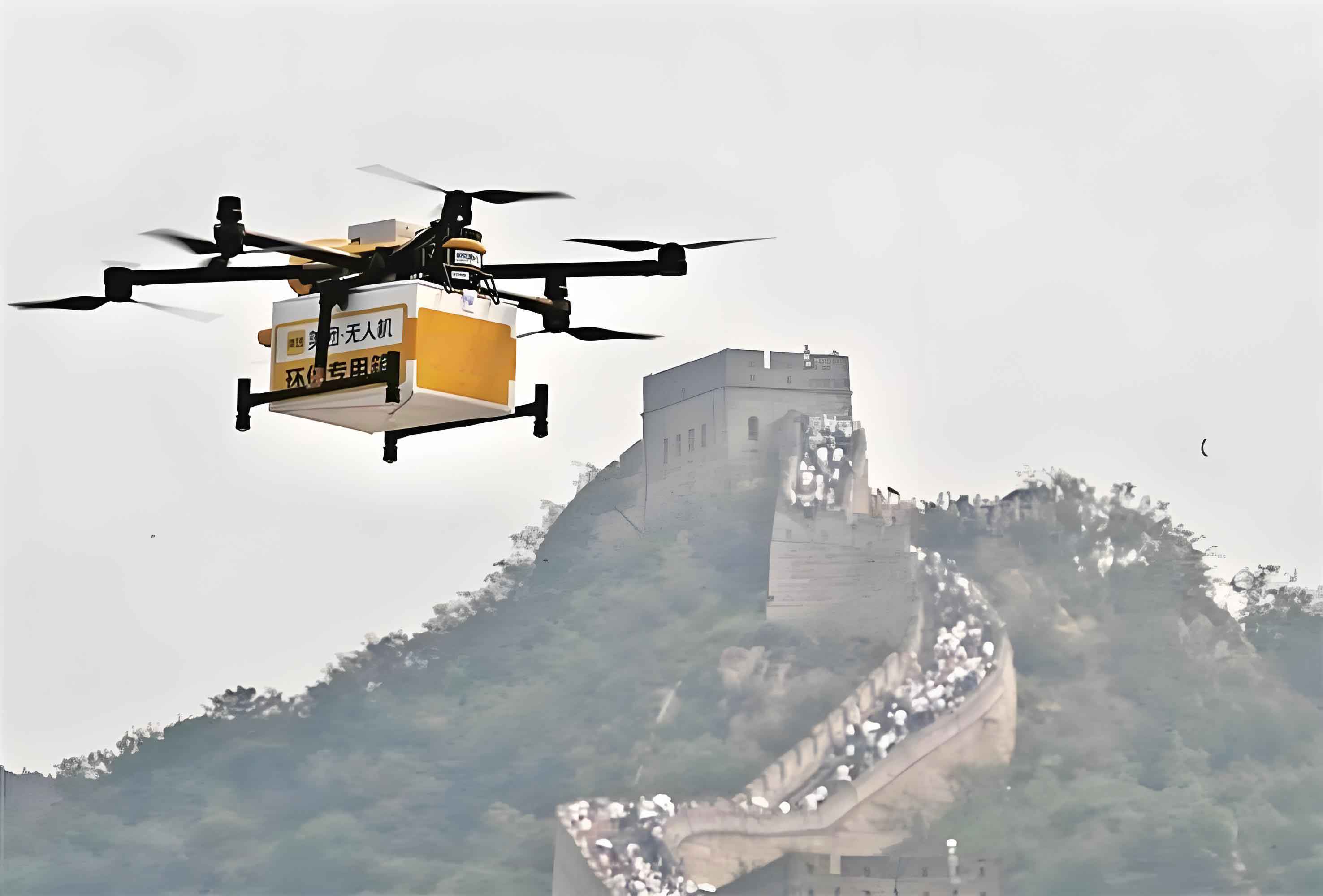
The rapid growth of e-commerce has intensified pressure on last-mile delivery systems, with approximately 300 million parcels circulating daily in China. Delivery drones represent a transformative solution, offering advantages over traditional ground transportation including reduced operational costs, enhanced efficiency, and traffic congestion mitigation. Despite extensive research on drone routing and regulations, predictive studies on market evolution remain limited. This research addresses this gap through a system dynamics approach to model the complex interplay of economic, social, and technological factors shaping delivery UAV adoption.
1. Introduction
The 2023 “Double Eleven” shopping festival generated ¥11.386 trillion in online transactions, highlighting the critical need for efficient logistics solutions. Delivery drones operate beyond terrestrial constraints, achieving superior delivery times while reducing costs by 30-50% compared to ground vehicles. Since 2018, when SF Express obtained China’s first delivery UAV operational license, companies including Meituan, DJI, and Shenzhen Zhihang have launched commercial delivery drone operations. Market projections indicate substantial growth potential for delivery UAV fleets, necessitating robust predictive methodologies. Existing demand forecasting studies exhibit limitations due to data scarcity during early-stage technology deployment. This research establishes a system dynamics (SD) framework to simulate delivery drone market evolution under dynamic interactions between economic development, social demand, and public acceptance.
2. Methodology and Applicability Analysis
System dynamics, introduced by Forrester in 1956, models complex systems through causal feedback loops and nonlinear interactions. The approach excels when:
- Multiple interdependent variables create feedback structures
- Historical data is insufficient for statistical modeling
- Policy impacts require scenario-based testing
The delivery UAV market constitutes a multi-feedback system influenced by GDP, population, technological investment, and regulatory policies. The SD methodology captures these dynamics through stock-flow relationships and delay effects, enabling scenario simulations from 2017 to 2030. Core assumptions include:
- Economic agents act rationally within market constraints
- Macroeconomic stability persists without major policy disruptions
- Secondary factors with negligible impact are excluded
3. System Dynamics Model Construction
3.1 Causal Relationships and Feedback Loops
The causal loop diagram identifies three primary subsystems governing delivery drone adoption:
| Subsystem | Key Variables | Feedback Mechanism |
|---|---|---|
| Economic & Demographic | GDP, Population, Disposable Income | + Economic growth → + Logistics investment |
| Social Logistics Demand | Parcel Volume, Delivery UAV Fleet | + Demand → + Drone utilization → + Revenue |
| Public Acceptance | Usage Willingness, Cost Savings | + Acceptance → + Drone parcels → + R&D |
Critical feedback loops include:
Positive Loop 1: GDP → (+) Disposable Income → (+) Retail Sales → (+) Logistics Demand → (+) Parcel Volume → (+) Delivery UAV Utilization → (+) Logistics Revenue → (+) GDP
Positive Loop 2: R&D Investment → (-) Operational Costs → (+) Delivery UAV Fleet → (+) Cost Savings → (+) Usage Willingness → (+) UAV Parcels → (+) Revenue → (+) R&D Investment
3.2 System Flow Diagram
The stock-flow structure quantifies relationships between 18 key variables:
$$ \small \text{Delivery UAV Fleet} = \int (\text{Fleet Growth Rate}) dt + \text{Initial Fleet} $$
$$ \small \text{Fleet Growth Rate} = f(\text{Delivery UAV Demand}, \text{Operational Costs}) $$
$$ \small \text{Delivery UAV Demand} = \frac{\text{UAV Parcels} \times 10^4}{\text{Delivery Capacity per UAV}} $$
3.3 Parameterization and Equations
Parameters were calibrated using 2017-2022 statistical data with the following key initializations:
| Parameter | Value | Source/Calculation |
|---|---|---|
| Initial GDP | ¥83.2 trillion | National Bureau of Statistics |
| Initial Population | 1.4 billion | National Bureau of Statistics |
| Initial Delivery UAV Fleet | 37,400 units | 17% of commercial UAV market |
| Delivery Capacity per UAV | 62,600 parcels/year | 313 days × 10 hours × 20 parcels/hour |
Core structural equations:
$$ \small \text{Logistics Demand} = 656.769 \times \text{Disposable Income} + \text{Retail Sales} – 1368.57 $$
$$ \small \text{Parcel Volume} = \text{Logistics Demand} \times \text{Infrastructure Coefficient} $$
$$ \small \text{UAV-Suitable Parcels} = \text{Parcel Volume} \times 0.978 \times 0.606 \times 0.86 \times 0.6 $$
$$ \small \text{UAV Parcels} = \text{UAV-Suitable Parcels} \times \frac{\text{Usage Willingness}}{100} $$
4. Simulation Results and Scenario Analysis
4.1 Model Validation
Historical validation demonstrated high predictive accuracy:
| Year | Delivery UAV Fleet (1,000 units) | Parcel Volume (billion) | Error (%) |
|---|---|---|---|
| 2018 | 4.67 vs 4.88 | 530.36 vs 507.10 | -4.30 | 4.59 |
| 2020 | 8.49 vs 8.79 | 818.91 vs 833.58 | -3.41 | -1.76 |
| 2022 | 15.51 vs 16.29 | 1099.64 vs 1105.81 | -4.79 | -0.56 |
Mean absolute errors remained below 5%, confirming model robustness for forecasting delivery UAV adoption trends.
4.2 Baseline Simulation
Projections indicate substantial delivery drone market expansion:
$$ \small \text{Delivery UAV Fleet}_{2025} = 416,800 \text{ units} $$
$$ \small \text{Delivery UAV Fleet}_{2030} = 1.7 \text{ million units} $$
The fleet growth rate follows an S-curve pattern, with rapid early expansion (2020-2025: >40% CAGR) moderating as market saturation approaches (2028-2030: 12-15% CAGR). This reflects initial infrastructure investments and subsequent efficiency optimization in delivery UAV operations.
4.3 Scenario Analysis
Policy interventions were simulated through parameter modulation:
| Policy Lever | Change | 2030 Fleet Impact | Sensitivity Coefficient |
|---|---|---|---|
| Logistics Demand | +30% | +34.2% | $$ \alpha_D = 1.14 $$ |
| R&D Investment | +30% | +28.7% | $$ \beta_R = 0.96 $$ |
| Usage Willingness | +30% | +41.5% | $$ \gamma_W = 1.38 $$ |
The comparative impact hierarchy is quantified as:
$$ \small \text{Impact Magnitude} = \gamma_W > \alpha_D > \beta_R $$
This relationship confirms that public acceptance exerts the strongest leverage on delivery UAV adoption, followed by underlying demand growth and technological advancement. Each 10% increase in usage willingness yields 2.3x greater fleet expansion than equivalent R&D investment increases for delivery drone technologies.
5. Conclusions
This research establishes a validated system dynamics framework for delivery UAV market forecasting, yielding three principal insights:
- Delivery drone fleets will grow exponentially to approximately 1.7 million units by 2030 under current conditions, transforming last-mile logistics infrastructure.
- Public acceptance demonstrates the strongest leverage effect (sensitivity coefficient γW = 1.38), surpassing logistics demand (αD = 1.14) and R&D investment (βR = 0.96) in driving adoption.
- Strategic priorities should include: 1) Public demonstration projects to enhance delivery UAV acceptance 2) Urban airspace integration to expand suitable delivery corridors 3) Targeted R&D in energy efficiency and automation.
The model provides policymakers with a scenario-testing tool for optimizing regulatory frameworks and investment strategies. Future research will integrate spatial analysis of vertiport deployment and environmental impact assessments of large-scale delivery UAV operations.