
In recent years, the threat of terrorism has become increasingly severe, posing significant challenges to counter-terrorism efforts worldwide. As a researcher focused on public security and legal frameworks, I have observed that police drones, or unmanned aerial vehicles (UAVs), have emerged as a critical tool in modern law enforcement, particularly in counter-terrorism attacks. These devices offer advantages such as low maintenance costs, stable operational efficiency, high mobility, and seamless integration into police合成作战 systems. However, their deployment in offensive operations raises complex legal questions that necessitate thorough examination. In this article, I will explore the legal regulation of police drones in counter-terrorism attacks, analyzing current frameworks, inherent特殊ities, existing problems, and proposing improvements. My goal is to contribute to the advancement of anti-terrorism work by ensuring that the use of police drones aligns with legal and ethical standards.
The term “police drone” refers to an unmanned aircraft system used by law enforcement agencies, capable of carrying various payloads for surveillance, reconnaissance, and attack purposes. In counter-terrorism attacks, police drones can perform functions like border control, patrol monitoring, evidence collection,参与攻击,物资运送, and communication relay. While their tactical value is undeniable, the legal规制 surrounding their offensive use remains underdeveloped. Based on my analysis, I believe that police drones can be regulated as police implements or weapons depending on their mounted equipment and intended actions, but this approach requires refinement due to unique characteristics. I will delve into these aspects systematically, employing tables and formulas to summarize key points and enhance clarity.
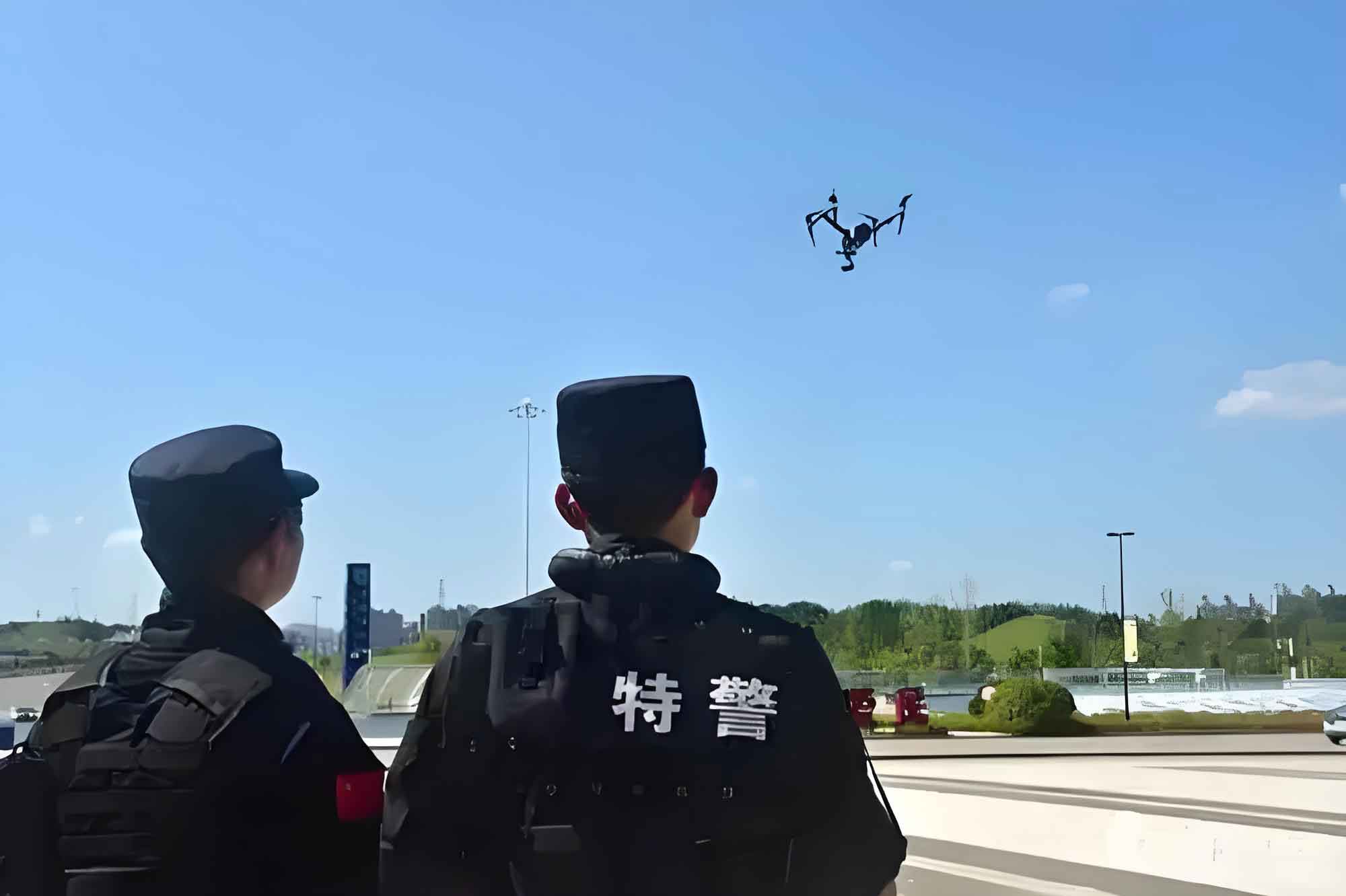
Currently, the legal basis for using police drones in counter-terrorism attacks in China is fragmented across multiple layers of legislation. According to my review, relevant laws include the “Counter-Terrorism Law” and the “People’s Police Law,” which grant authorities the power to use weapons and警械 in terrorist situations. However, these are supplemented by administrative regulations like the “Regulations on the Use of Police Implements and Weapons by the People’s Police” and normative documents such as the “Specifications for the Carrying and Use of Firearms by Public Security Police” and the “Operational Procedures for On-Site Suppression of Illegal and Criminal Acts by Public Security Police.” To illustrate this complexity, I have compiled a table summarizing the primary legal instruments:
| Legal Instrument | Type | Key Provisions Related to Police Drones |
|---|---|---|
| Counter-Terrorism Law | Law | Allows use of weapons against持枪支、刀具等凶器 or other dangerous methods in terrorist acts. |
| People’s Police Law | Law | Grants general authority to use警械 and weapons as needed. |
| Regulations on Use of Police Implements and Weapons | Administrative Regulation | Defines weapons as致命性警用器械 like firearms, and警械 as non-lethal tools; lists scenarios for use. |
| Specifications for Firearms Use | Normative Document | Details procedures for firearm deployment, including warnings and reporting. |
| Operational Procedures for On-Site Suppression | Normative Document | Provides guidelines for escalating force, but lacks specificity for police drones. |
From my perspective, this regulatory patchwork leads to inconsistencies. For instance, police drones are not explicitly mentioned in any law, creating ambiguity. When a police drone is equipped with lethal payloads, it may be classified as a weapon, yet existing rules for weapons primarily address firearms, leaving gaps for other lethal systems. This necessitates a focused analysis on the特殊ities of police drones in攻击 contexts.
Police drones possess unique characteristics that distinguish them from traditional警械 and weapons. Based on my research, I have identified three core特殊ities that impact legal规制: non-contact nature, limitations in audiovisual information, and特殊的攻击形态. To quantify these aspects, I propose a formula that represents the risk factor associated with police drone attacks:
$$ R = \frac{N \times L}{C} $$
Where \( R \) is the risk of误用 or误伤, \( N \) is the non-contact factor (ranging from 0 to 1, with 1 indicating complete detachment), \( L \) is the limitation in information accuracy (0 to 1, with 1表示 severe limitations), and \( C \) is the level of human control and confirmation (0 to 1, with 1 indicating high control). This formula highlights that as non-contact and limitations increase, risk escalates unless mitigated by human oversight. Let me elaborate on each特殊ity:
First, the non-contact nature of police drones means that operators are physically and emotionally detached from targets. This detachment can reduce psychological barriers to using force, akin to scenarios observed in military drone operations abroad. For example, studies on U.S. drone strikes have shown that non-contact engagement may contribute to higher civilian casualties. In my view, this underscores the need for stringent legal safeguards when deploying police drones.
Second, police drones suffer from limitations in audiovisual information. While they provide aerial perspectives, these views can be narrow or misleading, leading to misjudgments. For instance, a police drone might misinterpret children playing with toy guns as armed terrorists. I model this information gap using the following equation:
$$ I_{\text{effective}} = I_{\text{total}} \times (1 – \alpha) $$
Here, \( I_{\text{effective}} \) represents the useful information for decision-making, \( I_{\text{total}} \) is the total data collected by the police drone, and \( \alpha \) is the error rate due to perspective limitations (0 < α < 1). This implies that information overload and视角 constraints can diminish operational accuracy, necessitating complementary ground intelligence.
Third, the攻击形态 of police drones is特殊的 because they lack the progressive威慑 of human presence. Traditional police actions involve visible steps like verbal commands or drawing weapons, which may de-escalate situations. In contrast, a police drone can attack without such escalation, potentially depriving individuals of opportunities to surrender. I summarize this in a table comparing attack modalities:
| Aspect | Traditional Police Attack | Police Drone Attack |
|---|---|---|
| Contact Level | Direct physical and visual contact | Remote, non-contact operation |
| Information Source | Multi-sensory input from ground | Mostly visual/aerial data with limitations |
| Escalation Process | Gradual, with visible warnings | Potentially sudden, with reduced警告 cues |
| Psychological Impact | High empathy and situational awareness | Lower empathy, possible desensitization |
These特殊ities reveal that current laws are ill-equipped to regulate police drones effectively. In my analysis, I have identified several legal problems that must be addressed to ensure responsible use of police drones in counter-terrorism.
The first major issue is the unclear legal basis for police drones. As noted, no specific law governs their classification or use, leading to reliance on analogies to警械 and weapons. This creates uncertainty in procurement, training, and operational protocols. For example, police drone procurement varies across agencies without standardized guidelines, which I attribute to the absence of a unified legal framework. Furthermore, aviation regulations like the “Civil Aviation Law” exclude police drones from民用航空器 rules, leaving gaps in airspace management. From my perspective, this ambiguity hampers tactical innovation and increases legal risks for officers.
Second, the legal provisions for using警械 and weapons are scattered and inconsistent. The “Counter-Terrorism Law” and “People’s Police Law” offer broad principles, while detailed rules are found in lower-level regulations. This violates the legal reservation principle, as weapon use should be governed by law due to its impact on life and liberty. I have observed that实体要件 for weapon use, such as defining “凶器” or “other dangerous methods,” are vague, making it difficult for officers to assess threats accurately. Additionally, procedural rules for警械 are粗泛, lacking step-by-step guidance for escalation. To illustrate, consider the warning requirement: laws mandate warnings before using weapons, but do not specify methods for police drones, such as using onboard speakers or lights. This gap can lead to arbitrary enforcement.
Third, existing regulations fail to adapt to the特殊ities of police drones. For instance, warning procedures assume human presence, but police drones may need alternative methods. Similarly, rules for武器 focus on firearms, ignoring other lethal payloads that police drones might carry. I propose a formula to evaluate regulatory adequacy:
$$ A = \frac{S_{\text{covered}}}{S_{\text{total}}} $$
Where \( A \) is the adequacy score (0 to 1), \( S_{\text{covered}} \) is the number of police drone特殊ities addressed by laws, and \( S_{\text{total}} \) is the total特殊ities. Currently, \( A \) is low, indicating insufficient coverage. Moreover,配套法律规范 for police drone management, such as training standards and liability rules, are缺位, exacerbating risks.
To address these problems, I propose a comprehensive legal规制 framework based on principles tailored to police drones. From my standpoint, any use of police drones in counter-terrorism attacks should adhere to four core principles: legality and reasonableness, full warning, ground-guided confirmation, and exclusion of artificial intelligence control. Let me explain each in detail, using formulas where applicable.
The principle of legality and reasonableness requires that police drone attacks comply with laws and be proportional to the threat. This aligns with the proportionality principle in administrative law. I express this mathematically as:
$$ F_{\text{used}} \leq k \cdot T $$
Here, \( F_{\text{used}} \) represents the force applied by the police drone, \( T \) is the threat level posed by terrorists, and \( k \) is a proportionality constant (0 < k < 1) ensuring minimal necessary force. This ensures that police drones are deployed only when绝对必要, minimizing harm to rights.
Full warning principle mandates that police drones provide clear warnings before攻击. Given their non-contact nature, warnings should be multi-modal, including地面人员 shouts, drone-mounted audio alerts, and visual signals. I model warning effectiveness as:
$$ W_{\text{effectiveness}} = \sum_{i=1}^{n} w_i \cdot d_i $$
Where \( w_i \) is the weight of each warning method (e.g., verbal, visual), and \( d_i \) is its detectability to targets. This emphasizes that police drones must employ diverse警告手段 to ensure comprehension.
Ground-guided confirmation principle stipulates that police drone attacks require final approval from ground personnel. This mitigates information limitations and ensures human judgment. The decision process can be represented as:
$$ D_{\text{attack}} = \begin{cases}
1 & \text{if } G_{\text{confirm}} = 1 \text{ and } T_{\text{verified}} = 1 \\
0 & \text{otherwise}
\end{cases} $$
In this binary model, \( D_{\text{attack}} \) is the decision to attack (1 for yes, 0 for no), \( G_{\text{confirm}} \) indicates ground confirmation, and \( T_{\text{verified}} \)表示 threat verification by ground sources. This ensures that police drones do not operate autonomously.
Exclusion of AI control principle prohibits artificial intelligence from making攻击 decisions. Since AI lacks legal personhood and accountability, human officers must retain control. I frame this as a constraint:
$$ \text{AI}_{\text{role}} \in \{ \text{assist}, \text{monitor} \}, \quad \text{AI}_{\text{role}} \notin \{ \text{decide}, \text{execute} \} $$
This restricts AI to supportive functions, preserving human responsibility for police drone actions.
Based on these principles, I recommend完善法律依据 through legislative reforms. Specifically, I advocate for the enactment of a new law, such as the “People’s Police Use of警械 and Weapons Law,” which should explicitly address police drones. Key elements include defining police drones as警械 or weapons based on payloads, incorporating the above principles, simplifying实体要件 for weapon use, and enhancing procedural rules. For example, the law could state: “Police drones carrying lethal equipment shall be regulated as weapons, and their use must follow ground confirmation protocols.” To streamline实体要件, I propose a unified condition: weapons may be used when lives are imminently threatened or significant societal harm is impending, and lesser means are inadequate. This can be expressed as:
$$ \text{Use Weapon if: } \quad \exists \, \text{threat} \, | \, \text{threat} \geq \tau \land \text{alternatives} = \emptyset $$
Where \( \tau \) is a threshold threat level, and alternatives refer to non-lethal options. This reduces ambiguity for officers handling police drones.
Additionally, procedural improvements should establish a hierarchical force continuum, integrating police drones seamlessly. I suggest a table outlining escalation steps:
| Threat Level | Recommended Action | Police Drone Role |
|---|---|---|
| Low (e.g., verbal resistance) | Verbal commands, presence | Surveillance only |
| Medium (e.g., physical aggression) | Non-lethal警械 like tear gas | Deploy non-lethal payloads with warnings |
| High (e.g., armed attack) | Lethal weapons if necessary | Execute攻击 with ground confirmation |
This framework ensures that police drones are used proportionally, with clear thresholds.
Furthermore, I emphasize the need for a dedicated management regulation, such as the “Police Drone Use and Management Measures,” to be issued by the State Council. This should cover aspects like procurement standards, operator training, operational protocols, and liability mechanisms. For instance, training programs for police drone operators must include legal education and模拟 scenarios for counter-terrorism attacks. I propose a formula to assess training effectiveness:
$$ E_{\text{training}} = \frac{H_{\text{compliance}} \times S_{\text{skills}}}{T_{\text{duration}}} $$
Where \( E_{\text{training}} \) is effectiveness, \( H_{\text{compliance}} \) measures legal knowledge, \( S_{\text{skills}} \)表示 operational proficiency, and \( T_{\text{duration}} \) is training time. Higher scores indicate better preparedness for police drone deployments.
Regarding liability, the regulation should delineate administrative compensation and criminal responsibility for misuse of police drones. Officers who violate protocols may face sanctions based on harm caused. I summarize liability types in a table:
| Liability Type | Trigger | Potential Consequences |
|---|---|---|
| Administrative Compensation | Unlawful use causing damage | State compensation to victims |
| Administrative Sanctions | Negligence or minor violations | Warnings, demotions, or dismissal |
| Criminal Responsibility | Gross misconduct leading to death/injury | Charges like abuse of power or homicide |
This clarifies accountability, encouraging prudent use of police drones.
In conclusion, the integration of police drones into counter-terrorism attacks offers significant tactical benefits but demands robust legal规制. From my research, I find that current laws are inadequate due to the特殊ities of police drones, including non-contact operation, information limitations, and独特的攻击形态. To address this, I propose establishing core principles—legality and reasonableness, full warning, ground-guided confirmation, and AI exclusion—and enacting comprehensive legislation. By doing so, we can harness the potential of police drones while safeguarding human rights and法治. As terrorism evolves, continuous refinement of these frameworks will be essential. I hope this analysis contributes to ongoing discussions and inspires further research into the responsible use of police drones in public security.
Throughout this article, I have emphasized the importance of police drones in modern law enforcement, and I believe that with proper legal safeguards, they can become a cornerstone of effective counter-terrorism strategies. The journey toward optimal regulation requires collaborative efforts from lawmakers,执法 agencies, and scholars. As I continue to explore this field, I remain committed to advancing knowledge that balances innovation with ethical and legal standards for police drones.