
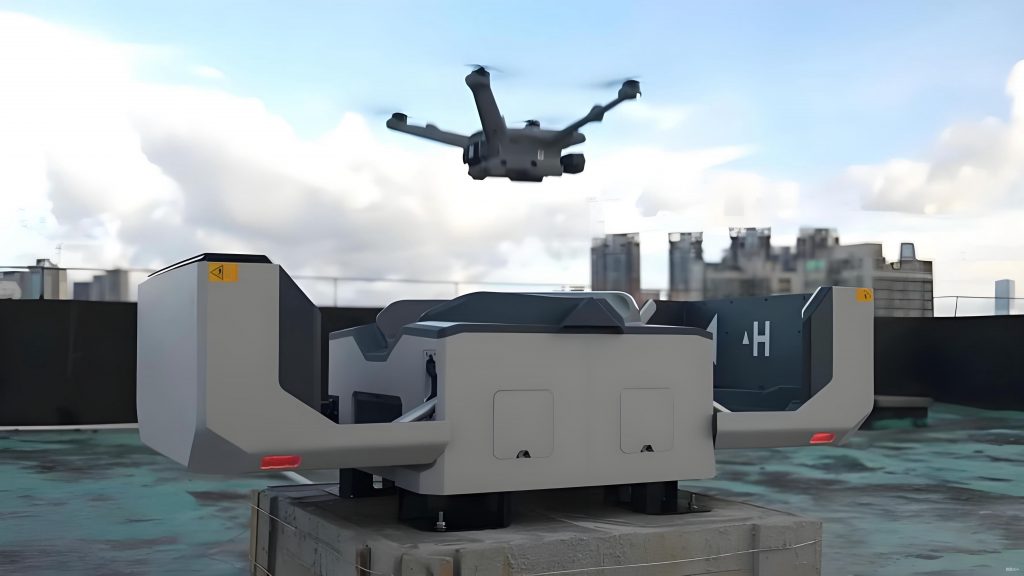
The integration of 5G technology with unmanned aerial vehicles (UAVs), or civilian drones, represents a pivotal force in the digital transformation and intelligent upgrading of modern industry. As a key component of the Industrial Internet of Things (IIoT), these advanced civilian drones offer unprecedented capabilities in areas such as precision agriculture, infrastructure inspection, logistics, and emergency response. However, the rapid proliferation and increasing sophistication of civilian drones bring significant legal and regulatory challenges that cannot be ignored. This paper examines two primary areas of concern: privacy infringement and associated data security risks, and illegal flight operations (“black flights”). By analyzing the current domestic legal landscape and comparing it with international regulatory approaches, this study aims to propose a comprehensive framework for the legal governance of civilian drones, ensuring their safe and sustainable integration into society.
1. Prevailing Risks in the Civilian Drone Ecosystem
The operational paradigm of civilian drones introduces unique vectors for risk, primarily centered on the erosion of personal privacy and the threat to public safety from unregulated flight.
1.1 Privacy Infringement and Data Security Challenges
The pervasive use of civilian drones, especially consumer-grade models equipped with high-resolution cameras and sensors, poses a substantial threat to individual privacy. These devices operate in residential areas, public spaces, and commercial zones, often collecting vast amounts of visual and spatial data.
1.1.1 Nature of the Privacy Risk
The privacy risk from civilian drones is characterized by its ease, breadth, and stealth. Unlike traditional surveillance, which is often ground-based and obvious, civilian drones can intrude upon private domains without the operator’s physical presence. The convergence with 5G networks amplifies this risk by enabling long-range, real-time control and data transmission with low latency. The core data security risks can be modeled by considering the data lifecycle vulnerability:
$$ \text{Total Risk} = \sum_{i=1}^{n} (P_{\text{capture}_i} \times V_{\text{sensitivity}_i} \times (1 – E_{\text{protection}_i})) $$
where \(P_{\text{capture}}\) is the probability of data capture by the drone, \(V_{\text{sensitivity}}\) is the sensitivity value of the captured data (e.g., personal identifiers, private activities), and \(E_{\text{protection}}\) is the effectiveness of technical/legal protections in place. The low \(E_{\text{protection}}\) for ad-hoc drone surveillance makes the overall risk significant.
1.1.2 Special Characteristics of Drone-Powered Privacy Infringement
Drone-based privacy violations possess distinct attributes that complicate legal redress:
- Effortless and Omni-directional Intrusion: Drones bypass traditional physical barriers, accessing vantage points previously available only with significant effort or expense.
- “Sensationless” Violation: Surveillance often occurs without the knowledge of the subject, creating a lag between the act and its discovery.
- Operator Anonymity (“Human-Machine Separation”): The physical dissociation between the pilot and the drone makes identifying the liable party exceptionally difficult, undermining accountability.
The transition of data from physical collection to digital dissemination further exacerbates the problem, creating a pipeline for potential large-scale data breaches and illegal use, directly contravening data confidentiality principles as outlined in data security laws.
1.2 The “Black Flight” Phenomenon
“Black flight” refers to the operation of civilian drones in violation of aviation regulations, including flights without required registration, pilot certification, or airspace authorization. These activities present grave dangers:
- Aviation Safety: Incursions into controlled airspace near airports pose a catastrophic collision risk with manned aircraft.
- Public Security: Unauthorized flights over critical infrastructure (power plants, government buildings) or large public gatherings can facilitate malicious acts or cause public panic.
- Nuissance and Trespass: Flights over private property without consent constitute a form of technological trespass.
The economic and safety cost of a single “black flight” incident near an airport, leading to ground stops and diversions, can be modeled as:
$$ C_{\text{incident}} = (N_{\text{cancellations}} \times C_{\text{cancel}}) + (N_{\text{delays}} \times T_{\text{delay}} \times C_{\text{delay/hr}}) + C_{\text{response}} + C_{\text{reputation}} $$
This highlights the multi-faceted impact of non-compliance.
2. Comparative Analysis of Legal Frameworks
Effective regulation of civilian drones requires robust legal structures. The approaches of China and the United States offer instructive contrasts.
2.1 Domestic (Chinese) Legal Landscape
China’s regulatory framework for civilian drones has evolved rapidly but remains fragmented, with a stronger focus on flight operations than on privacy.
Flight Safety Regulation: Key regulations include the “Interim Regulations on the Flight Management of Unmanned Aircraft” and rules on driver management. They establish a classification system (micro, light, small, etc.), registration requirements, no-fly zones, and pilot certification for certain categories. However, enforcement and real-time monitoring challenges persist.
Privacy and Data Protection: Specific laws addressing drone privacy are lacking. General principles from the Civil Code, Cybersecurity Law, and Personal Information Protection Law apply but are not tailored to the unique “sensationless” and aerial nature of drone infringement. Lower-level administrative provisions mention privacy but lack detailed definitions and penalties, creating an enforcement gap.
2.2 International Perspective: The U.S. Regulatory Approach
The United States employs a more layered approach involving both federal and state authorities.
Flight Safety Regulation: The Federal Aviation Administration (FAA) mandates registration for most civilian drones and operates the Part 107 rule for commercial operations, which includes aeronautical knowledge testing. The implementation of Remote ID rules acts as a digital license plate, enhancing traceability. Tools like the B4UFLY app provide clear airspace information to pilots.
Privacy Protection: While federal comprehensive drone privacy law is still debated, several states have enacted specific statutes. For example, Texas law prohibits using a drone to capture images of individuals or private property with the intent to conduct surveillance. The National Telecommunications and Information Administration (NTIA) developed a voluntary “Best Practices” guide for drone privacy, promoting transparency and data minimization.
| Aspect | China (Current Focus) | United States (Key Features) |
|---|---|---|
| Regulatory Authority | Civil Aviation Administration of China (CAAC) leading, with multi-agency involvement. | Federal Aviation Administration (FAA) for airspace; states for privacy/trespass. |
| Flight Management | Classification-based rules, registration, no-fly zones, pilot certification for certain classes. | FAA Part 107 for commercial use, mandatory registration, Remote ID, controlled airspace integration. |
| Privacy & Data Protection | General laws apply (Civil Code, PIPL). Lacks specific drone privacy statutes and clear enforcement mechanisms. | State-level drone privacy laws (e.g., TX, FL). Federal NTIA best practices. Integration with broader surveillance torts. |
| Enforcement & Technology | Challenges in monitoring and identifying “black flights” in real-time. | Emphasis on Remote ID for traceability, geofencing, and public awareness apps. |
3. Proposals for a Comprehensive Legal and Regulatory Framework
To mitigate the risks associated with civilian drones and foster responsible innovation, a multi-pronged strategy encompassing legal principles, regulatory architecture, and technological integration is essential.
3.1 Addressing Privacy Infringement and Data Governance
3.1.1 Establish Clear Legal Principles: Legislation should explicitly recognize privacy expectations in public spaces against highly intrusive, persistent, or targeted drone surveillance. Incorporating a “Reasonable Expectation of Privacy” test, adapted for the aerial context, would provide courts with a crucial standard. This test could consider factors like altitude, camera capability, duration of surveillance, and the nature of the location.
3.1.2 Enact Specialized Legislation: Amending the Civil Aviation Law to include a dedicated chapter on civilian drones is a necessary step. This should be complemented by specific drone operation regulations that articulate clear privacy rules, data handling obligations (collection limitation, purpose specification, security safeguards), and proportionate penalties. The legal liability model must address the “human-machine separation” issue, potentially imposing strict liability on the registered owner/operator for privacy violations originating from their device.
3.1.3 Integrate with Data Security Regimes: Data collected by civilian drones must fall under the purview of data security and personal information protection laws. A key principle for industrial drone applications should be “data minimization by design”:
$$ \text{Data Collection Legitimacy} = \begin{cases}
\text{True}, & \text{if } D_{\text{collected}} \subseteq D_{\text{operational\_necessity}} \\
\text{False}, & \text{otherwise}
\end{cases} $$
where \(D_{\text{collected}}\) is the set of all data points gathered and \(D_{\text{operational\_necessity}}\) is the minimal set required for the specified, legitimate purpose. Unrelated data, especially personal data, must not be collected or retained.
3.1.4 Clarify Regulatory Oversight and Promote Awareness: A lead agency must be designated with clear authority for privacy aspects of drone operations, coordinating with aviation, data security, and law enforcement bodies. Concurrently, public awareness campaigns are vital to educate both pilots on compliant, ethical use and citizens on their rights and recourse options.
3.2 Countering “Black Flights” and Ensuring Airspace Safety
3.2.1 Develop a Unified Regulatory and Monitoring System: A centralized, digital management system for civilian drones is crucial. This system should integrate:
- Mandatory UAS Traffic Management (UTM) Compliance: All but the smallest civilian drones should be required to connect to a UTM system for real-time identification, tracking, and dynamic airspace authorization.
- Enhanced Geofencing: Enforceable, digitally-updated geofences for sensitive areas (airports, military bases).
- Cross-Agency Data Sharing: Seamless information flow between aviation regulators, law enforcement, and national security agencies.
The effectiveness of such a system ( \(E_{\text{system}}\) ) in deterring “black flights” can be expressed as a function of coverage, reliability, and enforcement certainty:
$$ E_{\text{system}} = f(C_{\text{utm}}, R_{\text{id}}, P_{\text{detection}}, S_{\text{penalty}}) $$
where \(C_{\text{utm}}\) is UTM network coverage, \(R_{\text{id}}\) is Remote ID reliability, \(P_{\text{detection}}\) is the probability of detecting a non-compliant flight, and \(S_{\text{penalty}}\) is the severity of the imposed penalty.
3.2.2 Leverage 5G and Technology for Enforcement: 5G networks are not just an enabler for drone applications but also a cornerstone for their regulation. Key technological measures include:
| Technology | Regulatory Function | Impact |
|---|---|---|
| 5G Network Slicing | Dedicated, secure communication channel for UTM/Remote ID data. | Ensures reliable, low-latency tracking and command links, even in congested areas. |
| Remote ID (Network-Based) | Real-time broadcast of drone ID, location, and control station position via cellular network. | Solves operator anonymity; enables authorities and the public to identify drones. |
| UTM Integration | Cloud-based system for airspace management, flight planning, and dynamic deconfliction. | Provides a digital framework for authorized flights and automatically flags unauthorized ones. |
| Blockchain for Logging | Immutable record of registration, flight plans, and data access events. | Enhances auditability and non-repudiation for investigations and liability assignment. |
3.2.3 Harmonize and Strengthen Legal Penalties: Existing regulations need consolidation into a coherent legal hierarchy. Penalties for “black flights” must be escalated to provide meaningful deterrence, ranging from significant fines and equipment confiscation to criminal liability for operations that endanger national security or public safety.
4. Conclusion
The rise of 5G-enabled civilian drones signifies a transformative leap for the industrial internet and digital economy. However, their potential can only be fully realized within a trustworthy legal and regulatory environment. The dual challenges of privacy-data security and illegal flight operations demand a proactive, sophisticated response. This requires moving beyond fragmented rules towards a holistic legal framework that incorporates clear privacy principles, stringent but navigable flight safety regulations, and robust technical enforcement mechanisms powered by the very networks that enable advanced drone operations. By establishing such a framework, policymakers can safeguard fundamental rights and public safety while providing the stability and clarity needed for the responsible innovation and growth of the civilian drone industry.