
In recent years, the rapid advancement of the civil drone industry has unlocked numerous applications in logistics, urban public services, and emergency response. Large civil drones, defined by their maximum takeoff weight exceeding 150 kg, offer significant advantages in payload capacity, endurance, and range, positioning them as a focal point for future development. These civil drones are expected to play a crucial role in transforming various sectors, driven by their ability to operate in diverse environments. To clarify the innovation trajectory in this domain, we employ patent intelligence analysis to examine key technologies, including aircraft design, flight control systems, communication links, power systems, simulation, and ground control. By assessing patent application trends, technology branch distributions, and key applicants, we identify development hotspots and major branches, providing valuable insights for enhancing and innovating large civil drone technologies. This study leverages quantitative and qualitative methods to dissect global patent data, aiming to support strategic decision-making in the civil drone industry.
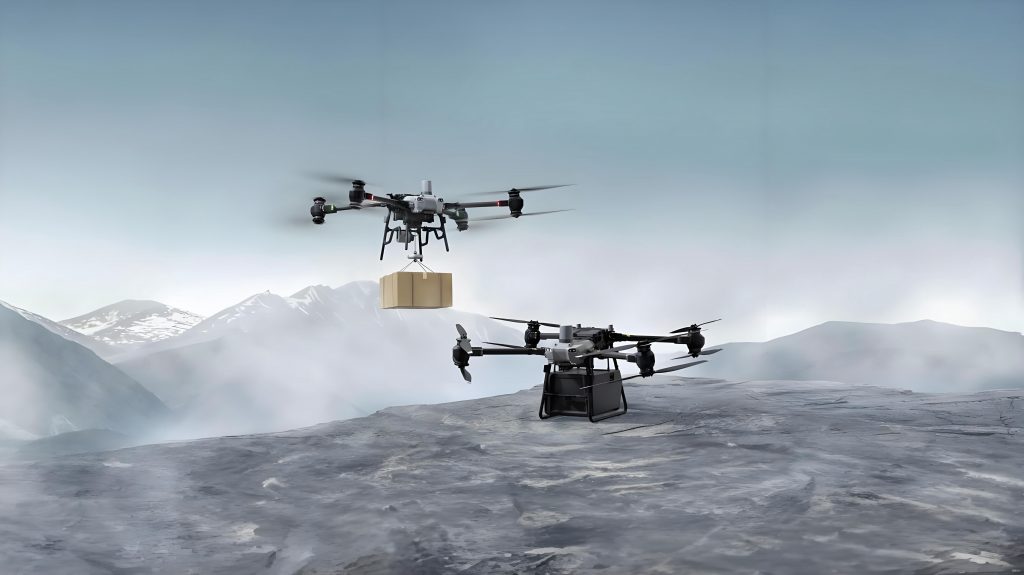
The methodology for this analysis involves retrieving patent data from global databases, focusing on keywords related to large civil drone technologies. After refining the search strategies and removing noise, we compiled a dataset of relevant patents up to a recent cutoff date. This approach allows us to track the evolution of civil drone innovations and highlight areas with high patent activity. In the following sections, we delve into each key technology area, presenting trends, distributions, and applicant insights through tables and mathematical models. The integration of formulas, such as those for control systems and communication efficiency, helps illustrate the technical foundations driving patent filings. As civil drones continue to evolve, understanding these patent landscapes is essential for fostering innovation and maintaining competitiveness in the global market for civil drone solutions.
Aircraft Design for Civil Drones
Aircraft design is a fundamental aspect of large civil drones, encompassing aerodynamic layouts and wing structures that influence performance and applicability. Patents in this area reveal a shift from traditional fixed-wing designs to more versatile configurations like tilt-rotor and compound-wing systems, which enable vertical takeoff and landing, reducing infrastructure requirements. The patent trend for civil drone aircraft design shows initial slow growth, with fewer than 20 applications annually until 2012, followed by a surge from 2013 to 2018 as interest in large civil drones intensified. Post-2018, applications have stabilized but remain above 40 per year, indicating sustained innovation. This pattern reflects the industry’s reliance on modifying existing manned or military aircraft, such as the AT200 or FH98 models, which limits hardware-specific patents but spurs advancements in adaptive designs for civil drone applications.
| Year Range | Annual Applications (Approx.) | Key Developments |
|---|---|---|
| 1990-2012 | <20 | Limited innovation, focus on fixed-wing civil drones |
| 2013-2018 | 20-60 | Rise of tilt-rotor and compound-wing civil drones |
| 2019-Present | >40 | Stable growth, emphasis on modular civil drone designs |
The distribution of branch technologies in civil drone aircraft design highlights three main categories: tilt-rotor, compound-wing, and other structures including fixed-wing. Tilt-rotor systems, exemplified by patents from companies like Bell Textron, allow for vertical takeoff and enhanced maneuverability, making them ideal for urban civil drone operations. Compound-wing designs offer a balance of simplicity and cost-effectiveness, as seen in prototypes like the JD.com VT1. These branches are becoming hotspots due to their ability to expand the operational scope of civil drones. The tilt-rotor segment, in particular, benefits from mechanical innovations, such as pivot mechanisms that integrate with power systems, which can be modeled using dynamics equations. For instance, the rotational motion of a tilt-rotor civil drone can be described by:
$$ \tau = I \alpha $$
where \( \tau \) is the torque, \( I \) is the moment of inertia, and \( \alpha \) is the angular acceleration. This formula underscores the importance of structural patents in optimizing performance for civil drones. Additionally, other aspects like landing gear and steering mechanisms contribute to the patent landscape, though they are less prominent. As civil drone technology progresses, we anticipate further diversification in aircraft design, driven by demands for efficiency and adaptability in various civil applications.
Flight Control Systems in Civil Drones
Flight control systems are the core of large civil drones, enabling stable, autonomous, or semi-autonomous operations through hardware and control methods. These systems include components like autopilots and redundancy management, as well as algorithms for trajectory planning, obstacle avoidance, and attitude control. The patent trend for civil drone flight control shows consistent growth, with a notable increase after 2001 and another surge post-2015, reflecting advancements in computational methods and sensor technologies. Control methods dominate the patent filings, indicating a shift toward software-driven innovations for civil drones, while hardware patents remain relatively stable due to the high barriers of entry and reliance on established aerospace suppliers.
| Technology Branch | Percentage of Patents (%) | Description |
|---|---|---|
| Trajectory Planning & Control | 30 | Includes navigation and path optimization for civil drones |
| Obstacle Avoidance | 20 | Uses sensors and AI for autonomous evasion in civil drones |
| Attitude Control | 15 | Maintains stability and orientation of civil drones |
| Takeoff and Landing Control | 10 | Focuses on automated procedures for civil drones |
| Redundancy Management | 10 | Ensures reliability through backup systems in civil drones |
| Other (e.g., Fault Detection) | 15 | Covers emergency handling and parameter monitoring for civil drones |
In trajectory planning for civil drones, algorithms often integrate satellite positioning with inertial navigation, combining long-term stability with short-term accuracy. This can be expressed using a fusion model:
$$ \mathbf{x}_{k} = \mathbf{F}_{k} \mathbf{x}_{k-1} + \mathbf{B}_{k} \mathbf{u}_{k} + \mathbf{w}_{k} $$
where \( \mathbf{x}_{k} \) is the state vector (e.g., position and velocity of the civil drone), \( \mathbf{F}_{k} \) is the state transition matrix, \( \mathbf{B}_{k} \) is the control input matrix, \( \mathbf{u}_{k} \) is the control vector, and \( \mathbf{w}_{k} \) is the process noise. Obstacle avoidance in civil drones increasingly employs machine learning techniques, such as reinforcement learning, which can be modeled as a reward maximization problem:
$$ R = \sum_{t=0}^{\infty} \gamma^{t} r_{t} $$
where \( R \) is the cumulative reward, \( \gamma \) is the discount factor, and \( r_{t} \) is the reward at time \( t \), guiding the civil drone to avoid obstacles efficiently. Patent applicants in this area include major aerospace firms like Boeing and Airbus, as well as academic institutions, highlighting the global competition in civil drone innovation. As civil drones become more autonomous, we expect further integration of AI and real-time data processing in flight control patents.
Communication Links for Civil Drones
Communication links are vital for large civil drones, facilitating data exchange and control between the drone and ground systems. Patents in this domain have seen fluctuating growth, with a gradual increase after 2011 as technologies like satellite communication and 5G gained prominence. The branch distribution shows that beyond-visual-line-of-sight (BVLOS) methods, such as satellite links, dominate due to their ability to support long-range operations of civil drones, while visual-line-of-sight (VLOS) and 5G are emerging for low-altitude applications. This evolution addresses the unique needs of civil drones, which often operate in remote or urban areas requiring reliable connectivity.
| Technology | Patent Share (%) | Applications in Civil Drones |
|---|---|---|
| Satellite Communication | 40 | Enables global coverage for civil drones in high-altitude missions |
| VLOS and 5G | 35 | Supports urban and short-range civil drone operations |
| Other (e.g., Hybrid Systems) | 25 | Includes adaptive protocols for civil drone networks |
The efficiency of communication links for civil drones can be analyzed using channel capacity formulas, such as the Shannon-Hartley theorem:
$$ C = B \log_2 \left(1 + \frac{S}{N}\right) $$
where \( C \) is the channel capacity in bits per second, \( B \) is the bandwidth, \( S \) is the signal power, and \( N \) is the noise power. This equation highlights the importance of patent innovations in enhancing data rates and reliability for civil drones. Additionally, latency reduction techniques are critical for real-time control of civil drones, often modeled with queuing theory:
$$ L = \frac{\lambda}{\mu – \lambda} $$
where \( L \) is the average number of packets in the system, \( \lambda \) is the arrival rate, and \( \mu \) is the service rate, emphasizing the need for optimized protocols in civil drone communications. Key patent applicants include telecommunications companies and research institutes, though the overall numbers are modest, suggesting room for growth in civil drone-specific communication technologies. As civil drones expand into areas like delivery and surveillance, we anticipate increased patent activity in secure and low-latency links.
Power Systems in Civil Drones
Power systems for large civil drones have evolved from adaptations of manned aircraft engines to specialized designs, with patents focusing on fuel engines, hybrid systems, and electric propulsion. The patent trend shows limited activity until 2008, after which applications gradually increased, averaging around 10 per year, as the unique demands of civil drones spurred innovations in efficiency and sustainability. Fuel engines remain the most patented technology due to their suitability for long-endurance civil drones, while hybrid and electric systems gain traction for their environmental benefits and operational flexibility.
| Power Type | Patent Percentage (%) | Advantages for Civil Drones |
|---|---|---|
| Fuel Engines | 50 | High power output for long-range civil drone missions |
| Hybrid Systems | 25 | Balances efficiency and emissions in civil drones |
| Electric Motors | 15 | Quiet operation for urban civil drone applications |
| Other (e.g., Propellers) | 10 | Includes mechanical innovations for civil drone propulsion |
In hybrid power systems for civil drones, the integration of fuel and electric components can be modeled using energy efficiency equations:
$$ \eta = \frac{P_{\text{output}}}{P_{\text{input}}} $$
where \( \eta \) is the efficiency, \( P_{\text{output}} \) is the useful power output, and \( P_{\text{input}} \) is the total power input. This formula underscores patent efforts to maximize the performance of civil drones. For propeller-based systems, aerodynamic principles apply, such as the thrust equation:
$$ T = \dot{m} \Delta v $$
where \( T \) is thrust, \( \dot{m} \) is the mass flow rate, and \( \Delta v \) is the change in velocity, relevant to patents on variable-pitch propellers for civil drones. Applicants include a mix of international corporations and local firms, with Bell Textron leading in tilt-rotor integrations. As sustainability becomes a priority, we expect more patents in alternative energy sources for civil drones, such as hydrogen fuel cells, to reduce the environmental impact of civil drone operations.
Simulation and Testing for Civil Drones
Simulation technologies for large civil drones encompass flight emulation, communication testing, and system validation, playing a crucial role in reducing development costs and enhancing safety. Patents in this area have grown steadily, driven by the need for realistic training environments and performance assessments for civil drones. The branch distribution is dominated by flight simulation, which replicates electromagnetic environments and payload scenarios, followed by communication simulation and testing protocols that ensure reliability in civil drone operations.
| Simulation Type | Patent Share (%) | Role in Civil Drone Development |
|---|---|---|
| Flight Simulation | 60 | Trains operators and tests civil drone behavior under various conditions |
| Communication Simulation | 20 | Validates link reliability for civil drones in noisy environments |
| Testing and Validation | 20 | Ensures compliance and safety standards for civil drones |
Mathematical models in simulation often involve differential equations to mimic civil drone dynamics. For example, the motion of a civil drone in a simulated environment can be represented as:
$$ \frac{d\mathbf{v}}{dt} = \mathbf{g} + \frac{1}{m} \mathbf{F}_{\text{aero}} $$
where \( \mathbf{v} \) is the velocity vector, \( \mathbf{g} \) is gravity, \( m \) is mass, and \( \mathbf{F}_{\text{aero}} \) is the aerodynamic force. This approach allows for precise testing of civil drone responses. Additionally, Monte Carlo methods are used in simulation patents to assess uncertainty in civil drone operations:
$$ P_{\text{failure}} = \frac{1}{N} \sum_{i=1}^{N} I_{\text{failure}}(i) $$
where \( P_{\text{failure}} \) is the probability of failure, \( N \) is the number of trials, and \( I_{\text{failure}} \) is an indicator function, highlighting risk management in civil drone patents. Most applicants are academic and research institutions, indicating a focus on foundational innovations for civil drones. As civil drones become more complex, we anticipate increased patent activity in real-time simulation and digital twins to optimize performance.
Ground Control Systems for Civil Drones
Ground control systems are essential for monitoring and directing large civil drones during missions, involving interfaces, data processing, and multi-drone management. Patents in this field cover a wide range of technologies, with remote control, human-machine interfaces, and universal platforms being the most prominent. These innovations aim to improve the usability and efficiency of civil drone operations, particularly in scenarios requiring coordination with air traffic management.
| Technology | Patent Percentage (%) | Function in Civil Drone Operations |
|---|---|---|
| Remote Control | 25 | Enables real-time command of civil drones from ground stations |
| Human-Machine Interface | 20 | Simplifies operator interaction with civil drone systems |
| Universal Platforms | 15 | Allows interoperability across different civil drone models |
| Data Processing | 15 | Handles large datasets from civil drone sensors |
| Other (e.g., Multi-Drone Mgmt) | 25 | Coordinates fleets of civil drones for complex tasks |
Control theory formulas are often applied in ground system patents for civil drones, such as PID controllers for stability:
$$ u(t) = K_p e(t) + K_i \int_0^t e(\tau) d\tau + K_d \frac{de(t)}{dt} $$
where \( u(t) \) is the control output, \( e(t) \) is the error signal, and \( K_p \), \( K_i \), and \( K_d \) are gains tuned for civil drone performance. For data processing, algorithms like Fast Fourier Transforms (FFT) are used to analyze signals from civil drones:
$$ X(k) = \sum_{n=0}^{N-1} x(n) e^{-j 2\pi k n / N} $$
where \( X(k) \) is the frequency domain representation, and \( x(n) \) is the time domain signal, aiding in patent innovations for efficient civil drone monitoring. As civil drones scale up in applications, ground control patents will likely focus on automation and AI-driven management to handle increased complexity.
Conclusion
This analysis of patent landscapes for large civil drones reveals significant trends and hotspots across key technologies. In aircraft design, tilt-rotor and compound-wing systems are emerging as innovative areas, while flight control systems dominate with advancements in trajectory planning and obstacle avoidance. Communication links are evolving toward satellite and 5G integrations, and power systems show a shift toward hybrid solutions. Simulation and ground control technologies are gaining traction, driven by the need for safety and efficiency in civil drone operations. Overall, the patent data underscores the dynamic nature of civil drone innovation, with opportunities for further growth in AI, sustainability, and interoperability. By leveraging these insights, stakeholders can prioritize research and development to enhance the capabilities and adoption of civil drones in various sectors, ultimately contributing to the advancement of the global civil drone industry.