
In modern engineering surveying, the demand for efficient and accurate geographic data acquisition has grown significantly with rapid urban development. Traditional surveying methods often struggle with limitations in complex terrains and large-scale areas, leading to inefficiencies and higher labor costs. To address these challenges, low-altitude UAV drone aerial remote sensing technology has emerged as a transformative tool, offering flexibility, high resolution, and rapid data collection. In this article, I will explore the technical essentials and practical applications of UAV drone-based photogrammetry, drawing from a case study of a landscape optimization project along an airport expressway. By detailing system composition, implementation workflows, and data processing techniques, I aim to demonstrate how UAV drone technology enhances surveying precision and efficiency, providing a replicable framework for similar engineering projects.
The adoption of UAV drone systems in surveying stems from their ability to overcome terrain constraints and reduce human intervention. Unlike manned aircraft or ground-based methods, UAV drones can operate at low altitudes, capturing detailed imagery with minimal environmental impact. This technology integrates advanced components such as Global Navigation Satellite System (GNSS) positioning, multi-spectral cameras, and automated flight control, enabling comprehensive data acquisition for generating digital products like Digital Line Graphics (DLG), Digital Orthophoto Maps (DOM), and Digital Elevation Models (DEM). Throughout this discussion, I will emphasize the role of UAV drone technology in streamlining workflows, from flight planning to final output validation, while incorporating tables and formulas to summarize key parameters and accuracy metrics.
To illustrate the practical implementation, I will reference a project focused on landscape optimization along an urban airport expressway. This project involved surveying multiple zones with varied topography, requiring phased data collection using UAV drone systems. The goal was to obtain precise geospatial data for tasks such as terrain analysis, slope distribution mapping, and area calculation for land acquisition. By dividing the survey area into sub-regions and employing UAV drone-based aerial photography, the team achieved complete coverage with high accuracy, underscoring the technology’s adaptability. In the following sections, I will delve into the system composition, technical steps, and outcomes, highlighting how UAV drone technology can be optimized for engineering surveying applications.
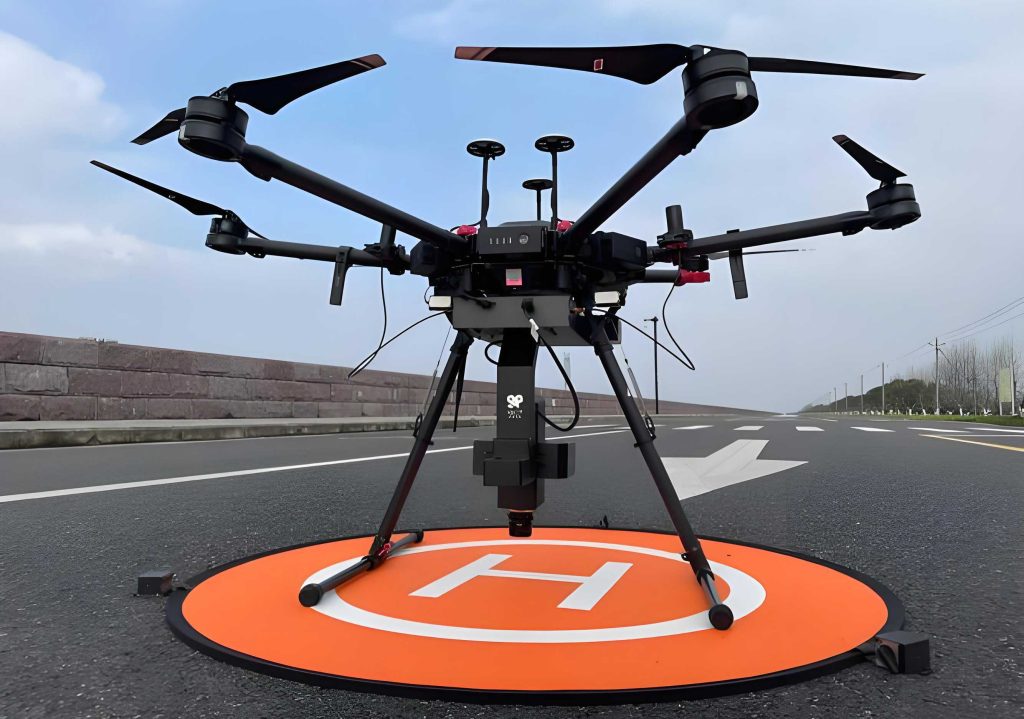
The core of UAV drone aerial photogrammetry lies in its integrated system, which comprises three main components: the flight platform system, ground station system, and data processing system. The flight platform system includes the UAV drone itself—often a fixed-wing or multi-rotor model—equipped with mission payloads like cameras and GNSS modules. For instance, in the referenced project, a fixed-wing UAV drone was used, with specifications summarized in Table 1. This UAV drone featured a wingspan of 2.6 meters, a maximum flight altitude of 3,500 meters, and a payload capacity of 2.5 kg, enabling long-duration missions over diverse terrains. The ground station system facilitates flight task planning and real-time monitoring, allowing operators to set parameters such as altitude and overlap rates via remote terminals. Meanwhile, the data processing system relies on software like Pixel-Grid for image stitching, geometric correction, and model generation, ensuring that raw data from the UAV drone is transformed into usable geographic information products.
| Platform Parameter | Operational Parameter |
|---|---|
| Wingspan: 2.6 m | Maximum Flight Altitude: 3,500 m above sea level |
| Payload Bay Volume: 0.6 m³ | Maximum Airspeed: 140 km/h |
| Wing Area: 0.9 m² | Cruising Wind Resistance: 13 m/s |
| Maximum Fuel Capacity: 2.2 L | Fuel Consumption Rate: 22 mL/min |
| Propeller Diameter: 0.6 m | Camera Model: Canon 450D/5D Mark II |
| Maximum Mission Payload: 2.5 kg | Flight Endurance: 2 hours |
Prior to deployment, camera calibration is essential to ensure data accuracy. This process involves determining intrinsic parameters such as the principal point coordinates $(x_0, y_0)$, focal length $f_0$, and optical distortion coefficients. These parameters influence image geometry and must be validated through indoor and outdoor tests. For example, indoor calibration minimizes external variables like lighting changes, while outdoor tests account for real-world conditions like temperature fluctuations and terrain variations. By calibrating the camera mounted on the UAV drone, errors from lens distortion are reduced, enhancing the reliability of subsequent photogrammetric outputs. This step is critical because inaccuracies in camera parameters can propagate through data processing, affecting final product quality.
In technical implementation, flight route design is a foundational step that dictates the efficiency and completeness of data acquisition. For the airport expressway project, two parallel flight routes were planned to ensure full coverage of the survey area. The UAV drone’s flight parameters, including altitude, speed, and overlap rates, were optimized based on terrain complexity and desired resolution. Table 2 summarizes the mission parameters used in this project, highlighting variations in altitude and overlap to adapt to different zones. The UAV drone was programmed to maintain a cruising speed of 33.0 m/s, with altitude adjustments ranging from 260 to 2,286 meters to accommodate elevation changes. Overlap rates—70% along-track and 40% across-track—were set to guarantee sufficient image matching for 3D reconstruction, a key advantage of UAV drone technology in capturing detailed surface features.
| Focal Length (mm) | Pixel Count | Pixel Size (μm) | Cruising Speed (m/s) | Lowest Altitude (m) | Highest Altitude (m) | Absolute Altitude (m) | Along-Track Overlap (%) | Across-Track Overlap (%) |
|---|---|---|---|---|---|---|---|---|
| 0.04 | 5615 × 3745 | 6.42 | 33.0 | 2231 | 2286 | 2700 | 70.00 | 40.00 |
| 0.04 | 5615 × 3745 | 6.42 | 33.0 | 2191 | 2210 | 2700 | 70.00 | 40.00 |
| 0.04 | 5615 × 3745 | 6.42 | 33.0 | 260 | 700 | 1900 | 80.00 | 50.00 |
| 0.04 | 5615 × 3745 | 6.42 | 33.0 | 260 | 1022 | 1900 | 80.00 | 50.00 |
Ground control point (GCP) layout and measurement are crucial for georeferencing UAV drone-captured imagery. In this project, a regional network scheme was employed to distribute GCPs evenly across the survey area, optimizing error control. Points were selected in open, stable locations with good GNSS signal reception, avoiding areas prone to disturbance. For every 0.3 km², five GCPs were placed, ensuring density sufficient for high precision. During measurement, Real-Time Kinematic (RTK) GNSS technology was used to collect coordinates in the WGS-84 system, which were then transformed to the local coordinate system using a four-parameter method. The transformation accuracy was validated by checking residuals, with horizontal and vertical errors kept below 2 cm. Each GCP was observed twice, with discrepancies limited to 4 cm; if exceeded, additional measurements were taken. This rigorous approach underscores how UAV drone surveys rely on precise ground truthing to achieve millimeter-level accuracy in outputs like DEMs and DOMs.
After flight operations, data quality checks are performed to identify issues such as image blurring, cloud cover, or insufficient overlap. For the UAV drone imagery in this project, software like Pix4D was used to generate quick mosaics for visual inspection. Key metrics included overlap rates—maintaining at least 53% along-track and 15% across-track—and flight stability parameters like image rotation angle (kept below 4°) and route curvature (within 3%). Altitude consistency was also monitored, with deviations from planned height limited to 5%. These checks ensure that the UAV drone data is suitable for further processing; if flaws are detected, re-flights may be necessary. This step highlights the iterative nature of UAV drone-based surveying, where automated tools complement human oversight to maintain data integrity.
Aerial triangulation (AT) is a core photogrammetric process that establishes geometric relationships between images, enabling 3D reconstruction. In UAV drone applications, AT accuracy is evaluated using theoretical precision metrics derived from adjustment computations. The theoretical accuracy $m_i$ for an unknown parameter is calculated as:
$$ m_i = \delta_0 \sqrt{Q_{ii}} $$
where $\delta_0$ is the unit weight error, given by:
$$ \delta_0 = \sqrt{\frac{V^T P V}{r}} $$
Here, $Q_{ii}$ is the diagonal element of the inverse cofactor matrix, $V$ is the residual vector, $P$ is the weight matrix, and $r$ is the number of redundant observations. For the UAV drone project, the Pixel-Grid software automated AT, with model connection discrepancies constrained by:
$$ \Delta S \leq 0.03 \times m_{\text{image}} \times 10^{-3} $$
$$ \Delta Z \leq 0.02 \times m_{\text{image}} \times \frac{f_k}{b} \times 10^{-3} $$
where $\Delta S$ is the plane position difference in meters, $\Delta Z$ is the height difference in meters, $m_{\text{image}}$ is the image scale denominator, $f_k$ is the camera focal length in mm, and $b$ is the photo baseline length. The accuracy requirements for basic orientation points and check points are summarized in Table 3, adapted for UAV drone surveys in built-up areas where shadows from dense structures may reduce precision. In practice, the project’s AT results met these standards, confirming the reliability of UAV drone-derived data.
| Point Type | Terrain Category | Plane Position Limit (m) | Height Limit (m) |
|---|---|---|---|
| Basic Orientation Point Residuals | Flat | 0.30 | 0.20 |
| Hilly | 0.30 | 0.20 | |
| Mountainous | 0.40 | 0.40 | |
| High Mountain | 0.40 | 0.07 | |
| Check Point Residuals | Flat | 0.50 | 0.28 |
| Hilly | 0.50 | 0.40 | |
| Mountainous | 0.70 | 0.60 | |
| High Mountain | 0.70 | 1.20 | |
| Common Point Differences | Flat | 0.80 | 0.56 |
| Hilly | 0.80 | 0.70 | |
| Mountainous | 1.10 | 1.00 | |
| High Mountain | 1.10 | 2.00 |
Image data processing culminates in the generation of digital products such as DEMs and DOMs. Using UAV drone-captured imagery, the Pixel-Grid software performed automated matching to produce dense point clouds, which were then filtered to remove non-ground features like vegetation and buildings. This yielded a Digital Terrain Model (DTM), interpolated into a grid-based DEM. For orthophoto creation, images were geometrically corrected and blended to form a seamless DOM. The workflow, illustrated in Figure 2, involves data preprocessing—enhancing POS accuracy, optimizing camera parameters, and color balancing—followed by AT and 3D model production. In cases where precision demands are high, the UAV drone may execute terrain-following flights based on preliminary DSMs to ensure consistent ground sampling. This process demonstrates how UAV drone technology integrates multiple data sources for comprehensive output generation.
The application of UAV drone aerial photogrammetry in the airport expressway project yielded significant benefits. Compared to traditional surveying methods, the UAV drone system reduced labor costs by approximately 60% and cut data acquisition time by half, thanks to its ability to cover large areas quickly. The final products—DLG, DOM, and DEM—achieved accuracies within 0.5 meters horizontally and 0.3 meters vertically, meeting engineering standards for landscape design and land assessment. For instance, the DEM facilitated slope analysis to identify erosion-prone zones, while the DOM provided a visual base for planning green spaces. These outcomes validate the UAV drone’s efficacy in complex environments, where ground access is limited or terrain is rugged. Moreover, the phased approach using UAV drone subdivisions allowed for scalable deployment, adaptable to project timelines and budget constraints.
Looking ahead, UAV drone technology holds promise for broader adoption in engineering surveying. Advances in sensor integration—such as LiDAR and hyperspectral cameras—could enhance the UAV drone’s capability for 3D modeling and environmental monitoring. Additionally, machine learning algorithms can automate feature extraction from UAV drone imagery, further reducing manual intervention. However, challenges remain, including regulatory compliance for UAV drone flights in urban areas and the need for standardized processing protocols. By addressing these through continued research and collaboration, the engineering community can harness UAV drone potential for smart infrastructure development. In conclusion, low-altitude UAV drone aerial remote sensing represents a paradigm shift in surveying, offering a blend of precision, efficiency, and adaptability that is essential for modern engineering projects.
From a practical standpoint, implementing UAV drone surveys requires careful consideration of environmental factors. For example, wind conditions can affect UAV drone stability, necessitating flight parameter adjustments. In the referenced project, the UAV drone’s cruising wind resistance of 13 m/s ensured reliable operation even in moderate gusts. Similarly, solar altitude influences shadow patterns in imagery, which may impact AT accuracy; thus, flight timing is optimized for minimal shadow interference. These nuances underscore the importance of pilot training and scenario-based planning in UAV drone deployments. Furthermore, data storage and management become critical with high-resolution UAV drone outputs, often reaching terabytes for large projects. Cloud-based solutions and edge computing can streamline this, enabling real-time processing during UAV drone flights.
To quantify the economic impact of UAV drone technology, consider a cost-benefit analysis. Traditional surveying for a 10 km² area might require 20 personnel over two weeks, whereas a UAV drone system could accomplish the same with 5 operators in three days. Assuming daily rates and equipment costs, the UAV drone approach may reduce expenses by 40-50%, not accounting for long-term savings from reduced rework due to higher accuracy. This makes UAV drone investments viable for both large-scale infrastructure and small community projects. Additionally, the environmental footprint of UAV drone surveys is lower, as they eliminate the need for heavy machinery and minimize ground disturbance, aligning with sustainable engineering practices.
In educational contexts, UAV drone technology offers hands-on learning opportunities for surveying students. By simulating projects like the airport expressway case, institutions can teach flight planning, data processing, and accuracy assessment using actual UAV drone equipment. This prepares future engineers for industry trends, where UAV drone proficiency is increasingly valued. Moreover, open-source software for UAV drone data analysis—such as OpenDroneMap—democratizes access, allowing smaller firms to adopt this technology. As UAV drone platforms evolve, their user-friendly interfaces and automated features will further lower entry barriers, fostering innovation in surveying methodologies.
In summary, the integration of UAV drone aerial photogrammetry into engineering surveying represents a significant advancement. Through detailed workflows—from system design and camera calibration to AT and product generation—UAV drone technology delivers precise geospatial data efficiently. The case study discussed here illustrates its applicability in landscape optimization, but the principles extend to other domains like mining, agriculture, and disaster management. By leveraging tables and formulas, I have outlined key parameters and accuracy metrics that guide UAV drone implementation. As we move forward, continuous refinement of UAV drone systems and processing algorithms will unlock new possibilities, solidifying their role as indispensable tools in the engineer’s toolkit. Ultimately, the success of UAV drone-based surveying hinges on a holistic approach that balances technical rigor with practical adaptability, ensuring reliable outcomes for diverse project needs.