
The advancement and adoption of agricultural UAV technology for crop protection has introduced a paradigm shift in modern farming practices. The core advantage of using an agricultural UAV lies in its ability to perform rapid, low-volume spraying over difficult terrain, potentially increasing operational efficiency and reducing the exposure of personnel to chemicals. However, this application method inherently faces a significant challenge: spray droplet drift. Drift refers to the movement of spray droplets away from the intended target zone, which leads to reduced efficacy, economic loss, and potential environmental contamination affecting neighboring crops, water bodies, and ecosystems.
Among the various environmental factors influencing drift, crosswind is arguably the most critical and uncontrollable variable during field operations. The interaction between the airflow generated by the agricultural UAV‘s rotors, the aerodynamic wake of the aircraft itself, and the ambient crosswind creates a highly complex flow field that governs droplet trajectory. Smaller droplets, which are often desirable for good canopy penetration and coverage in agricultural UAV applications, are particularly susceptible to being carried off-target by even mild breezes. Therefore, a profound understanding of how crosswind speed modulates the deposition and drift characteristics of common spray nozzles is essential for optimizing application parameters, developing drift mitigation technologies, and formulating responsible operational guidelines for agricultural UAV pilots.
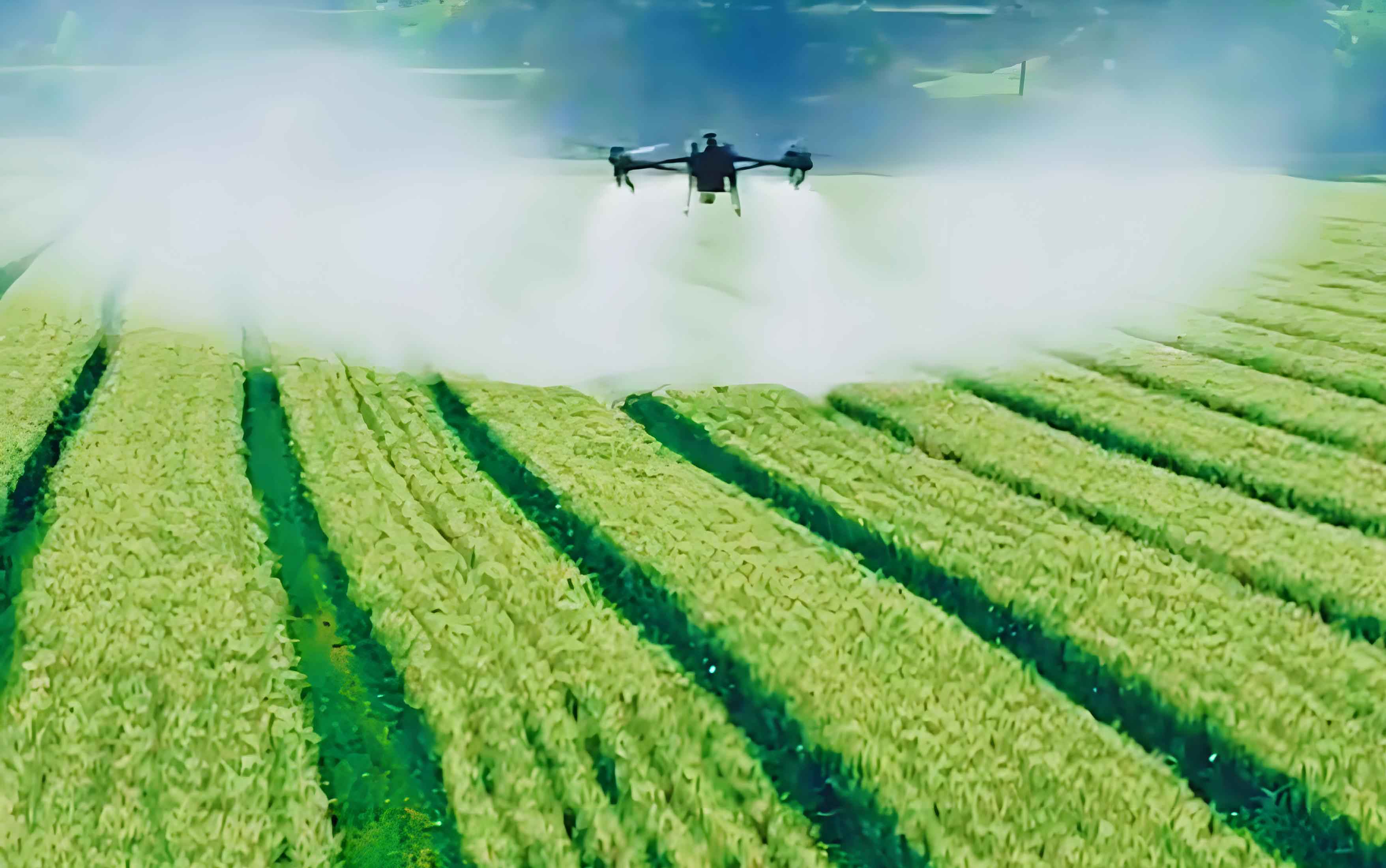
Traditionally, field trials have been used to assess spray performance, but they suffer from poor repeatability due to unpredictable meteorological conditions. In this investigation, I employ a more controlled and synergistic approach by integrating Computational Fluid Dynamics (CFD) simulation with physical wind tunnel experimentation. This methodology allows for a detailed, visualizable analysis of droplet flow fields under precisely defined crosswind conditions, followed by empirical validation. The primary objective is to quantify and characterize the influence of increasing lateral wind speeds on the droplet deposition pattern and drift potential from a standard flat-fan nozzle, a type frequently mounted on agricultural UAV boom systems. The insights gained are intended to provide a reliable data foundation and theoretical guidance for enhancing the precision and reducing the environmental footprint of spraying operations conducted by agricultural UAV.
Numerical Methodology: Computational Fluid Dynamics Simulation
To model the intricate process of droplet dispersion in a crosswind, I developed a three-dimensional, transient computational model based on the Eulerian-Lagrangian framework. This approach treats the air (continuous phase) as a Eulerian field and tracks individual spray droplets (discrete phase) as Lagrangian particles moving through that field.
Geometry, Mesh, and Boundary Conditions
The computational domain was designed to represent a section of a wind tunnel, measuring 20 m in length (X: -2.5 m to 17.5 m), with a width expanding from 2.0 m at the inlet to 2.2 m at the outlet (Z: -1.1 m to 1.1 m), and a height of 1.1 m (Y: 0 m to 1.1 m). A flat-fan nozzle was positioned at the coordinate origin (0, 0, 0.6 m), orientated vertically downward. The domain was discretized into approximately 300,000 high-quality tetrahedral cells, ensuring sufficient resolution to capture critical flow features. The boundary conditions were specified as follows: the upstream face (X = -2.5 m) was a velocity inlet where crosswind speeds ($v_{wind}$) of 0, 1, 2, 3, 4, 5, and 6 m/s were prescribed; the downstream face (X = 17.5 m) was a pressure outlet; all other surfaces, including the ground, were treated as no-slip walls.
Mathematical Modeling Framework
The continuous phase airflow, assumed to be incompressible and turbulent, was solved using the Reynolds-Averaged Navier-Stokes (RANS) equations with the standard k-ε turbulence model for its robustness and computational efficiency. The governing equations for continuity and momentum are:
Continuity: $$ \frac{\partial \rho}{\partial t} + \nabla \cdot (\rho \vec{u}) = 0 $$
Momentum: $$ \frac{\partial}{\partial t} (\rho \vec{u}) + \nabla \cdot (\rho \vec{u} \vec{u}) = -\nabla p + \nabla \cdot (\bar{\bar{\tau}}) + \rho \vec{g} $$
where $\rho$ is air density, $\vec{u}$ is the velocity vector, $p$ is pressure, $\bar{\bar{\tau}}$ is the stress tensor, and $\vec{g}$ is gravity.
The discrete phase droplet trajectories were predicted by integrating the force balance equation on each particle, which accounts for drag and gravitational forces. The equation of motion for a droplet is:
$$ \frac{d\vec{u}_p}{dt} = \frac{18\mu}{\rho_p d_p^2} \frac{C_D Re}{24} (\vec{u} – \vec{u}_p) + \frac{\vec{g}(\rho_p – \rho)}{\rho_p} $$
Here, $\vec{u}_p$ is the droplet velocity, $\rho_p$ is droplet density, $d_p$ is droplet diameter, $\mu$ is the dynamic viscosity of air, $Re$ is the relative Reynolds number, and $C_D$ is the drag coefficient. The flat-fan atomizer model was used to initialize the droplet injection with a spray angle of 120° (half-angle of 60°) and a spread angle of 6°. The droplet size distribution was modeled using a linearized instability sheet breakup model, with secondary breakup and droplet coalescence effects also considered. The discrete phase boundary conditions were set to “escape” at the inlet/outlet, “trap” on the ground to simulate deposition, and “reflect” on other walls.
Simulation Procedure and Evaluation Metrics
For each crosswind speed case, the airflow was first simulated to a steady state. Then, a 5-second spray injection was simulated, followed by a sufficient flow time to allow all droplets to either deposit or exit the domain. To evaluate performance, I defined two key metrics calculated from the simulated droplet mass settling on the ground:
1. Accurate Deposition Rate ($R_a$): The percentage of total sprayed droplet mass deposited within a defined elliptical target zone directly beneath the nozzle. The ellipse dimensions were derived from the nozzle spray angle and mounting height.
2. Horizontal Drift Rate ($R_h$): The percentage of total sprayed droplet mass deposited on the ground beyond a downwind distance of 2 m from the nozzle, representing significant off-target movement.
The relationships between $v_{wind}$, $R_a$, and $R_h$ were then analyzed.
Experimental Methodology: Wind Tunnel Validation
To validate the CFD findings, I conducted physical experiments in a low-speed, open-return agricultural aviation wind tunnel. The test section configuration aimed to closely mirror the simulation setup.
Experimental Setup and Procedure
A standard flat-fan pressure nozzle was mounted 0.6 m above the tunnel floor, centered in the test section. The spray fan was oriented perpendicular to the incoming airflow direction. The spray mixture consisted of water with a 0.5% w/w concentration of Rhodamine-B fluorescent tracer. Crosswind speeds of 1, 3, and 6 m/s were tested, covering calm to upper-operational-limit conditions for a typical agricultural UAV. Each test consisted of a 5-second spray event.
Droplet collection was performed using vertical and horizontal arrays of 1 mm diameter polyethylene lines:
- Vertical Array (V1-V8): Placed 2 m downwind of the nozzle at heights from 0.1 m to 0.8 m. This array measured the droplet flux profile through a vertical plane to characterize airborne drift.
- Horizontal Array (H3-H15): Placed at a height of 0.1 m, spanning from 2 m to 15 m downwind of the nozzle. This array quantified the downwind ground deposition, enabling the calculation of the experimental horizontal drift rate ($R_{h,exp}$).
After spraying, the collection lines were washed, and the Rhodamine-B concentration in the wash solution was measured using a fluorometer. The deposited mass on each line was calculated and used for analysis.
Experimental Data Analysis
From the vertical array data, the droplet flux profile $ \dot{v}(y) $ was fitted, and the characteristic drift height ($h$) was computed. This parameter represents the centroid height of the downwind droplet cloud and is a key indicator of drift potential:
$$ h = \frac{\int_0^{h_N} \dot{v}(y) y \, dy}{\int_0^{h_N} \dot{v}(y) \, dy} $$
The experimental horizontal drift rate was calculated as:
$$ R_{h,exp} = \frac{A_d}{T_a} \times 100\% $$
$$ \text{where } A_d = \sum_{i=1}^{n} d_i \left( \frac{s}{w} \right) \text{ and } T_a = V_{spray} \cdot C_{tracer} $$
$A_d$ is the total tracer mass collected on the horizontal lines, $d_i$ is mass on line $i$, $s$ is line spacing (1 m), $w$ is line diameter (0.001 m), $T_a$ is total tracer mass sprayed, $V_{spray}$ is spray volume, and $C_{tracer}$ is tracer concentration.
Results and Analysis
CFD Simulation Results: Visualization and Quantitative Trends
The CFD simulations provided clear visual evidence of the crosswind’s dramatic effect. Under calm conditions ($v_{wind}=0$ m/s), the droplet cloud formed a symmetrical, vertical sheet, depositing primarily in a compact elliptical pattern beneath the nozzle. As the crosswind speed increased, the entire droplet plume was progressively deflected downwind. The high-concentration deposition zone shifted significantly, and a large portion of the droplet mass was transported over long distances before settling.
The quantitative analysis of deposition metrics revealed strong, mathematically definable trends. The accurate deposition rate $R_a$ decreased exponentially with increasing wind speed, while the horizontal drift rate $R_h$ increased linearly. The regression equations derived from the simulation data are:
$$ R_a = 14.11 \cdot e^{-0.529 \cdot v_{wind}} \quad (R^2 = 0.995) $$
$$ R_h = 7.96 \cdot v_{wind} + 14.25 \quad (R^2 = 0.995) $$
These relationships are summarized in the table below, illustrating the rapid deterioration of target deposition and the proportional increase in drift with wind speed.
| Crosswind Speed (m/s) | Simulated $R_a$ (%) | Simulated $R_h$ (%) |
|---|---|---|
| 0 | 14.11 | 14.25 |
| 1 | 8.32 | 22.21 |
| 2 | 4.91 | 30.17 |
| 3 | 2.90 | 38.13 |
| 4 | 1.71 | 46.09 |
| 5 | 1.01 | 54.05 |
| 6 | 0.66 | 60.58 |
Wind Tunnel Experimental Results
The wind tunnel tests corroborated the fundamental trends predicted by the simulation. The measured horizontal drift rates increased sharply with crosswind speed. Furthermore, analysis of the vertical droplet flux profiles showed an increase in the characteristic drift height ($h$), indicating that droplets were carried higher into the airstream at greater wind speeds, which exacerbates long-range drift potential. The experimental data is presented in the following table:
| Crosswind Speed (m/s) | Experimental $R_{h,exp}$ (%) | Characteristic Height $h$ (m) |
|---|---|---|
| 1 | 0.4 | 0.175 |
| 3 | 48.1 | 0.200 |
| 6 | 75.1 | 0.245 |
The vertical flux profile changed shape with wind speed. At 1 m/s, the profile decreased monotonically with height, suggesting most droplets were settling. At 3 m/s and 6 m/s, the profiles exhibited a peak above the ground, confirming the “lifting” or “rolling” vortex effect visualized in the CFD simulations, where droplets are entrained in recirculating airflow behind the spray sheet.
Correlation Between Simulation and Experiment
A direct comparison of the horizontal drift rates from simulation ($R_h$) and experiment ($R_{h,exp}$) was performed. Although the absolute values differed due to the inherent simplifications in the CFD model (e.g., perfect wall conditions, simplified turbulence), a highly significant linear correlation was found:
$$ R_{h,sim} = 1.888 \cdot R_{h,exp} – 0.353 \quad (R^2 = 0.963, p < 0.05) $$
This strong correlation validates the CFD model’s ability to correctly predict the trend and relative magnitude of drift in response to crosswind for this nozzle type. The model is therefore a reliable tool for conducting parametric studies and “what-if” analyses for agricultural UAV spraying systems without the immediate need for extensive physical testing.
Discussion and Implications for Agricultural UAV Operations
The findings from this integrated study have clear and critical implications for the practice of spraying using an agricultural UAV. The exponential decay of accurate deposition ($R_a$) underscores that even low wind speeds can drastically reduce the amount of pesticide reaching the intended canopy zone from a standard flat-fan nozzle. This directly translates to potential under-dosing and control failures. Conversely, the linear rise in horizontal drift ($R_h$) quantifies the escalating environmental risk and economic waste as wind speed increases.
The identified “lifting” phenomenon at higher wind speeds (3-6 m/s) is particularly concerning for agricultural UAV operations. It suggests that droplets do not simply travel closer to the ground in a crosswind; they can become mixed into turbulent eddies and be transported both further and higher than might be intuitively expected. This increases the risk of contamination for sensitive off-target areas. For operators of agricultural UAV systems, this research reinforces the non-negotiable importance of adhering to strict wind speed limits during application. The data suggests that operations should be avoided as winds approach 3 m/s, as drift potential becomes severe.
From a technological perspective, the results highlight an urgent need for the development and adoption of drift-reduction technologies (DRT) specifically tailored for agricultural UAV. This could include:
- Nozzle Selection: Moving towards air-induction or other drift-reducing nozzles that produce larger, more wind-resistant droplets, albeit with a potential trade-off in coverage.
- Spray System Integration: Designing boom and nozzle placement on the agricultural UAV to minimize interference from the rotor downwash, which can interact unpredictably with crosswinds.
- Real-Time Decision Support: Using the validated CFD model as a core component in simulation software that can predict drift risk for specific UAV-sprayer configurations under forecasted weather conditions, aiding in pre-mission planning.
The successful correlation between CFD and wind tunnel data demonstrates the power of a combined numerical-experimental approach. This methodology allows researchers and engineers to efficiently screen numerous variables (nozzle type, pressure, UAV speed, wind angle) in silico before conducting focused and validatory physical tests. This accelerates the development cycle for more precise and sustainable agricultural UAV spraying systems.
Conclusion
In this investigation, I systematically analyzed the impact of crosswind on the droplet drift from a standard flat-fan nozzle, representative of those used in agricultural UAV spraying. By employing a combined methodology of Computational Fluid Dynamics (CFD) simulation and controlled wind tunnel experimentation, I was able to visualize, quantify, and validate the drift process. The key conclusions are:
- Crosswind speed has a profound and quantifiable negative impact on spray targeting. The accurate deposition rate ($R_a$) decreases exponentially, while the downwind horizontal drift rate ($R_h$) increases linearly with increasing wind speed.
- At higher wind speeds (≥3 m/s), a droplet lifting or rolling phenomenon occurs, entraining droplets in recirculating airflow and increasing the characteristic height of the drift cloud, thereby amplifying long-range drift risk.
- The developed CFD model demonstrated a strong and significant predictive capability for drift trends, as validated by wind tunnel data ($R^2 = 0.963$). This establishes simulation as a reliable, cost-effective tool for studying agricultural UAV spray dispersion.
The insights generated from this study provide a solid scientific foundation for formulating operational guidelines to limit spray drift from agricultural UAVs. They underscore the critical necessity of operating within very low wind speed thresholds and actively encourage the innovation and adoption of advanced nozzle technologies and intelligent spraying systems. As the use of agricultural UAVs continues to expand globally, integrating such research-driven knowledge into practice is essential for ensuring that this promising technology achieves its goal of efficient, effective, and environmentally responsible crop protection.