
As a professional deeply embedded within the fire service’s supervisory and enforcement division, I have witnessed a profound transformation in our operational capabilities. The rapid evolution of Intelligent Firefighting (Smart Fire Protection) presents unprecedented opportunities to redefine our approach to fire prevention, risk assessment, and emergency response. This paradigm shift is not merely about adopting new tools; it is about fundamentally enhancing the efficacy, safety, and predictive power of our supervisory enforcement framework. From my vantage point, the integration of data analytics, the Internet of Things (IoT), immersive simulation, and aerial reconnaissance platforms like the fire drone is revolutionizing our daily duties and strategic planning.
1. Core Duties and Inherent Challenges in Fire Supervision & Enforcement
Our primary mandate is to ensure public safety through rigorous enforcement of fire codes and regulations. This encompasses a wide array of responsibilities: conducting detailed inspections of buildings and facilities, analyzing local fire safety landscapes, developing and implementing mitigation strategies, reviewing architectural plans for fire safety compliance, and leading public education initiatives. We are the frontline auditors of societal fire resilience.
However, this critical mission is fraught with persistent challenges. The sheer volume and variety of structures under our jurisdiction make comprehensive, timely inspections a logistical puzzle. Information exists in silos—construction blueprints, historical incident reports, real-time sensor data—making holistic risk assessment difficult. Furthermore, the dynamic nature of urban environments, with evolving infrastructure and new materials, constantly introduces novel hazards. Our personnel often operate in complex, high-stakes environments where rapid, accurate judgment is paramount, and the physical risks during emergency oversight or post-incident investigation are ever-present.
2. Transformative Applications of Intelligent Firefighting
The advent of intelligent systems provides a multifaceted toolkit to address these very challenges, moving us from a reactive to a proactive and precise model of enforcement.
2.1 Data Analytics and Predictive Modeling
The cornerstone of modern fire prevention is data. We now leverage big data analytics to process vast datasets, moving beyond intuition to evidence-based decision-making.
2.1.1 Analyzing Historical Trends and Operational Efficacy
By mining historical fire incident data, we can identify patterns correlating with time, location, cause, weather conditions, and building occupancy. This analysis reveals high-risk zones and periods, allowing for targeted resource allocation. We can also audit the performance and maintenance logs of fire safety systems across a city, pinpointing systemic failures or neglect.
| Data Category | Analysis Purpose | Enforcement Action |
|---|---|---|
| Historical Fire Incidents | Identify temporal/spatial clusters, common causes | Schedule concentrated inspection campaigns in high-frequency zones. |
| Fire System Activation Logs | Assess reliability and false alarm rates | Mandate maintenance or upgrades for faulty systems. |
| Weather & Environmental Data | Correlate with fire ignition and spread probability | Issue pre-emptive warnings during high-risk weather (e.g., low humidity, high winds). |
| Building Use & Occupancy Metrics | Understand risk profiles based on activity | Tailor inspection frequency and focus for industrial, residential, or assembly occupancies. |
2.1.2 Predictive Risk Modeling for Proactive Deployment
Machine learning models synthesize multi-dimensional data to forecast fire risk. These models output dynamic risk scores for different urban sectors, guiding our daily patrols and preparedness levels.
Consider a simplified risk score $R$ for a city block, which could be modeled as a weighted function of various factors:
$$ R(t, l) = \alpha \cdot H(l) + \beta \cdot W(t) + \gamma \cdot C(t,l) + \delta \cdot S(l) $$
Where:
- $H(l)$: Historical fire index for location $l$.
- $W(t)$: Weather risk factor (e.g., based on temperature, wind, humidity) at time $t$.
- $C(t,l)$: Crowd density or activity level at location $l$ and time $t$.
- $S(l)$: Aggregate status score of installed fire safety systems at $l$.
- $\alpha, \beta, \gamma, \delta$: Model weights derived from machine learning.
A high $R$ triggers specific protocols: increased drone surveillance, alerting nearby patrol units, and verifying the readiness of automatic systems. This transforms our work from blanket coverage to intelligent, threat-focused deployment. Optimization models also help allocate inspection resources. If we have $I$ inspectors and $N$ sites with risk scores $R_i$, we can maximize covered risk:
$$ \text{Maximize} \sum_{i=1}^{N} x_i R_i $$
$$ \text{Subject to} \sum_{i=1}^{N} t_i x_i \leq T_{total} $$
$$ x_i \in \{0,1\} $$
Where $x_i$ is a binary decision variable for inspecting site $i$, $t_i$ is the time required, and $T_{total}$ is the total available inspector-hours.
2.2 Intelligent Monitoring and Sensor Networks
Real-time awareness is critical. IoT sensor networks provide a continuous pulse on the state of fire defenses and environmental conditions.
2.2.1 Real-time Status Monitoring of Fire Safety Systems
Sensors attached to hydrants, sprinkler control valves, fire pumps, and electrical panels stream data on pressure, water flow, operational status, and power integrity. Anomalies—like a sudden drop in water pressure or a pump failure—generate instant alerts to our command center, enabling immediate dispatch for verification and repair before an emergency occurs.
2.2.2 Early Detection of Ignition Sources and Hazards
Beyond fixed systems, networks of thermal, smoke, and gas sensors deployed in high-risk areas (e.g., electrical substations, warehouses) provide early warning. Advanced video analytics can detect visible smoke or unauthorized open flames in monitored areas. For instance, a thermal camera can detect abnormal heat buildup in a server room, expressed as a rate of temperature change exceeding a safe threshold:
$$ \frac{dT}{dt} > k_{critical} $$
Where $T$ is temperature and $k_{critical}$ is an empirically determined safe limit.
| Sensor Type | Measured Parameter | Primary Function in Enforcement |
|---|---|---|
| Pressure Sensor | Water pressure in mains & standpipes | Ensure adequate supply for firefighting; detect leaks or tampering. |
| Thermal Imaging Camera | Surface temperature | Identify electrical faults, overheating machinery, or smoldering fires. |
| Air-sampling Smoke Detector | Particulate concentration | Ultra-early warning in sensitive environments (data centers, archives). |
| Gas Concentration Sensor | Levels of CO, CH₄, etc. | Prevent explosions in industrial settings; assess post-fire atmosphere. |
2.3 Immersive Technologies for Training and Field Guidance
Virtual Reality (VR) and Augmented Reality (AR) bridge the gap between classroom learning and real-world execution, significantly enhancing both training quality and on-site operational accuracy.
2.3.1 VR for High-Fidelity Scenario Training
VR simulations immerse firefighters and inspectors in hyper-realistic scenarios—a high-rise fire, a chemical plant leak, a complex residential rescue. Trainees can practice decision-making, equipment handling, and communication under intense psychological pressure without any real-world risk. These simulations can be tailored to local building types and known hazards, providing directly relevant experience.
2.3.2 AR for Real-time Operational Support
In the field, AR glasses or tablet overlays transform how we conduct inspections and manage incidents. During an inspection, looking at a fire door through an AR device can display its certification data, last inspection date, and compliance checklist. At an emergency scene, a commander can see building plans, utility shut-off locations, and the real-time positions of personnel and equipment overlaid on their field of view.
| Technology | Application Phase | Specific Benefit for Enforcement |
|---|---|---|
| Virtual Reality (VR) | Pre-incident Training & Assessment | Standardizes complex scenario training; allows for safe failure and repetitive practice of rare, high-risk events. |
| Augmented Reality (AR) | Live Inspection & Emergency Response | Provides hands-free access to critical data (schematics, hydrant locations, hazard info), reducing error and improving speed. |
2.4 Proactive Hazard Detection and Monitoring
This is where mobility and connectivity converge to give us eyes in previously inaccessible places.
2.4.1 Aerial Surveillance with Fire Drones
The fire drone has become one of our most versatile assets. Equipped with high-resolution visual, thermal, and multispectral cameras, a fire drone can rapidly survey large industrial complexes, forest interfaces, or disaster-stricken areas.
- Pre-Inspection Reconnaissance: Before a physical visit, a fire drone can capture the roof condition, exterior storage practices, and access points of a facility, helping us plan a more effective inspection.
- Monitoring High-Risk Zones: During periods of extreme fire danger, fleets of fire drone units can patrol powerline corridors, wildland-urban interfaces, or large public events, using thermal sensors to detect hotspots invisible to the naked eye. The thermal signature can be analyzed to estimate heat intensity $Q$ based on pixel values and emissivity $\epsilon$:
$$ Q \propto \epsilon \cdot \sigma \cdot (T_{target}^4 – T_{ambient}^4) $$
Where $\sigma$ is the Stefan-Boltzmann constant.
- Post-Incident Investigation: After a fire, a fire drone can safely map the scene in 3D, documenting burn patterns and structural integrity to help determine the origin and cause.
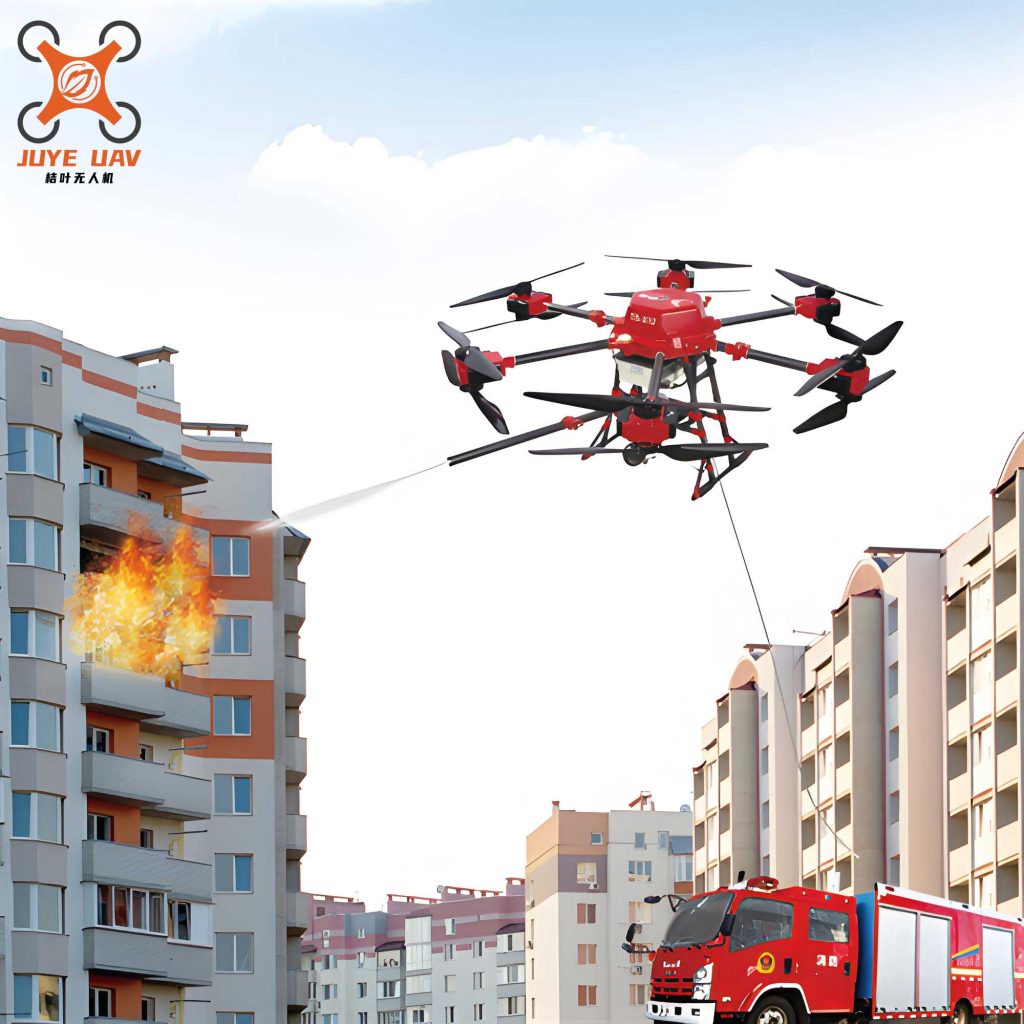
The operational matrix of a fire drone mission can be summarized as follows:
| Mission Phase | Fire Drone Capability | Data Output for Enforcement |
|---|---|---|
| Pre-flight Planning | Automated flight path generation over area of interest (AOI). | Optimized coverage grid, ensuring no blind spots. |
| In-flight Data Acquisition | Simultaneous capture of visual, thermal, and gas data. | Geotagged imagery, heat maps, gas concentration plots. |
| Real-time Analysis | Onboard AI for immediate anomaly detection (e.g., hotspot). | Instant alert with coordinates sent to command center. |
| Post-mission Reporting | Automated orthomosaic and 3D model generation. | Comprehensive visual report for compliance records or evidence. |
2.4.2 IoT for Comprehensive Facility Monitoring
While drones provide external mobility, stationary IoT networks offer internal, continuous monitoring. In complex facilities, sensors track everything from the temperature of electrical panels to the obstruction status of fire exits (using door position sensors). This data feeds into a central Building Management System (BMS) accessible to our enforcement team, allowing for remote “virtual inspections” and continuous compliance monitoring.
3. Tangible Advantages for Supervisory Enforcement
The integration of these intelligent systems yields measurable improvements across our core mission metrics.
| Aspect | Traditional Approach | Intelligent Firefighting Enhancement | Quantifiable Impact |
|---|---|---|---|
| Efficiency | Reactive, schedule-based inspections; manual data review. | Predictive, risk-based targeting; automated data aggregation and analysis. | Higher rate of critical violation discovery per inspector-hour. |
| Prevention & Response | Reliance on periodic checks; delayed situational awareness during incidents. | Continuous monitoring and early warning; real-time data feeds for command decisions. | Reduction in preventable fires; faster, more informed incident containment. |
| Personnel Safety | Inspectors and firefighters enter unknown or hazardous environments routinely. | Remote assessment via fire drone and sensors; AR guidance reduces procedural errors. | Decreased exposure to toxic atmospheres, structural collapse, and other onsite dangers. |
| Evidence & Documentation | Manual note-taking, sketches, and photographs. | Automated digital logs, geotagged imagery, 3D scans from fire drone surveys. | Ironclad, objective records for compliance tracking and legal proceedings. |
4. Confronting Challenges and Envisioning the Future
Despite the clear benefits, the path forward is not without obstacles. Acknowledging and strategically addressing these is crucial for sustainable integration.
4.1 Risks of Technological Dependency
Our growing reliance on interconnected systems introduces vulnerabilities. Network outages, cyber-attacks, or software failures could cripple our enhanced capabilities. Therefore, robust fail-safes, redundant communication channels (like mesh networks for fire drone fleets), and rigorous cybersecurity protocols are non-negotiable investments. The system’s resilience $S_{res}$ might be modeled as a function of redundancy $R$, backup capacity $B$, and security strength $\sigma$:
$$ S_{res} = f(R, B, \sigma) $$
We must strive to maximize $S_{res}$ while maintaining operational agility.
4.2 Data Privacy and Security Imperatives
The vast data collected—from building interiors via sensors to public spaces via drones—raises significant privacy concerns. Clear policies on data collection, anonymization, storage duration, and access permissions must be established and transparently communicated. Encryption and secure data pipelines are essential to maintain public trust.
4.3 The Human Factor: Training and Adoption
Technology is only as good as its users. Comprehensive, ongoing training programs are needed to ensure personnel are proficient with new tools, from interpreting AI-generated risk maps to piloting a fire drone. Overcoming institutional inertia and fostering a culture of technological adoption is equally important.
4.4 Fostering Cross-Sector Collaboration
Intelligent firefighting thrives on data interoperability. Seamless collaboration between fire departments, city planning authorities, utility companies, law enforcement, and private building owners is essential. Shared data platforms and common communication protocols will break down information silos, creating a unified safety ecosystem.
5. Conclusion
The integration of Intelligent Firefighting into supervisory enforcement represents a fundamental leap forward in our mission to protect lives and property. From the predictive power of data analytics to the immersive training of VR, from the persistent gaze of IoT sensors to the agile reconnaissance of the fire drone, these technologies empower us to be more proactive, precise, and safe. The challenges—technological, ethical, and human—are significant but manageable through deliberate planning, investment, and collaboration. As we continue to refine and adopt these tools, we are building not just a smarter fire service, but a fundamentally more resilient community. The future of fire safety is intelligent, interconnected, and inexorably linked to our willingness to embrace this technological evolution.