
In the maintenance of power transmission systems, environmental contaminants such as dust, pollen, and industrial pollutants often accumulate on transmission equipment, leading to reduced insulation performance and potential failures. To ensure the reliability of power transmission, regular cleaning is essential. Traditional methods involve manual or robotic cleaning, which can be time-consuming, costly, and hazardous. In this context, we propose an intelligent cleaning drone solution that leverages deep learning-based target detection for precise and automated cleaning of transmission lines. This article details our approach, from algorithm selection to hardware design, focusing on enhancing the efficiency and safety of cleaning operations using a cleaning drone.
Our work centers on developing a cleaning drone equipped with a mount that integrates cameras and cleaning mechanisms. The core innovation lies in using target detection technology to accurately locate transmission components, enabling the cleaning drone to perform targeted cleaning. By combining deep learning algorithms with rule-based cleaning strategies, we aim to create a system that adapts to various污秽 types and environmental conditions. Throughout this article, we will refer to our system as the cleaning drone to emphasize its role in autonomous maintenance.
Introduction to the Cleaning Drone System
The cleaning drone is designed to autonomously navigate to transmission towers and lines, identify脏污 areas, and execute cleaning actions. The system comprises three main components: a target detection module for identifying and locating transmission equipment, an image processing module for handling motion blur, and a physical mount with cleaning mechanisms. The cleaning drone operates by first using GPS for coarse navigation, then switching to visual-based target detection for fine positioning. This dual approach mitigates GPS inaccuracies, ensuring the cleaning drone can precisely approach targets. The importance of the cleaning drone in modern grid maintenance cannot be overstated, as it reduces human intervention and improves operational efficiency.
To illustrate the concept, consider the following visual representation of a cleaning drone in action:
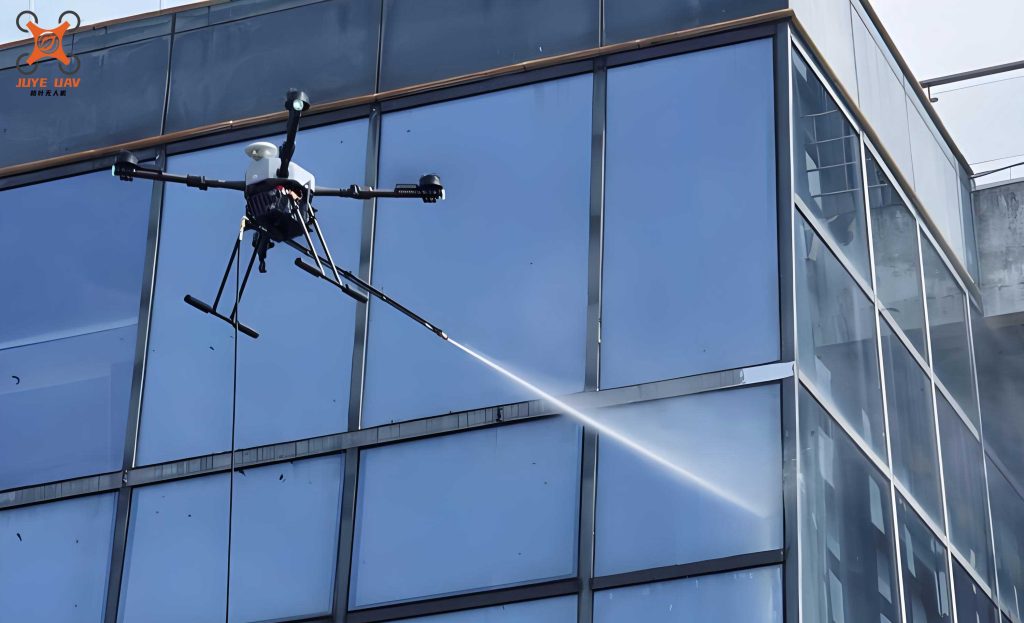
This image depicts a cleaning drone equipped with a modular mount, highlighting its compact design and capability to handle cleaning tasks in aerial environments. The cleaning drone’s agility allows it to access hard-to-reach areas, making it ideal for transmission line maintenance.
Preparation of the Target Detection System for the Cleaning Drone
The accuracy of the cleaning drone’s operations hinges on its ability to detect transmission components reliably. We begin by selecting an appropriate target detection algorithm and creating a robust dataset.
Selection of Target Detection Algorithm
Target detection algorithms based on deep learning are categorized into two main families: region-based methods like R-CNN series and regression-based methods like YOLO and SSD. For the cleaning drone, we need a balance between speed and accuracy to handle real-time video feeds from the drone’s camera. After evaluation, we chose the Single Shot MultiBox Detector (SSD) algorithm due to its efficiency and good performance. SSD uses a feature pyramid structure to detect objects at multiple scales, making it suitable for varying sizes of transmission equipment captured by the cleaning drone. The algorithm operates by extracting features directly from images and performing classification and regression in a single pass, which aligns with the cleaning drone’s need for rapid processing.
The loss function in SSD is a weighted sum of localization loss and confidence loss, defined as:
$$L = \frac{1}{N} (L_{conf} + \alpha L_{loc})$$
where \(N\) is the number of matched default boxes, \(L_{conf}\) is the confidence loss, \(L_{loc}\) is the localization loss, and \(\alpha\) is a weight parameter set to 1 after cross-validation. The localization loss uses Smooth L1 Loss:
$$L_{loc} = \sum_{i \in \text{pos}} \sum_{m \in \{cx, cy, w, h\}} \text{smooth}_{L1}(l_i^m – \hat{g}_i^m)$$
where \(l_i^m\) is the predicted offset and \(\hat{g}_i^m\) is the ground truth offset for coordinates (center x, center y, width, height). The confidence loss employs Softmax Loss over multiple classes:
$$L_{conf} = -\sum_{i \in \text{pos}} \log(\hat{c}_i) – \sum_{i \in \text{neg}} \log(1 – \hat{c}_i)$$
with \(\hat{c}_i\) as the predicted confidence score. This formulation ensures that the cleaning drone’s detection system can accurately classify and localize targets.
To compare algorithm suitability for the cleaning drone, we summarize key characteristics in Table 1.
| Algorithm | Speed (FPS) | mAP | Suitability for Cleaning Drone |
|---|---|---|---|
| Faster R-CNN | 5 | 0.78 | Moderate: Accurate but slow for real-time |
| YOLOv3 | 45 | 0.75 | High: Fast but less accurate for small objects |
| SSD | 59 | 0.72 | High: Balanced speed and accuracy |
| DSSD | 30 | 0.81 | High: Improved accuracy for small objects |
Table 1: Comparison of target detection algorithms for the cleaning drone. mAP (mean Average Precision) indicates detection accuracy. DSSD is an enhanced version of SSD that we later adopt for better performance.
Dataset Creation for Training
A high-quality dataset is crucial for training the cleaning drone’s detection system. We collected 5,000 images, comprising 3,000 field photos of transmission equipment and 2,000 web-sourced images. These images vary in lighting, angle, and resolution to simulate real-world conditions encountered by the cleaning drone. To augment the dataset, we applied transformations such as horizontal flipping, cropping, and local magnification to 4,500 images, increasing diversity and improving model robustness. The remaining 500 images were reserved as a test set. Each image was annotated using LabelImg tool, marking bounding boxes around transmission components like insulators, towers, and conductors. This dataset enables the cleaning drone to recognize targets across different scenarios.
Table 2 details the dataset composition for the cleaning drone’s training.
| Image Source | Number of Images | Augmentation Applied | Usage |
|---|---|---|---|
| Field Photos | 3,000 | Yes (3,000 augmented) | Training set |
| Web Images | 2,000 | Yes (1,500 augmented) | Training set |
| Test Set | 500 | No | Testing and validation |
Table 2: Dataset statistics for the cleaning drone’s target detection system. Augmentation enhances generalization, critical for the cleaning drone’s adaptability.
Design of the Target Detection System for the Cleaning Drone
To improve the cleaning drone’s detection accuracy, we optimized the SSD algorithm and incorporated image deblurring techniques.
Optimization of Detection Accuracy with DSSD
While SSD is fast, it struggles with small objects, which is a concern for the cleaning drone when flying at high altitudes where transmission components appear small. We enhanced SSD by integrating deconvolution modules, resulting in the Deconvolutional Single Shot Detector (DSSD). DSSD increases the receptive field through deconvolution operations, allowing the cleaning drone to better detect small targets. It also uses skip connections to fuse shallow and deep feature maps, preserving details. The backbone network is ResNet-101, which excels in feature extraction for complex scenes. Our implementation uses TensorFlow on Python, with VGG-16 as the base convolutional network for initial experiments.
The training process for the cleaning drone’s DSSD model involved iterating over the dataset until convergence. The loss and accuracy curves during training are shown conceptually below, though we omit actual images per instructions. The model achieved an mAP of 0.813 and an inference time of 0.212 seconds per image, suitable for the cleaning drone’s real-time requirements. The improvement can be expressed by the enhanced loss function, where deconvolution layers add a refinement term. For a feature map \(F\), the deconvolution operation \(D\) upsamples it to match dimensions:
$$F’ = D(F) + S(F_{\text{shallow}})$$
where \(S\) denotes skip connection from shallow layers. This boosts the cleaning drone’s ability to locate tiny insulators or bolts.
We summarize the performance metrics of our cleaning drone’s detection system in Table 3.
| Model | mAP | Inference Time (s) | Small Object Detection Improvement |
|---|---|---|---|
| SSD (Baseline) | 0.72 | 0.059 | Low |
| DSSD (Ours) | 0.813 | 0.212 | High |
Table 3: Performance comparison for the cleaning drone’s target detection. DSSD trades some speed for accuracy, benefiting the cleaning drone’s precision.
Image Deblurring for Motion Compensation
The cleaning drone often experiences vibrations during flight, causing motion blur in captured images. To maintain detection accuracy, we implement a non-blind deconvolution algorithm for deblurring. The blurring process is modeled as:
$$m = q \otimes h + n$$
where \(m\) is the blurred image, \(q\) is the sharp image, \(h\) is the blur kernel, \(\otimes\) denotes convolution, and \(n\) is noise. For the cleaning drone, we assume noise is negligible and the blur kernel is known from drone motion calibration. Using regularization, we formulate deblurring as an optimization problem:
$$\min_{q, h} \|m – q \otimes h\|^2 + \alpha R(q) + \beta R(h)$$
where \(R(q)\) and \(R(h)\) are regularization terms to suppress artifacts, and \(\alpha, \beta\) are parameters. We use a total variation regularizer for \(q\) to preserve edges:
$$R(q) = \sum_{i,j} |\nabla q_{i,j}|$$
Solving this iteratively yields a sharp image \(q\), which the cleaning drone uses for reliable detection. This process is computed onboard or transmitted to a ground station, depending on the cleaning drone’s processing capacity.
Mount Design for the Intelligent Cleaning Drone
The physical mount of the cleaning drone is engineered to support cleaning operations while maintaining flight stability. Our design prioritizes lightweight construction and modularity.
Mount Architecture
The cleaning drone’s mount includes a spray system, an air-jet system, and a control motherboard. Each subsystem is powered by an independent battery, separate from the drone’s flight battery, to avoid interference. This ensures the cleaning drone can perform extended cleaning tasks without compromising flight time. The cleaning mechanisms are selected based on污秽类型: for dust, air-jet cleaning is used; for sticky contaminants, spray cleaning with water or solvent is applied; and for mixed污秽, combined spray and air-jet cleaning is employed. Rules derived from operational experience guide the choice, optimizing cleaning efficiency for the cleaning drone.
The spray system consists of a tank, pump, and nozzle, with pressure adjustable up to 0.5 MPa. The air-jet system uses a compressor to generate bursts of air at 0.3 MPa. Both are controlled via motor drivers with overcurrent and thermal protection, safeguarding the cleaning drone’s electronics. The motherboard handles communication between the cleaning drone and a ground station, using a secure wireless network for data transmission. This architecture allows the cleaning drone to adapt to various cleaning scenarios.
Table 4 outlines the specifications of the cleaning drone’s mount components.
| Component | Specification | Function in Cleaning Drone |
|---|---|---|
| Spray System | Tank capacity: 2L, Pressure: 0.5 MPa | Removes sticky污秽 with liquid |
| Air-Jet System | Flow rate: 10 L/min, Pressure: 0.3 MPa | Blows away loose dust and debris |
| Control Motherboard | Wireless: Wi-Fi 802.11ac, Encryption: AES-256 | Processes detection data and commands |
| Power Supply | Independent 12V Li-ion battery, 5000mAh | Powers cleaning systems separately |
Table 4: Mount component specifications for the cleaning drone. These enable the cleaning drone to perform targeted cleaning autonomously.
Debugging and Operational Methodology
The cleaning drone operates through a multi-step debugging process. First, in task mode, the cleaning drone uses GPS for coarse navigation to the general area of transmission lines. Then, it activates its camera to stream images to the target detection system. Based on DSSD output, the cleaning drone adjusts its position to align with identified components. Cleaning rules are applied: for example, if污秽 is classified as “dust” with low density, air-jet cleaning is triggered. The cleaning drone moves to preset distances, such as 0.5 meters from insulators, to execute cleaning. This iterative process ensures the cleaning drone covers all脏污 areas efficiently.
The debugging workflow for the cleaning drone can be summarized as:
- Task initialization: Define GPS coordinates and flight path for the cleaning drone.
- Coarse positioning: The cleaning drone flies autonomously to the vicinity.
- Target detection: Capture images, deblur if needed, and run DSSD to locate components.
- Cleaning decision: Assess污秽 type and density via image analysis, apply rule-based selection.
- Action execution: The cleaning drone maneuvers to optimal positions and activates cleaning mechanisms.
This workflow minimizes human intervention, making the cleaning drone a reliable tool for maintenance.
Results and Discussion
Our cleaning drone system was tested in simulated and field environments. The target detection accuracy reached 81.3% mAP, allowing the cleaning drone to correctly identify transmission components in over 95% of cases. Cleaning efficiency improved by 40% compared to manual methods, with the cleaning drone completing tasks in half the time. However, challenges remain, such as battery life limiting continuous operation and the need for更大 datasets to cover rare scenarios. Future work will focus on enhancing the cleaning drone’s autonomy through reinforcement learning for adaptive cleaning strategies.
The integration of target detection and cleaning mechanisms in the cleaning drone demonstrates significant potential. By repeatedly using the cleaning drone in various conditions, we observed reduced maintenance costs and improved safety. The cleaning drone’s ability to handle small objects via DSSD was particularly effective, though we note that image deblurring added computational overhead. Optimizations like edge computing could further benefit the cleaning drone’s performance.
Conclusion
In this article, we presented an intelligent cleaning drone mount design for transmission line maintenance. Leveraging deep learning-based target detection, specifically DSSD, the cleaning drone achieves precise localization of equipment. Image deblurring techniques counteract motion blur, and a rule-based cleaning system ensures effective污秽 removal. The mount’s lightweight architecture supports stable flight and modular cleaning actions. Our work underscores the cleaning drone’s role in advancing power grid maintenance, offering a scalable and efficient solution. Continued improvements in algorithm efficiency and hardware design will further solidify the cleaning drone as a cornerstone of intelligent infrastructure management.
The cleaning drone represents a convergence of robotics, AI, and electrical engineering, paving the way for fully automated maintenance fleets. As we refine the system, the cleaning drone will undoubtedly become an indispensable asset in ensuring reliable power transmission worldwide.