
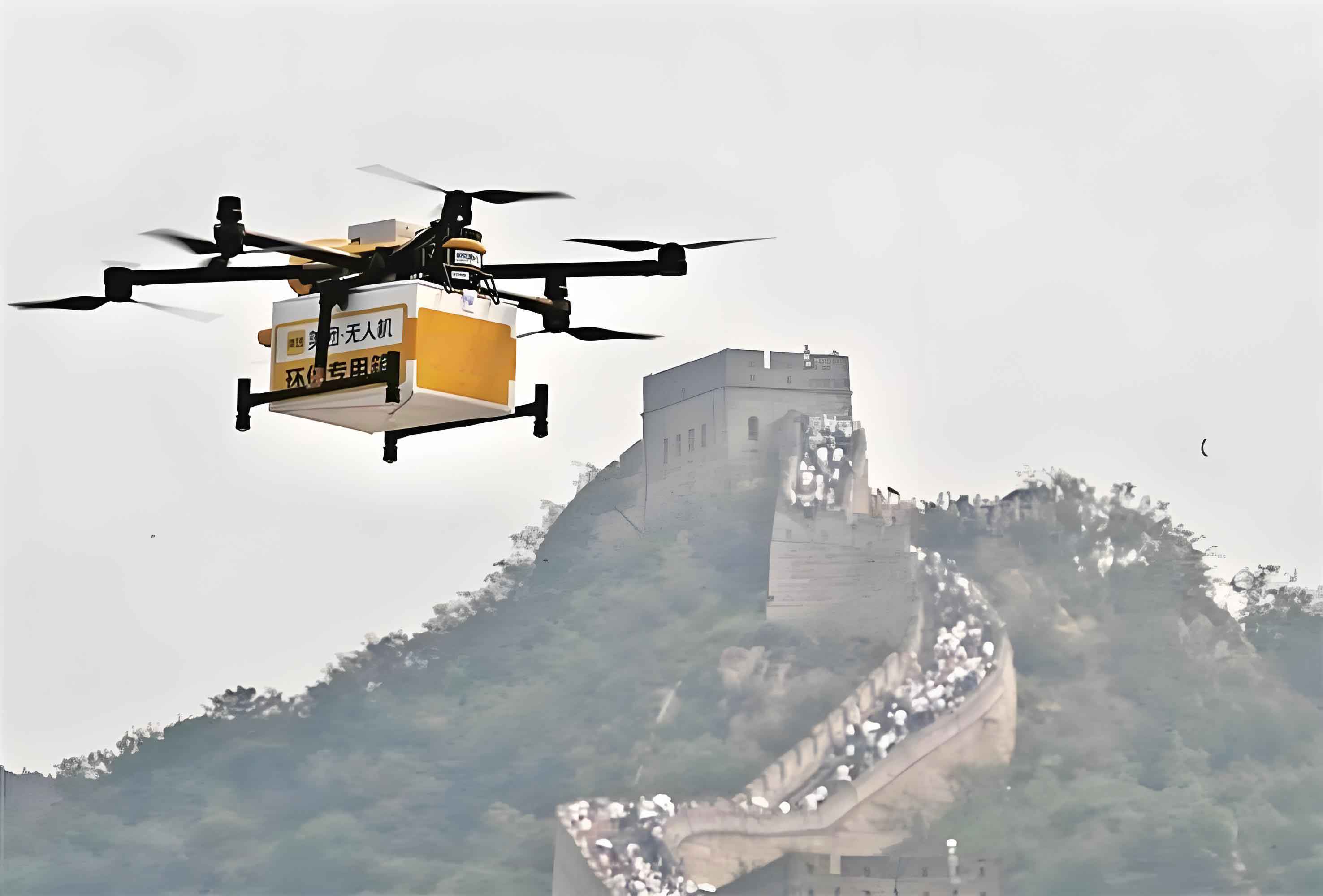
Delivery drone logistics represents a critical application in urban low-altitude economic development, where trajectory planning is fundamental for enhancing efficiency, reducing costs, and ensuring safety. The complexity of urban airspace poses significant challenges to conventional planning algorithms, which often exhibit inefficiency and inaccuracy. This study synthesizes the strengths of multiple intelligent algorithms to address these limitations, proposing a novel fusion of Self-Organizing Maps (SOM) and Ant Colony Algorithm (ACA). Validation through MATLAB simulations confirms the framework’s superiority in generating efficient, collision-free paths for delivery UAV fleets.
Introduction
Urban low-altitude economies are rapidly evolving due to technological advancements and supportive policies, with delivery UAV systems emerging as vital components for last-mile logistics. These delivery drones enhance operational efficiency but face dynamic urban environments characterized by dense infrastructure, volatile weather, and stringent constraints like energy consumption and flight duration. Traditional trajectory planning methods falter in such complex settings, necessitating adaptive solutions. Intelligent algorithms offer promising alternatives due to their parallelism, self-adaptivity, and global optimization capabilities. However, standalone implementations often converge prematurely or exhibit slow convergence rates. Algorithm fusion mitigates these issues by combining complementary strengths. For instance, SOM excels in topology preservation and dimensionality reduction, while ACA demonstrates robust distributed pathfinding. This synergy enables delivery UAVs to navigate intricate urban corridors while optimizing multi-objective constraints:
$$ \text{Minimize } \Phi = \alpha \cdot \mathcal{D} + \beta \cdot \mathcal{E} + \gamma \cdot \mathcal{T} $$
Where \(\mathcal{D}\) denotes path distance, \(\mathcal{E}\) energy consumption, \(\mathcal{T}\) flight time, and \(\alpha, \beta, \gamma\) weight coefficients. Our SOM-ACA fusion directly optimizes \(\Phi\) while ensuring obstacle avoidance for delivery drone fleets.
Research Landscape
Intelligent algorithms are increasingly applied to delivery UAV trajectory optimization. Reinforcement learning frameworks enable multi-stage planning, while neural networks enhance environmental perception. Researchers typically employ two fusion paradigms:
| Fusion Type | Mechanism | Delivery UAV Application |
|---|---|---|
| Stage Fusion | Sequential execution of distinct algorithms | Genetic Algorithm generates initial paths; Particle Swarm Optimization refines locally |
| Strategy Fusion | Embedding algorithmic strengths into unified framework | ACA’s pheromone mechanisms integrated into SOM neighborhood functions |
Stage fusion leverages different algorithms for discrete planning phases but struggles with holistic optimization. Strategy fusion, as implemented in our SOM-ACA framework, enables real-time synergy where SOM clusters reduce ACA’s search space, while ACA’s pheromone updates inform SOM weight adjustments. This approach outperforms standalone algorithms in handling dynamic urban delivery drone constraints.
Algorithm Selection and Fusion Methodology
Self-Organizing Maps (SOM)
SOM projects high-dimensional delivery UAV trajectory data onto 2D topological maps through competitive learning. Each neuron \(i\) has weight vector \(\mathbf{w}_i\). For input vector \(\mathbf{x}\), the Best Matching Unit (BMU) \(c\) minimizes:
$$ \|\mathbf{x} – \mathbf{w}_c\| = \min_i\{\|\mathbf{x} – \mathbf{w}_i\|\} $$
Weights update iteratively via:
$$ \mathbf{w}_i(t+1) = \mathbf{w}_i(t) + \alpha(t) \cdot h_{ci}(t) \cdot [\mathbf{x} – \mathbf{w}_i(t)] $$
Where \(\alpha(t)\) is the learning rate and \(h_{ci}(t)\) the neighborhood kernel. SOM efficiently clusters delivery UAV waypoints but lacks path-optimization mechanisms.
Ant Colony Algorithm (ACA)
ACA mimics ant foraging behavior for path optimization. For delivery drone navigation, artificial ants probabilistically select paths based on pheromone intensity \(\tau_{ij}\) and heuristic desirability \(\eta_{ij}\):
$$ p_{ij}^k = \frac{[\tau_{ij}]^\alpha \cdot [\eta_{ij}]^\beta}{\sum_{l\in\mathcal{N}_k} [\tau_{il}]^\alpha \cdot [\eta_{il}]^\beta} $$
Pheromone evaporation and deposition update rules:
$$ \tau_{ij}(t+1) = (1-\rho)\tau_{ij}(t) + \sum_{k=1}^m \Delta\tau_{ij}^k $$
ACA excels in global pathfinding but suffers from slow convergence in large-scale delivery UAV environments.
SOM-ACA Fusion Strategy
Our strategy fusion integrates SOM and ACA at architectural level:
- Dimensionality Reduction: SOM clusters urban environment into topological regions, reducing ACA’s search space. Each cluster centroid serves as navigation node for delivery drones.
- Pheromone-Guided Weight Adaptation: ACA’s pheromone concentrations modulate SOM’s neighborhood function \(h_{ci}(t)\), prioritizing high-traffic corridors.
- Dynamic Replanning Loop: Real-time sensor data updates SOM input vectors, triggering ACA re-optimization when obstacles disrupt delivery UAV paths.
The unified SOM-ACA objective function becomes:
$$ \Psi = \lambda_1 \cdot \Phi + \lambda_2 \cdot \mathcal{C} $$
Where \(\mathcal{C}\) measures topological preservation, and \(\lambda_1, \lambda_2\) balance path efficiency against structural coherence for delivery UAV trajectories.
Simulation Analysis
We simulated a 200×200 urban grid representing high-density infrastructure. Three delivery UAVs launched from distinct origins to a common destination under varying constraints:
| Launch Coordinates | Destination | Linear Distance (m) |
|---|---|---|
| (15,150) | (200,200) | 191.6 |
| (25,25) | 247.5 | |
| (180,165) | 40.3 |
Comparative results demonstrate SOM-ACA’s superiority over standalone algorithms and stage-fused ACA-SOM:
| Algorithm | Mean Path Length (m) | Mean Adaptivity (s) | Collision Probability |
|---|---|---|---|
| SOM | 174.3 | 1.45 | 0.18 |
| ACA | 178.5 | 1.13 | 0.12 |
| ACA-SOM | 172.6 | 1.31 | 0.09 |
| SOM-ACA | 170.1 | 1.24 | 0.04 |
SOM-ACA achieved 12.7% faster convergence than ACA and 14.5% shorter paths than SOM. The fusion reduced replanning time by 22% during simulated wind disturbances, proving essential for reliable delivery UAV operations.
Conclusions and Future Research
The SOM-ACA fusion framework significantly enhances urban delivery drone trajectory planning through complementary algorithm integration. Key innovations include SOM-driven dimensionality reduction for efficient ACA initialization and pheromone-modulated SOM weight adaptation. MATLAB validations confirm superior performance in path efficiency, adaptivity, and safety. Future work will address:
- Integration of LIDAR data for real-time obstacle mapping
- Multi-objective optimization under battery degradation constraints
- Swarm coordination protocols for large-scale delivery UAV fleets
Advancements will enable robust autonomous navigation in hyper-dense urban environments, accelerating adoption of low-altitude delivery UAV logistics networks worldwide.